In short
A raised CA-125 is not a cancer diagnosis: periods, endometriosis, fibroids, pelvic infection and liver disease can all raise it, and a normal result does not rule ovarian cancer out. NICE's 2026 guidance uses age-based thresholds, and does not use CA125 on its own at age 39 or under.
Emergency if: Sudden, severe pelvic or tummy pain together with fainting, or you feel very unwell: call emergency services now or go to an emergency department now, without waiting for an appointment or a CA-125 result. This is our precaution on top of the NHS advice for sudden severe pelvic pain, which says to ask for an urgent appointment or urgent advice.
On your report
CA-125
On this page
01
What does a high CA-125 mean?
CA-125 is a protein, a type of tumour marker. MedlinePlus says organs of the female reproductive system, such as the ovaries and fallopian tubes, may make CA-125 when they are inflamed, which can happen in response to normal bodily functions such as a period, and the body may also make high levels in response to ovarian cancer. The National Cancer Institute says an elevated tumour marker does not mean someone has cancer, and that not everyone with a cancer has a higher level.
So a high CA-125 is a reason for a conversation and usually a scan, not a diagnosis. MedlinePlus says only a biopsy can diagnose ovarian cancer. It also says the reverse is true: high levels do not always mean ovarian cancer, but a normal result does not rule it out, because levels may be low in the early stages and not everyone with ovarian cancer makes high levels.
02
Can CA-125 be high without cancer?
Yes, and often. MedlinePlus lists endometriosis, pelvic inflammatory disease, uterine fibroids and liver disease, plus natural bodily functions such as a period and pregnancy. The NHS ovarian cyst page gives the same kind of non-cancer causes for high levels of these chemicals: endometriosis, a pelvic infection, fibroids and your period. The NHS also says the vast majority of ovarian cysts are non-cancerous, though a small number are cancerous.
Our endometriosis, fibroids and ovarian cyst stories describe these conditions. If your CA-125 was ordered because of a cyst or fibroid on an ultrasound, ask the doctor how the result changes the plan. The NHS says doctors arrange these blood tests if there is any concern that a cyst could be cancerous, and that high levels do not necessarily mean cancer.
03
Is CA-125 a screening test for ovarian cancer?
No, not for most people. MedlinePlus says a provider cannot use CA-125 to screen for ovarian cancer if you are not at high risk, because other conditions that are not cancer can also raise it. The National Cancer Institute says studies of tumour markers as screening tests have generally found that they do not work well, because they miss some people with the disease and flag people who do not have cancer. The most common use of CA-125, MedlinePlus says, is to see whether ovarian cancer treatment is working and to check whether the cancer has come back.
MedlinePlus says a provider may suggest CA-125 plus other tests for people at very high risk, such as those with a mother or sister, or two or more other relatives, who had ovarian cancer, or an inherited change in the BRCA1 or BRCA2 genes, or Lynch syndrome. If that is you, your doctor sets the plan. A CA-125 added to a routine health package, with no symptoms and no high-risk history, cannot tell you that you are free of cancer or that you have it.
04
What is a normal CA-125 level? Is under 35 normal?
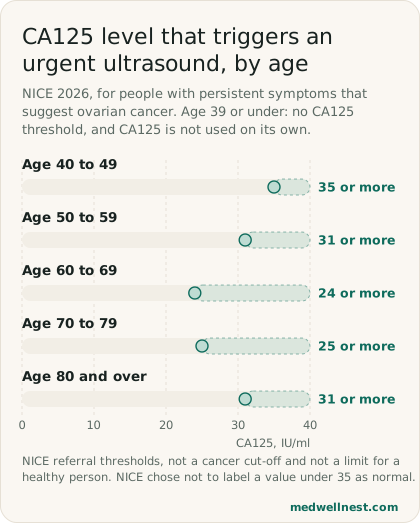
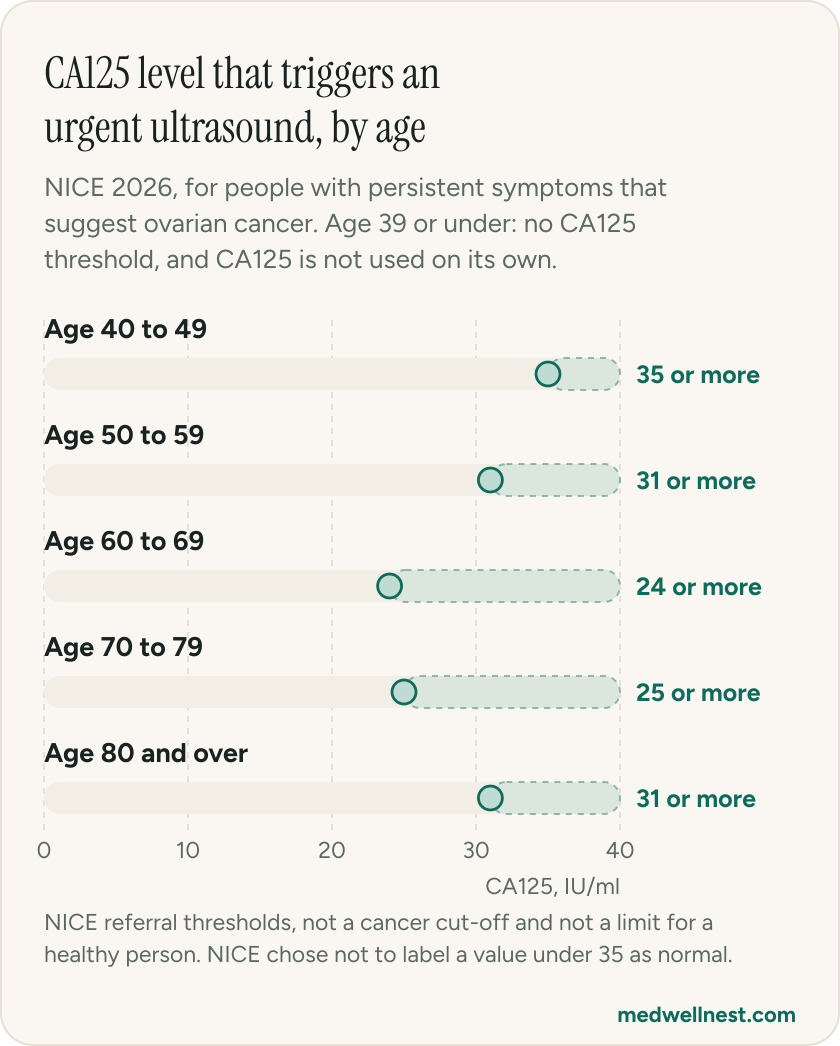
Your report prints the range your lab uses, and many reports and web pages treat under 35 as normal. The 2026 update of the NICE suspected-cancer guideline (NG12) deliberately did not: its committee "agreed not to label CA125 <35 U/ml as a 'normal' level". Instead NICE gives thresholds, printed in its table in IU/ml (its own reasoning writes the same 35 as U/ml), for people with persistent symptoms that suggest ovarian cancer, by age: 40 to 49, 35 IU/ml or greater; 50 to 59, 31 or greater; 60 to 69, 24 or greater; 70 to 79, 25 or greater; 80 and over, 31 or greater. At or above the threshold for your age, NICE says to arrange an urgent ultrasound scan of the abdomen and pelvis.
For people aged 39 or under with persistent symptoms, NICE says "do not use serum CA125 measurement in isolation for decision making", because it is not an accurate indicator of ovarian cancer risk in this age group, and to consider an urgent ultrasound scan instead. These thresholds are for people with symptoms who are being assessed, not a cut-off for a healthy person's report. NICE writes them for women and for trans men and non-binary people with female reproductive organs. They are NICE's thresholds, and some other guidelines and labs use different cut-offs. Your lab's printed range, and your doctor's reading of your age, symptoms and scan, matter more than a single number.
05
Which symptoms should I get checked, and what happens after a high CA-125?
The NHS lists symptoms of ovarian cancer that happen frequently, roughly 12 or more times a month: a swollen tummy or feeling bloated; pain or tenderness in the tummy or between the hips; no appetite or feeling full quickly after eating; and needing to pee urgently or more often. Others can include indigestion, constipation or diarrhoea, back pain, feeling tired all the time, losing weight without trying and unusual vaginal bleeding. The NHS stresses that these symptoms are very common and have many causes, but are worth getting checked because finding cancer early can mean it is more treatable. NICE lists the same four main symptoms and says to test when they are persistent or frequent.
What happens next, according to the NHS: a blood test for a protein sometimes linked to ovarian cancer and, if the level is high, an ultrasound scan of the abdomen and pelvis. If the scan is normal, the doctor should check for other causes and ask you to return if symptoms continue or become more frequent. The NHS notes that ovaries can be too small to show on a scan, especially after the menopause. If the blood test and scan suggest cancer, you are referred to a specialist gynaecological cancer service, and tests such as a CT scan or a needle biopsy confirm the diagnosis. An urgent referral, usually within 2 weeks, does not definitely mean you have cancer.
06
When is pelvic or tummy pain urgent?
A CA-125 report is not an emergency by itself. But the NHS says to ask for an urgent appointment, or urgent advice from the local health advice service, if you have sudden, severe pelvic pain, or tummy pain with feeling sick or being sick. The NHS says an ovarian cyst usually causes symptoms only if it splits, is very large or twists. If sudden severe pain comes with fainting, or you feel very unwell, do not wait for an appointment: call emergency services or go to an emergency department now. That last step is our precaution on top of the NHS wording.
For symptoms that are persistent but not sudden, such as ongoing bloating, feeling full quickly, pelvic pain or needing to pee more often, the NHS says to see a doctor, and to go back if they have not gone away or are getting worse or more frequent. That is a routine visit rather than an emergency, but do not wait for them to settle on their own.
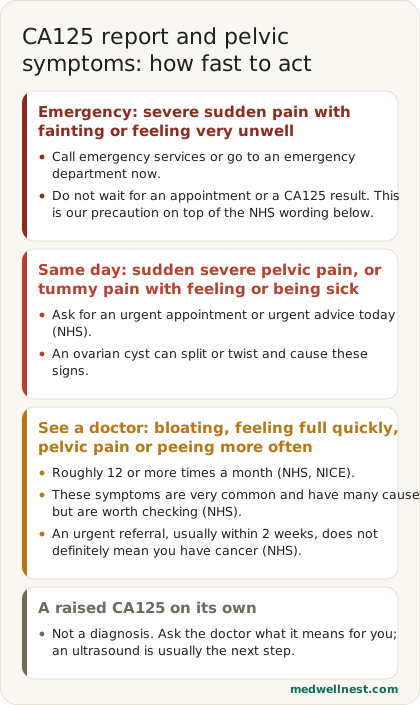
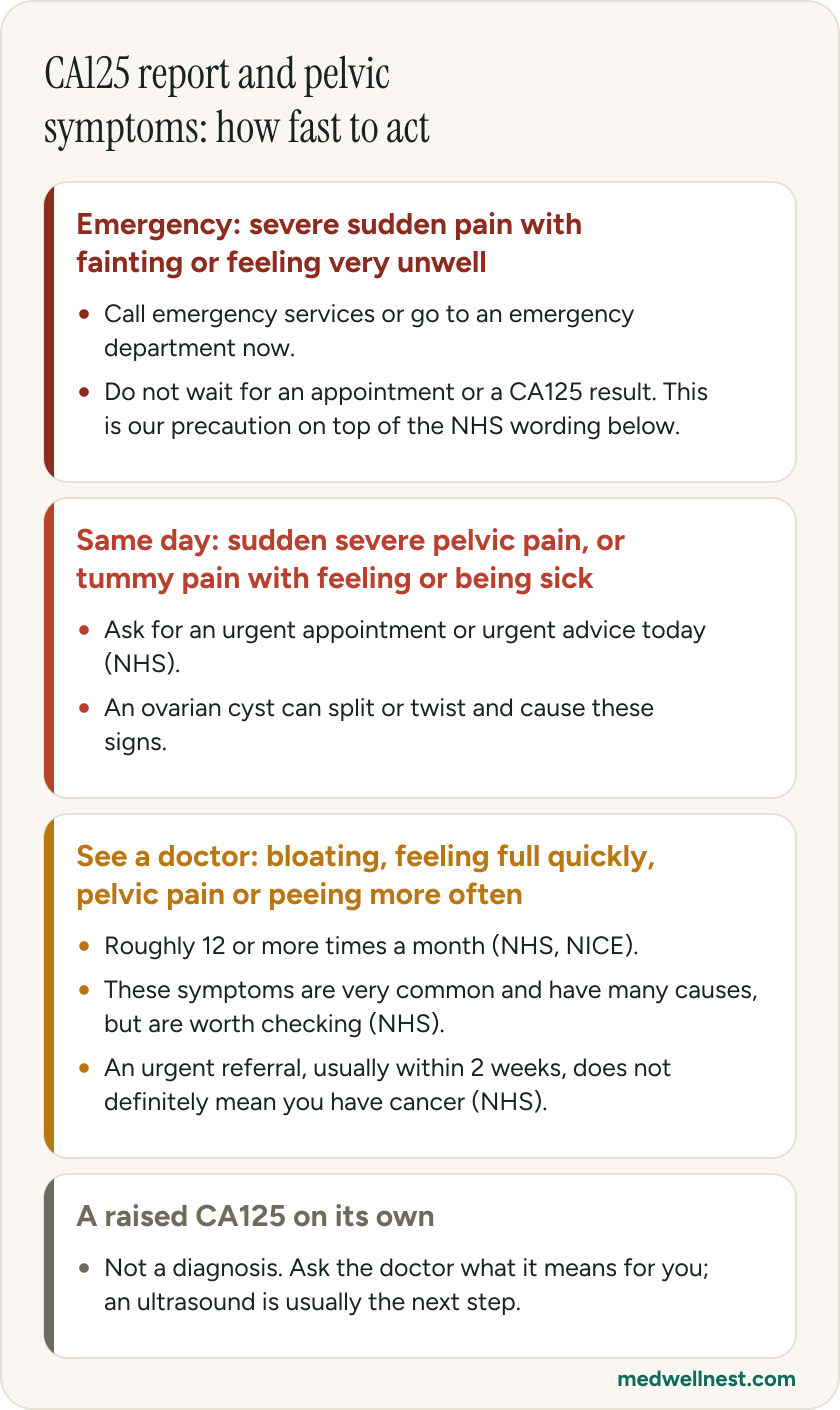
CA-125 report and pelvic symptoms: how fast to act
Emergency — act now
Sudden, severe pelvic or tummy pain together with fainting, or you feel very unwell: call emergency services now or go to an emergency department now, without waiting for an appointment or a CA-125 result. This is our precaution on top of the NHS advice for sudden severe pelvic pain, which says to ask for an urgent appointment or urgent advice.
Same-day — call promptly
Sudden, severe pelvic pain, or tummy pain with feeling sick or being sick: ask for an urgent appointment or urgent advice today, without waiting for a routine appointment. The NHS gives these as the signs to act on for an ovarian cyst, which can split or twist. If you cannot be seen today, go to an emergency department.
Routine — see a doctor
Persistent bloating, feeling full quickly, pelvic or tummy pain, or needing to pee more often, roughly 12 or more times a month, or a raised CA-125 you do not understand: see a doctor and take the report. The NHS says these symptoms are very common and have many causes but are worth checking, and to go back if they have not gone away or are getting worse or more frequent. An urgent referral, usually within 2 weeks, does not definitely mean you have cancer.
Values mentioned in this story
Each one opens a visual guide with its normal range and what moves it — upload a report and we place your own numbers on the same scale.
Sources
- CA-125 blood test — MedlinePlusmedlineplus.gov
- Suspected cancer: recognition and referral (NG12), ovarian cancer recommendations — NICE guidelinenice.org.uk
- Ovarian cancer: symptoms — NHSnhs.uk
- Ovarian cancer: tests and next steps — NHSnhs.uk
- Ovarian cyst — NHSnhs.uk
- Tumor markers fact sheet — National Cancer Institutecancer.gov
Share this story
Curious where your own values stand?
Two minutes from upload to a full visual picture. Free to analyze.