In short
A fasting gallbladder wall is normally up to 3 mm. A thicker wall can come from eating before the scan, inflammation of the gallbladder, or a problem elsewhere such as hepatitis, heart failure, low albumin or dengue. Here is how to read the number, the words around it, and when to go to emergency.
Emergency if: Severe pain in the upper right belly with fever, or yellow eyes or skin with fever and belly pain: go to an emergency department now. StatPearls calls infection of the bile ducts life-threatening, and fever, right upper belly pain and jaundice are its classic trio.
On your report
Albumin, Total Bilirubin, SGPT (ALT)
On this page
01
The normal number: up to 3 mm, after fasting
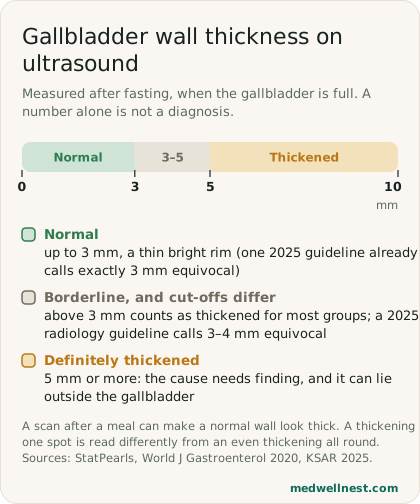
The gallbladder is a small bag under the liver that stores bile. On an ultrasound, its wall normally looks like a thin bright line. A 2020 review in the World Journal of Gastroenterology says most studies take 3 mm as the upper limit of normal, and describes a normal wall as a thin rim of 3 mm or less.
Groups do not all draw the line in the same place. A radiology society's 2025 guidance on incidental findings (KSAR) notes there is no established consensus on the cut-off: several international bodies use more than 3 mm, and one multi-society guideline uses more than 4 mm for thickening in one spot. It calls 3–4 mm equivocal and 5 mm or more, or a distinct thickening in one area above 3 mm, definite thickening. So a report that says 3.5 mm is borderline, not alarming by itself.
02
Did you fast? A meal can fake a thick wall
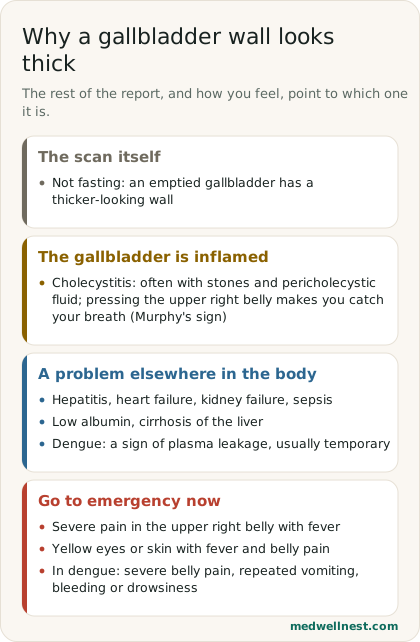
After you eat, the gallbladder squeezes bile out and shrinks, and a contracted gallbladder's wall looks thicker. The 2020 review says gallbladder ultrasound should always be done fasting because of this pseudo-thickening, and the KSAR guidance asks for more than 6 hours of fasting before gallbladder measurements such as polyp size. If your report says the gallbladder is contracted or partially distended, or you ate before the scan, the thickness may not mean much, and a repeat scan after fasting may settle it.
The report also says whether the thickening is diffuse, meaning even all the way round, or focal, meaning in one spot. The two are read differently. Even thickening is the pattern seen with problems elsewhere in the body, while in the KSAR guidance a distinct thickening in one spot counts as definite above 3 mm. When imaging cannot tell whether a thickening could be a growth, that guidance recommends a follow-up ultrasound in 3–6 months.
03
When the gallbladder itself is inflamed
The most familiar cause is acute cholecystitis, inflammation of the gallbladder, most often because a stone blocks its outlet. StatPearls lists the ultrasound findings that suggest it: a wall thicker than 3 mm, oedema of the wall, fluid around the gallbladder (pericholecystic fluid) and gallstones. Reports may also mention sludge, thick bile that settles in the gallbladder, or a distended gallbladder.
Murphy's sign is a finding on examination rather than a number. StatPearls describes it as a catch in the breath when the upper right belly is pressed. A thick wall with stones, fluid around it and a positive Murphy's sign in someone with pain and fever fits cholecystitis, which StatPearls says can progress to perforation, sepsis and death without timely treatment.
04
When the cause is outside the gallbladder
A thick wall does not always mean a gallbladder problem. The 2020 review lists hepatitis, congestive heart failure, kidney failure, sepsis and low albumin as body-wide conditions that thicken the wall evenly, and the KSAR guidance adds cirrhosis of the liver. In these, the wall is swollen with fluid rather than inflamed. The review warns that mistaking this for gallbladder disease can lead to an unnecessary operation.
This is why the rest of your report and your blood tests matter. Liver enzymes such as SGPT, bilirubin and albumin, along with how your heart and kidneys are working, help your doctor decide whether the gallbladder is the problem or a bystander.
05
Gallbladder wall thickening in dengue
In dengue, fluid can leak out of the blood vessels around the time the fever comes down. WHO's 2009 dengue guideline says abdominal ultrasound can be a useful tool for detecting this leakage. A thickened gallbladder wall is one of the ultrasound signs studied: a 2025 review of studies found that in confirmed dengue without other illnesses it picked up severe dengue with a sensitivity of 88%, but a specificity of only 63%, so it also appears in many people who do not become severely ill.
The same review describes the thickening as an early, temporary sign of plasma leakage that settles on its own around the time other signs of leakage, such as fluid in the belly or chest, clear. It is a sign of the dengue, not a separate gallbladder disease. What matters is how you are: in dengue, severe belly pain, repeated vomiting, bleeding or drowsiness means hospital now, whatever the scan says.
When to act
Emergency — act now
Severe pain in the upper right belly with fever, or yellow eyes or skin with fever and belly pain: go to an emergency department now. StatPearls calls infection of the bile ducts life-threatening, and fever, right upper belly pain and jaundice are its classic trio.
Same-day — call promptly
Upper right belly pain that has lasted hours, pain after fatty meals with vomiting, or a thick gallbladder wall on a scan while you have dengue: be seen at a hospital today for a blood count and haematocrit check.
Routine — see a doctor
A borderline wall thickness found by chance with no symptoms, or a scan done without fasting: ask your doctor whether a repeat fasting ultrasound or a follow-up scan in 3–6 months is needed.
Values mentioned in this story
Each one opens a visual guide with its normal range and what moves it — upload a report and we place your own numbers on the same scale.
Sources
- Acute Cholecystitis — StatPearlsncbi.nlm.nih.gov
- Cholangitis — StatPearlsncbi.nlm.nih.gov
- Imaging-based algorithmic approach to gallbladder wall thickening — World Journal of Gastroenterology, 2020pmc.ncbi.nlm.nih.gov
- Interpretation, Reporting, Imaging-Based Workups, and Surveillance of Incidentally Detected Gallbladder Polyps and Gallbladder Wall Thickening: 2025 Recommendations From the Korean Society of Abdominal Radiology — Korean Journal of Radiologypmc.ncbi.nlm.nih.gov
- Ultrasound evaluation of gallbladder wall thickness for predicting severe dengue: a systematic review and meta-analysis — The Ultrasound Journal, 2025pmc.ncbi.nlm.nih.gov
- Dengue: Guidelines for Diagnosis, Treatment, Prevention and Control, chapter 2: Clinical management — WHO, 2009ncbi.nlm.nih.gov
Share this story
Curious where your own values stand?
Two minutes from upload to a full visual picture. Free to analyze.