In short
Most low back pain improves within a few weeks, and staying active is slightly better than long bed rest. A scan is not needed first, belts and paracetamol alone are not advised, and numbness around the genitals, bladder or bowel changes or weakness in both legs need an emergency department now.
Emergency if: You have back pain with pain, tingling, weakness or numbness in both legs; a loss of feeling around your genitals or anus; changes in your bladder or bowels, such as difficulty peeing or peeing or pooing yourself; changes in how the genitals feel during sex, not being able to get or keep an erection, or not being able to orgasm; chest pain; or the pain started after a serious accident such as a car accident, or you have had cancer and develop leg weakness, numbness or difficulty walking: call emergency services now or go to an emergency department now. Do not drive yourself; ask someone to drive you, and bring the medicines you take. These are the immediate-action signs on the NHS back pain page; the cancer sign follows NICE's guideline on spinal metastases.
On this page
01
How long does low back pain (kamar dard) take to get better?
The NHS says back pain, particularly lower back pain, is very common and usually improves within a few weeks, but it can sometimes last longer or keep coming back. It is not always obvious what causes it, and it often gets better on its own. A pulled muscle is a common cause. A slipped disc, sciatica or ankylosing spondylitis can sometimes be behind it, and very rarely back pain is a sign of a broken bone, cancer or an infection.
A Lancet series on low back pain says that for nearly all people it is not possible to identify a specific cause, and that only a small proportion have a well understood one, such as a vertebral fracture, cancer or infection. It also says most people with a new episode recover quickly, but recurrence is common and in a small proportion the pain becomes persistent and disabling. Strong pain at the start, psychological distress and pain at several places in the body raise the chance that it will persist.
Recovering quickly does not mean it never comes back. The WHO's 2023 guideline says up to two thirds of people who have an episode of acute low back pain still have symptoms a year later, often on and off. NICE calls pain acute when it has lasted less than 3 months and chronic when it has lasted 3 months or longer. WHO uses the term chronic primary low back pain for pain lasting more than 3 months that is not due to an underlying disease, which it says used to be called non-specific low back pain.
02
Should I rest in bed or keep moving with kamar dard?
The NHS advice is to stay active and carry on with your daily activities, and not to stay in bed for long periods. It says walking, swimming, yoga and pilates may help, and that you can try exercises and stretches for back pain, but should stop if the pain gets worse and ask for advice.
The Cochrane review of advice to rest in bed versus advice to stay active included ten trials. For acute low back pain, two trials with 401 people suggested small improvements in pain (standardised mean difference 0.22, 95% confidence interval 0.02 to 0.41) and in function (0.29, 0.09 to 0.49) with advice to stay active. For sciatica it found little or no difference between the two kinds of advice, with moderate quality evidence. The review searched up to May 2009 and rates the evidence for back pain as moderate quality, so the benefit it found is small, not dramatic.
In practice this means staying active is not harmful and is slightly better than long bed rest. It does not mean pushing through severe pain, and the NHS says to stop an exercise that makes the pain worse. For comfort, the NHS suggests an ice pack wrapped in a cloth to reduce pain and swelling, and a heat pack or hot water bottle wrapped in a cloth to relieve stiffness or muscle spasms.
03
Do I need an MRI or X-ray for kamar dard?
NICE says not to routinely offer imaging in a non-specialist setting for people with low back pain, with or without sciatica. It says people who are referred for a specialist opinion may not need imaging either, and that in specialist settings imaging should be considered only if the result is likely to change management.
The reason is that for nearly all people with low back pain no specific cause can be identified, so a scan usually has no single cause to point to. Our spine MRI story explains how common scan findings such as disc bulges are in people with no pain at all. The exception is when a doctor suspects something specific: NICE tells clinicians to think about other diagnoses and to exclude specific causes such as cancer, infection, trauma or inflammatory disease like spondyloarthritis, and to follow the relevant guidelines if one is suspected. The red flags below are what prompts that.
04
What treatment helps low back pain: NICE, NHS and WHO?
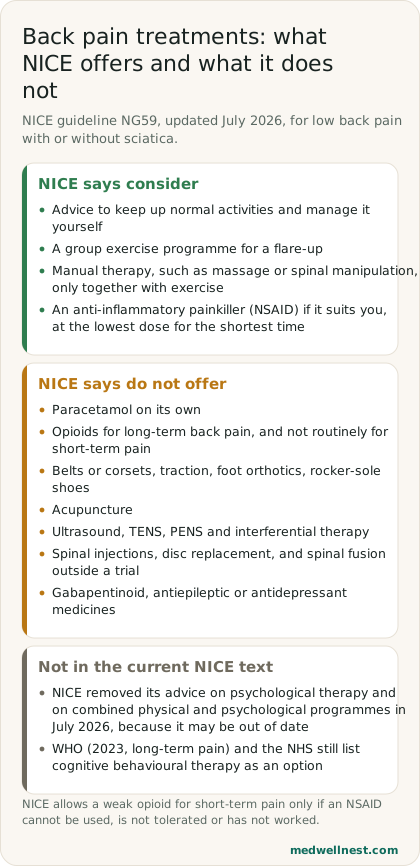
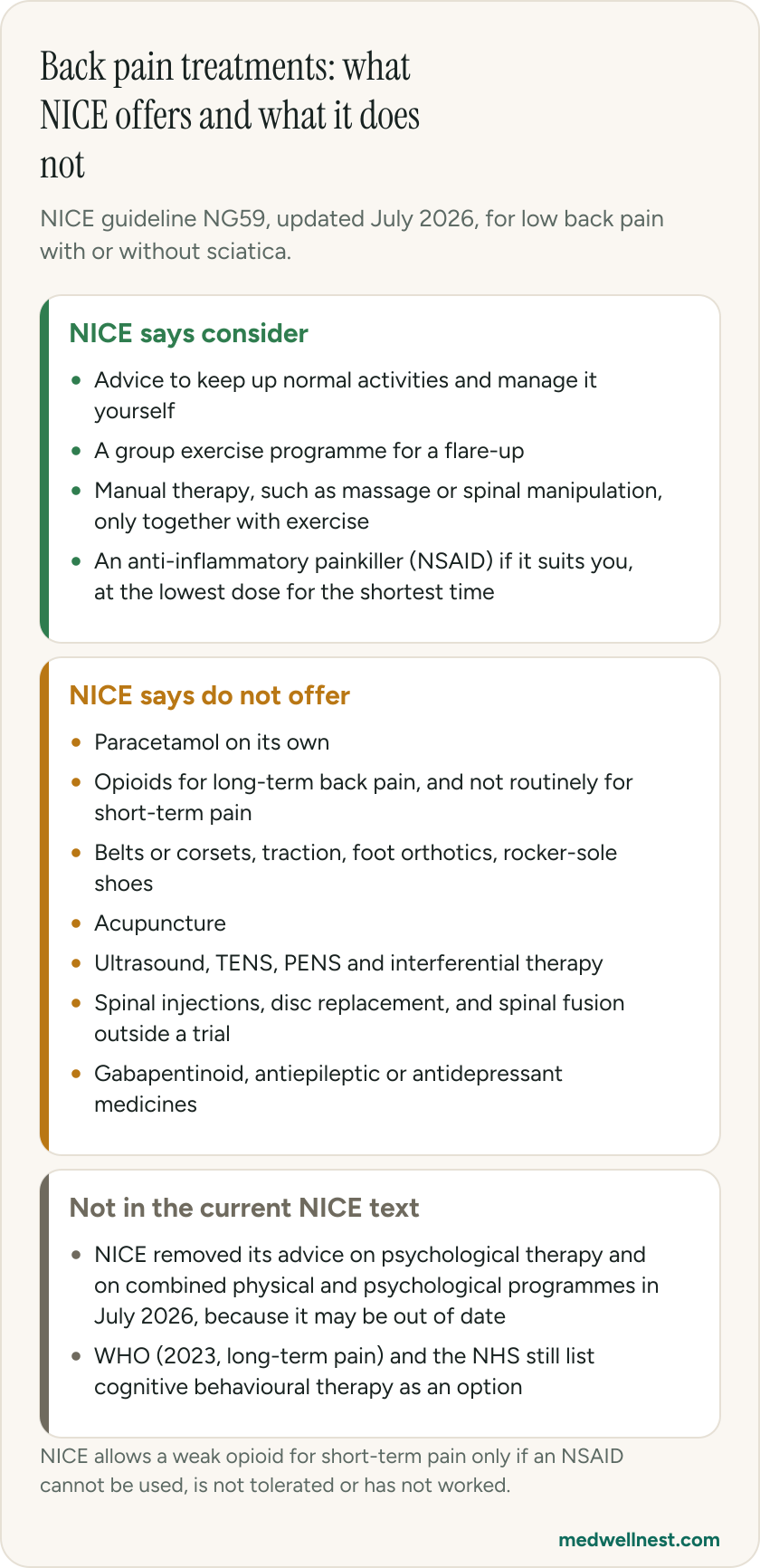
NICE says to give people information on the nature of low back pain and encouragement to continue normal activities. It says to consider a group exercise programme (biomechanical, aerobic, mind-body or a mix) for an episode or flare-up, and to consider manual therapy, meaning spinal manipulation, mobilisation or soft tissue techniques such as massage, but only as part of a treatment package that includes exercise. It also says to consider oral anti-inflammatory painkillers (NSAIDs) at the lowest effective dose for the shortest possible time, weighing the stomach, liver, heart and kidney risks and the person's age.
The NHS adds that if pain does not improve after a few weeks, other options include group exercise sessions and physiotherapy, manual therapy, and cognitive behavioural therapy (CBT) to help you cope with the pain. For long-term pain the WHO's 2023 guideline says several treatments may be offered in most settings: structured education, structured exercise, spinal manipulation, massage, CBT and operant therapy, NSAIDs, and a package of care that combines physical and psychological approaches. WHO rates most of this evidence low or very low certainty, and rates the NSAID evidence moderate. WHO also says adults may need several interventions together rather than one on its own.
Two gaps between the sources are worth knowing. NICE removed its recommendations on psychological therapy, and on combined physical and psychological programmes, in July 2026 because a review found they may be out of date and an update was not prioritised, so current NICE text neither recommends nor advises against them, while the NHS and WHO still list CBT and WHO lists combined biopsychosocial care. And NICE says not to offer acupuncture, while WHO says needling therapies may be offered for long-term pain, on low certainty evidence.
05
What should I not use for kamar dard: paracetamol alone, belts, TENS, opioids?
NICE says not to offer paracetamol alone for low back pain. The NHS says the same: paracetamol on its own is not recommended, though it may be used with another painkiller, and ibuprofen-type medicines may not be suitable for everyone, so check with a pharmacist or doctor. NICE says not to offer opioids for chronic low back pain or routinely for acute pain, and allows a weak opioid for acute pain only if an NSAID cannot be used, is not tolerated or has not worked. It also says not to offer antidepressants of the SSRI, SNRI or tricyclic type, or gabapentinoids and other antiepileptics, for low back pain.
NICE also says not to offer belts or corsets, foot orthotics, rocker sole shoes, traction, acupuncture, ultrasound, TENS, PENS or interferential therapy, and not to offer spinal injections. It says not to offer spinal fusion for low back pain except as part of a trial, and not to offer disc replacement. For long-term pain the WHO's 2023 guideline likewise says traction, therapeutic ultrasound, TENS, lumbar braces or belts and opioids should not be used as part of routine care, along with several other medicines such as muscle relaxants and anticonvulsants.
06
When is kamar dard serious? Red flags that need a doctor or an emergency department
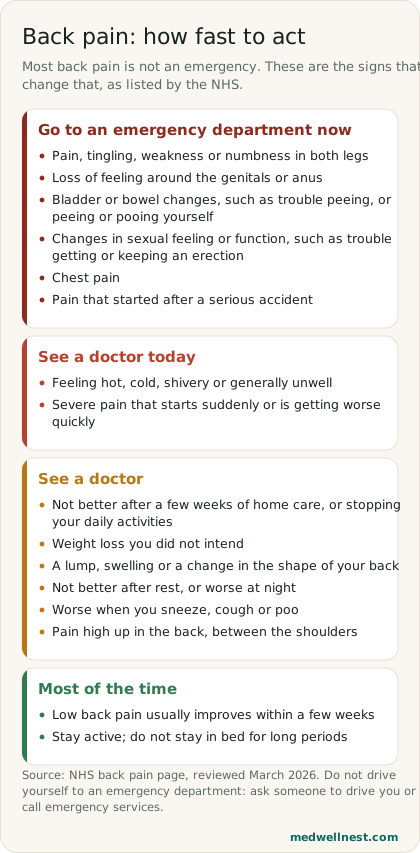
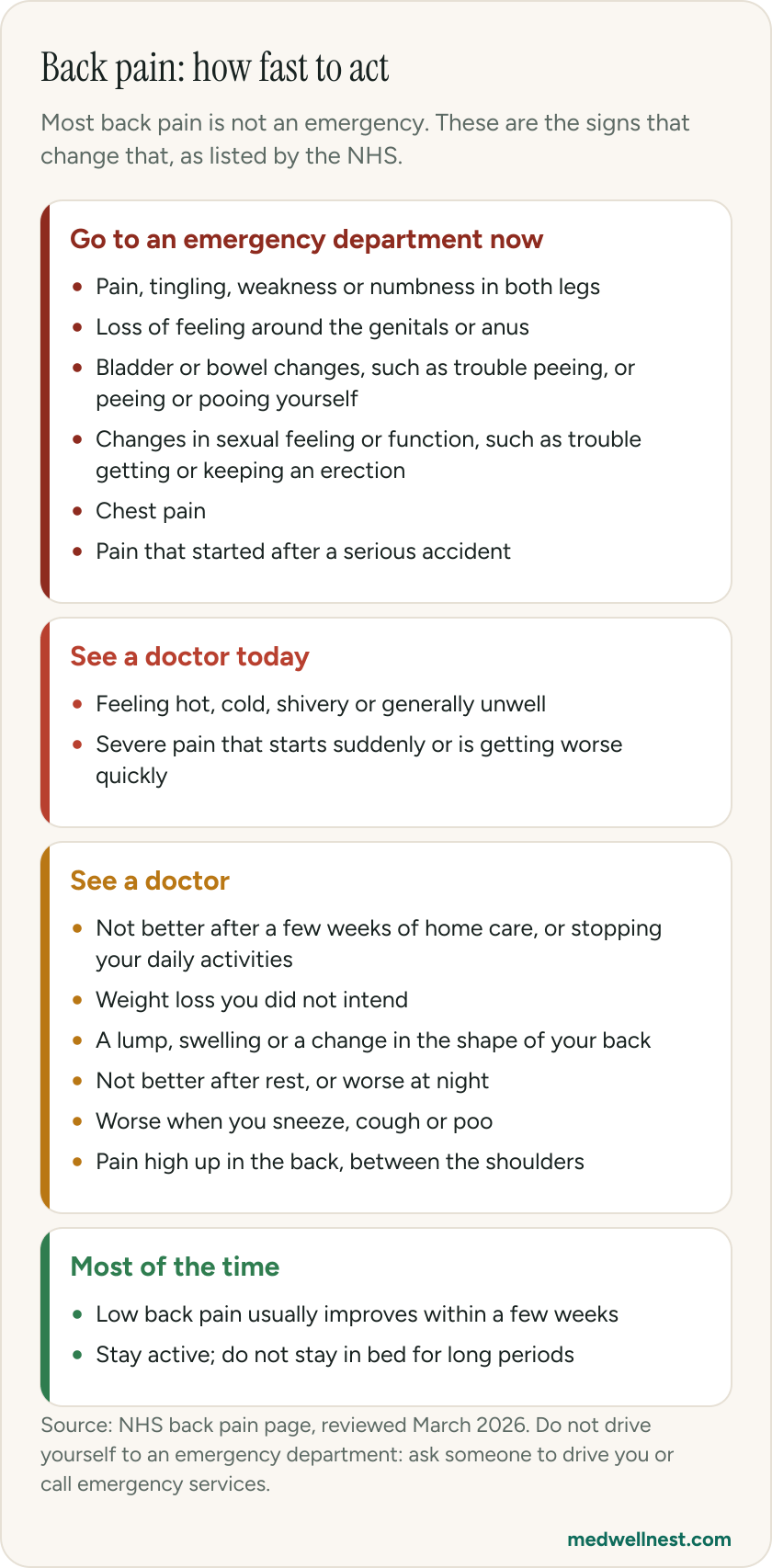
The NHS lists the signs that need an emergency response: pain, tingling, weakness or numbness in both legs; a loss of feeling around your genitals or anus; changes in your bladder or bowels, such as difficulty peeing or peeing or pooing yourself; changes in how the genitals feel during sex, not being able to get or keep an erection, or not being able to orgasm; chest pain; and pain that started after a serious accident such as a car accident. Doctors call the nerve compression behind the bladder, bowel and numbness signs cauda equina syndrome, which our slipped disc story describes. The NHS says do not drive yourself: ask someone to drive you or call emergency services, and take your medicines with you.
The NHS puts feeling hot, cold, shivery or generally unwell with back pain, and severe pain that starts suddenly or is getting worse quickly, in its urgent tier, which means getting a doctor's help the same day. Its non-urgent list says to see a doctor if the pain does not improve after a few weeks of home care, stops you doing your daily activities, or worries you; if you have lost weight without trying; if there is a lump or swelling or your back has changed shape; if it does not improve with rest or is worse at night; if it is worse when you sneeze, cough or poo; or if it comes from the top of the back between your shoulders.
Health pages group these signs differently, and some only say they deserve prompt evaluation. Following the current NHS page: after a serious accident is an emergency, fever or feeling unwell is same day, and unexplained weight loss is a see-a-doctor sign. If you have had cancer, or have it now, and develop back pain that is severe and constant, getting steadily worse or waking you at night, see a doctor the same day; with leg weakness, numbness, difficulty walking or bladder or bowel changes it is an emergency. NICE's guideline on spinal metastases gives these timings.
07
Is low back pain the same as sciatica or a slipped disc?
No. This page is about pain that sits in the back. Sciatica is nerve pain that runs from the back down one leg, and a slipped (herniated) disc is one possible cause. NICE gives separate advice for sciatica: it says not to offer gabapentinoids, other antiepileptics, oral corticosteroids or benzodiazepines for sciatica, because there is no overall evidence of benefit and there is evidence of harm, and not to offer opioids for chronic sciatica. NICE does say to consider an epidural injection of local anaesthetic and steroid for acute and severe sciatica. Our sciatica and slipped disc stories cover those, and the spine MRI story explains the words on a scan report.
Low back pain: how fast to act
Emergency — act now
You have back pain with pain, tingling, weakness or numbness in both legs; a loss of feeling around your genitals or anus; changes in your bladder or bowels, such as difficulty peeing or peeing or pooing yourself; changes in how the genitals feel during sex, not being able to get or keep an erection, or not being able to orgasm; chest pain; or the pain started after a serious accident such as a car accident, or you have had cancer and develop leg weakness, numbness or difficulty walking: call emergency services now or go to an emergency department now. Do not drive yourself; ask someone to drive you, and bring the medicines you take. These are the immediate-action signs on the NHS back pain page; the cancer sign follows NICE's guideline on spinal metastases.
Same-day — call promptly
You have back pain and feel hot, cold, shivery or generally unwell, or the pain is severe and started suddenly or is getting worse quickly, or you have had cancer and the back pain is severe and constant, getting steadily worse or waking you at night: see a doctor the same day. The NHS puts the first two in its urgent tier; the cancer sign follows NICE's guideline on spinal metastases.
Routine — see a doctor
Your back pain has not improved after a few weeks of home care, is stopping your daily activities, is worse at night or when you sneeze, cough or poo, is high up between the shoulders, or comes with weight loss you did not intend or a lump, swelling or change in the shape of your back: see a doctor. These are the NHS non-urgent signs.
Sources
- Back pain — NHSnhs.uk
- Low back pain and sciatica in over 16s: assessment and management (NG59) — NICE guidelinenice.org.uk
- Advice to rest in bed versus advice to stay active for acute low-back pain and sciatica — Cochrane review (Dahm et al., 2010)pubmed.ncbi.nlm.nih.gov
- What low back pain is and why we need to pay attention — The Lancet low back pain series (Hartvigsen et al., 2018)pubmed.ncbi.nlm.nih.gov
- WHO guideline for non-surgical management of chronic primary low back pain in adults (2023)who.int
- Spinal metastases and metastatic spinal cord compression (NG234) — NICE guidelinenice.org.uk
Share this story
Curious where your own values stand?
Two minutes from upload to a full visual picture. Free to analyze.