In short
An NCV report is a table of delays, speeds and signal sizes, and the EMG half lists resting activity and motor unit changes. Here is what the words mean, how carpal tunnel shows up, what the tests feel like, and why a normal NCV does not rule out small-fibre neuropathy.
Emergency if: Tingling or weakness in the legs or arms that is spreading or getting worse over hours or a day or two, or any new weakness with trouble breathing, swallowing or speaking: go to an emergency department now. Guillain-Barré syndrome needs urgent treatment in hospital. A face drooping on one side, an arm you cannot lift or slurred speech can be a stroke: call emergency services now.
On your report
Vitamin B12, HbA1c
On this page
01
NCV and EMG: two halves of one test
A nerve conduction study (NCS, also called NCV after the speed it measures) and a needle electromyography (EMG) test are electrodiagnostic tests. MedlinePlus explains that they check how well your muscles and the nerves that control them are working, and that they are usually done at the same time, with the nerve conduction study first. StatPearls adds that they help locate the problem, separate sensory from motor involvement, and tell axonal from demyelinating patterns.
Neither test names a cause by itself. StatPearls says a detailed neurological examination should come before an EMG, which it describes as an extension of the clinical assessment. MedlinePlus says your provider will weigh your symptoms, medical history and the results of other tests when reading the results. So the report is a set of measurements for the doctor who ordered it to interpret, not a diagnosis printed in a table.
02
The NCV words: latency, velocity, amplitude and F-wave
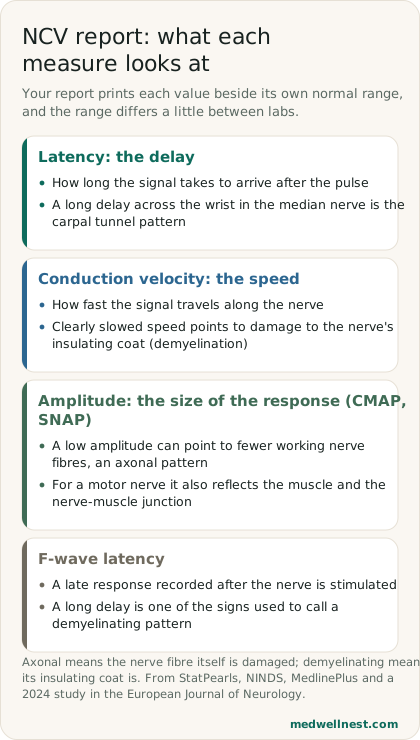
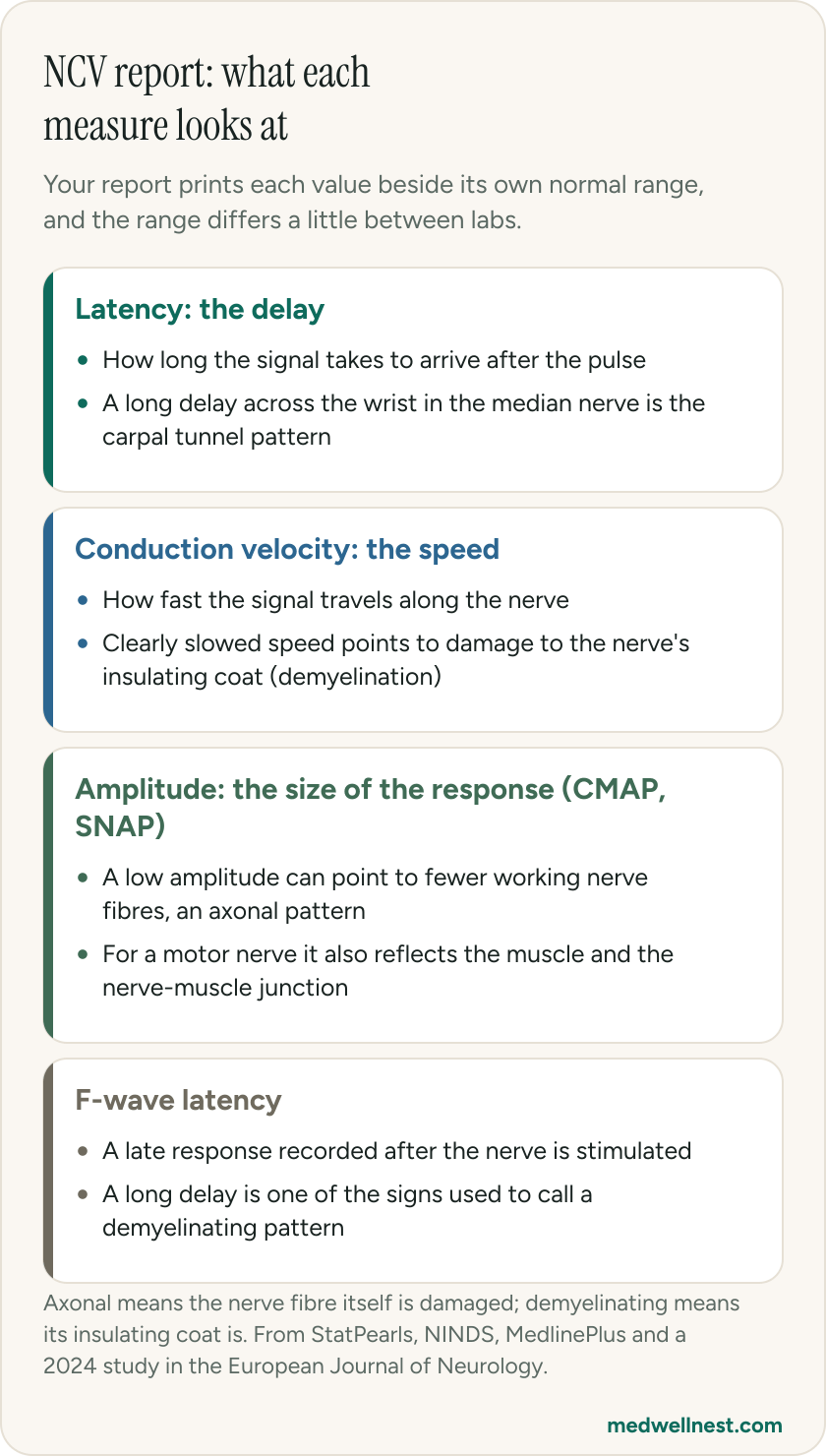
In a nerve conduction study, electrodes on the skin give a mild pulse to a nerve and record the response. MedlinePlus says the provider notes how long it takes for the muscle to respond, and that the speed of the response is called the conduction velocity. That waiting time is the latency. StatPearls says the test also reports amplitude: the size of the response, called the compound muscle action potential (CMAP) for a motor nerve and the sensory nerve action potential (SNAP) for a sensory nerve. Some reports add F-wave latency, the timing of a late response recorded after the nerve is stimulated.
These numbers sort damage into two broad patterns. StatPearls says NCS can distinguish axonal injury, to the nerve fibre itself, from myelin sheath injury, to its insulating coat. A study of Guillain-Barré syndrome in the European Journal of Neurology (2024) shows how the numbers are used in research criteria: a prolonged distal motor latency, a reduced motor conduction velocity and a prolonged F-wave latency count towards a demyelinating pattern, while a reduced distal CMAP amplitude, without those features, counts towards an axonal one.
Your report prints each value beside a normal range set by the lab, so compare with that range rather than with a number found online. MedlinePlus says a damaged nerve has a slower and weaker signal, which shows up as slow speed and small amplitude.
03
Carpal tunnel on NCV: the delay at the wrist
In carpal tunnel syndrome the median nerve is squeezed where it passes through the wrist, and the NCV looks for a delay in exactly that stretch. A review in Advanced Biomedical Research (2015) notes that a prolonged median motor distal latency was first described in 1956, and that median sensory slowing across the carpal tunnel has also been demonstrated in people with the condition. It summarises a practice parameter that recommends a median sensory study across the wrist, a median motor study recorded from the thenar muscle at the base of the thumb, and one other nerve in the same limb for comparison.
The same review says that if the median sensory and motor latencies are abnormal compared with an adjacent nerve in the same limb, that confirms carpal tunnel syndrome, in a person whose symptoms and examination fit it. It also recommends needle EMG of a sample of muscles from the neck roots down to the hand, including a thenar muscle supplied by the median nerve. Our carpal tunnel guide covers symptoms, splints and treatment; the NCV is the test that puts a number on the squeeze.
04
EMG words: fibrillations, positive sharp waves and motor unit changes
For the EMG half, a thin needle sits in the muscle and records its electrical activity at rest and as you tighten it. MedlinePlus says a healthy muscle should not give off any electrical signals when you are not moving it, and that a damaged muscle may show activity at rest or abnormal activity during use. Fibrillation potentials and positive sharp waves are names for spontaneous activity at rest; a report lists them when the resting muscle is not quiet.
StatPearls says needle EMG detects spontaneous muscle activity, the action potentials of single or multiple motor units, and their recruitment or interference pattern. A motor unit is one nerve cell and the muscle fibres it controls, so changes in the size, shape or recruitment of motor unit potentials describe how the nerve supply and the muscle are working together. NINDS says the needle exam can help tell muscle disorders from nerve disorders and can show whether a pinched nerve is present. Reading which pattern fits is the specialist's job; resting activity on its own does not say whether the cause is in the nerve or the muscle.
05
What the tests feel like, and what to tell the person doing them
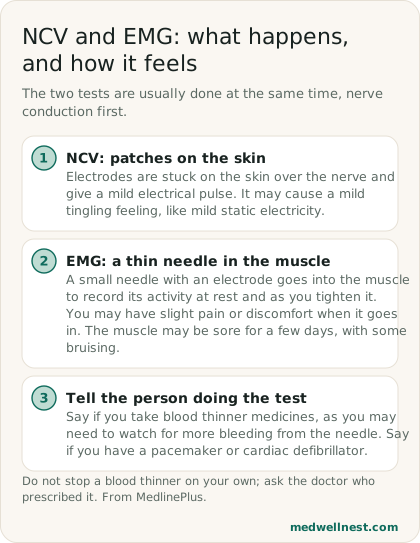
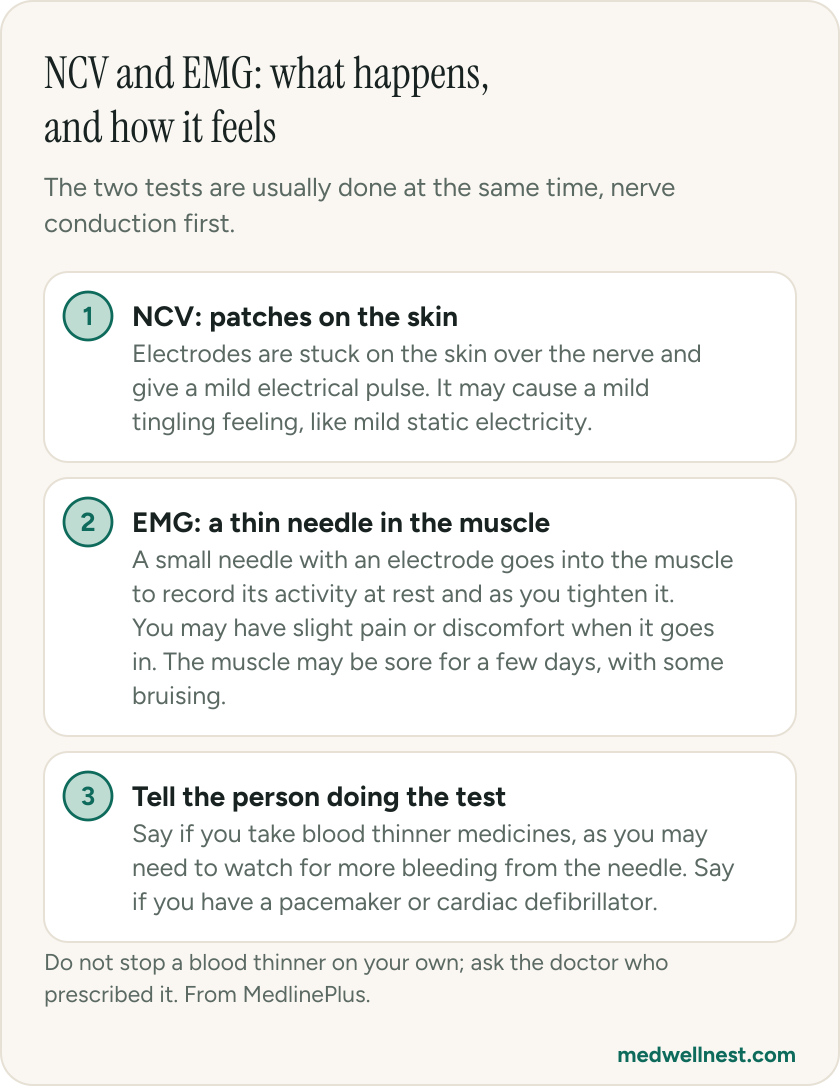
MedlinePlus says an EMG may take from 30 to 60 minutes and a nerve conduction study from 15 minutes to over an hour, depending on how many nerves and muscles are tested. The nerve pulses may cause a mild tingling feeling, like mild static electricity. The needle may cause slight pain or discomfort as it goes in. The tested muscles may be sore for a few days and you may have some bruises where the needles went in.
Tell the person doing the test if you take blood thinner medicines, because you may need to watch for more bleeding from the needle. MedlinePlus also says to mention a pacemaker or cardiac defibrillator, which needs special steps beforehand. Do not stop a blood thinner on your own; ask the doctor who prescribed it. Clean skin with no lotions, creams or perfumes for a day or two beforehand helps, because they can change the results.
06
A normal NCV does not close the case
StatPearls says NCV measures the speed of the signal in large myelinated axons. Small nerve fibres, which carry pain and temperature sensation, are not what the test measures. NINDS lists inability to feel pain or changes in temperature as a result of damage to small fibre nerves, and says a skin biopsy is most commonly used to diagnose small fibre neuropathies that do not respond to standard nerve conduction studies and electromyography.
So burning feet, odd temperature sensations or pain with a normal NCV and EMG are not a reason to stop looking. Ask the doctor what else could be checked. NINDS says blood tests can detect diabetes, vitamin deficiencies, liver or kidney dysfunction and other metabolic disorders that can sit behind a neuropathy. Our diabetic neuropathy guide and our guide to tingling in the hands and feet from B12 and diabetes cover those causes.
07
Weakness spreading through the arms or legs is not a job for the test queue
Guillain-Barré syndrome is a rare condition in which the immune system attacks the nerves. The NHS says it is serious and needs urgent treatment in hospital. It usually affects the arms and legs first: tingling, numbness or pins and needles in the feet and hands come first, usually followed by muscle weakness and difficulty moving the joints. Other symptoms can include problems breathing, drooping face muscles, trouble swallowing or speaking, and double vision.
The NHS says symptoms usually get worse over the first 2 to 4 weeks, and that some people become unable to move their legs, arms and face. MedlinePlus lists Guillain-Barré syndrome among the conditions an abnormal result can point to, but weakness that is spreading is an emergency first and a test result afterwards. The NHS also warns that a drooping face, an arm that cannot be lifted or slurred speech can be signs of a stroke, which is an emergency in its own right; our stroke guide has the details.
When not to wait for the test
Emergency — act now
Tingling or weakness in the legs or arms that is spreading or getting worse over hours or a day or two, or any new weakness with trouble breathing, swallowing or speaking: go to an emergency department now. Guillain-Barré syndrome needs urgent treatment in hospital. A face drooping on one side, an arm you cannot lift or slurred speech can be a stroke: call emergency services now.
Same-day — call promptly
Numbness, tingling or weakness that is slowly getting worse over several days without trouble breathing, swallowing or speaking, or a new weak hand or foot: see a doctor today instead of waiting for the NCV appointment.
Routine — see a doctor
Tingling or numbness in the fingers or feet that has lasted for weeks without getting worse: take the NCV and EMG report back to the doctor who ordered it, and ask about blood tests for diabetes and vitamin deficiency. Tell the person doing an EMG if you take blood thinners.
Values mentioned in this story
Each one opens a visual guide with its normal range and what moves it — upload a report and we place your own numbers on the same scale.
Sources
- Electromyography (EMG) and Nerve Conduction Studies — MedlinePlusmedlineplus.gov
- Nerve Conduction Studies and Electromyography — StatPearlsncbi.nlm.nih.gov
- Peripheral Neuropathy — NINDSninds.nih.gov
- Guillain-Barré syndrome — NHSnhs.uk
- Practical approach to electrodiagnosis of the carpal tunnel syndrome: a review — Advanced Biomedical Research, 2015pmc.ncbi.nlm.nih.gov
- Electrodiagnostic subtyping in Guillain-Barré syndrome patients in the International Guillain-Barré Outcome Study — European Journal of Neurology, 2024pmc.ncbi.nlm.nih.gov
Share this story
Curious where your own values stand?
Two minutes from upload to a full visual picture. Free to analyze.