In short
MedlinePlus gives 299 to 1054 pg/mL as normal, but ranges vary by lab and no single cut-off is agreed. A grey-zone result can be checked with an MMA test. Here is how to read pg/mL and pmol/L, what lowers B12, and what a high result means.
Emergency if: Sudden confusion, or sudden weakness or numbness on one side of the body or face: call emergency services now. These can be signs of a stroke, not B12.
On your report
Vitamin B12, Homocysteine, MCV, Hemoglobin
On this page
01
What is the normal range for vitamin B12 in pg/mL and pmol/L?
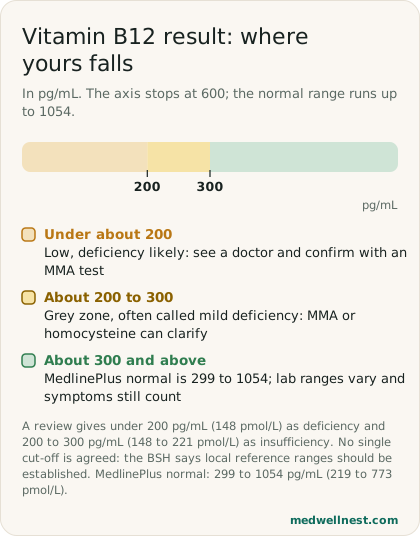
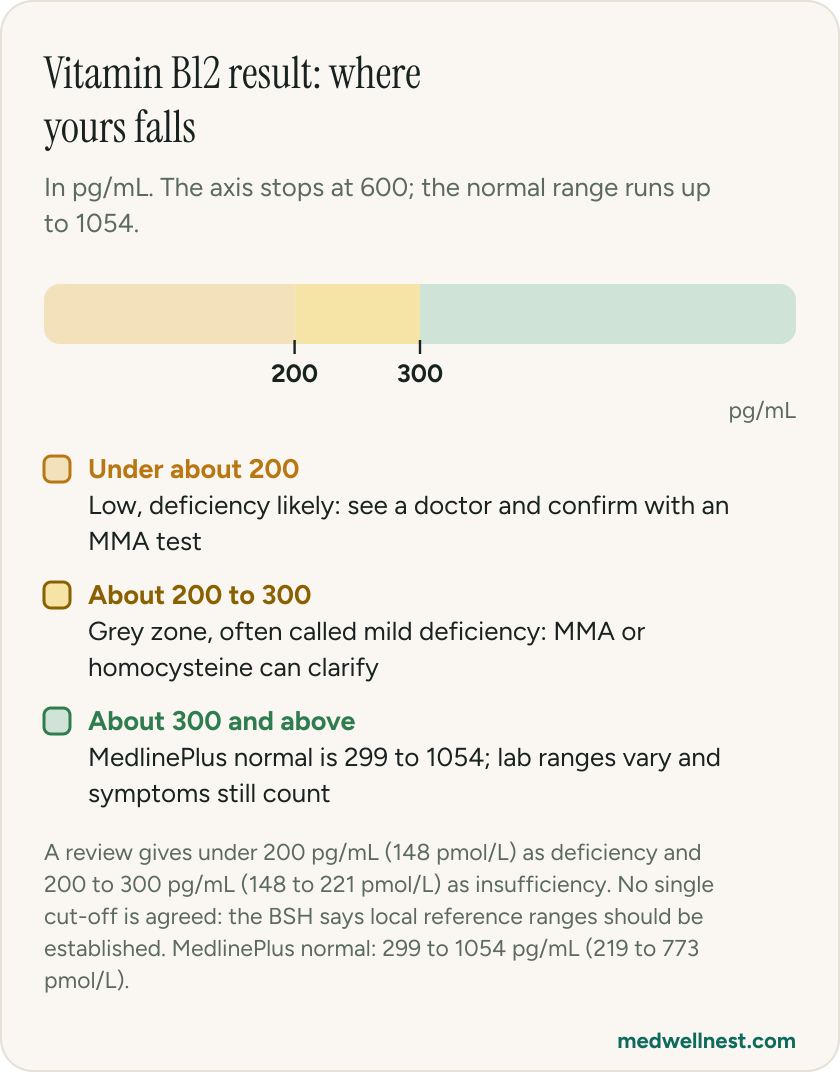
MedlinePlus gives normal values as 299 to 1054 pg/mL, which is 219 to 773 pmol/L. It adds that normal ranges vary among laboratories, and that some labs use different measurements or test different samples. So always compare your result with the range printed on your own report.
Reports use two units. From the pairs MedlinePlus prints, 1 pmol/L is about 1.36 pg/mL. A 2018 review gives the common cut-offs in both units: below 148 pmol/L (200 pg/mL) as deficiency and 148 to 221 pmol/L (200 to 300 pg/mL) as insufficiency. Check which unit your report uses before you compare it with any number you read online.
A reminder on preparation: MedlinePlus says to avoid food and drink for about 6 to 8 hours before this test, so check the instruction from your lab. Our guide on fasting before blood tests explains which tests need it.
02
My B12 is low or borderline. Do I have a deficiency?
MedlinePlus says a value below 299 pg/mL (219 pmol/L) is a possible sign of deficiency, and that deficiency should be confirmed by checking methylmalonic acid (MMA); a high MMA indicates true B12 deficiency. A 2024 expert consensus describes serum B12 below 148 pmol/L as commonly considered frank deficiency, and 148 to about 220 pmol/L as often considered mild deficiency, with some experts extending that band to 260 pmol/L. The World Health Organization cut-offs, quoted in a 2016 review, are above 221 pmol/L adequate, 148 to 221 low, and below 148 deficiency.
That is why a result near 200 to 300 pg/mL is called a grey zone. The BSH (haematology society) guideline says there is no gold standard test, definitive cut-off points are not possible given the variety of methods, and local reference ranges should be used. It says the clinical picture is the most important factor, and that second-line MMA helps clarify uncertain results. Homocysteine can help too, but is less specific than MMA.
Neither test is perfect. The 2024 consensus says 30 to 40 percent of people with nerve or blood symptoms from B12 deficiency may have a normal serum B12. MMA can also be raised by kidney problems, so your doctor reads it with your other results. If symptoms are strong and the result does not fit, the guideline says treatment should not be delayed, because delay risks nerve damage.
03
What causes low vitamin B12: diet, metformin, acidity medicines or something else?
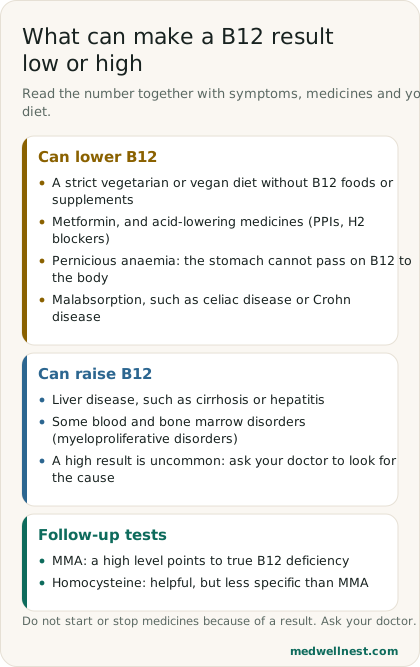
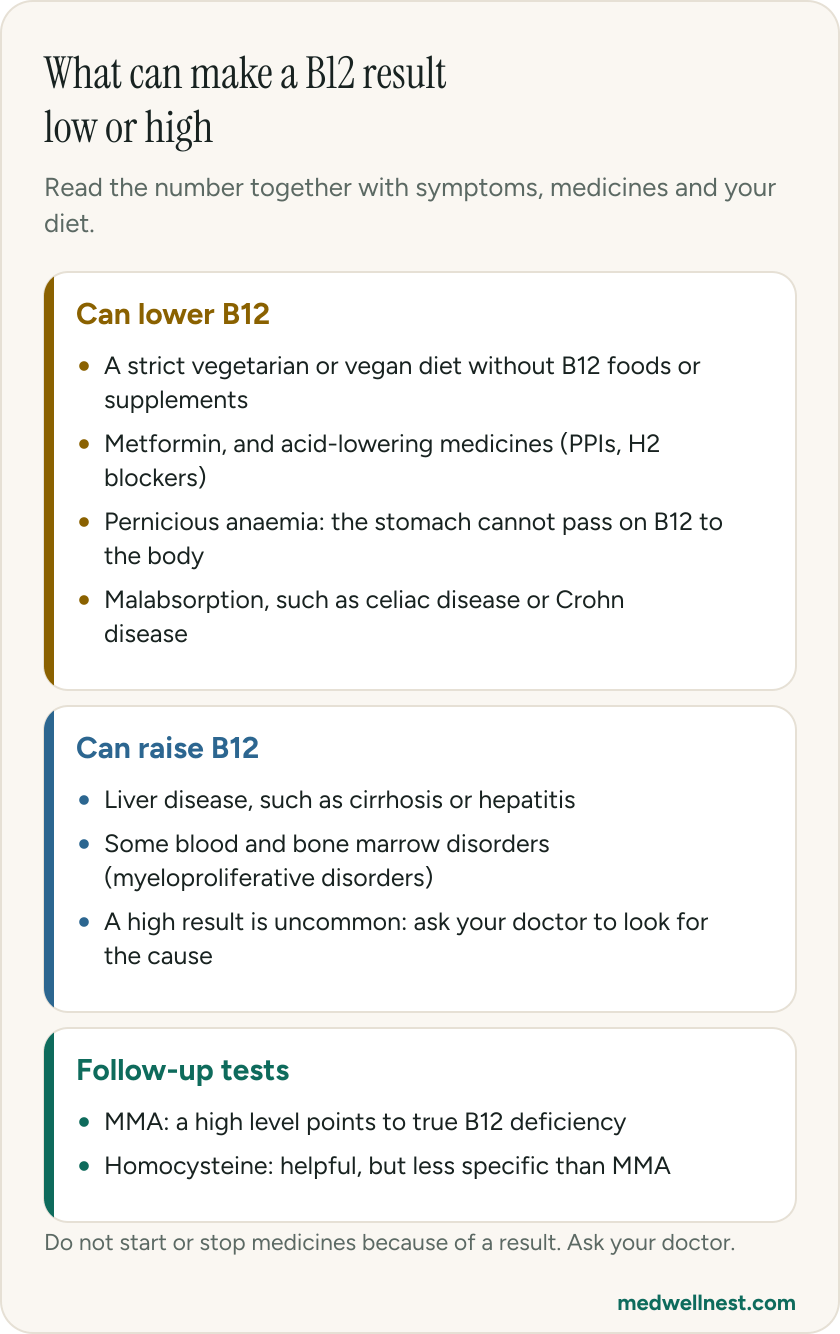
MedlinePlus lists too little B12 in the diet (rare, except with a strict vegetarian diet), diseases that stop absorption such as celiac disease and Crohn disease, and lack of intrinsic factor, a protein that helps the gut absorb B12. The NHS describes pernicious anaemia, where the immune system attacks cells in the stomach so that B12 from food cannot be absorbed, and says a vegan diet without supplements or fortified foods can also cause it. Our guide to B12 on plant-based diets covers food sources.
Medicines matter. The 2024 consensus says metformin is causally related to lower serum B12, with an effect seen as early as 3 months after starting. The NHS names proton pump inhibitors and anticonvulsants as medicines that can reduce absorption, and MedlinePlus lists metformin, proton pump inhibitors and H2 blockers among medicines that can affect the test result, and a 2018 review says there is clear evidence that proton pump inhibitors, H2 blockers and metformin reduce B12 levels. Never stop metformin or any other medicine because of a B12 result; talk to your doctor, who can arrange follow-up.
04
What are the symptoms of low B12: tingling, tiredness, memory problems?
The NHS lists extreme tiredness, lack of energy, pins and needles, a sore red tongue, mouth ulcers, muscle weakness, vision problems, mood problems from mild depression or anxiety to confusion and dementia, and problems with memory and judgement. MedlinePlus adds numbness or tingling in the arms and legs, and loss of balance. The NHS says B12 deficiency can cause unusually large red blood cells; our guides to anaemia types and the CBC explain that part of a report.
Symptoms and numbers do not always agree. The NHS says some people have symptoms and seem to have normal levels, and some have low levels without symptoms. It also says many problems improve with treatment but nerve problems can be permanent, so it matters to get checked early. If tingling in the hands and feet is what worries you, our guide on tingling hands and feet in B12 and diabetes starts from that symptom.
05
What does a high vitamin B12 result mean?
MedlinePlus says an increased B12 level is uncommon, because excess B12 is usually removed in the urine. It lists liver disease, such as cirrhosis or hepatitis, and myeloproliferative disorders, which are blood and bone marrow disorders, as conditions that can increase the level.
A single high result does not mean you have one of these. But it is not a number to ignore either. Tell your doctor about every supplement, injection and medicine you take, because B12 tablets or injections affect how the result is read, and ask whether the result needs a repeat test or a look for a cause. Do not start or stop any supplement on the strength of a report alone.
When to act
Emergency — act now
Sudden confusion, or sudden weakness or numbness on one side of the body or face: call emergency services now. These can be signs of a stroke, not B12.
Same-day — call promptly
You have new numbness or tingling that is spreading, trouble with balance or walking, or new memory problems or confusion: see a doctor today, whatever your B12 result says. The NHS says nerve problems from B12 deficiency can sometimes be permanent, so delay costs.
Routine — see a doctor
Your result is low, borderline or high but you feel well: show the report to your doctor and ask whether an MMA or homocysteine test is needed. Mention metformin, acid-lowering medicines, your diet and any supplements.
Values mentioned in this story
Each one opens a visual guide with its normal range and what moves it — upload a report and we place your own numbers on the same scale.
Sources
- Vitamin B12 level — MedlinePlus Medical Encyclopediamedlineplus.gov
- Guidelines for the diagnosis and treatment of cobalamin and folate disorders — BSH guideline (2014)pubmed.ncbi.nlm.nih.gov
- Diagnosis, Treatment and Long-Term Management of Vitamin B12 Deficiency in Adults: A Delphi Expert Consensus (2024)pmc.ncbi.nlm.nih.gov
- Biomarkers and Algorithms for the Diagnosis of Vitamin B12 Deficiency — Frontiers in Molecular Biosciences (2016)pmc.ncbi.nlm.nih.gov
- Vitamin B12 or folate deficiency anaemia — NHSnhs.uk
- Proton Pump Inhibitors, H2-Receptor Antagonists, Metformin, and Vitamin B-12 Deficiency: Clinical Implications — Advances in Nutrition (2018)pmc.ncbi.nlm.nih.gov
Share this story
Curious where your own values stand?
Two minutes from upload to a full visual picture. Free to analyze.