In short
An anal fistula is a small tunnel between the bowel and the skin near the anus, usually left after an abscess. The NHS says it will not usually get better on its own and surgery is recommended in most cases. A hot, swollen, painful lump with fever needs same-day care; confusion or severe pain needs emergency care now.
Emergency if: You have a painful swelling near the anus or a high temperature and you are confused, have slurred speech or are not making sense, are breathing very fast, have blue, pale or blotchy skin or a rash that does not fade when you press it, or you feel very unwell and worry it could be sepsis; or you are in severe pain; or bleeding from the bottom will not stop, or there is a lot of blood or large clots: call emergency services now or go to an emergency department now. Do not drive yourself. The NHS lists these as emergency signs of sepsis and of piles.
On this page
01
What is an anal fistula (bhagandar)?
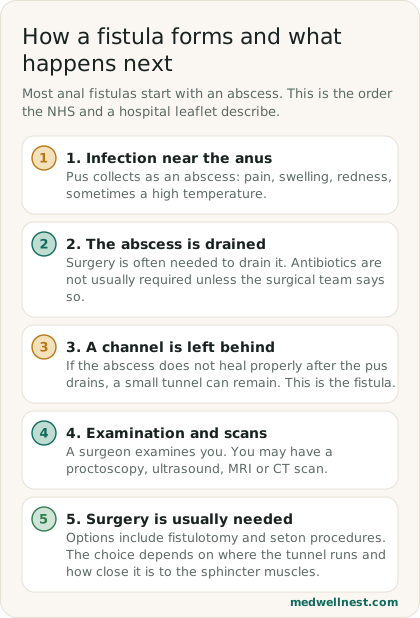
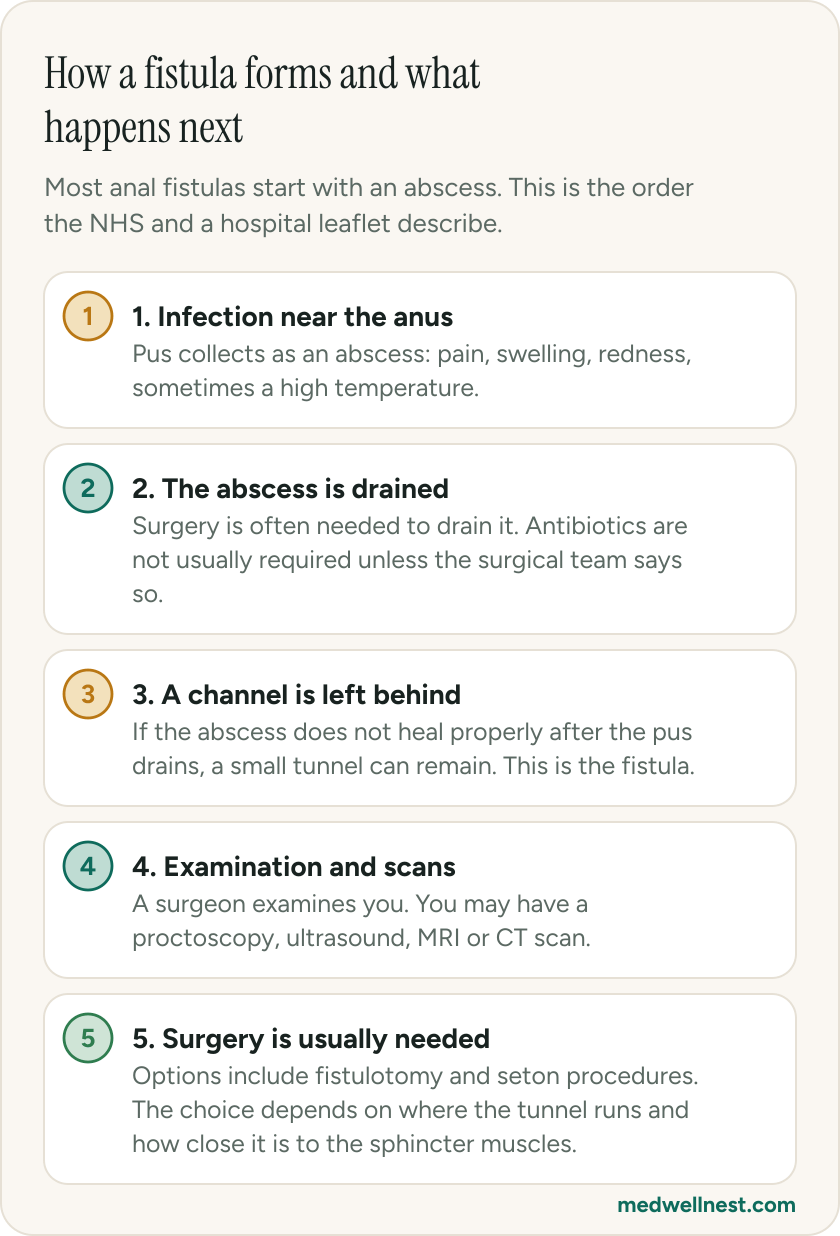
An anal fistula is a small tunnel that develops between the end of the bowel and the skin near the opening of the bottom (the anus), according to the NHS. In Hindi it is often called bhagandar. It is usually caused by an infection near the anus that collects as a pocket of pus, called an abscess. When the pus drains away, it can leave a small channel behind.
Most anal fistulas develop after an anal abscess, the NHS says, and you can get one if the abscess does not heal properly after the pus has drained. Less common causes listed by the NHS are Crohn's disease, diverticulitis, a skin condition called hidradenitis suppurativa, infection with tuberculosis (TB) or HIV, and a complication of surgery near the anus. A hospital leaflet adds that people with diabetes, inflammatory bowel disease or a weakened immune system are more likely to get abscesses.
02
What are the symptoms of an anal fistula?
The NHS lists these symptoms: skin irritation around the anus; a constant, throbbing pain that may be worse when you sit down, move around, poo or cough; smelly discharge from near the anus; passing pus or blood when you poo; and, if you also have an abscess, swelling and redness around the anus with a high temperature. Some people have difficulty controlling bowel movements (bowel incontinence).
The outer end of the fistula might be visible as a hole in the skin near the anus, although the NHS says this may be hard to see yourself. Because many of these signs overlap with piles and a fissure, an examination is the only reliable way to tell them apart.
03
How is a fistula different from piles and an anal fissure?
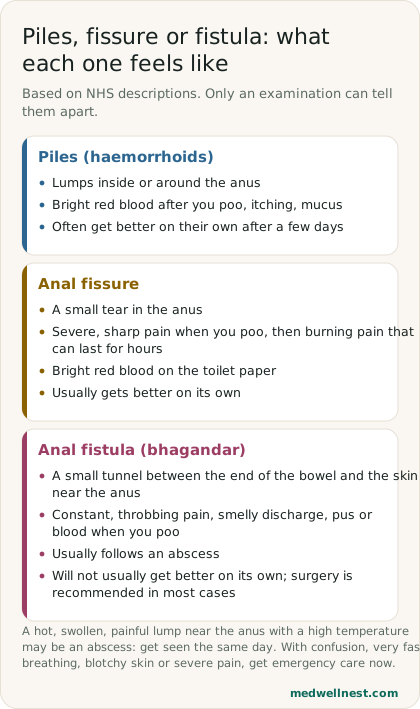
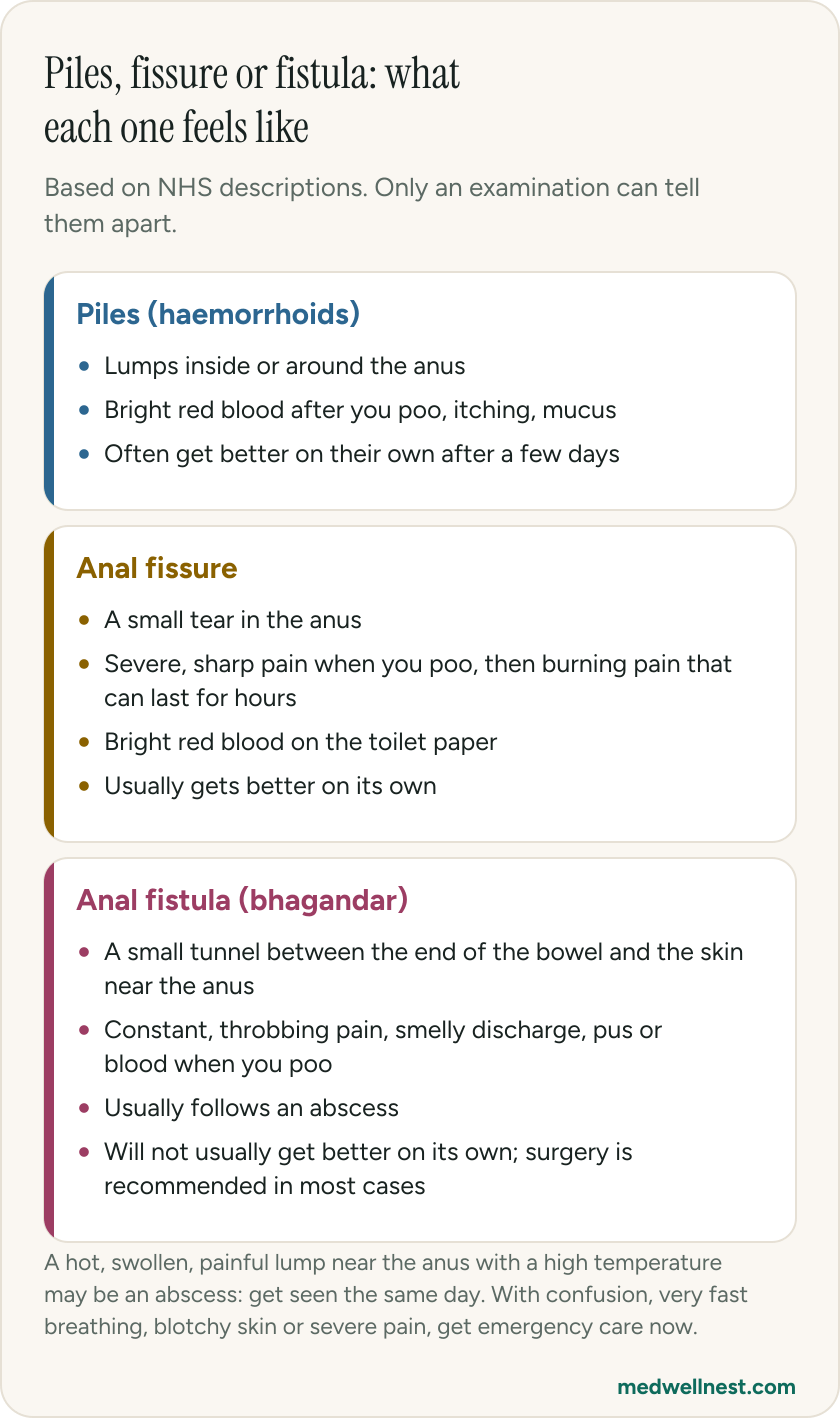
The NHS describes piles as lumps inside and around the anus, often with bright red blood after you poo, itching and mucus, and says they often get better on their own after a few days. An anal fissure is a small tear that causes severe, sharp pain when you poo, followed by burning pain that may last for hours, and bright red blood on the toilet paper; the NHS says it usually gets better on its own.
A fistula is different in kind: it is a tunnel, not a lump or a tear. Its typical signs are constant throbbing pain, smelly discharge and pus or blood when you poo, and the NHS says it will not usually get better on its own. If you keep having discharge near the anus, or pain that is not the sharp-when-pooing pattern of a fissure, do not assume it is piles. Our guides to piles and to anal fissure cover those two conditions in detail.
04
Is a painful, swollen lump near the anus an abscess, and how fast do I need care?
An anal abscess is the usual starting point for a fistula. A hospital patient leaflet describes an anorectal abscess as a collection of pus in or around the anus and rectum, with pain or tenderness that may be worse when opening the bowels, a hard lump, pus discharge, fever, constipation and feeling tired and unwell. It says surgery is often required to drain the abscess, and that antibiotics are not usually required unless the surgical team says so.
The NHS lists swelling and redness around the anus with a high temperature as a sign of a fistula with an abscess. For piles, the NHS tells people to ask for an urgent appointment if their temperature is very high, or they feel hot, cold or shivery and generally unwell, or pus is leaking. Use the same caution with any painful swelling near the anus: get seen the same day instead of waiting to see whether it settles. If you also become confused, breathe very fast, have blue, pale or blotchy skin, or are in severe pain, the NHS treats these as emergency signs, so get emergency care now; an infection that spreads can lead to sepsis. The leaflet says that with prompt treatment people with an abscess can fully recover in a short period.
05
How is an anal fistula diagnosed? Is an MRI needed?
The NHS says a doctor will ask about your symptoms and any bowel conditions, look at the skin around the anus and may do a gentle rectal examination with a gloved finger. If a fistula is suspected you are referred to a specialist called a colorectal surgeon. The tests the NHS lists are a further physical and rectal examination, a proctoscopy (a lit telescope used to look inside the anus), and an ultrasound, MRI or CT scan.
The NHS adds that you may sometimes need an initial examination of the area under general anaesthetic to help decide the best treatment. The best option depends on the position of the fistula and on whether it is a single channel or branches in different directions, which is why scans and examination matter before surgery. Having a fistula alongside bowel symptoms such as diarrhoea or blood in the stool is worth mentioning, since Crohn's disease is one of the less common causes.
06
Can a fistula heal without an operation, and what surgery is used?
The NHS says anal fistulas usually need surgery because they rarely heal if left untreated. It names these main options: a fistulotomy, which cuts open the whole length of the fistula so it heals as a flat scar, and seton procedures, where a piece of surgical thread is left in the fistula for several weeks. The NHS says a fistulotomy is the most effective treatment for many fistulas but is usually suitable only for fistulas that do not pass through much of the sphincter muscle, because the risk of incontinence is lowest in those.
For a fistula that passes through a significant part of the sphincter, the NHS says a surgeon may first place a seton. A loose seton lets the fistula drain but does not heal it; a tighter seton may be used to cut through the fistula slowly, which can take several procedures. Other options the NHS names are an advancement flap, the LIFT procedure, endoscopic ablation, laser, a bioprosthetic plug and fibrin glue. It calls fibrin glue the only non-surgical option, but generally less effective than a fistulotomy for simple fistulas, with results that may not last. No source we read gives a reliable way to heal a fistula without a procedure, so do not wait on home treatment.
Many people do not need to stay in hospital overnight after surgery, though some stay a few days, the NHS says. Ask your surgeon which procedure is planned and why.
07
What are the risks of fistula surgery: coming back and loss of bowel control?
The NHS lists three main risks: infection, which may need antibiotics and in severe cases hospital treatment; the fistula coming back despite surgery; and bowel incontinence, which it calls a potential risk with most types of treatment, although severe incontinence is rare and every effort is made to prevent it. The aim of surgery is to heal the fistula while avoiding damage to the sphincter muscles that control the bowel.
The NHS says the level of risk depends on where the fistula is and on the specific procedure. We did not find a reliable figure for how often fistulas return or how often incontinence follows, so none is given here. Ask the surgeon to explain the risk for your type of fistula before you agree to a procedure, and tell them if you already have trouble controlling your bowels.
Anal fistula and abscess: how fast to act
Routine — see a doctor
You have persistent symptoms of an anal fistula, such as throbbing pain near the anus, smelly discharge, or pus or blood when you poo: see a doctor, who can examine you and refer you to a colorectal surgeon. The NHS says surgery is recommended in most cases.
Same-day — call promptly
You have a painful, swollen, red lump near the anus with a high temperature, or you feel hot, cold or shivery and generally unwell, or pus is leaking: get seen the same day. The NHS tells people with piles and these signs to ask for an urgent appointment, and a hospital leaflet says an abscess is usually drained by surgery. Tell the doctor if you have diabetes, bowel inflammation or a weakened immune system, which make abscesses more likely.
Emergency — act now
You have a painful swelling near the anus or a high temperature and you are confused, have slurred speech or are not making sense, are breathing very fast, have blue, pale or blotchy skin or a rash that does not fade when you press it, or you feel very unwell and worry it could be sepsis; or you are in severe pain; or bleeding from the bottom will not stop, or there is a lot of blood or large clots: call emergency services now or go to an emergency department now. Do not drive yourself. The NHS lists these as emergency signs of sepsis and of piles.
Sources
- Anal fistula — NHSnhs.uk
- Anal fistula: treatment — NHSnhs.uk
- Piles (haemorrhoids) — NHSnhs.uk
- Anal fissure — NHSnhs.uk
- Anorectal abscess: patient information — Bradford Teaching Hospitals NHS Foundation Trustbradfordhospitals.nhs.uk
- Sepsis — NHSnhs.uk
Share this story
Curious where your own values stand?
Two minutes from upload to a full visual picture. Free to analyze.