In short
An audiogram plots the softest sounds you can hear, pitch by pitch. Here is what O, X, < and > mean, how air and bone results separate conductive from sensorineural loss, the WHO 2021 dB grades, the noise notch, and why sudden loss is urgent.
Emergency if: Sudden hearing loss with a drooping face, numbness or weakness on one side, slurred speech, sudden loss of balance or sudden vision trouble: call emergency services now, because this can be a stroke.
On this page
01
What an audiometry test measures
In pure-tone audiometry you listen to beeps of different pitches and signal each time you hear one. For every pitch the audiologist records the softest level you could detect, called your threshold. StatPearls describes a standard test running from about 250 Hz to 8000 Hz, including 250, 500, 1000, 2000, 3000, 4000, 6000 and 8000 Hz.
Loudness is shown in decibels hearing level, or dB HL. The scale is set against standard average hearing thresholds, so 0 dB HL is average normal hearing, not silence, and some people can hear below 0. StatPearls notes that a 5 dB difference between two tests can simply reflect the 5 dB steps the test uses, not a real change.
Many reports also give a pure-tone average. Check which pitches it uses: StatPearls describes the traditional average of 500, 1000 and 2000 Hz, while WHO grades hearing loss on the average of 500, 1000, 2000 and 4000 Hz in the better ear.
02
Reading the chart: axes and symbols
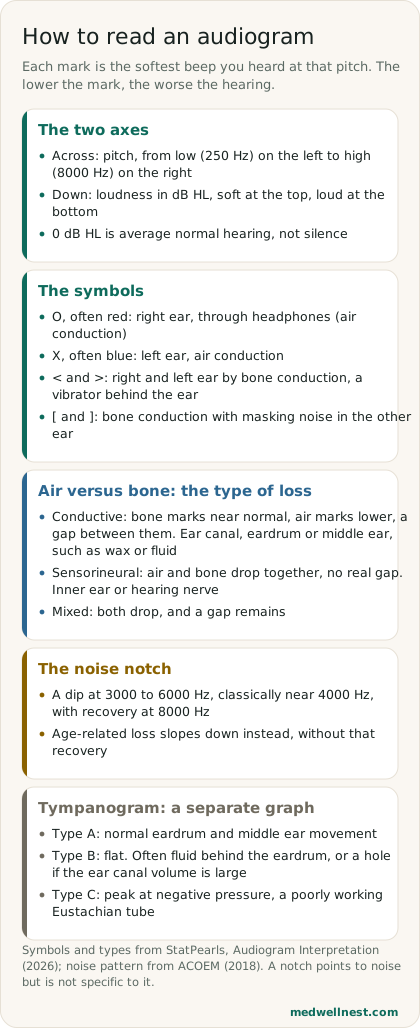
Pitch runs across the chart, from low on the left to high on the right. Loudness runs down the chart: soft sounds at the top, loud sounds at the bottom. The lower a mark sits, the louder that beep had to be before you heard it, so marks lower on the page mean poorer hearing.
The symbols tell you which ear and which test. In the standard set described by StatPearls, O is the right ear and X is the left ear, tested through headphones or earphones, called air conduction; when colour is used, the right ear is usually red and the left ear blue. The signs < and > are the right and left ear tested by bone conduction, with a small vibrator behind the ear, and [ and ] are bone results with masking noise played into the other ear.
03
Air, bone and the type of hearing loss
Comparing the two kinds of marks tells the type of hearing loss. Bone conduction bypasses the ear canal and middle ear and reaches the inner ear directly. StatPearls explains that a gap between air and bone results suggests a conductive problem, while air and bone results that drop together, without a clear gap, suggest sensorineural hearing loss.
Conductive loss comes from the ear canal, eardrum or middle ear, for example wax or fluid. Sensorineural loss comes from the inner ear or the hearing nerve. Mixed loss has both: all the marks are lower, and a gap remains between air and bone.
Some reports include a tympanogram, a separate graph of how the eardrum moves. Type A is normal. Type B is flat: with a normal ear canal volume it usually means fluid behind the eardrum, and with a large volume a hole in the eardrum or a grommet tube. Type C has its peak at negative pressure, pointing to a poorly working Eustachian tube.
04
The WHO grades in dB
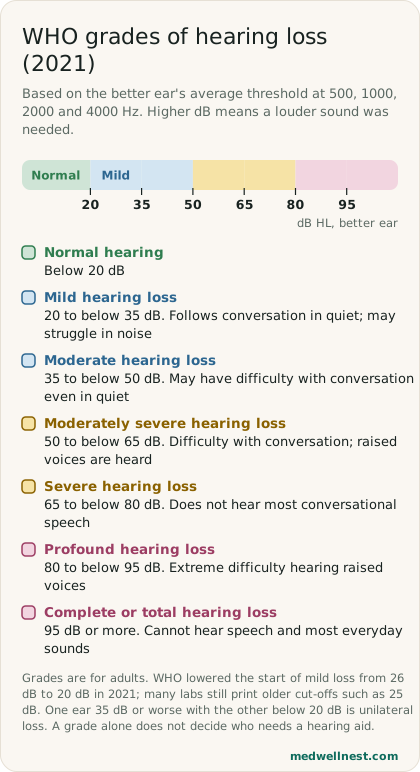
In 2021 WHO revised its grades of hearing loss, based on the better ear. Normal hearing is below 20 dB. Mild loss is 20 to below 35 dB, moderate 35 to below 50 dB, moderately severe 50 to below 65 dB, severe 65 to below 80 dB, profound 80 to below 95 dB, and complete hearing loss 95 dB or more. Unilateral loss means below 20 dB in the better ear and 35 dB or more in the worse ear. Exactly 20 dB sits on the line: the WHO table counts it as mild, while WHO's text calls 20 dB or better normal.
WHO lowered the start of mild hearing loss from 26 dB to 20 dB, so an older chart or lab may still call 25 dB normal; StatPearls notes that 0 to 20 or 25 dB HL has traditionally been treated as the normal range in adults. WHO also stresses that the grades are for adults and for describing populations, and that an audiogram grade alone should not decide who needs a hearing aid, because difficulty following speech in background noise, the main complaint of many people, is not captured by the grade.
05
The 4 kHz noise notch
Years of loud noise at work leave a typical pattern. The American College of Occupational and Environmental Medicine (ACOEM) says noise-induced hearing loss is always sensorineural, usually affects both ears, and first shows as a notch, a dip in the chart at 3000, 4000 or 6000 Hz, with better hearing again at 8000 Hz. Age-related hearing loss also affects high pitches, but slopes steadily downward without that recovery.
A notch points towards noise, but StatPearls cautions that it is not specific to noise, and ACOEM notes that in older people noise and age effects can be hard to separate without earlier audiograms. Keep your pre-employment and yearly work audiograms: comparing them is how a change is recognised early, while hearing protection can still prevent further loss.
06
When a hearing result is urgent
Sudden hearing loss is different from gradual loss. NICE advises that hearing loss that came on over 3 days or less, within the past 30 days, and is not explained by wax or an ear infection, needs to be seen within 24 hours by an ear, nose and throat service or an emergency department. The American Academy of Otolaryngology guideline describes sudden hearing loss as a frightening symptom, often with ringing or dizziness, and says treatment with steroids may be offered within 2 weeks of the start, which is why delay matters.
If a drooping face, numbness or weakness on one side came on suddenly, call emergency services now, because this can be a stroke. Otherwise, hearing loss in one ear together with numbness or a drooping face on the same side needs to be seen within 24 hours by an ear, nose and throat service. On a routine audiogram, NICE suggests considering an MRI scan when the two ears differ by 15 dB or more at 2 neighbouring pitches with sensorineural loss. The otolaryngology guideline on sudden hearing loss advises against routine blood tests, so the audiogram and an ear examination come first.
When to act
Emergency — act now
Sudden hearing loss with a drooping face, numbness or weakness on one side, slurred speech, sudden loss of balance or sudden vision trouble: call emergency services now, because this can be a stroke.
Same-day — call promptly
Hearing loss in one or both ears that came on over 3 days or less, within the past 30 days, and is not explained by wax or an infection: get seen today, by an ear, nose and throat service or an emergency department. NICE advises assessment within 24 hours, and treatment works best when started early.
Routine — see a doctor
Hearing loss that came on suddenly more than 30 days ago or worsened over weeks: see an ear, nose and throat doctor within 2 weeks. Gradual loss, a noise notch or a difference between the ears on a routine audiogram: book an ear, nose and throat or audiology review.
Sources
- World report on hearing — WHO 2021who.int
- Audiogram Interpretation — StatPearls, NCBI Bookshelfncbi.nlm.nih.gov
- ACOEM Guidance Statement: Occupational Noise-Induced Hearing Loss — ACOEM 2018acoem.org
- Hearing loss in adults: assessment and management (NG98) — NICEnice.org.uk
- Clinical Practice Guideline: Sudden Hearing Loss (Update) — American Academy of Otolaryngology 2019journals.sagepub.com
Share this story
Curious where your own values stand?
Two minutes from upload to a full visual picture. Free to analyze.