In short
Most colds clear in 1 to 2 weeks. Count your child's breaths for a full minute while calm: WHO calls 60 or more under 2 months, 50 or more at 2 to 11 months and 40 or more at 1 to 5 years fast breathing. Chest indrawing, grunting, blue lips or not feeding need an emergency department now.
Emergency if: Your child is struggling to breathe, with grunting, the tummy sucking in under the ribs or very fast breathing; there are pauses in breathing; the lips, tongue or skin are blue or grey; or your child is floppy, will not wake or stay awake, cannot drink or feed, or has a fit: call emergency services now or go to an emergency department now. Also go to an emergency department now if a baby under 3 months has a temperature of 38 °C or higher, or a baby under 2 months is breathing 60 or more times a minute, unless a doctor can see your baby within 2 hours. The NHS and WHO list these as emergency signs.
On this page
01
How long does a cold or cough last in a child?
The NHS says you should begin to feel better from a cold in about 1 to 2 weeks, and that symptoms can last longer in young children, who may also be irritable, have difficulty feeding and sleeping, breathe through their mouth and be sick after coughing. A cough will usually clear on its own within 3 to 4 weeks. With bronchiolitis, a chest infection of babies and children under 2, the NHS says symptoms are usually worst between days 3 and 5 and the cough usually gets better in 3 weeks.
At home, the NHS advises plenty of fluids, and says it is common for small children to lose their appetite for a few days. It says not to give aspirin to children under 16, not to give honey to children under 12 months, and not to let children breathe steam from a bowl of hot water because of the risk of scalding. Decongestants should not be used by children under 6, and some cough and cold medicines are not suitable for babies, so ask a pharmacist. Antibiotics are not normally prescribed for coughs, and there is little evidence that supplements such as vitamin C prevent colds.
02
How do I count my child's breathing rate?
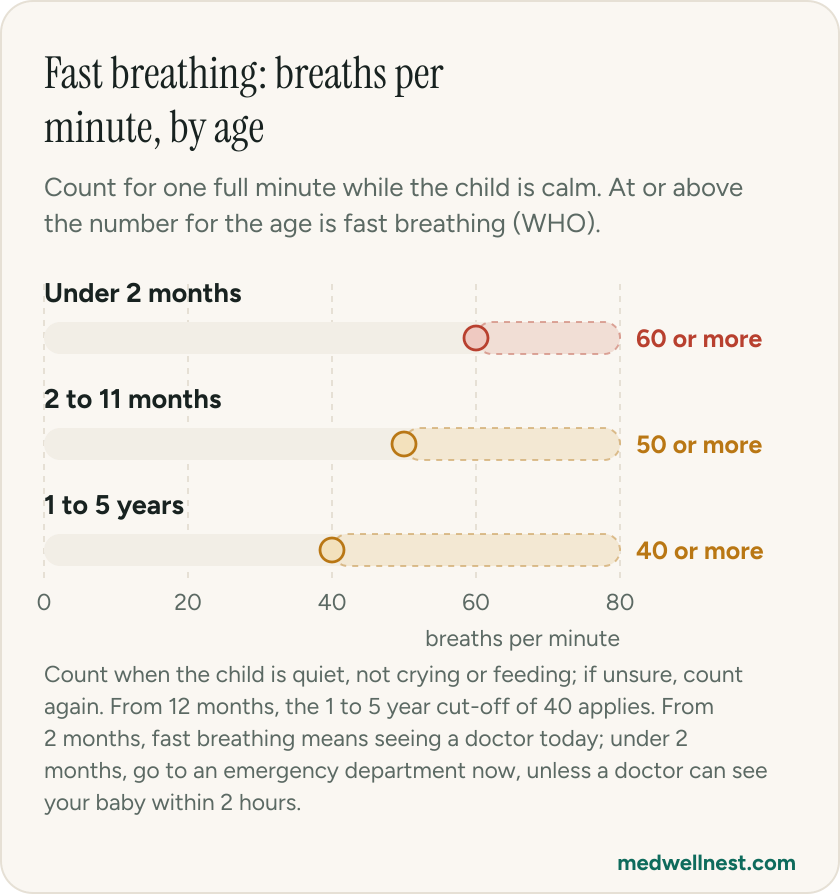
WHO's pocket book says to count while the child is calm, because a frightened, crying or angry child will not give an accurate count. If the child is sleeping, do not wake them. Use a watch with a second hand, look for breathing movement anywhere on the chest or tummy (lift the shirt if you cannot see it), and count the breaths for one full minute. If you are not sure of the number, for example because the child was moving or upset, count again.
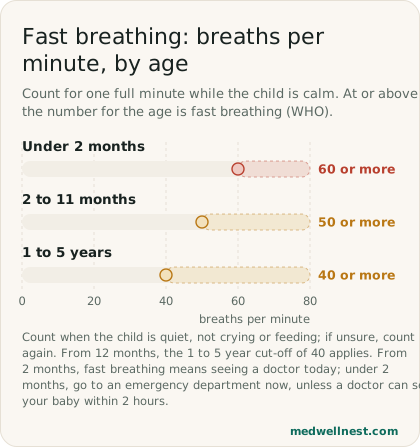
WHO's Pocket Book of Hospital Care for Children (2013) gives the cut-offs for fast breathing: 60 breaths a minute or more under 2 months, 50 or more from 2 to 11 months, and 40 or more from 1 to 5 years. From 12 months, the 1 to 5 year cut-off of 40 applies. WHO diagnoses pneumonia in a child under 5 with cough or difficult breathing by fast breathing or lower chest wall indrawing. So a calm count at or above the number for the age means a child aged 2 months or more should be seen by a doctor today. A baby under 2 months with fast breathing should go to an emergency department now, unless a doctor can see the baby within 2 hours.
03
What is chest indrawing, and which signs mean an emergency?
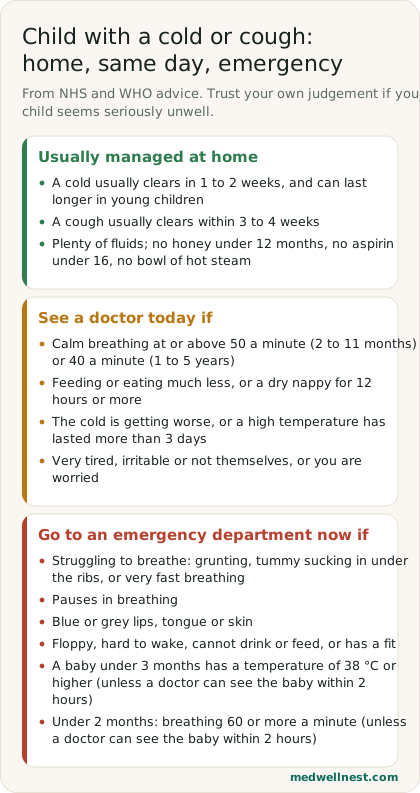
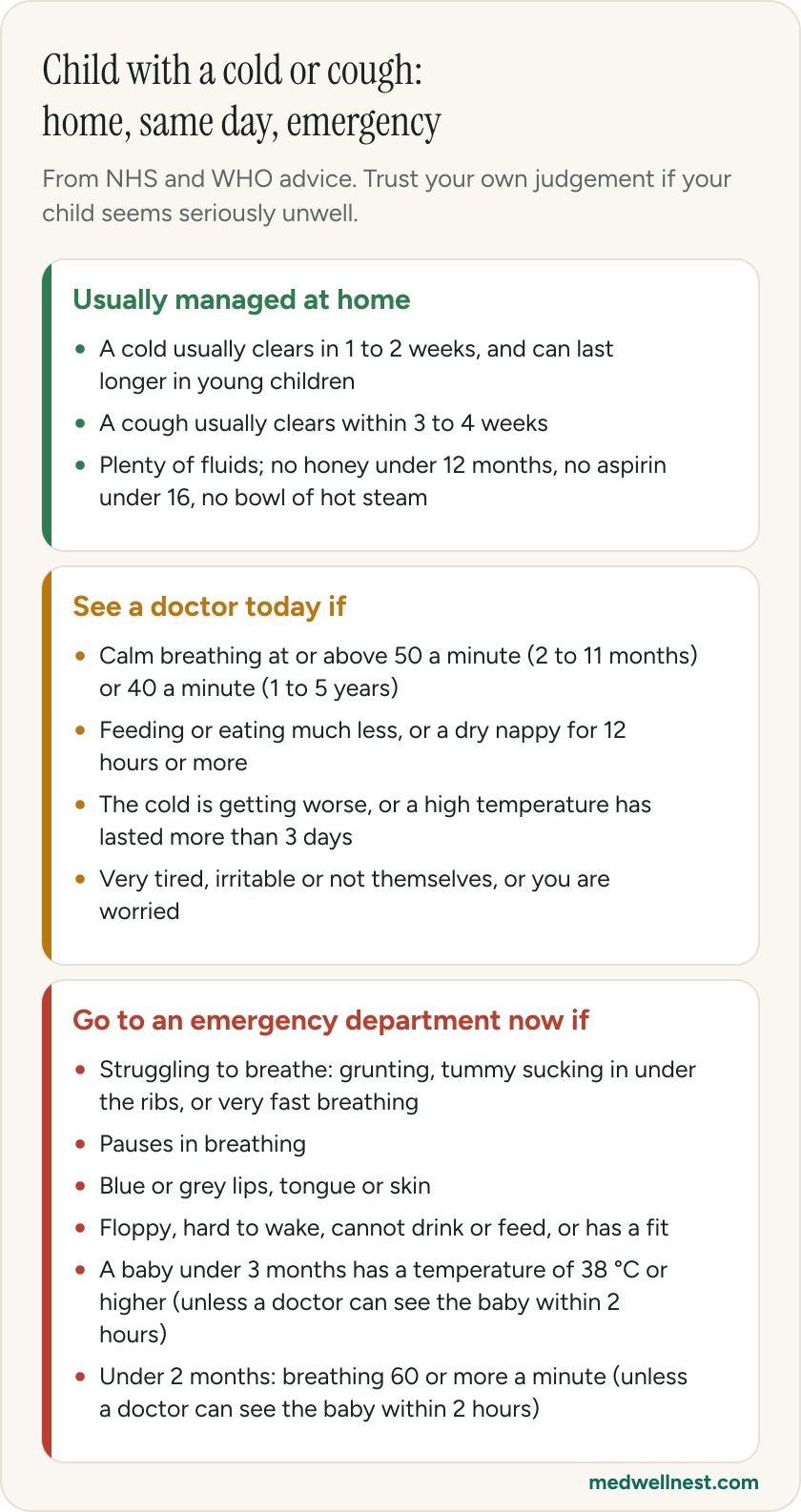
WHO describes lower chest wall indrawing as the lower chest wall going in when the child breathes in. If only the soft tissue between the ribs or above the collarbone goes in, that is not lower chest wall indrawing. WHO's pocket book counts lower chest wall indrawing as a sign of pneumonia, and grunting or very severe indrawing as signs of severe pneumonia. The NHS says to get emergency help if a child with bronchiolitis is having difficulty breathing, with grunting noises, the tummy sucking in under the ribs or very fast breathing, if there are pauses in breathing, if the skin, tongue or lips are blue or grey, or if the child is floppy and will not wake or stay awake. WHO's list of severe pneumonia adds being unable to breastfeed or drink, being lethargic or unconscious, and convulsions.
Some signs call for a doctor the same day. The NHS says to get an urgent appointment if a cold is getting worse, if the child is feeding or eating much less, if there has been a dry nappy for 12 hours or more, if the child is very tired, irritable or not themselves. A baby is different: for a baby under 3 months with a temperature of 38 °C or higher, or a baby under 2 months who is breathing 60 or more times a minute, go to an emergency department now, unless a doctor can see the baby within 2 hours. WHO's pocket book lists a raised temperature and fast breathing among the danger signs in a young infant. The NHS adds that you may know if your child seems seriously unwell, and you should trust your own judgement.
04
Is it a cold, bronchiolitis, croup or pneumonia?
Only a doctor can tell them apart, but the pattern helps. A cold brings a blocked or runny nose, sneezing and a cough. Bronchiolitis starts like a cold in a baby or child under 2, then brings a cough, faster breathing, difficulty feeding and wheezing or crackling sounds. Croup brings a barking cough that may sound like a seal and is often worse at night; the NHS says it usually gets better within 48 hours, and that you should still call or see a doctor if you think your child has it. Pneumonia brings cough with fast breathing, fever and sometimes grunting, and WHO's pocket book lists lower chest indrawing as another sign.
The warning signs above apply to all of them, which is why counting and looking matter more than naming the illness at home. Doctors may also check oxygen with a pulse oximeter; WHO treats a level below 90% as a sign of severe pneumonia. Our guides to bronchiolitis, croup, pneumonia and childhood fever cover each in turn.
05
When should I see a doctor about a cough or cold that will not go away?
The NHS says to see a doctor if a cold comes with a high temperature for more than 3 days, if symptoms get worse, if the temperature is very high or the child feels hot, cold or shivery, if the child is short of breath or has chest pain, or if you are worried about your child. It also says to see a doctor for a cough lasting more than 3 weeks.
WHO's pocket book treats a cough lasting 14 days or more as a chronic cough, which can be caused by tuberculosis, whooping cough, an inhaled object, asthma or another problem, so it needs a proper check. A child who keeps coming back with wheeze or night cough should also be assessed for asthma. Our guide to a cough that will not go away covers the longer-lasting cough.
When to act
Emergency — act now
Your child is struggling to breathe, with grunting, the tummy sucking in under the ribs or very fast breathing; there are pauses in breathing; the lips, tongue or skin are blue or grey; or your child is floppy, will not wake or stay awake, cannot drink or feed, or has a fit: call emergency services now or go to an emergency department now. Also go to an emergency department now if a baby under 3 months has a temperature of 38 °C or higher, or a baby under 2 months is breathing 60 or more times a minute, unless a doctor can see your baby within 2 hours. The NHS and WHO list these as emergency signs.
Same-day — call promptly
Calm breathing is at or above the fast-breathing count for the age (50 a minute from 2 to 11 months, 40 from 1 to 5 years); your child is feeding or eating much less or has had a dry nappy for 12 hours or more; your child is very tired, irritable or not themselves; the cold is getting worse; or a high temperature has lasted more than 3 days: see a doctor today.
Routine — see a doctor
A cold has gone on beyond 2 weeks without getting worse, a cough has lasted 2 weeks or more (WHO's pocket book calls this a chronic cough), or your child keeps having wheeze or a night cough: book a doctor's visit. The NHS says colds usually clear in 1 to 2 weeks and coughs within 3 to 4 weeks.
Sources
Share this story
Curious where your own values stand?
Two minutes from upload to a full visual picture. Free to analyze.