In short
At birth, the WHO median is 3.3 kg for boys and 3.2 kg for girls; by 12 months it is 9.6 kg and 8.9 kg. Here are the WHO median and normal range for every month to age 2, why the line your baby follows matters more than any single weight, and when to see a doctor.
Emergency if: Your baby is not feeding, is floppy, is difficult to wake, is breathing very fast or struggling to breathe, or has had no wet nappy for 12 hours: get emergency care now.
On this page
01
How to read the WHO numbers
The figures here come from the WHO Child Growth Standards. WHO built them from 8440 children in six countries who were raised in conditions that favoured healthy growth, and whose mothers followed practices such as breastfeeding. WHO says the standards describe how children should grow, and can be used for all children everywhere, whatever their ethnicity, family income or type of feeding. They take the breastfed baby as the model of normal growth.
For each month, the tables give a median, the middle weight, and lines called standard deviations (SD), also known as z-scores. WHO says children who are growing normally will generally sit on or between −2 SD and +2 SD, so that is the range shown on the charts below. Being above or below the median is not a problem in itself: a healthy baby can track steadily along a line above or below it.
WHO uses weight-for-age to spot a baby who is underweight, which it defines as below −2 SD, or severely underweight, below −3 SD. It does not use weight-for-age to call a child overweight; it says that question is better answered with weight-for-length or BMI-for-age.
02
Boys: birth to 2 years
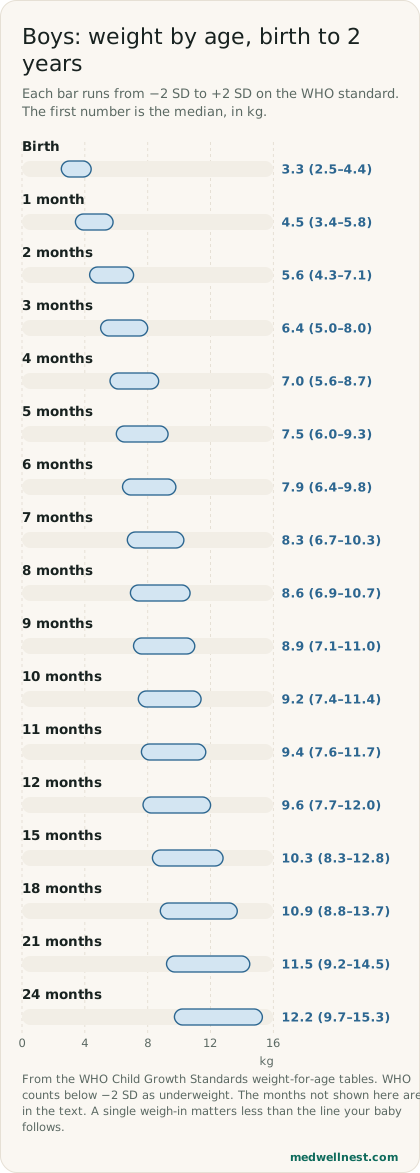
The WHO median for boys is 3.3 kg at birth (range 2.5 to 4.4, from −2 SD to +2 SD), 4.5 kg at 1 month (3.4 to 5.8), 5.6 kg at 2 months (4.3 to 7.1), 6.4 kg at 3 months (5.0 to 8.0), 7.0 kg at 4 months (5.6 to 8.7), 7.5 kg at 5 months (6.0 to 9.3) and 7.9 kg at 6 months (6.4 to 9.8).
From 7 to 12 months: 8.3 kg (6.7 to 10.3), 8.6 kg (6.9 to 10.7), 8.9 kg (7.1 to 11.0), 9.2 kg (7.4 to 11.4), 9.4 kg (7.6 to 11.7), and 9.6 kg at 12 months (7.7 to 12.0).
In the second year: 9.9 kg at 13 months (7.9 to 12.3), 10.1 at 14 (8.1 to 12.6), 10.3 at 15 (8.3 to 12.8), 10.5 at 16 (8.4 to 13.1), 10.7 at 17 (8.6 to 13.4), 10.9 at 18 (8.8 to 13.7), 11.1 at 19 (8.9 to 13.9), 11.3 at 20 (9.1 to 14.2), 11.5 at 21 (9.2 to 14.5), 11.8 at 22 (9.4 to 14.7), 12.0 at 23 (9.5 to 15.0) and 12.2 kg at 24 months (9.7 to 15.3).
03
Girls: birth to 2 years
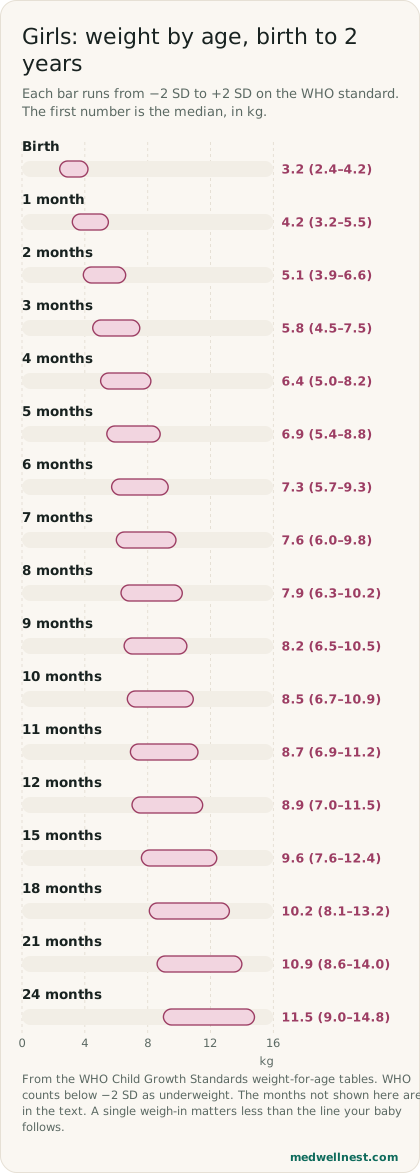
The WHO median for girls is 3.2 kg at birth (range 2.4 to 4.2), 4.2 kg at 1 month (3.2 to 5.5), 5.1 kg at 2 months (3.9 to 6.6), 5.8 kg at 3 months (4.5 to 7.5), 6.4 kg at 4 months (5.0 to 8.2), 6.9 kg at 5 months (5.4 to 8.8) and 7.3 kg at 6 months (5.7 to 9.3).
From 7 to 12 months: 7.6 kg (6.0 to 9.8), 7.9 kg (6.3 to 10.2), 8.2 kg (6.5 to 10.5), 8.5 kg (6.7 to 10.9), 8.7 kg (6.9 to 11.2), and 8.9 kg at 12 months (7.0 to 11.5).
In the second year: 9.2 kg at 13 months (7.2 to 11.8), 9.4 at 14 (7.4 to 12.1), 9.6 at 15 (7.6 to 12.4), 9.8 at 16 (7.7 to 12.6), 10.0 at 17 (7.9 to 12.9), 10.2 at 18 (8.1 to 13.2), 10.4 at 19 (8.2 to 13.5), 10.6 at 20 (8.4 to 13.7), 10.9 at 21 (8.6 to 14.0), 11.1 at 22 (8.7 to 14.3), 11.3 at 23 (8.9 to 14.6) and 11.5 kg at 24 months (9.0 to 14.8). Girls have their own chart because, as the NHS notes, boys tend to be a little heavier and their growth pattern differs slightly.
04
The first weeks: weight loss is expected
Almost every newborn gets lighter before getting heavier. The NHS says it is normal for babies to lose some weight in the first few days after birth, and that most are back at or above their birth weight by 3 weeks. Babies are weighed during the first 2 weeks to check that they are regaining it.
If your baby loses a large amount of weight, or has not regained the birth weight by 3 weeks, the NHS says you should get support: someone will ask how feeding is going, may watch a breastfeed, and will look at your baby's health in general. The WHO charts suit every baby, however they are fed. WHO built them with the breastfed baby as the norm, whereas older charts were based on formula-fed babies.
Weighing too often creates worry without adding information. After the first 2 weeks, the NHS suggests weighing no more than once a month up to 6 months, no more than once every 2 months from 6 to 12 months, and no more than once every 3 months after the first birthday, unless there is a concern.
05
The line matters more than the dot
WHO's training on growth charts says that most children grow in a track, on or between the lines and roughly parallel to the median, and that the track may be above or below the median. A baby who was born on the −1 SD line and stays near it is growing as expected, even though every weight sits below the median.
What WHO asks you to notice is a change in the pattern: the line crossing a z-score line, a sharp rise or fall, or a flat line with no gain. It says a sharp fall needs looking into, and a flat line usually signals a problem. In the first 6 months, when babies grow fastest, it says even one month without gain is a possible problem. A sharp rise after an illness, on the other hand, can be healthy catch-up growth.
The NHS gives a practical version of the same rule: weights often move up or down by one centile line, but crossing two lines is less common and is a reason to talk to your baby's doctor. It also notes that weight gain may slow for a while during an illness and usually returns to normal within 2 to 3 weeks.
06
When to see a doctor
Book a check if your baby's weight falls below −2 SD for their age, if the line crosses two centile lines or stays flat, or if the birth weight has not come back by 3 weeks. WHO notes that a weight far from the median in either direction may be a sign of a problem, but that the doctor will also weigh up the trend, the baby's health and the parents' own size.
Take the numbers with you. Write down the dates and weights from the health card, plus length if it was measured, and mention how feeding is going, any illness, and how many wet nappies there are in a day. A doctor needs the whole line, not one reading, to judge growth.
Some signs cannot wait for a weigh-in. A baby who is not feeding, is floppy, is hard to wake, or has had no wet nappy for 12 hours needs urgent care, whatever the scale says.
When to act
Emergency — act now
Your baby is not feeding, is floppy, is difficult to wake, is breathing very fast or struggling to breathe, or has had no wet nappy for 12 hours: get emergency care now.
A temperature of 38°C or higher in a baby under 3 months: get emergency care now.
Routine — see a doctor
Birth weight not regained by 3 weeks, a large early weight loss, or feeding that is not going well: see your baby's doctor soon and ask for help with feeding.
Weight below −2 SD for age, a line that crosses two centile lines, or no weight gain for a month in the first 6 months: book a check with your baby's doctor and take the dated weights with you.
Sources
- WHO Child Growth Standards: weight-for-age, boys, birth to 5 years (z-scores)cdn.who.int
- WHO Child Growth Standards: weight-for-age, girls, birth to 5 years (z-scores)cdn.who.int
- WHO Training Course on Child Growth Assessment, Module C: Interpreting growth indicatorsiris.who.int
- Child growth standards: questions and answers — WHOwho.int
- Your baby's weight and height — NHSnhs.uk
- When to get urgent medical help for babies and children under 5 — NHSnhs.uk
Share this story
Curious where your own values stand?
Two minutes from upload to a full visual picture. Free to analyze.