In short
Bad breath is very common and the NHS says you can usually treat it yourself by cleaning your teeth, tongue and between your teeth. See a dentist if it lasts a few weeks. A fruity smell with thirst, vomiting or drowsiness is an emergency, whether or not you have been diagnosed with diabetes.
Emergency if: Fruity-smelling breath with thirst, needing to pee more often, stomach pain, feeling or being sick, breathing more deeply than usual, or feeling sleepy or confused, whether or not you have been diagnosed with diabetes: call emergency services now or go to an emergency department now. The NHS says these can be diabetic ketoacidosis, which can be life threatening.
On your report
HbA1c, Fasting Glucose
On this page
01
What causes bad breath?
MedlinePlus says bad breath is usually related to poor dental hygiene: not brushing and flossing regularly lets bacteria in the mouth release sulfur compounds. The NHS lists strong-smelling or spicy food and drink, problems with the teeth or gums such as gum disease, holes in the teeth or an infection, fasting or crash dieting, smoking, and some medical conditions such as dry mouth, tonsillitis and acid reflux.
MedlinePlus also lists an abscessed tooth, cavities, dentures, alcohol use disorder, tonsils with deep crypts and sulfur granules, a sinus infection, a throat infection and tobacco smoking among the causes. Vitamin supplements, especially in large doses, and some medicines, including insulin, can also cause it. The NHS calls bad breath, which is sometimes called halitosis, very common.
02
Why does my breath still smell after brushing?
Brushing the teeth is only part of it. The NHS says the best way to avoid bad breath is to keep your teeth, tongue and mouth clean, and its list includes cleaning the tongue once a day and cleaning between the teeth at least once a day. The ADA explains that hundreds of types of bacteria live naturally in the mouth, and that when you eat, they feed on the food left behind and leave a foul-smelling waste product.
Dryness matters too. The ADA says saliva washes out the mouth, so if you do not make enough, your mouth is not cleaned as much as it should be, and dry mouth can come from certain medicines, salivary gland problems or breathing through your mouth. The NIDCR says hundreds of medicines can reduce saliva, for example some for high blood pressure, depression and bladder control, that diabetes and Sjögren's disease can cause dry mouth, and that dry mouth is not a normal part of aging. The ADA also notes that smokers may not realise how their breath smells, because smoking affects the sense of smell.
03
What actually helps bad breath?
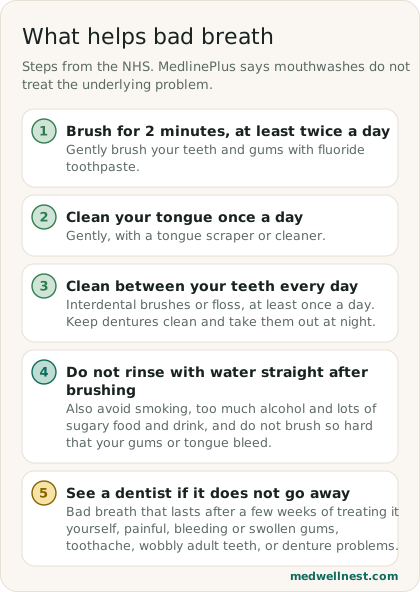
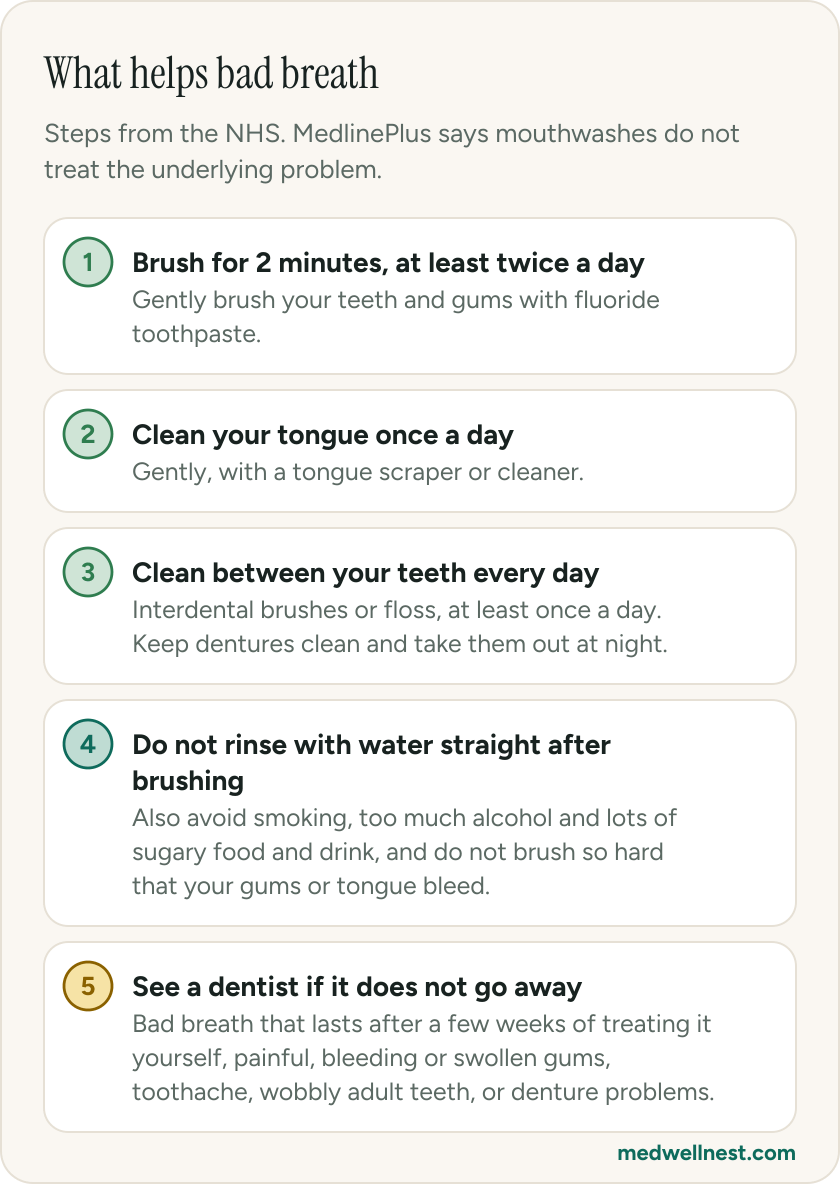
The NHS says to gently brush your teeth and gums at least twice a day for 2 minutes with a fluoride toothpaste, gently clean your tongue once a day with a tongue scraper or cleaner, clean between your teeth with interdental brushes or floss at least once a day, get regular dental check-ups, and keep dentures clean and take them out at night. Sugar-free mints or chewing gum after strong-smelling food and drink can also help.
The NHS says not to smoke, not to drink too much alcohol, not to have lots of sugary foods and drinks, not to brush so hard that your gums or tongue bleed, and not to rinse your mouth with water straight after brushing. It also says you can try an antibacterial mouthwash or toothpaste. MedlinePlus and the ADA are clear that mouthwash is not the fix: MedlinePlus says mouthwashes are not effective in treating the underlying problem, and the ADA says over-the-counter mouthwashes can kill bacteria or temporarily mask bad breath but are only a temporary solution. MedlinePlus says fresh parsley or a strong mint often works against temporary bad breath.
04
When should I see a dentist about bad breath?
The NHS says to see a dentist if bad breath does not go away after treating it yourself for a few weeks, or if you have painful, bleeding or swollen gums, toothache or wobbly adult teeth, or problems with your dentures. The ADA says regular check-ups let a dentist find problems such as gum disease or dry mouth before they become more serious.
MedlinePlus says to contact your provider if breath odour does not go away and there is no obvious cause, such as smoking or eating foods that cause it, or if you have breath odour with signs of a respiratory infection such as fever, cough, or face pain with discharge from the nose. The ADA says that if a dentist rules out other causes and you brush and floss every day, the bad breath could come from another problem such as a sinus condition, gastric reflux, diabetes, or liver or kidney disease, and then you should see your healthcare provider.
05
Can bad breath be a sign of diabetes, kidney disease or a stomach problem?
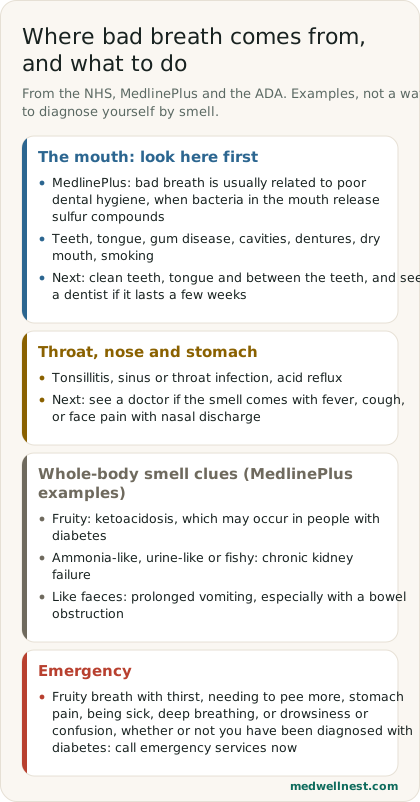
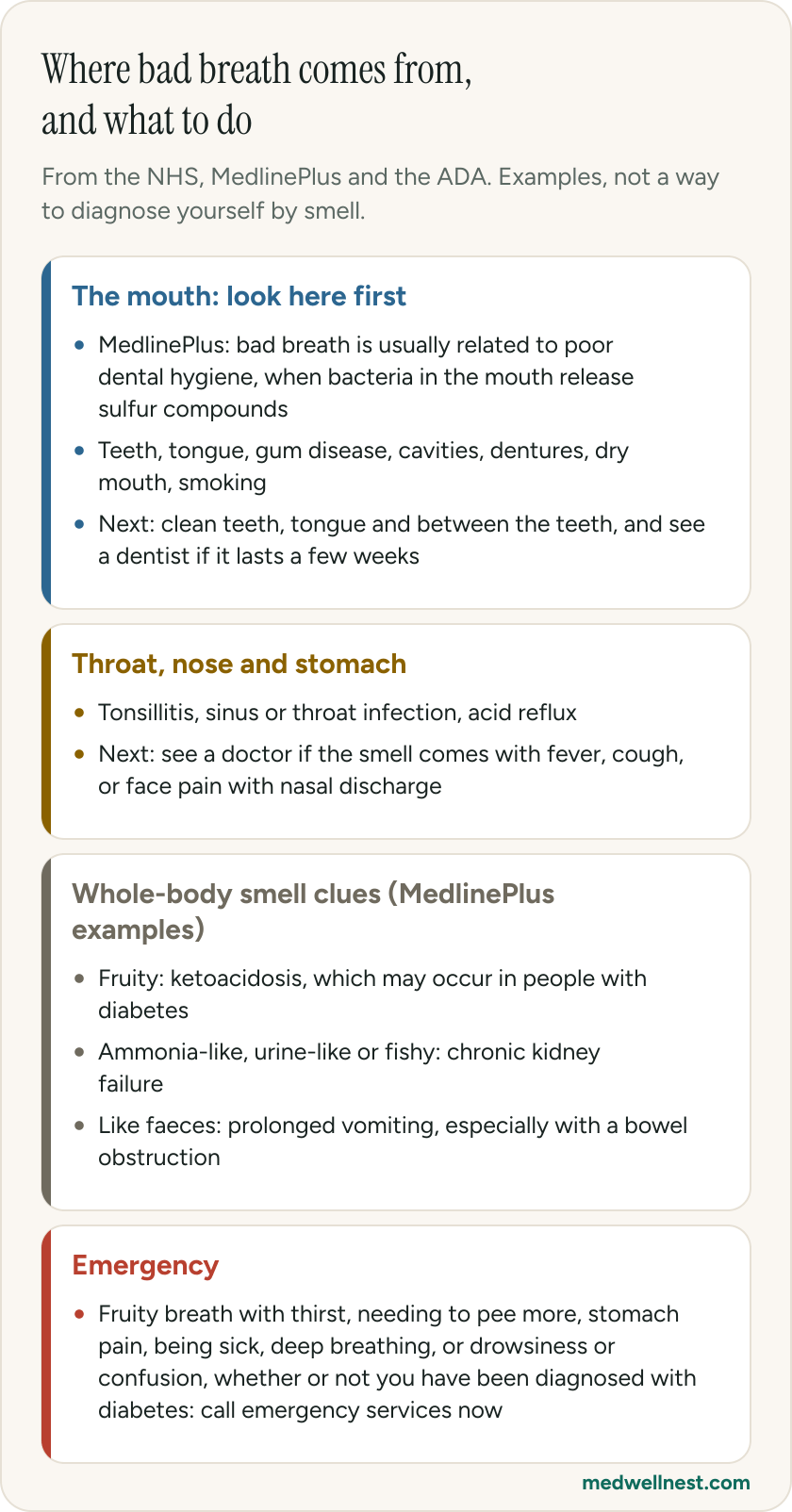
Sometimes, but it is not the usual cause. MedlinePlus says bad breath is usually related to poor dental hygiene, and that blood tests to check for diabetes or kidney failure are done only in rare cases. It gives 3 examples of disorders that produce a distinct breath odour: a fruity odour is a sign of ketoacidosis, which may occur in people with diabetes and is potentially life-threatening; breath that smells like faeces can occur with prolonged vomiting, especially when there is a bowel obstruction; and an ammonia-like (also described as urine-like or fishy) odour can occur in people with chronic kidney failure.
Treat these as clues, not as a way to diagnose yourself by smell. MedlinePlus presents them as examples, and many ordinary things change how breath smells, from foods such as cabbage, garlic and raw onions to smoking. What matters more is the pattern: breath odour that persists without an obvious cause, or that comes with other symptoms, is a reason to see a doctor.
06
When is bad breath an emergency?
Fruity-smelling breath (the NHS compares it to nail polish remover) is one of the symptoms of diabetic ketoacidosis (DKA), which the NHS says can be life threatening and needs urgent treatment in hospital. The other symptoms are feeling thirsty, needing to pee more often, stomach pain, feeling or being sick, diarrhoea, breathing more deeply than usual, feeling tired, sleepy or confused, and blurred vision. They usually develop over 24 hours, but it can be faster.
The NHS says to call emergency services or go to an emergency department if you have a high level of ketones (over 3mmol/L in blood or over 2+ in urine), if you do not know your ketone levels but have symptoms such as thirst, needing to pee more often, sleepiness or confusion and fruity breath, or if you have these symptoms and have not been diagnosed with diabetes. Breath that smells like faeces after prolonged vomiting is the other signal MedlinePlus links to a serious cause, a bowel obstruction. The sources give no timeframe for it, so we treat it as a same-day problem, which is a cautious choice.
Bad breath: how fast to act
Emergency — act now
Fruity-smelling breath with thirst, needing to pee more often, stomach pain, feeling or being sick, breathing more deeply than usual, or feeling sleepy or confused, whether or not you have been diagnosed with diabetes: call emergency services now or go to an emergency department now. The NHS says these can be diabetic ketoacidosis, which can be life threatening.
Same-day — call promptly
Breath that smells like faeces together with prolonged or repeated vomiting: see a doctor today. MedlinePlus links this smell to a bowel obstruction but gives no timeframe, so same-day is our cautious choice. If you also have severe tummy pain or cannot stop vomiting, go to an emergency department now.
Routine — see a doctor
Bad breath that has not gone away after a few weeks of cleaning your teeth, tongue and between your teeth; painful, bleeding or swollen gums; toothache; wobbly adult teeth; denture problems; or breath odour with fever, cough, or face pain with nasal discharge: see a dentist, or a doctor if you have the fever, cough or face pain. The NHS and MedlinePlus give these as reasons to be seen.
Values mentioned in this story
Each one opens a visual guide with its normal range and what moves it — upload a report and we place your own numbers on the same scale.
Sources
- Bad breath — NHSnhs.uk
- Breath odor — MedlinePlus Medical Encyclopediamedlineplus.gov
- Diabetic ketoacidosis — NHSnhs.uk
- Bad breath — MouthHealthy, American Dental Associationmouthhealthy.org
- Dry mouth — National Institute of Dental and Craniofacial Researchnidcr.nih.gov
Share this story
Curious where your own values stand?
Two minutes from upload to a full visual picture. Free to analyze.