In short
A blood culture grows a blood sample to look for bacteria. Here is why bottles are drawn in sets, how fast they turn positive, why no growth still does not rule out infection, how a lone skin germ is judged, and the signs of sepsis that cannot wait for a result.
Emergency if: Fever or a known infection with confusion, slurred speech, very fast breathing, blue, pale or blotchy skin, a rash that does not fade when pressed, a very high or very low temperature, or you are worried it might be sepsis: go to an emergency department or call emergency services now. Do not wait for the culture result; sepsis is a medical emergency.
On this page
01
What a blood culture does, and why bottles come in sets
MedlinePlus describes a blood culture as a lab test to check for bacteria or other germs in a blood sample. The sample is placed in a culture and watched to see if germs grow. The skin is first cleaned with an antiseptic such as chlorhexidine, which reduces the chance of skin germs getting into the sample and causing a false-positive result. Doctors may order it if you have symptoms of a serious infection, sepsis, which MedlinePlus says can include high fever, chills, rapid breathing and heart rate, confusion and low blood pressure.
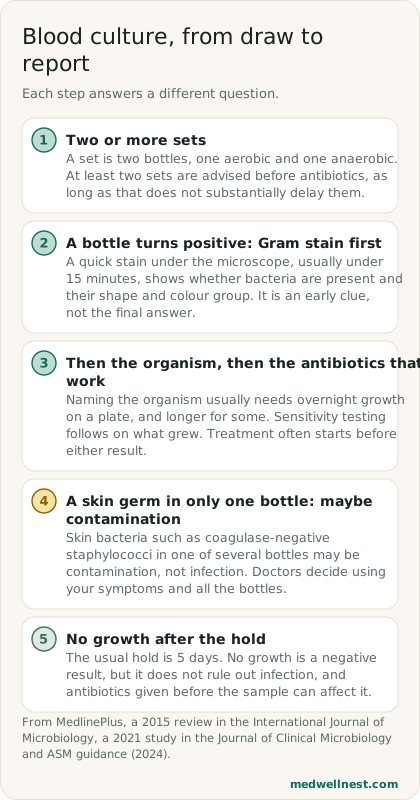
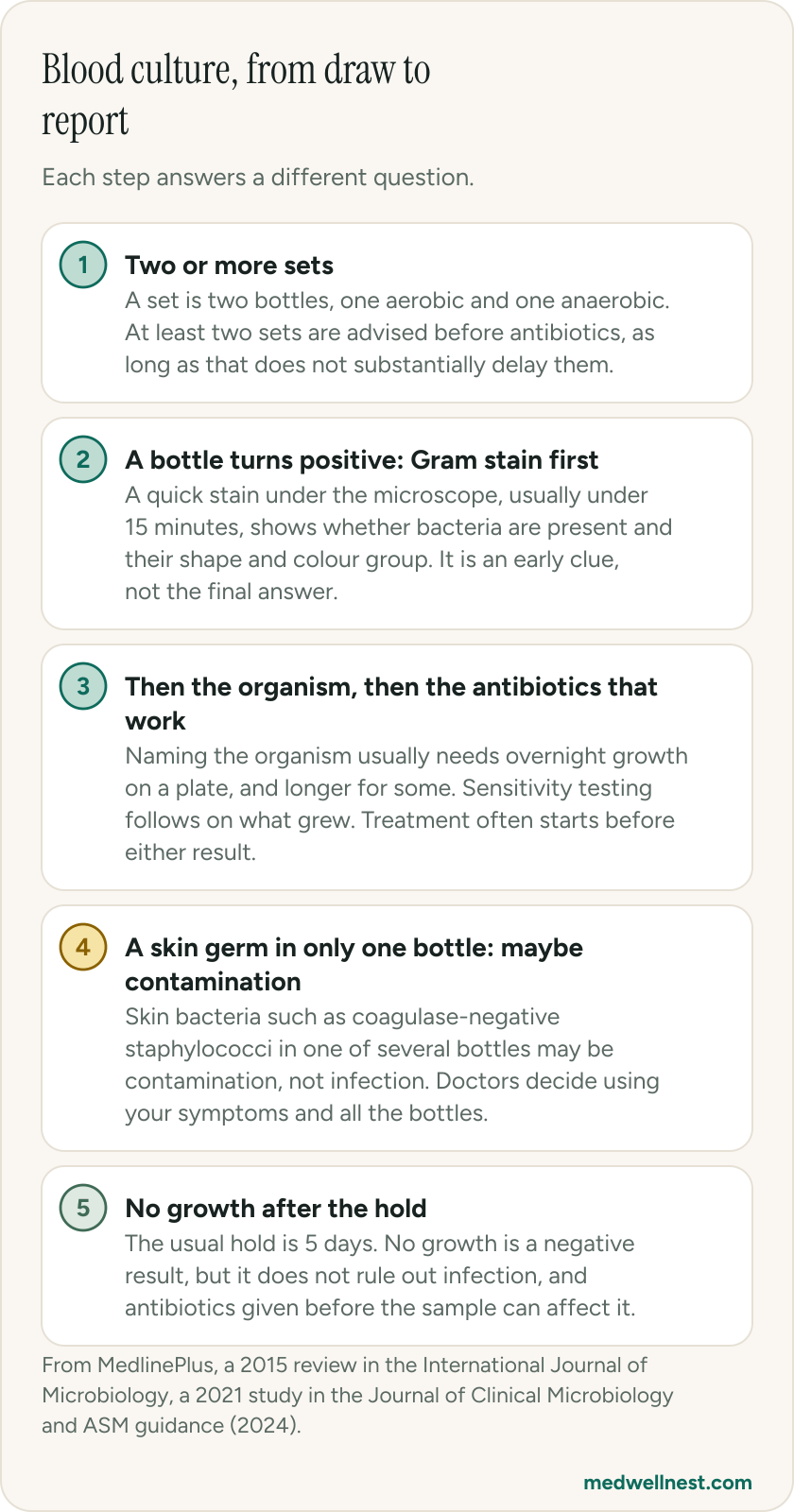
A set is two bottles, one for germs that need air (aerobic) and one for germs that do not (anaerobic). A review in the International Journal of Microbiology quotes a guideline recommending at least two sets before antimicrobial therapy. MedlinePlus explains one reason for repeats: with some infections, bacteria are found in the blood only intermittently, so a series of three or more blood cultures may be done to increase the chance of finding the infection. A second reason shows up later, when one bottle grows a skin germ and the others do not.
02
Hours to days: time to positivity and no growth after 5 days
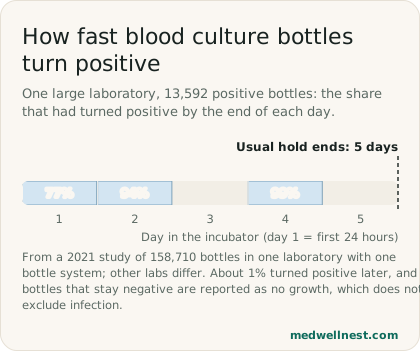
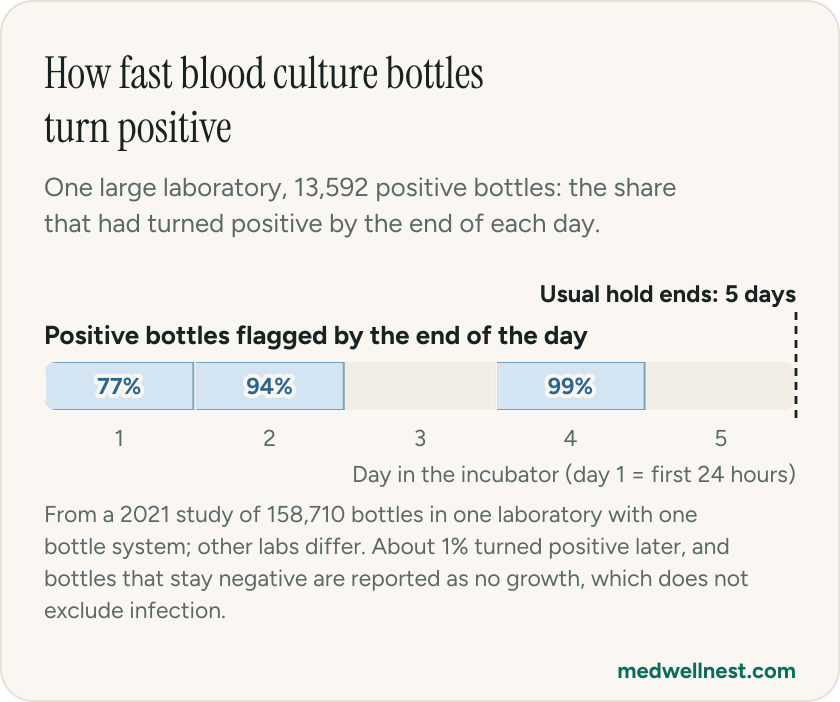
A 2021 study in the Journal of Clinical Microbiology says the standard interval for incubating bottles before they are discarded as negative has remained 5 days, and that a 5-day minimum is recommended for most commercial systems. It looked at 158,710 bottles in one laboratory: 13,592 were positive, 8.6%. Of the positive bottles, 76.74% had flagged within 24 hours, 93.56% by 48 hours and 98.71% by the end of 4 days.
Time to positivity depends on the germ. In that laboratory the median time was 15.6 hours for Staphylococcus aureus, 9.5 hours for E. coli, 15.9 hours for Pseudomonas aeruginosa and 42.9 hours for Candida yeasts. The International Journal of Microbiology review puts the overall median at around 15 hours, with individual bottles turning positive anywhere from a few hours to several days. Only 175 bottles, 0.1% of all bottles, flagged after 4 days, and about half of those grew Cutibacterium, a skin organism. The authors argued 4 days was enough for their system, so the hold can differ between labs, and a report that says no growth after 5 days is the usual final negative.
03
Gram stain first, then the organism and the sensitivity
When a bottle turns positive, the International Journal of Microbiology review says most bottles are Gram stained, which usually takes under 15 minutes, and that the result is ideally passed to the doctor quickly. It then needs a plate: identification usually needs overnight culturing and longer for some organisms, and complete identification of rare organisms often takes more than 72 hours for bacteria and more than 60 hours for fungi. Sensitivity testing follows on whatever grew.
Because the organism and the sensitivity reach the doctor with a delay of several days, the same review says that antibiotics are started blind, based on experience, the likely site of infection and local resistance patterns. The Surviving Sepsis Campaign (2021) recommends antimicrobials immediately, ideally within 1 hour, for adults with possible septic shock or a high likelihood of sepsis, and says cultures should be taken first only if that causes no substantial delay, meaning under 45 minutes. So you may be on antibiotics for days before the report arrives. How to read S, I and R on the sensitivity part is covered in our culture and sensitivity guide.
04
One bottle with a skin germ: contamination or infection?
The American Society for Microbiology (ASM) defines blood culture contamination as skin bacteria isolated from a single bottle that do not indicate a true bloodstream infection. Its 2024 guideline says there is no standard definition, but typically one of a short list of skin germs growing in a single bottle, or set, out of several sets drawn within 24 hours may be called a contaminant. The list includes coagulase-negative staphylococci, Corynebacterium, Bacillus species, Micrococcus, certain alpha-haemolytic streptococci and Cutibacterium acnes.
MedlinePlus says contamination is a false-positive result, with bacteria from your skin or from lab equipment instead of your blood, and that it means you do not have a true infection. That is why the same germ in only one bottle is judged differently from the same germ in several sets. The decision belongs to your doctor, who weighs your symptoms and every bottle together; a report that names a skin germ is not a reason to stop or start antibiotics on your own.
05
A negative culture does not rule out infection
The International Journal of Microbiology review says only 30 to 60% of blood cultures in sepsis become positive. It lists factors that influence how a culture behaves, including the amount of blood taken, the number of germs, and whether the patient was given antibiotics before the sample was taken. MedlinePlus notes that bacteria can be found in the blood only intermittently in some infections. So a report of no growth lowers the chance of a bloodstream infection but cannot exclude it.
This matters when you are unwell. If a blood culture is negative but you still have a fever, shivering or feel worse, the culture does not cancel those signs, and a doctor decides from the whole picture. If a doctor or lab tells you a culture is positive, MedlinePlus says bacteria in the blood can cause sepsis, a medical emergency treated in hospital, so follow the instructions you are given straight away.
06
Sepsis signs do not wait for a culture
The NHS says sepsis is a serious reaction to an infection that can be life-threatening, that it develops very quickly and needs urgent treatment in hospital. In adults it lists confusion or slurred speech, breathing very fast, blue, pale or blotchy skin, a very high or very low temperature with feeling hot or cold to the touch or shivery, a rash that does not fade when you press it, or any symptoms you are worried might be sepsis. Babies and young children have extra signs. A person with sepsis may not have every sign. Our sepsis guide explains the signs in more detail.
Infection, fever and a pending culture
Emergency — act now
Fever or a known infection with confusion, slurred speech, very fast breathing, blue, pale or blotchy skin, a rash that does not fade when pressed, a very high or very low temperature, or you are worried it might be sepsis: go to an emergency department or call emergency services now. Do not wait for the culture result; sepsis is a medical emergency.
Same-day — call promptly
A doctor or lab tells you a blood culture is positive: follow their instructions straight away, and go to hospital if they ask you to come in. If you are on antibiotics with a culture pending and feel worse, with a fever that is not settling or new shivering: contact the doctor or hospital today and say a culture is pending. If any sepsis sign above appears, go to an emergency department instead.
Routine — see a doctor
Your report says no growth and you feel better, or it names a skin germ in only one bottle: keep your follow-up with the doctor who ordered it and ask whether it was judged a contaminant.
Sources
- Blood culture — MedlinePlus Medical Encyclopediamedlineplus.gov
- Rapid identification of pathogens in positive blood culture of patients with sepsis — International Journal of Microbiology, 2015pmc.ncbi.nlm.nih.gov
- Evaluation of optimal blood culture incubation time — Journal of Clinical Microbiology, 2021pmc.ncbi.nlm.nih.gov
- ASM evidence-based laboratory medicine practice guidelines to reduce blood culture contamination rates — Clinical Microbiology Reviews, 2024pmc.ncbi.nlm.nih.gov
- Surviving Sepsis Campaign: international guidelines for management of sepsis and septic shock 2021 — Intensive Care Medicinepmc.ncbi.nlm.nih.gov
- Sepsis — NHSnhs.uk
Share this story
Curious where your own values stand?
Two minutes from upload to a full visual picture. Free to analyze.