In short
O negative red cells can go to anyone, and AB positive patients can receive red cells from all eight types. Plasma works the other way round, so AB is the universal plasma donor. Here is the full chart, why hospitals still cross-match, and the basics of donating.
Emergency if: Chills, fever, back or flank pain, flushing, trouble breathing or feeling faint during a transfusion: tell the staff immediately so it can be stopped. After leaving hospital, severe difficulty breathing, chest pain, a tingling or swelling mouth or throat, or collapse needs emergency services now.
On your report
Hemoglobin, Total Bilirubin
On this page
01
What your blood group is made of
Your blood group is inherited from your parents. NHS Blood and Transplant says the two systems that matter most for transfusion are ABO and Rh. ABO gives the letter; Rh gives the plus or minus. Together they make the eight common types: A+, A−, B+, B−, O+, O−, AB+ and AB−.
The letter depends on antigens, markers on the surface of red cells, and antibodies in the plasma. Group A has A antigens and anti-B antibodies. Group B has B antigens and anti-A antibodies. Group O has neither antigen but both antibodies. Group AB has both antigens and neither antibody. Rh positive means your red cells carry the RhD antigen; Rh negative means they do not. The Red Cross notes there are more than 300 other known antigens, which is where rare blood types come from.
02
Red cells: who can receive from whom
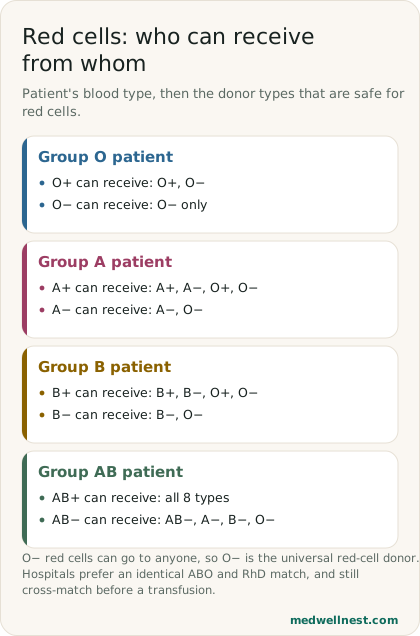
The rule for red cells is that the donor's cells must not carry an antigen the patient's plasma will attack. NHS Blood and Transplant explains that blood from the wrong ABO group can be life-threatening. The Red Cross adds the Rh rule: Rh-negative patients get Rh-negative blood, while Rh-positive patients can get either.
Put together, as the Lifeblood blood service lists it: O− can receive only O−. O+ can receive O+ and O−. A− can receive A− and O−; A+ can receive A+, A−, O+ and O−. B− can receive B− and O−; B+ can receive B+, B−, O+ and O−. AB− can receive AB−, A−, B− and O−. AB+ can receive red cells from all eight types, which is why it is called the universal recipient.
O negative is the universal red-cell donor, because its cells carry no A, B or RhD antigen. NHS Blood and Transplant says it is safe for everyone to receive O negative red cells, and Lifeblood says it is the blood given in an emergency when a patient's type is not known and there is no time to wait. Some sources, including MedlinePlus, call group O the universal donor without mentioning Rh; the blood services are specific that it is O negative.
03
Plasma: the rules run the other way
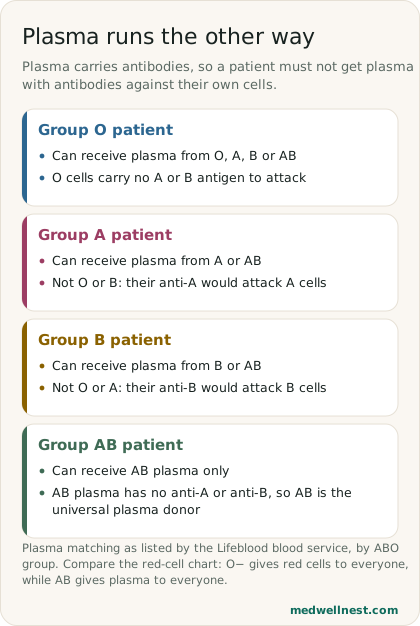
Plasma is the liquid part of blood, and it is the plasma that carries the antibodies. So for a plasma transfusion the question flips: the donor's plasma must not contain an antibody that would attack the patient's own red cells. The Red Cross puts it simply: the rules for plasma are the reverse.
The Lifeblood blood service lists it this way. A group O patient can receive plasma from any group, because O cells have no A or B antigen to attack. A group A patient can receive A or AB plasma, but not O or B, whose anti-A would attack their cells. A group B patient can receive B or AB plasma, but not O or A. A group AB patient can receive only AB plasma.
That makes AB the universal plasma donor, the mirror image of O negative for red cells. The Red Cross states it the same way: the universal plasma donor has type AB blood.
04
Why hospitals still cross-match
A compatible type on the chart is not the end of the checks. Lifeblood says it is best for patients to receive red cells of the identical ABO group and RhD type, with O negative for everyone kept as the fallback for emergencies when there is no time to find out.
The reason is the minor antigens. MedlinePlus explains that many are not picked up by routine blood typing, and a reaction can still happen even when A, B and Rh match. That is why, outside emergencies, a sample of your blood is mixed with the donor blood first (a cross-match, with a Coombs test) to look for trouble before any is given. MedlinePlus credits this careful matching for how rare serious transfusion reactions now are.
If you are having a transfusion and develop fever, chills, back or flank pain, flushing, trouble breathing, bloody urine, or feel faint or dizzy, tell the staff at once. The NHS says to tell the team immediately about any trouble breathing, and lists a tingling or swelling mouth or throat, or chest pain, after you have gone home as an emergency. Reactions usually appear during or soon after the transfusion but can occasionally come days later.
05
Donating blood, and your group in pregnancy
Donation rules are set by each blood service, so check with your local blood bank before you go. As one example, NHS Blood and Transplant allows men to give blood every 12 weeks and women every 16 weeks, for donors who are generally fit and well, aged 17 to 65 at their first donation, and weighing between 50 and 158 kg. Other services set different gaps and limits, so follow your own centre's rules. Giving blood is also one way to find out your group: NHS Blood and Transplant tells donors their type after the first donation.
Your Rh type matters in pregnancy. MedlinePlus says blood typing is very important during pregnancy, because careful testing can prevent severe anaemia and jaundice in the newborn. Lifeblood explains that some Rh-negative people make antibodies against RhD, which can happen when pregnant with an Rh-positive baby. Our guide to Rh-negative pregnancy and the anti-D injection covers the tests and timing in detail.
When to act
Routine — see a doctor
You do not know your blood group: ask your doctor whether it has been tested, or find out when you donate. If you are pregnant or planning a pregnancy, make sure your group and Rh type are checked early.
Same-day — call promptly
Fever or shivering, aching muscles, feeling sick, back pain, dark or bloody urine or passing very little, yellow skin or eyes, or unusual bleeding in the hours, days or weeks after a transfusion: contact the hospital that gave it or see a doctor today, and say you recently had blood.
Emergency — act now
Chills, fever, back or flank pain, flushing, trouble breathing or feeling faint during a transfusion: tell the staff immediately so it can be stopped. After leaving hospital, severe difficulty breathing, chest pain, a tingling or swelling mouth or throat, or collapse needs emergency services now.
Values mentioned in this story
Each one opens a visual guide with its normal range and what moves it — upload a report and we place your own numbers on the same scale.
Sources
- Blood Types — American Red Crossredcrossblood.org
- Blood types — NHS Blood and Transplantblood.co.uk
- Who can give blood — NHS Blood and Transplantblood.co.uk
- Matching blood groups — Australian Red Cross Lifebloodlifeblood.com.au
- Blood typing — MedlinePlus Medical Encyclopediamedlineplus.gov
- Blood transfusion — NHSnhs.uk
Share this story
Curious where your own values stand?
Two minutes from upload to a full visual picture. Free to analyze.