In short
You can eat rice, roti and fruit with diabetes. The amount of carbohydrate matters more than the glycaemic index. Diabetes UK puts basmati rice and chapatti in the medium GI band, and a fruit portion is about 80 g, roughly a palm.
Emergency if: Low sugar with a seizure (fit), someone not responding normally or unconscious, or a low they cannot treat themselves: give no food or drink if they cannot swallow safely, give glucagon if available and you know how, and call emergency services now. High sugar with feeling or being sick, stomach pain, breathing faster than usual or a fast heartbeat, drowsiness or struggling to stay awake, a fruity smell on the breath, confusion or a high ketone level: call emergency services now or go to an emergency department now. The NHS says not to drive yourself.
On your report
HbA1c, Post-Prandial Glucose (PPBS)
On this page
01
Can I eat rice and roti if I have diabetes?
Yes, in sensible portions. Diabetes UK says the amount of carbohydrate you eat has a bigger effect on blood sugar than the glycaemic index (GI) alone, and that the most important thing is to watch carbohydrate portion sizes. The American Diabetes Association (ADA) 2026 Standards say eating patterns should emphasise non-starchy vegetables, whole fruits, legumes, whole grains, nuts and seeds, and minimise sugar-sweetened drinks, sweets, refined grains and processed foods.
The ADA also says to choose minimally processed, high-fibre carbohydrate, with at least 14 g of fibre per 1,000 kcal and at least half of grains as whole, intact grains. It says to choose whole-grain versions of commonly eaten foods where culturally appropriate, such as brown rice, and where that is not appropriate to focus on portion control.
02
Which is better for diabetes, rice or roti?
Neither is a safe or forbidden food on the sources we read. Diabetes UK lists basmati rice and chapatti together in the medium GI band, and suggests brown or basmati rice instead of white rice, and wholemeal chapatti with dhal. It gives no GI number for white rice, and none of the sources we read gives a GI value for a home-made chapati or for millets, so we do not print one.
GI also changes with how a food is cooked and processed and with what it is eaten with. Diabetes UK says protein, fat and fibre slow digestion, and that combining foods changes the overall GI of a meal. A roti eaten with dal and vegetables is a different meal from a roti eaten alone. Lentils, beans and peas are in the low band, which is one reason dal is a sensible partner.
03
What is the glycaemic index, and should I use it?
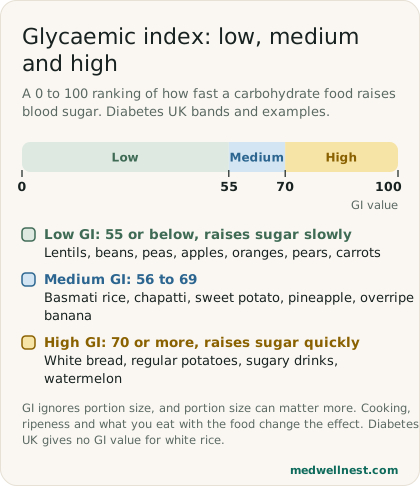
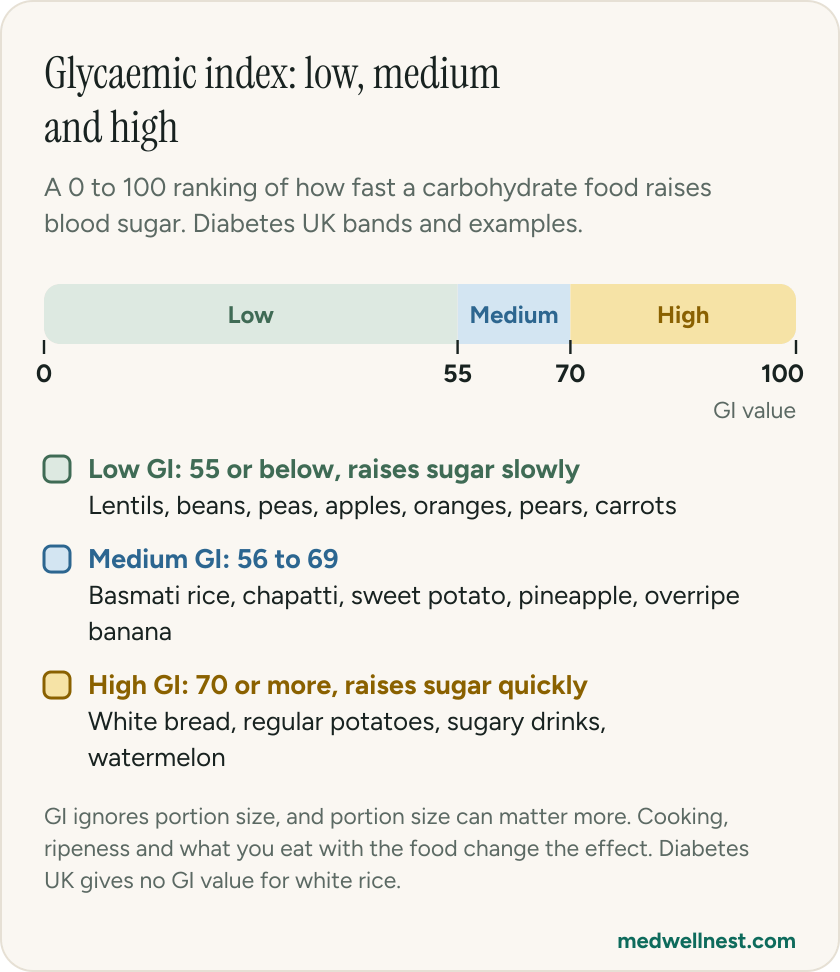
The GI ranks carbohydrate foods from 0 to 100 by how quickly they raise blood sugar. Diabetes UK uses 55 or below as low, 56 to 69 as medium and 70 or more as high. Its examples: low includes lentils, beans, peas, apples, oranges and carrots; medium includes basmati rice, chapatti, sweet potato and pineapple; high includes white bread, regular potatoes, sugary drinks and watermelon.
GI is a guide, not the whole answer. It ignores portion size, which Diabetes UK says can have a bigger impact. Pasta has a lower GI than watermelon, but a similar amount of pasta has more carbohydrate and affects blood sugar more. Most chocolates are low GI because of their fat, so low GI does not mean healthy, and a baked potato is high GI but has useful nutrients. The ADA calls the research on GI in diabetes complex, with mixed effects on HbA1c, while Diabetes UK says low-GI choices can particularly help long-term HbA1c in type 2 diabetes.
04
How much fruit can I eat with diabetes, and which fruit?
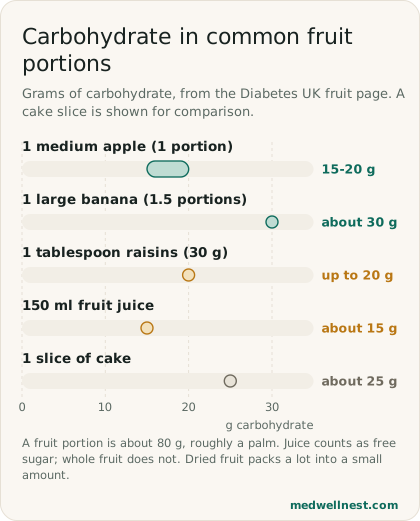
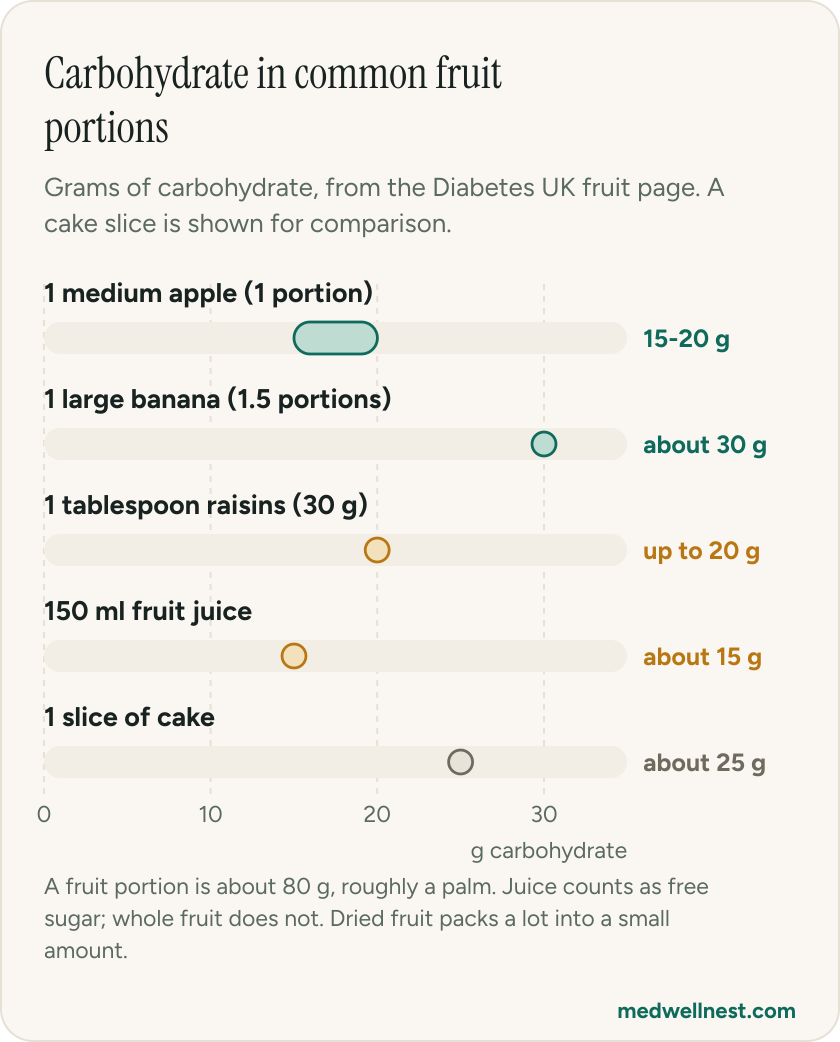
Diabetes UK says the sugar in whole fruit does not count as free sugar, and that it is unlikely you need to cut down on fruit or vegetables. It advises cutting back on high-sugar, high-fat snacks and drinks first. A fruit portion is about 80 g, roughly what fits in the palm of an adult hand. One portion is one medium fruit such as an apple, banana, pear or orange, two small fruits such as two plums or seven strawberries, or a large fruit slice such as one slice of papaya or two slices of mango.
Carbohydrate varies by fruit and by form. A medium apple has about 15 to 20 g, a large banana counts as 1.5 portions and has about 30 g, 30 g of dried fruit, about one heaped tablespoon of raisins, can have as much as 20 g, and 150 ml of juice has about 15 g that counts as free sugar. A standard slice of cake is about 25 g. Diabetes UK says juices and smoothies are best avoided or cut down, because the fibre is removed or broken down and it is easy to drink a lot.
Spread fruit through the day instead of eating a lot at once, and watch dried fruit, grapes and tropical fruit, which are easy to overeat. Diabetes UK places strawberries, pears, apples, oranges and grapes in the low GI band, pineapple, cantaloupe melon and overripe banana in the medium band and watermelon in the high band. It does not give a GI for mango, so we cannot say where it sits.
05
How do I build a plate with rice, roti or dal?
The plate method needs no counting or weighing. Using a 9-inch plate, NIDDK says half should be non-starchy vegetables such as leafy greens, peppers, carrots or green beans, one quarter high-fibre carbohydrate such as brown rice, whole grains, beans or fruit, and one quarter protein such as lean meat, fish, dairy or tofu. NIDDK says that if you do not take insulin you may not need to count carbohydrate when using this method.
Diabetes UK also advises spreading carbohydrate evenly through the day and avoiding large portions all at once. If you want more precise help, the ADA recommends individualised nutrition advice from a registered dietitian. The ADA does not recommend vitamins, minerals, or herbs and spices such as cinnamon for blood sugar, and NIDDK says there is no clear proof that specific foods, herbs, spices or supplements help manage diabetes, so there is no special flour or spice to rely on.
06
What if I take insulin or tablets and change what I eat?
Tell your doctor or diabetes team before a big change. The NHS says low blood sugar is common with insulin and can also happen with gliclazide and glimepiride, and that you are more likely to get it if you miss or delay meals or do not eat enough carbohydrate. If you take insulin, NIDDK says counting carbohydrate can help you know how much insulin to take.
Do not change or stop diabetes medicines because of a diet change unless your doctor says so, the NHS adds. High sugar also needs watching: feeling or being sick, stomach pain, fast breathing, drowsiness, a fruity smell on the breath or confusion is an emergency, as the escalation box below explains.
Food changes and diabetes: how fast to act
Emergency — act now
Low sugar with a seizure (fit), someone not responding normally or unconscious, or a low they cannot treat themselves: give no food or drink if they cannot swallow safely, give glucagon if available and you know how, and call emergency services now. High sugar with feeling or being sick, stomach pain, breathing faster than usual or a fast heartbeat, drowsiness or struggling to stay awake, a fruity smell on the breath, confusion or a high ketone level: call emergency services now or go to an emergency department now. The NHS says not to drive yourself.
Same-day — call promptly
Low sugar again and again, or at night, after cutting down on rice, roti or meals while on insulin or tablets such as gliclazide or glimepiride: contact your doctor or diabetes team today. Also today if diabetes medicine is combined with vomiting, diarrhoea or a very high temperature.
Routine — see a doctor
You want a meal plan, are unsure about portions, or want to try a different way of eating with diabetes: ask your doctor for a dietitian referral and bring your recent HbA1c and home readings.
Values mentioned in this story
Each one opens a visual guide with its normal range and what moves it — upload a report and we place your own numbers on the same scale.
Sources
- Glycaemic index and diabetes — Diabetes UKdiabetes.org.uk
- Fruit, vegetables and diabetes — Diabetes UKdiabetes.org.uk
- Healthy Living with Diabetes — NIDDKniddk.nih.gov
- Standards of Care in Diabetes 2026, section 5: Facilitating Positive Health Behaviors — American Diabetes Associationpmc.ncbi.nlm.nih.gov
- Low blood sugar (hypoglycaemia) — NHSnhs.uk
- High blood sugar (hyperglycaemia) — NHSnhs.uk
Share this story
Curious where your own values stand?
Two minutes from upload to a full visual picture. Free to analyze.