In short
Nerve damage hides injuries and poor blood flow slows healing, so a small sore on a diabetic foot can become an ulcer. A foot sore needs same-day attention, and a sore with fever, black tissue or a deep infection needs an emergency department now.
Emergency if: A foot sore comes with a fever, confusion or slurred speech, uncontrollable shivering, difficulty breathing or blue, pale, grey or blotchy skin; or a foot infection turns black and smelly or tissue turns black; or you have a sore and have been told the blood supply to your leg is poor, or your doctor suspects a deep or bone infection: go to an emergency department now. NICE says these limb-threatening and life-threatening problems need immediate referral to acute services. Do not drive yourself, and keep weight off the foot.
On this page
01
Why do wounds and cuts heal slowly in diabetes (sugar mein ghav theek nahi hota)?
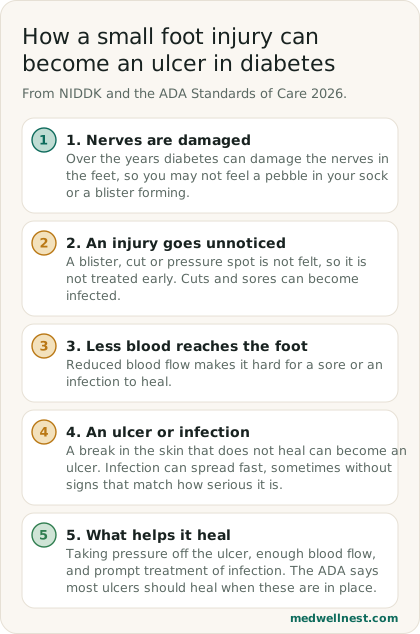
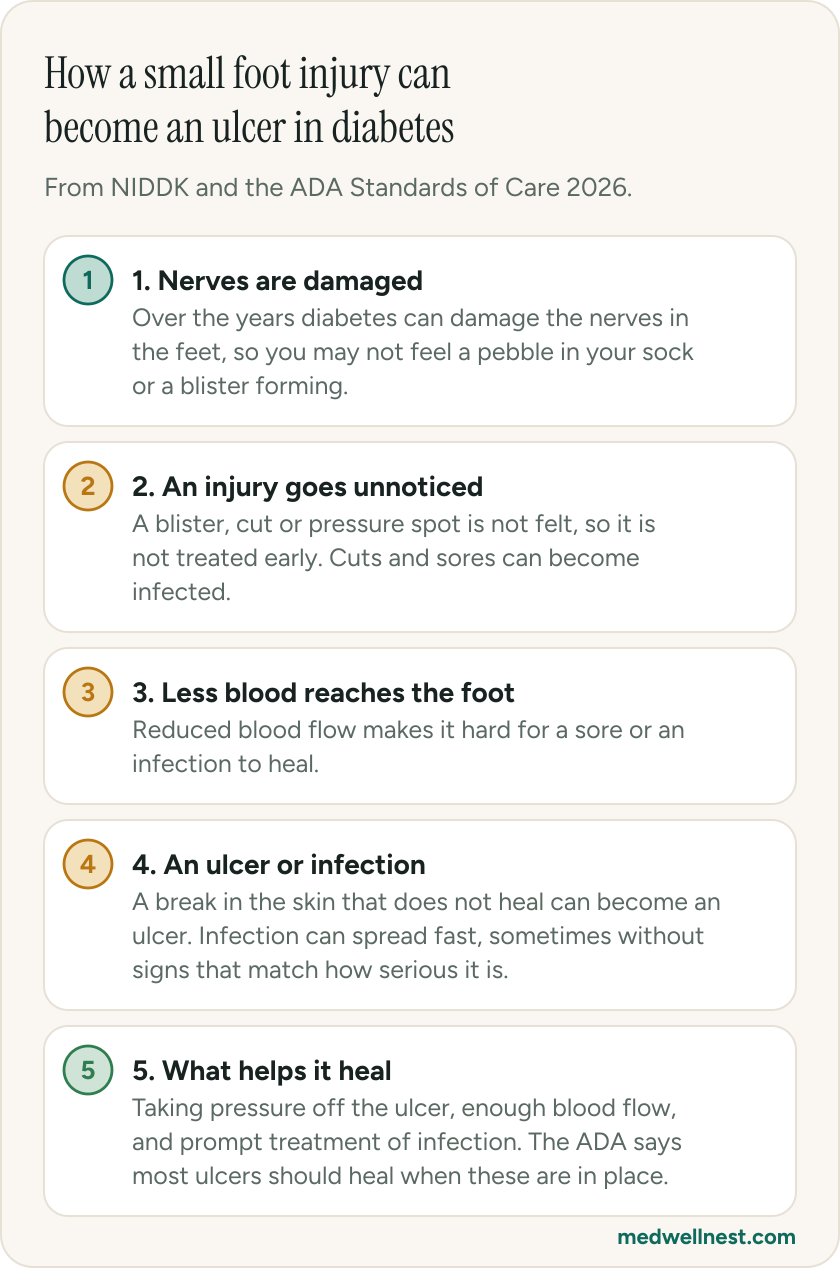
NIDDK gives two reasons. Over time diabetes may damage the nerves, so you lose feeling in your feet and may not feel a pebble inside your sock or a blister on your foot, which can lead to cuts and sores that then become infected. Diabetes can also lower the blood flow in the feet, and not enough blood reaching the legs and feet makes it hard for a sore or an infection to heal. NIDDK says that sometimes a bad infection never heals and can lead to gangrene, and that gangrene and foot ulcers that do not get better with treatment can lead to an amputation of a toe, the foot or part of the leg.
The ADA Standards of Care 2026 add numbers. Nerve damage was a component cause in 78% of people with diabetes who had ulcers in one multicentre trial, and the combination of nerve damage, minor injury and a foot deformity was present in more than 63%. Up to 50% of diabetic nerve damage may cause no symptoms, so a foot that does not hurt or tingle is not necessarily safe. The ADA also says infection can advance rapidly in a foot with nerve and blood-flow problems, often without signs that match how serious it is, and that infection is usually the final trigger for amputation. Our guide to diabetic neuropathy covers the daily foot check.
02
What is a diabetic foot ulcer, and what are the warning signs?
The ADA defines a diabetic foot ulcer as a break of the top layer of skin and at least part of the deeper layer, below the ankle, in a person with diabetes. In plain terms it is an open sore on the foot. NICE guideline NG19 counts as an active diabetic foot problem an ulcer, an infection, chronic limb-threatening ischaemia (a very poor blood supply to the leg), gangrene, or a suspected acute Charcot foot, meaning an unexplained hot, swollen foot with a change in colour, with or without pain.
NIDDK's warning signs are a cut, blister or bruise on the foot that does not start to heal after a few days; skin that becomes red, warm or painful, which are signs of a possible infection; a callus with dried blood inside it, which can be the first sign of a wound under the callus; and a foot infection that becomes black and smelly, which suggests gangrene. NIDDK says Charcot foot may start with redness, warmth and swelling and later, bones in the foot and toes can shift or break, giving a rocker-bottom shape.
03
How fast should I see a doctor for a diabetic foot sore?
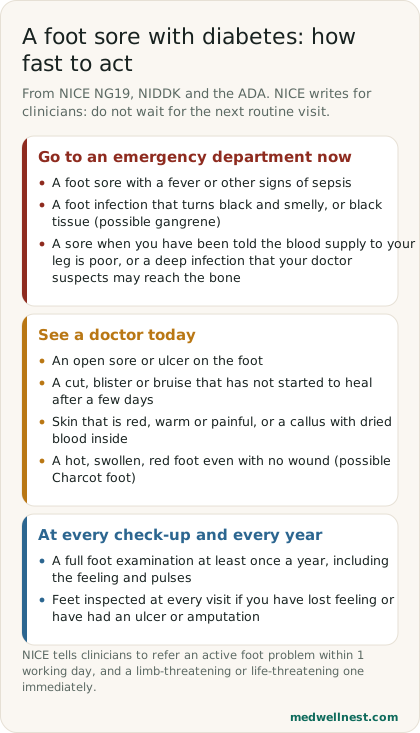
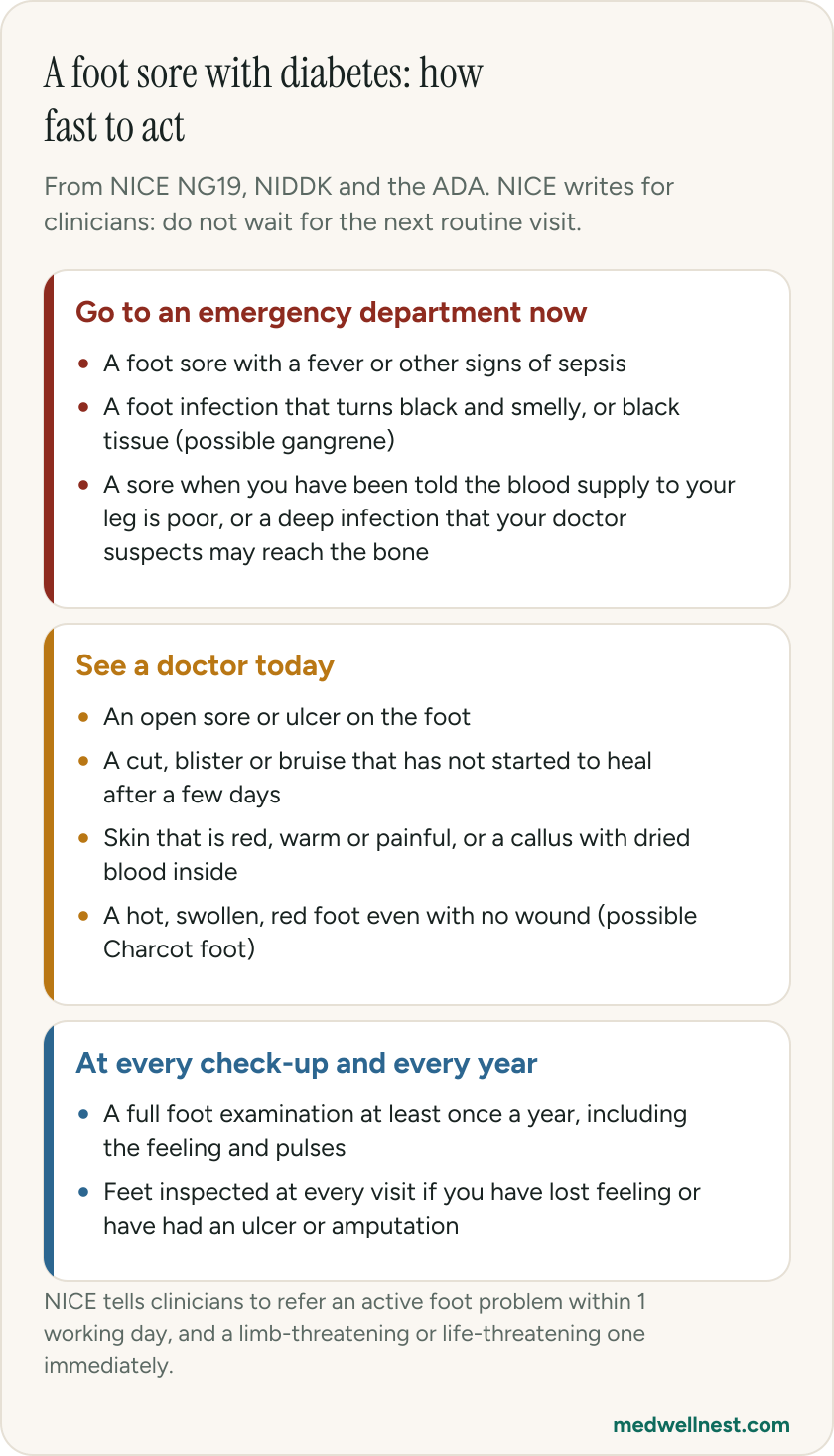
NIDDK says to call your health care provider right away for the signs above. NICE, writing for health professionals, says that for an active diabetic foot problem the person should be referred within 1 working day to the multidisciplinary foot care service or foot protection service, for triage within 1 further working day. For a limb-threatening or life-threatening problem the referral should be immediate, to acute services. Its examples are an ulcer with fever or any signs of sepsis, an ulcer with limb ischaemia, clinical concern about a deep soft tissue or bone infection with or without an ulcer, and gangrene with or without an ulcer. The ADA says any open ulcer or unexplained swelling, redness or raised skin temperature needs urgent referral to a foot care specialist, and that necrotising infections and wet gangrene are surgical emergencies.
For you this means that a foot sore is not something to leave until your next routine visit: tell your diabetes team or doctor the same day. If the sore comes with a fever or you feel very unwell, go to an emergency department. The NHS lists the adult signs of sepsis, a serious reaction to infection, as confusion or slurred speech, uncontrollable shivering, muscle pain, difficulty breathing, blue, pale, grey or blotchy skin, a high or low temperature, and not peeing all day. It adds that a high temperature is less common in older adults, so do not wait for a fever.
A hot, swollen, red foot with no wound at all also needs prompt attention. The ADA says a person with nerve damage who has a warm, swollen, red foot, with or without an injury and without an open sore, needs a workup for possible Charcot foot, total non-weight-bearing and urgent referral to a foot care specialist, and NICE counts it as an active problem.
04
What treatment helps a diabetic foot ulcer heal, and what is offloading?
NICE says standard care for a diabetic foot ulcer is one or more of offloading, control of foot infection, control of ischaemia, wound debridement and wound dressings. The ADA lists the same principles and adds revascularisation, restoring blood flow, when an ulcer is ischaemic. It says most ulcers should heal if pressure is removed from the ulcer site, the arterial circulation is sufficient, and infection is managed and treated aggressively. Debridement is the removal of dead or unhealthy tissue, and NICE says it should be done only by trained health professionals.
Offloading means taking pressure off the ulcer. NICE says to offer a non-removable cast for nerve-damage ulcers on the forefoot and midfoot that are not infected and have a good blood supply, and an alternative offloading device until a cast can be provided. For suspected infection NICE says to start antibiotics as soon as possible, taking samples first, to consider an X-ray, and to think about infection in the bone (osteomyelitis), which can be present even when X-rays and blood markers look normal. The ADA says a person with suspected poor blood supply and an ulcer, infection or gangrene needs referral to a vascular specialist, and that time is often of the essence. Which treatment and which medicine you need is a clinical decision.
05
Can I cut a corn or treat a foot wound at home if I have diabetes?
No. NIDDK says not to cut corns and calluses, not to use medicated corn plasters and not to use liquid corn and callus removers, because cutting and over-the-counter corn removal products can damage the skin and cause an infection. If you have nerve damage, corns and calluses can become ulcers, so talk with a foot doctor about the best way to care for them. NIDDK says to use a pumice stone only if your doctor tells you to, rubbing gently in one direction. The ADA says to avoid self-care of ingrown nails and calluses, and NICE says debridement should be done only by trained professionals.
NIDDK says to trim toenails straight across and to have a foot doctor trim them if you cannot see, feel or reach your feet, your nails are thick or yellowed, or they curve into the skin. It advises bringing your own tools to a pedicure. For a small cut, blister or sore it says to cover it with a bandage, and to call your provider right away if it does not start to heal after a few days. To protect numb skin, do not put a hot water bottle or heating pad on the feet. NIDDK also says smoking can lower the blood flow to the feet and that managing your blood glucose helps keep your feet healthy.
06
What shoes should I wear with diabetes, and do I need special footwear?
NIDDK's advice is to wear shoes and socks at all times, not to walk barefoot or in just socks even indoors, and to check the inside of your shoes for pebbles before putting them on. It suggests clean, lightly padded, well-fitting socks, ideally with no seams, and walking or athletic shoes for daily wear, not vinyl or plastic shoes. Buy shoes at the end of the day when feet are largest and make sure there is enough room for your toes. Avoid pointed toes and high heels. If you have a bunion or hammertoes you may need extra-wide or deep shoes, and if the shape of your feet has changed, for example from Charcot foot, special shoes or inserts called orthotics. When breaking in new shoes, wear them for only a few hours at first and check your feet for sore areas.
The ADA recommends specialised therapeutic footwear for people at high risk of ulcers: those with loss of protective feeling, foot deformities, ulcers, callus, poor circulation or a past amputation. NICE says moderate risk means deformity, nerve damage or peripheral arterial disease, high risk includes a past ulcer or amputation, dialysis, or nerve damage together with poor circulation, and that people at moderate or high risk should go to a foot protection service, which assesses the need for specialist footwear. The evidence is modest: the ADA says custom orthoses reduce pressure under the foot, but a systematic review found no significant reduction in ulcers after 18 months compared with standard insoles and extra-depth shoes, and that evidence for preventing a first ulcer was nonexistent. So fit, daily checks and an examination at least once a year, and at every visit if you have lost feeling or had an ulcer, matter as much as the shoe.
A foot sore with diabetes: how fast to act
Routine — see a doctor
You have not had a full foot examination, including a check of feeling and pulses, in the past year, or you have a bunion, hammertoes, a changed foot shape, corns, calluses or nail problems: ask your diabetes team for a foot check and a footwear review, and ask a foot doctor, not a blade or corn remover, to deal with corns, calluses and nails. If you have lost feeling or have had an ulcer before, have your feet looked at every visit.
Same-day — call promptly
You have an open sore or ulcer on the foot, a cut, blister or bruise that has not started to heal after a few days, skin that is red, warm or painful, a callus with dried blood inside, or a hot, swollen, red foot even with no wound: see a doctor or contact your diabetes team today, and keep weight off a hot, swollen foot. NIDDK says to call right away, and NICE says clinicians should refer an active foot problem within 1 working day, so do not wait for a routine visit.
Emergency — act now
A foot sore comes with a fever, confusion or slurred speech, uncontrollable shivering, difficulty breathing or blue, pale, grey or blotchy skin; or a foot infection turns black and smelly or tissue turns black; or you have a sore and have been told the blood supply to your leg is poor, or your doctor suspects a deep or bone infection: go to an emergency department now. NICE says these limb-threatening and life-threatening problems need immediate referral to acute services. Do not drive yourself, and keep weight off the foot.
Sources
Share this story
Curious where your own values stand?
Two minutes from upload to a full visual picture. Free to analyze.