In short
Heavy sweating of the hands, feet or underarms that starts early in life is often primary hyperhidrosis, but sweating all over, at night, or with weight loss, fever or chest pain can point to another cause. Treatments come in classes, from strong antiperspirants to surgery.
Emergency if: Sweating with chest pain or pressure, especially pain that feels tight or like squeezing or spreads to the arm, neck or jaw; severe difficulty breathing (gasping, choking or unable to get words out); pale, blue or grey lips or skin; or passing out; or sweating and shaking with confusion in someone with diabetes who is not responding normally or is unconscious: call emergency services now. The NHS lists these as emergencies for a heart attack and for very low blood sugar. Sweating is a heart-attack symptom, so we treat any chest pain or pressure with sweating as an emergency.
On your report
TSH, HbA1c, Fasting Glucose
On this page
01
Is my sweating normal or is it hyperhidrosis?
The NHS says it is normal to sweat when you are hot or exercising, and that you may be sweating excessively if you sweat when your body does not need to cool down. MedlinePlus describes hyperhidrosis as sweating excessively and unpredictably, even when the temperature is cool or you are at rest. The AAD says that sweat on a hot day or during exercise does not by itself mean hyperhidrosis; it is more likely if you also sweat heavily in the cool, in a temperature others find comfortable, when you eat certain foods or give a speech, or when you take certain medicines or have another medical condition.
The NHS says excessive sweating is common and can affect the whole body or just certain areas, and that it can happen for no obvious reason, because of another condition, or as a side effect of a medicine. The AAD says hyperhidrosis is not contagious. None of these pages gives a figure for how many people have it, so we do not quote one.
02
Why do my palms, feet and underarms sweat so much?
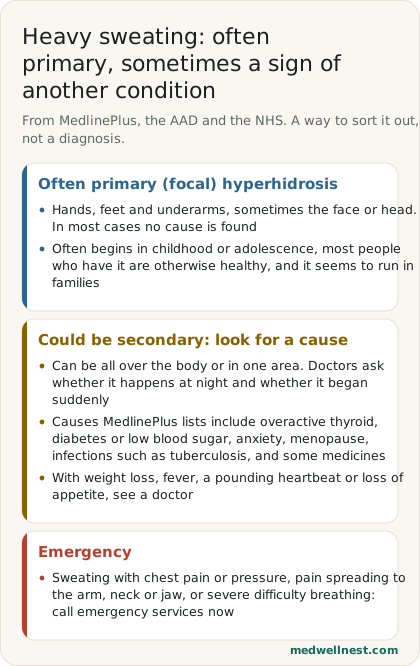
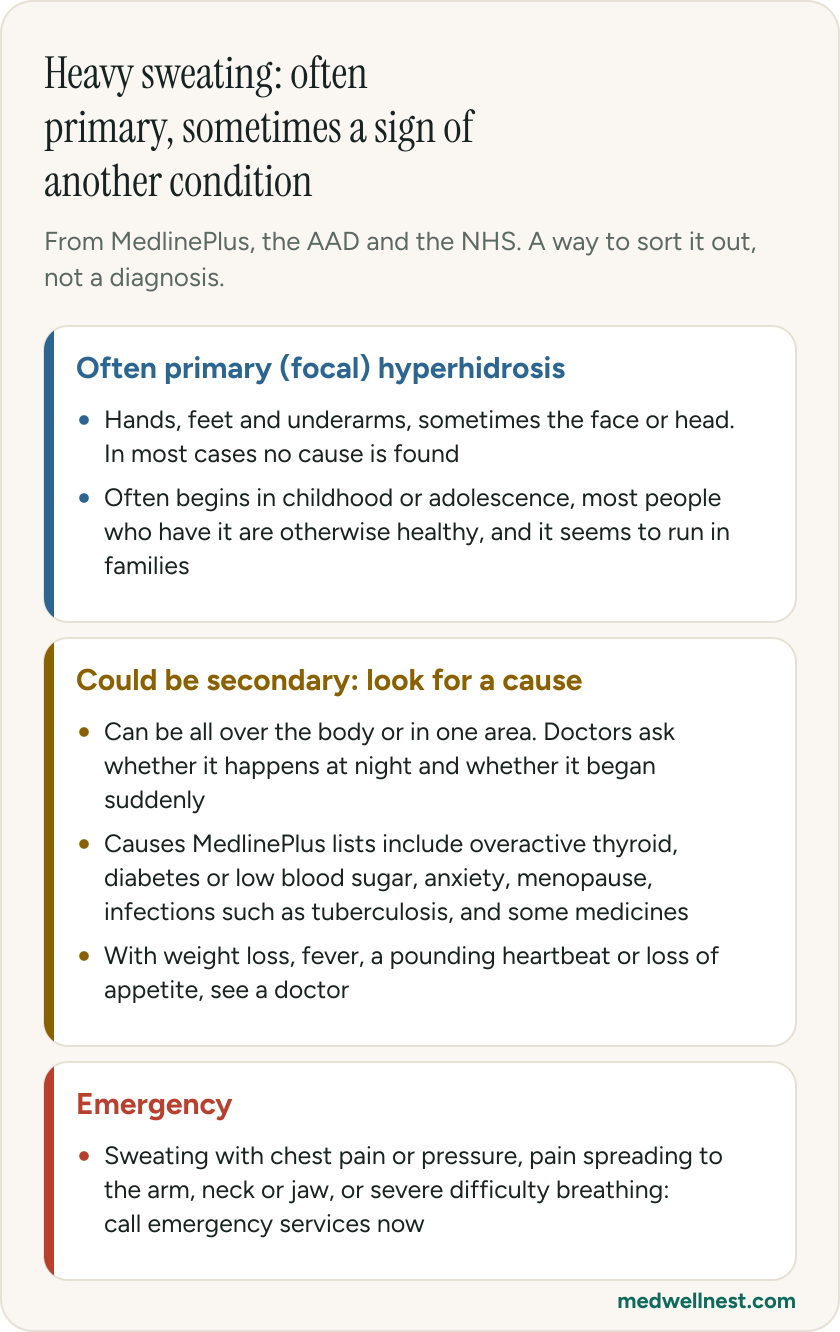
When the sweating affects the hands, feet and armpits, MedlinePlus calls it focal hyperhidrosis, and says that in most cases no cause can be found and that it seems to run in families. Sweating that is not caused by another disease is called primary hyperhidrosis. MedlinePlus says people with it appear to have overactive sweat glands, and the AAD says it may be caused by overactive nerves.
The AAD says hyperhidrosis often begins in childhood or adolescence and that most people who develop it are otherwise healthy. It usually involves 1 or 2 areas, such as the underarms, palms, soles or head, though it is also possible to sweat all over the body. The NHS says it sometimes gets better with age. The AAD says some people struggle for years because they do not know they have a medical condition and that something can be done about it.
03
Which illnesses and medicines can cause heavy sweating?
When sweating is a result of another medical condition, MedlinePlus calls it secondary hyperhidrosis, and it may be all over the body or in 1 area. The conditions it lists include an overactive thyroid, diabetes and low blood sugar (glucose control disorders), anxiety conditions, menopause, tuberculosis and other infections, heart disease such as a heart attack, lung disease, cancer, Parkinson's disease, stroke, and certain medicines and substances of abuse. The NHS lists causes of night sweats that include menopause symptoms, anxiety, medicines such as some antidepressants, steroids and painkillers, low blood sugar, and alcohol or drug use.
To tell the two apart, doctors ask where the sweating happens, whether it happens at night, whether it began suddenly, what triggers it, and what other symptoms come with it: weight loss, a pounding heartbeat, cold or clammy hands, fever or loss of appetite (MedlinePlus). Blood tests may be ordered if thyroid problems or other medical conditions are suspected, and the NHS says the doctor may refer you for tests if another condition may be causing it.
04
What can I do myself, and what can a pharmacist offer?
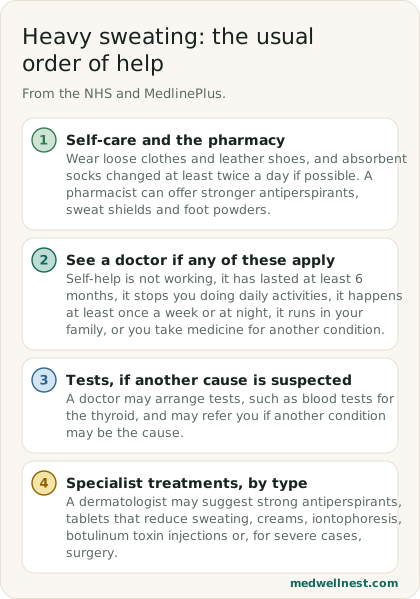
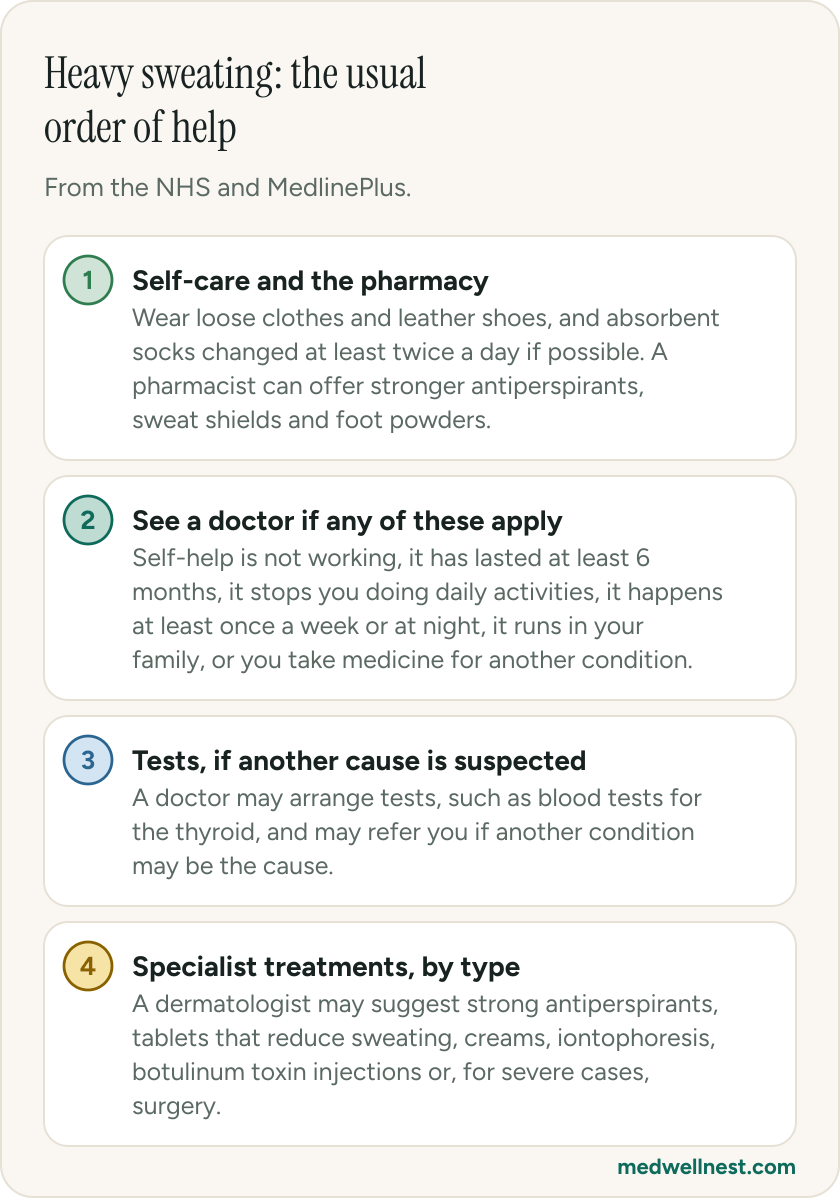
The NHS suggests wearing loose-fitting clothes, wearing socks that absorb moisture and changing them at least twice a day if possible, and wearing leather shoes and different shoes from day to day. It says to avoid tight clothes and synthetic fabrics such as nylon, enclosed boots or sports shoes that may make your feet sweat more, and things that can make sweating worse, such as alcohol and spicy food.
A pharmacist can offer stronger antiperspirants instead of deodorant, armpit or sweat shields to protect your clothing, foot powders and gentler soap substitutes (NHS). MedlinePlus says deodorants do not prevent sweating but help reduce body odour, and that strong antiperspirants, which plug the sweat ducts, are the first line of treatment for underarm sweating; they can irritate the skin.
05
What treatments are there for hyperhidrosis?
Treatments come in classes, and the choice depends on where you sweat and how severe it is. The NHS says a dermatologist may suggest tablets that reduce sweating, a cream, iontophoresis (a weak electric current passed through water or on a wet pad), botulinum toxin ('botox') injections for the underarms, or surgery such as removal of the sweat glands. MedlinePlus adds that iontophoresis is most effective for the hands and feet, needs several sessions and rarely causes skin cracking or blisters; that botulinum toxin is used for severe underarm, palm and sole sweating and only blocks the nerves temporarily; and that medicines can have side effects and are not right for everyone.
For severe cases that other treatments do not help, MedlinePlus describes endoscopic thoracic sympathectomy, a minimally invasive operation that cuts a nerve to switch off the signal to sweat, usually for people whose palms sweat much more than normal; it does not work as well for armpit sweating. Underarm surgery removes the sweat glands. The AAD says there is currently no way to switch hyperhidrosis off for good, but a dermatologist can build a treatment plan, typically a medication, a procedure or both, and the right plan varies with the type and where you sweat. If another condition is the cause, the NHS says treatment depends on what is causing it.
06
When should I see a doctor about sweating?
The NHS says to see a doctor if you are sweating excessively and self-help is not working, it has lasted at least 6 months, it stops you getting on with daily activities, it happens at least once a week, it happens at night, you have a family history of excessive sweating, or you are taking medicine for another condition. If there is no obvious cause and nothing helps, you may be referred to a dermatologist.
MedlinePlus says to contact your provider if sweating is prolonged, excessive and unexplained, comes with weight loss, happens mostly during sleep, or comes with fever, a rapid, pounding heartbeat or shortness of breath, which may be a sign of an underlying disease such as an overactive thyroid. It also lists sweating with or after chest pain or pressure: that combination can be a heart attack, so call emergency services (see the next section). The NHS says to see a doctor for regular night sweats that wake you or worry you, night sweats with a cough or diarrhoea, and night sweats with weight loss for no reason. These are reasons to book an appointment rather than wait for the sweating to pass, though the NHS does not list them as emergencies. It also lists night sweats with a very high temperature, or with feeling hot, cold or shivery; because of the fever, see a doctor about these the same day.
07
When is heavy sweating an emergency?
Sweating is one of the symptoms of a heart attack, which the NHS says needs emergency treatment. Call emergency services if sweating comes with chest pain that feels tight or like squeezing, chest pain spreading to the arms, neck or jaw, severe difficulty breathing, pale, blue or grey lips or skin, or if someone has passed out and is not responding normally. Do not drive yourself to hospital.
Sweating with shaking, hunger, dizziness or confusion can be low blood sugar. The NHS says it usually affects people with diabetes who take insulin or some other diabetes medicines and is rare in people without diabetes, and that it needs to be treated quickly. Call emergency services if someone with very low blood sugar is not responding normally or is unconscious and a glucagon injection is not available or has not worked within 10 minutes, or if they have been drinking alcohol. If you do not have diabetes and get shaking, sweating, a fast heartbeat and confusion, the NHS says to see a doctor.
Heavy sweating: how fast to act
Emergency — act now
Sweating with chest pain or pressure, especially pain that feels tight or like squeezing or spreads to the arm, neck or jaw; severe difficulty breathing (gasping, choking or unable to get words out); pale, blue or grey lips or skin; or passing out; or sweating and shaking with confusion in someone with diabetes who is not responding normally or is unconscious: call emergency services now. The NHS lists these as emergencies for a heart attack and for very low blood sugar. Sweating is a heart-attack symptom, so we treat any chest pain or pressure with sweating as an emergency.
Same-day — call promptly
Sweating with a fever, with a rapid, pounding heartbeat, or with breathlessness that came on suddenly or is worse than usual but is not severe: contact a doctor today. This includes night sweats with a very high temperature or feeling hot, cold or shivery. MedlinePlus says to contact your provider for these, and the NHS lists sudden breathlessness as a reason for urgent advice; neither gives a timeframe for the rest, so same-day is our cautious choice. If you have any chest pain, pressure or tightness, are gasping or cannot get words out, or feel very unwell, call emergency services now.
Routine — see a doctor
Sweating that self-help is not controlling, that has lasted 6 months or more, that stops you doing daily activities, that happens at least once a week or at night, that runs in your family, or that happens while you take medicine for another condition; or night sweats with weight loss for no reason, or with a cough or diarrhoea: book an appointment with a doctor and do not wait for it to pass. The NHS and MedlinePlus list these as reasons to see a doctor; neither calls them urgent.
Values mentioned in this story
Each one opens a visual guide with its normal range and what moves it — upload a report and we place your own numbers on the same scale.
Sources
Share this story
Curious where your own values stand?
Two minutes from upload to a full visual picture. Free to analyze.