In short
G6PD is an enzyme that protects red blood cells. In G6PD deficiency, an inherited condition that mainly affects males, red cells can break down after fava beans, some infections or certain medicines, and it is a cause of newborn jaundice. Most people feel well otherwise, and avoiding triggers is how it is managed.
Emergency if: After a trigger (a new medicine, an infection or fava beans) you are breathless, feel faint, have a very fast heartbeat, or you pass dark urine (dark or yellow-orange) with yellow skin or eyes: go to an emergency department now and say you have G6PD deficiency. MedlinePlus does not set an urgency level, but it lists these as signs of red cell breakdown and says severe episodes can rarely lead to kidney failure or death, so do not wait. A newborn with jaundice who is under 24 hours old, sleepier than normal, not feeding, floppy or stiff, with a high or low temperature, no wet nappies or trouble breathing also needs an emergency department now; the NHS lists all of these as immediate-action signs.
On your report
G6PD (Glucose-6-Phosphate Dehydrogenase), Hemoglobin, Total Bilirubin, Reticulocyte Count
On this page
01
G6PD deficiency kya hai? What does the G6PD enzyme do?
G6PD stands for glucose-6-phosphate dehydrogenase. MedlinePlus describes it as an enzyme, a protein that speeds up certain chemical reactions, that helps your red blood cells work properly. Without enough of it, red blood cells are vulnerable to damage from oxidants, and they can be destroyed faster than the body can replace them. This is called haemolysis, and when it is bad enough it causes haemolytic anaemia.
Many people with the deficiency never have a problem. MedlinePlus Genetics says many never experience signs or symptoms and are unaware they have the condition. The World Health Organization (WHO) Bulletin lists three ways it shows up: newborn jaundice, acute haemolytic anaemia triggered by fava beans, infection or drugs, and a very rare chronic form. Estimates of how many people are affected worldwide run from about 400 million (MedlinePlus Genetics) to 500 million (WHO Bulletin).
02
Is G6PD deficiency inherited? Why are boys affected more, and can girls and women have it?
Yes, it is inherited. The G6PD gene sits on the X chromosome, so the condition is X-linked. Males have one X chromosome, so one altered copy is enough to cause deficiency, which is why MedlinePlus says it mainly affects men. Fathers cannot pass X-linked traits to their sons, because sons receive the father's Y chromosome. But a father with G6PD deficiency passes his only X chromosome to every daughter, so all his daughters carry the altered gene. A mother who carries one altered copy has a 1 in 2 chance of passing it to each child: a son who inherits it will have the deficiency, and a daughter who inherits it will be a carrier.
Women have two X chromosomes and are more likely to be carriers, but carrying is not always harmless. MedlinePlus Genetics says that many females with one altered copy have deficiency similar to affected males, because the X chromosome with the normal copy is switched off in many of their cells. The WHO Bulletin explains that a female carrier's enzyme level reflects how many of her red cells are deficient, from nearly none to nearly all, so a carrier can have mild or severe haemolysis. MedlinePlus says a woman with slightly low G6PD may be a carrier who can pass the gene to her children.
03
What should I avoid in G6PD deficiency? Which foods, medicines and mothballs trigger it?
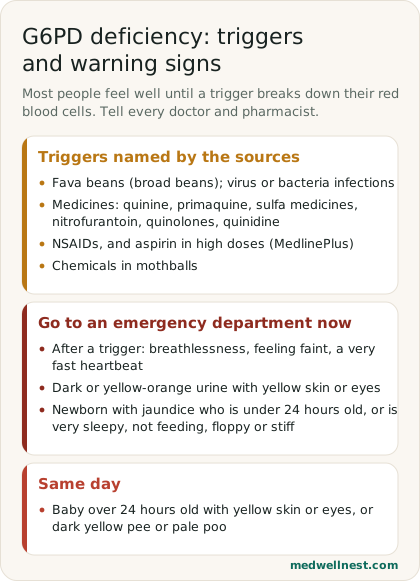
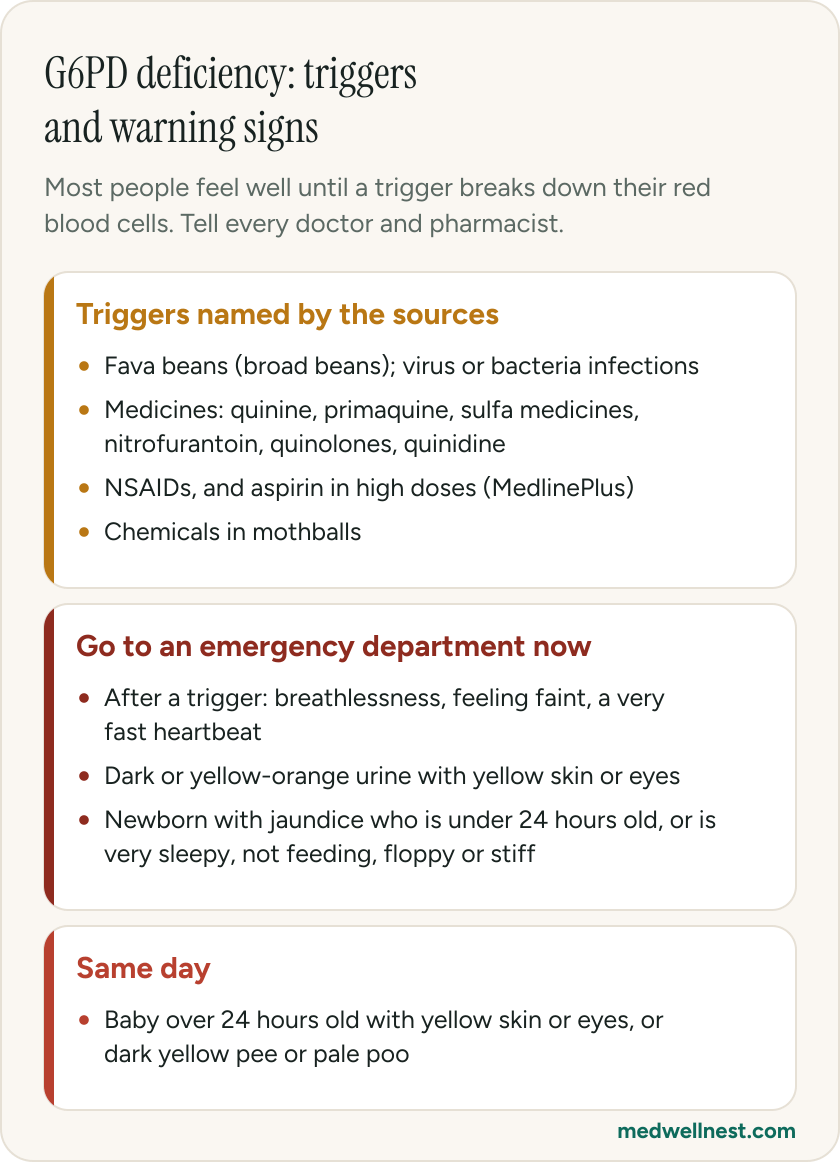
Most people with G6PD deficiency have no symptoms until a trigger sets off the destruction of red blood cells. MedlinePlus lists fava beans (also called broad beans), including pollen from fava plants, viral and bacterial infections, certain antibiotics, anti-malaria medicines, and other medicines including anti-inflammatory painkillers (NSAIDs) such as ibuprofen and aspirin. Its encyclopedia page names quinine, quinidine, sulfa medicines, quinolone antibiotics and nitrofurantoin, aspirin in high doses, and chemicals in mothballs.
Other sources add primaquine and tafenoquine, malaria medicines for which WHO recommends G6PD testing before use. Lists differ between sources and none is complete, so the safe approach is to tell every doctor, dentist and pharmacist that you or your child has G6PD deficiency before any new medicine, to keep mothballs away, and to ask which medicines to avoid. MedlinePlus says most people can manage the condition and prevent symptoms by avoiding triggering substances. Do not start or stop prescribed medicines on a guess: ask the prescriber or pharmacist, who can check each one against your G6PD status.
04
What are the symptoms of G6PD deficiency? What does a haemolytic episode look like?
MedlinePlus lists the symptoms of haemolytic anaemia as tiredness, pale skin, yellow skin or eyes (jaundice), a fast heartbeat, shortness of breath, and dark or yellow-orange urine. The encyclopedia also lists fever, abdominal pain and an enlarged spleen and liver, and says symptoms are more common in men.
Episodes are most often brief, because the body keeps making new red blood cells, which have normal G6PD activity. MedlinePlus says treatment may include treating an infection if there is one, stopping any medicine that is causing the red cell destruction, and in some cases blood transfusions. It also says that in rare cases kidney failure or death may follow a severe episode, which is why breathlessness, dark urine and yellow eyes should never be waited out.
05
Does G6PD deficiency cause jaundice in newborns, and should my baby be tested?
It can. MedlinePlus Genetics calls G6PD deficiency a significant cause of mild to severe jaundice in newborns, and the WHO Bulletin lists neonatal jaundice as one of its main forms. MedlinePlus says a newborn might need a G6PD test if jaundice does not go away in two weeks or is not caused by another condition, or if there is a family history of G6PD deficiency.
WHO recommends newborn screening where G6PD deficiency is common, meaning it affects more than 3 to 5% of males. Whatever the testing policy, all newborn jaundice needs watching. The NHS says jaundice in a baby less than 24 hours old needs emergency care, and that a baby over 24 hours old who looks jaundiced, has jaundice that is not getting better, or has dark yellow or brown pee or pale creamy poo should be seen urgently the same day. A baby who is sleepier than normal, not feeding, floppy or stiff, with a very high or low temperature, no wet nappies, or difficulty breathing also needs an emergency department.
06
How is the G6PD test done, and what do normal, low and intermediate results mean?
The test is a blood sample from a vein, or from a heel prick in a baby, and needs no special preparation. MedlinePlus says a lower than normal amount means G6PD deficiency, but your symptoms and risk of haemolysis vary with your health history and exposure to triggers. Labs print the result in their own units, often U/g Hb for the quantitative test, with their own reference range, so follow the range printed on your report. A simple yes-or-no (qualitative) screening test can pick out deficient people, but WHO's guide says qualitative tests cannot distinguish females with 30–80% activity from those above 80%, so a quantitative test is needed to measure the level.
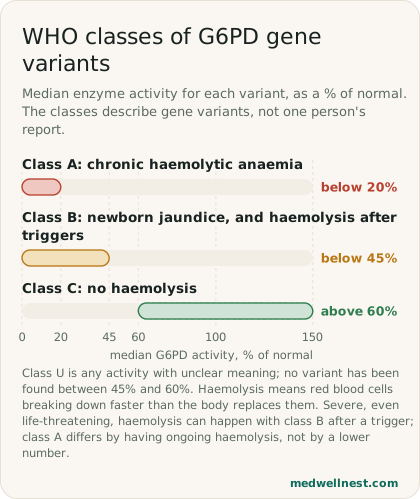
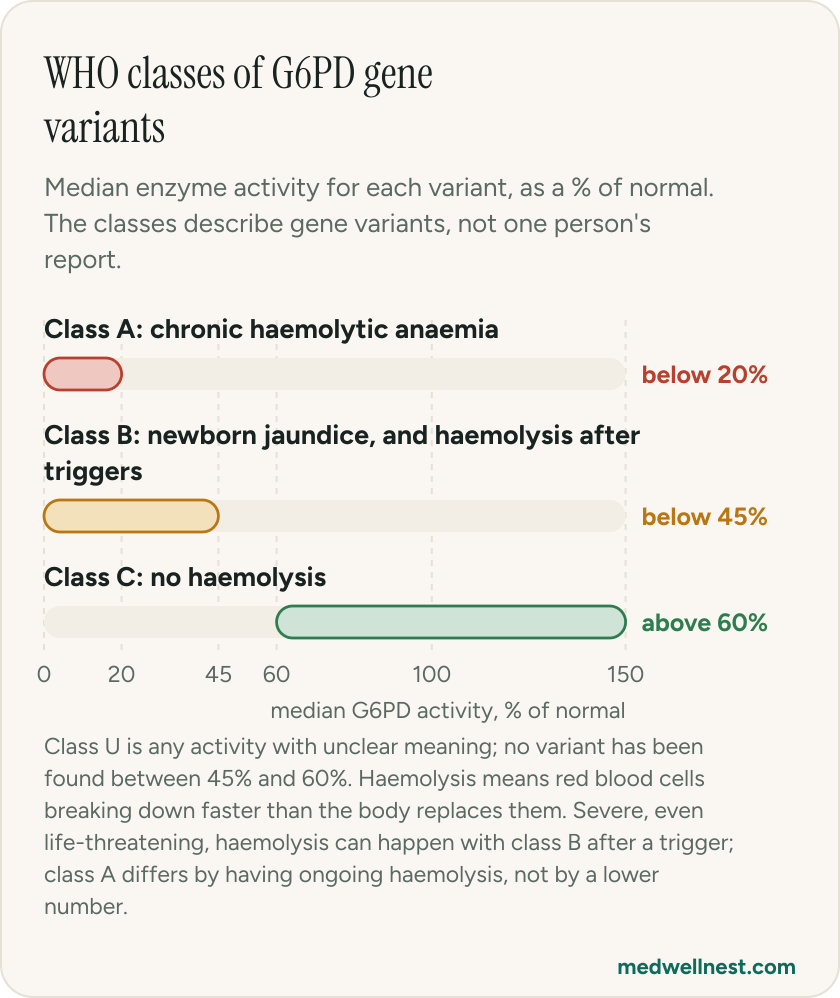
In WHO's testing guide, activity is judged as a percentage of a normal value set locally: males under 30% are deficient and 30% or more normal; females under 30% are deficient, 30% to 80% intermediate and 80% or more normal. Female carriers can fall in the intermediate zone. The WHO Bulletin separately classes G6PD gene variants (not people) by median enzyme activity: class A under 20% with chronic haemolytic anaemia, class B under 45% with newborn jaundice and haemolysis after triggers, class C over 60% with no haemolysis.
07
Can the G6PD test be normal even if I have deficiency? When should it be repeated?
Yes, timing matters. During a haemolytic episode the older, most deficient red cells are the first to be destroyed, and the new cells made to replace them have normal G6PD activity, so a test taken during or just after an episode can look better than your true level. MedlinePlus says a man with a normal result is unlikely to have a deficiency, but that your provider may want to repeat the test in a few weeks if it was done during an episode of haemolytic anaemia.
So if you were tested while sick, with dark urine or yellow eyes, and the result is normal, ask whether to repeat it after recovery. Mention any recent blood transfusion too, so the doctor can judge whether the timing of the test matters, and do not take a normal report as permission to ignore triggers if you or your family have had a reaction.
08
When is G6PD deficiency an emergency, and what should I do after a trigger?
Go to an emergency department now if, after a trigger such as a new medicine, an infection or fava beans, you have breathlessness, feel faint, have a very fast heartbeat, or have dark urine (dark or yellow-orange, per MedlinePlus) with yellow skin or eyes. MedlinePlus does not set an urgency level, but it lists shortness of breath, a fast heartbeat and dark urine as signs of red cell breakdown and says severe episodes can rarely lead to kidney failure or death, so do not wait. Transfusion is sometimes needed.
Tell the team about the G6PD deficiency and the suspected trigger straight away, including every medicine taken. For a mild tired spell with slightly darker urine after a new medicine, speak to a doctor or pharmacist the same day before taking another dose. If you are told your G6PD is low, ask which medicines to avoid, and whether your relatives should be tested, including brothers, sisters who could be carriers and, for a man with the deficiency, his daughters, who all carry the gene.
When to act
Emergency — act now
After a trigger (a new medicine, an infection or fava beans) you are breathless, feel faint, have a very fast heartbeat, or you pass dark urine (dark or yellow-orange) with yellow skin or eyes: go to an emergency department now and say you have G6PD deficiency. MedlinePlus does not set an urgency level, but it lists these as signs of red cell breakdown and says severe episodes can rarely lead to kidney failure or death, so do not wait. A newborn with jaundice who is under 24 hours old, sleepier than normal, not feeding, floppy or stiff, with a high or low temperature, no wet nappies or trouble breathing also needs an emergency department now; the NHS lists all of these as immediate-action signs.
Same-day — call promptly
A baby over 24 hours old looks yellow, has jaundice that is not getting better, or has dark yellow or brown pee or pale creamy poo: get urgent medical help today, as the NHS advises. An adult or child with G6PD deficiency who has new tiredness, paler skin or darker urine after starting a medicine or after an infection should speak to a doctor today before taking more of the medicine.
Routine — see a doctor
Your report says G6PD is low or intermediate and you feel well: tell every doctor, dentist and pharmacist, ask for a list of foods and medicines to avoid, and ask whether to repeat the test if it was done during an illness and whether family members should be tested. Keep mothballs away from the home and from children's clothes and bedding.
Values mentioned in this story
Each one opens a visual guide with its normal range and what moves it — upload a report and we place your own numbers on the same scale.
Sources
- G6PD Test — MedlinePlusmedlineplus.gov
- Glucose-6-phosphate dehydrogenase deficiency — MedlinePlus Medical Encyclopediamedlineplus.gov
- Glucose-6-phosphate dehydrogenase deficiency — MedlinePlus Geneticsmedlineplus.gov
- New WHO classification of genetic variants causing G6PD deficiency — Bulletin of the World Health Organization, 2024pmc.ncbi.nlm.nih.gov
- Guide to G6PD deficiency rapid diagnostic testing — World Health Organization, 2018who.int
- Jaundice in babies — NHSnhs.uk
Share this story
Curious where your own values stand?
Two minutes from upload to a full visual picture. Free to analyze.