In short
Breast enlargement in boys and men is common and often harmless. MedlinePlus says more than half of boys get some in puberty and it often goes away in 6 months to 2 years. A hard, one-sided or fixed lump, a skin sore, or bloody nipple discharge needs a doctor soon.
On your report
Testosterone, Total, Estradiol
On this page
01
What is gynaecomastia, and is a lump in a boy's or man's chest normal?
Gynaecomastia is where men and boys have bigger breasts than usual, according to the NHS. It is common and may not need treatment, but can sometimes be caused by other conditions. The main symptom is bigger breasts than usual; the nipples or breasts may also look swollen or feel sore, and one or both breasts may be affected.
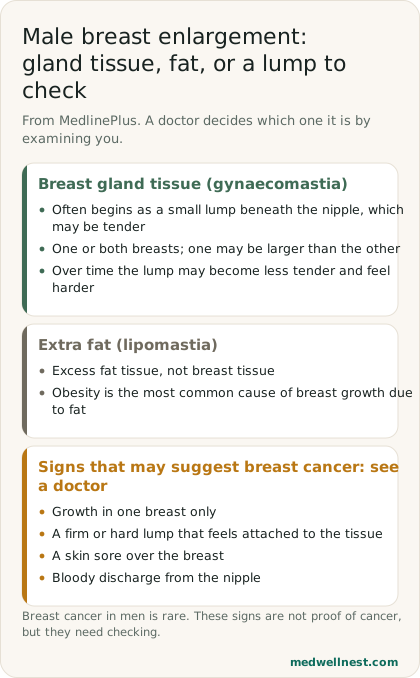
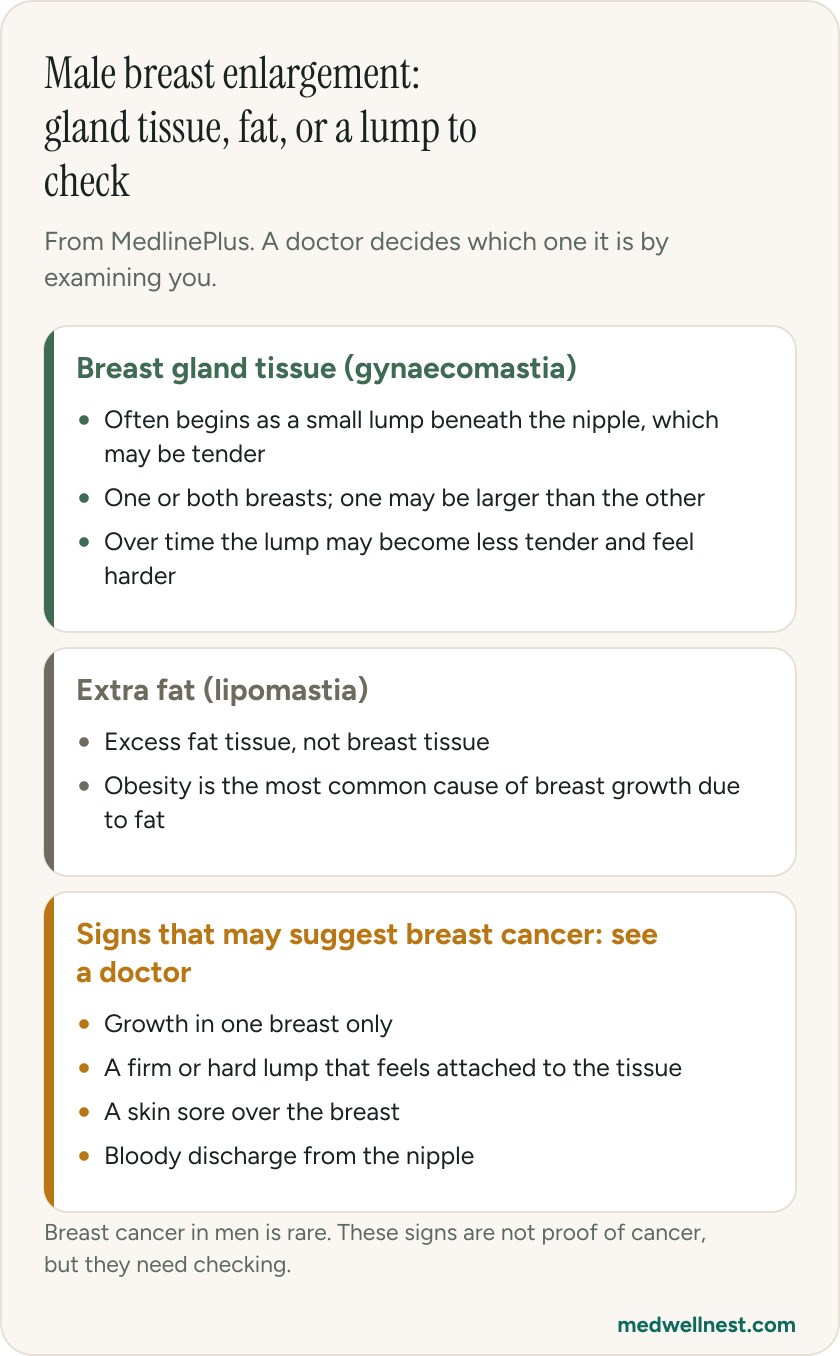
MedlinePlus says the condition begins as a small lump beneath the nipple, which may be tender. One breast may be larger than the other, and over time the lump may become less tender and feel harder. Enlarged breasts in males are usually harmless, MedlinePlus says, but can cause real distress, particularly in young men.
02
Is gynaecomastia normal in teenage boys, and how long does it last?
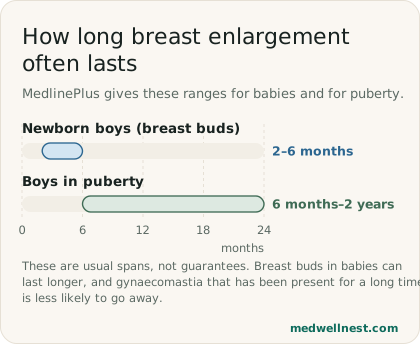
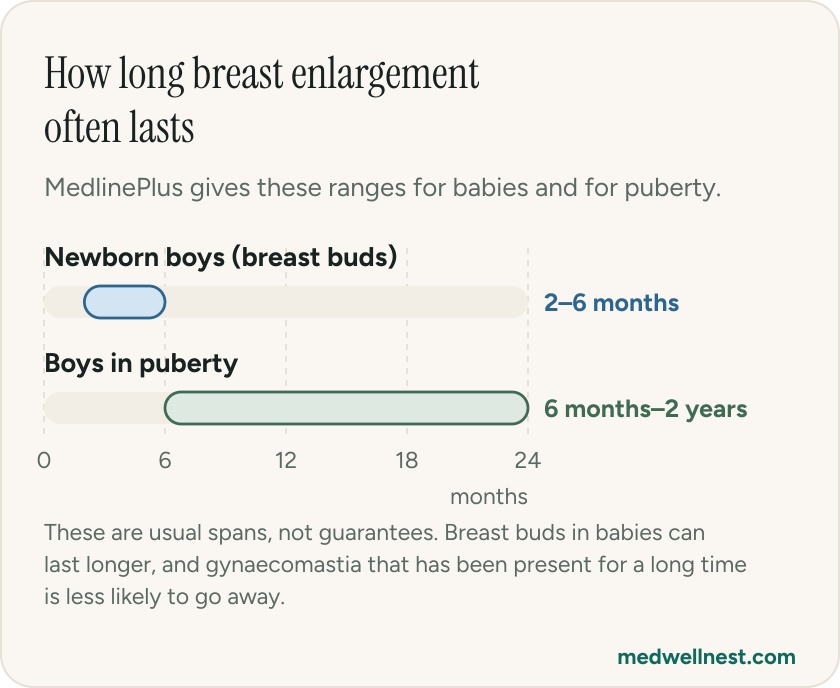
Yes, it is very common in puberty. MedlinePlus says breast growth in preteens and teens is caused by normal hormone changes during puberty, and that more than one half of boys develop some breast enlargement during puberty. It says the growth often goes away in 6 months to 2 years. The NHS says that when gynaecomastia is caused by puberty it usually goes away by itself over time.
MedlinePlus also says that if a son has breast growth but has not yet reached puberty, he should be checked by a doctor. And gynaecomastia that has been present for a long time is less likely to go away even when the right treatment is started. If it is still there after the spans in the chart, or it is causing distress, a doctor can look for a cause and talk through options. About half of boy babies are also born with breast buds, which usually go away in 2 to 6 months but can last longer, MedlinePlus says.
03
Is it gynaecomastia or just chest fat, and how can I tell?
MedlinePlus says it is important to find out whether the extra growth is breast tissue or excess fat tissue, which it calls lipomastia. It says obesity is also the most common cause of breast growth due to fat.
MedlinePlus says a doctor will take a medical history and examine you. You may not need any tests, but blood hormone level tests, a breast ultrasound, liver and kidney function studies or a mammogram may be done to check for certain diseases. The warning signs covered below apply whichever it turns out to be.
04
What causes gynaecomastia in adult men?
The NHS lists hormone changes in men over 50 or during puberty, being overweight, certain medicines, an overactive thyroid, kidney disease or cirrhosis, and drug use including anabolic steroids. MedlinePlus explains that it is usually caused by an imbalance of estrogen and testosterone, and lists chronic liver disease, kidney failure and dialysis, low testosterone and, rarely, thyroid disease and some tumours, including a non-cancerous pituitary tumour, as health causes. Hormone changes with ageing can also cause it, more often in overweight men and men aged 50 and older.
MedlinePlus lists many medicine groups that can cause breast growth, among them cancer chemotherapy, hormone treatment for prostate cancer, treatment for an enlarged prostate, some HIV, heartburn and ulcer medicines, some heart and anti-anxiety medicines, antifungals, some antibiotics, tricyclic antidepressants, opioids, corticosteroids and anabolic steroids. It also lists alcohol, amphetamines, heroin, marijuana and methadone. It advises stopping recreational drugs and any supplements or medicines taken for bodybuilding, and says not to stop any other medicine before talking to your doctor. Our low testosterone and cirrhosis stories cover two of the underlying causes.
05
Could a lump in a man's chest be breast cancer? What are the warning signs?
Breast cancer in men is rare, MedlinePlus says, though men with enlarged breasts may have an increased risk. The signs that may suggest it are one-sided breast growth, a firm or hard lump that feels attached to the tissue, a skin sore over the breast, and bloody discharge from the nipple. The NHS adds a lump or swelling in the chest or armpit, changes in the size or shape of either side of the chest, a nipple that turns inwards, or a rash on the nipple that may look like eczema.
The NHS says some of these symptoms, including lumps, are common and can have other causes, so having them does not mean you definitely have breast cancer. But it says it is important to get checked, and that if cancer is the cause, finding it early may mean it is easier to treat. The NHS also lists skin dimpling that may look like orange peel, redness, and pain in the breast or nipple that is not going away as reasons to see a doctor. A doctor may refer you urgently to a breast clinic if they think the symptoms could be cancer, which does not mean you have it.
06
How is gynaecomastia treated?
Often no treatment is needed, MedlinePlus says. If a medical condition is the cause, it is treated; the NHS says treating the condition may help reduce breast size, and that losing weight may be recommended if you are overweight. Your doctor will talk about any medicines or substances that may be the cause, and stopping or changing them may make the problem go away, but never stop a prescribed medicine yourself first.
For breast growth that is large, uneven or does not go away, MedlinePlus says treatments that may be used are hormone treatment that blocks the effects of estrogens, or breast reduction surgery to remove the breast tissue. The NHS says surgery can reduce the breasts if other treatments have not worked. This page gives no advice on supplements, because none of the sources we read recommends any.
Male breast enlargement: how fast to act
Routine — see a doctor
Both breasts are enlarged or tender, especially in puberty, or you are worried about the size or look of your breasts, or pain in the breast or nipple is not going away: see a doctor, who can look for a cause such as a medicine, weight, or a liver, kidney, thyroid or hormone problem. MedlinePlus says a boy who has breast growth before puberty should be checked.
See a doctor soon, without waiting to see if it settles, if you have a hard or firm lump, growth on one side only, a lump or swelling in the chest or armpit, skin dimpling, redness, a rash or sore on the breast or nipple, or any discharge or bleeding from a nipple. The NHS lists these as reasons to see a doctor and says an urgent referral to a breast clinic may follow if cancer is suspected.
Values mentioned in this story
Each one opens a visual guide with its normal range and what moves it — upload a report and we place your own numbers on the same scale.
Sources
Share this story
Curious where your own values stand?
Two minutes from upload to a full visual picture. Free to analyze.