In short
If an adult collapses and is not breathing normally, call emergency services and push hard and fast in the centre of the chest, 5 to 6 cm deep and 100 to 120 times a minute, until an AED or help arrives. Children, babies and people pulled from water need rescue breaths too.
Emergency if: Someone is unresponsive and not breathing normally, including gasping: call emergency services on speaker, start chest compressions, and send someone for an AED.
On your report
Troponin I
On this page
01
Recognising cardiac arrest
In a cardiac arrest the heart suddenly stops pumping, and the person collapses and stops breathing normally. The Resuscitation Council UK (RCUK) says to assume cardiac arrest in anyone who is unresponsive with abnormal breathing. Slow, laboured breathing, gasping or panting all count as abnormal, and a short burst of seizure-like movement can happen at the start.
It is not the same as a heart attack. RCUK describes a heart attack as a blocked artery to the heart, usually causing chest pain. A heart attack can lead to a cardiac arrest, which is why chest pain needs an ambulance straight away.
Call first. RCUK says to call emergency services for any unresponsive person, then check breathing while the call connects, with the phone on speaker so your hands are free. The American Heart Association (AHA) likewise says a lone rescuer with a phone should call and then begin CPR at once. The call handler can help you judge the breathing and talk you through CPR.
02
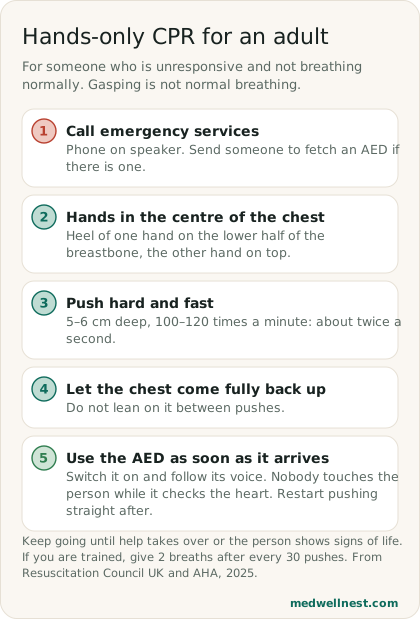
Hands-only CPR, step by step
Kneel beside the person. Put the heel of one hand on the lower half of the breastbone, in the centre of the chest, and your other hand on top. Press straight down at least 5 cm but not more than 6 cm, at a rate of 100 to 120 a minute, which RCUK puts simply as pushing down hard and releasing twice a second. The AHA gives the same figures.
Let the chest come all the way back up after every push, and do not lean on it in between. Keep interruptions to a minimum. RCUK says not to drag someone off a bed onto the floor; start where they are and push harder to make up for a soft mattress.
If you have not been trained in rescue breaths, give continuous compressions without stopping. RCUK says call handlers should assume a caller does not know CPR and give compression-only instructions. Keep going until an ambulance crew takes over, the person shows signs of life, or an AED tells you to pause.
03
Using an AED
An automated external defibrillator (AED) is a box that checks the heart rhythm and gives a shock if one is needed. RCUK is clear that anyone can use one, with no training, and that it should be used as soon as it is available. Bystander CPR together with an AED raises the chance of survival two- to four-fold, it says.
Switch it on and do what it says. Stick the pads on bare skin in the positions drawn on them. A bra can stay on if the pads can still go in the right place; if it gets in the way, take it off. Make sure nobody touches the person while the AED is checking the rhythm, and start compressions again straight after a shock, or straight away if it says no shock is needed.
Send someone else to fetch it rather than stopping CPR yourself. For children, RCUK says a lone rescuer should put calling and CPR ahead of fetching an AED. The call handler may be able to tell them where the nearest AED is.
04
Rescue breaths: when they matter
For adults, compressions are what matter most, and the AHA says all lay rescuers should give them. If you are trained, both RCUK and the AHA encourage adding breaths: 2 rescue breaths after every 30 compressions, each just enough to make the chest start to rise.
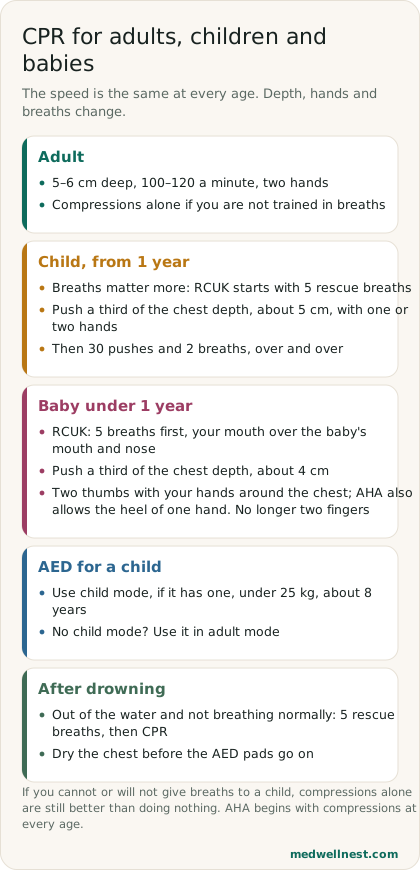
Children are different. RCUK says cardiac arrest in babies, children and teenagers usually comes from a breathing or circulation problem, not from the heart itself, and the AHA says effective breathing is paramount for them. The AHA recommends CPR with breaths for infants and children, while adding that compressions alone are better than no CPR if you cannot or will not give breaths.
Drowning is the other case. RCUK's first-aid guidance says that once someone is out of the water, unresponsive and not breathing, give five rescue breaths straight away and then start standard CPR, drying the chest before using an AED. Do not go into the water yourself unless you are trained in water rescue.
05
CPR for children and babies
For a child from 1 year, RCUK starts with five rescue breaths, then 30 compressions and 2 breaths, over and over. Push down a third of the depth of the chest, about 5 cm, using one hand or two for a bigger child. Those trained in children's life support use 15 compressions to 2 breaths instead.
For a baby under 1, cover the baby's mouth and nose with your mouth for the five breaths. Push down a third of the depth of the chest, about 4 cm. Both guidelines have dropped the old two-finger method: RCUK now uses two thumbs on the breastbone with your hands wrapped around the chest, and the AHA accepts either that or the heel of one hand. The rate stays at 100 to 120 a minute at every age.
An AED can be used on a child. RCUK says to switch on its child mode, if it has one, for children under 25 kg, about 8 years old, and to use adult mode if there is no child setting. If you are alone with a child and have no phone, RCUK says to give CPR for 1 minute before leaving to get help.
06
Fear of doing harm
People hold back because they fear hurting someone or getting it wrong. RCUK's 2025 guidelines put it bluntly: no greater harm can occur than failing to act when someone needs CPR and defibrillation. It adds that the risk of catching an infection while giving CPR, and the risk of being hurt by an AED shock, are both low.
The details in this guide changed in 2025, especially for babies, so a course taken years ago may have taught you differently. A short practical session is the best way to learn how deep 5 cm really feels. If it ever happens before you have trained, call, push hard and fast, and let the call handler guide you.
When to act
Routine — see a doctor
No emergency now: take a practical CPR course, and refresh it if you trained before the 2025 changes, particularly for babies.
Emergency — act now
Someone is unresponsive and not breathing normally, including gasping: call emergency services on speaker, start chest compressions, and send someone for an AED.
Chest pain that could be a heart attack, even if the person is awake: call emergency services now, because a heart attack can turn into a cardiac arrest.
Values mentioned in this story
Each one opens a visual guide with its normal range and what moves it — upload a report and we place your own numbers on the same scale.
Sources
- Adult basic life support Guidelines 2025 — Resuscitation Council UKresus.org.uk
- Paediatric life support Guidelines 2025 — Resuscitation Council UKresus.org.uk
- How to do CPR — Resuscitation Council UKresus.org.uk
- First aid Guidelines 2025 — Resuscitation Council UKresus.org.uk
- Part 7: Adult Basic Life Support, 2025 Guidelines — American Heart Associationcpr.heart.org
- Part 6: Pediatric Basic Life Support, 2025 Guidelines — American Heart Associationcpr.heart.org
Share this story
Curious where your own values stand?
Two minutes from upload to a full visual picture. Free to analyze.