In short
Use a validated upper-arm monitor, sit quietly for five minutes, take two readings a minute apart morning and evening, and average several days. At home, NICE and NHS guidance treat 135/85 as high, lower than the 140/90 used in a clinic.
Emergency if: Above 180/120 with chest pain, shortness of breath, back pain, numbness, weakness, a change in vision or difficulty speaking: call emergency services now and do not wait for it to come down.
On your report
Creatinine, eGFR (Estimated Glomerular Filtration Rate), Potassium, Sodium +2 more
On this page
01
Why a home reading is worth having
High blood pressure does not usually cause symptoms, and the NHS says the only way to find out if you have it is to get it checked. A single clinic reading can mislead. Some people read higher in front of a doctor, which NICE calls the white-coat effect and defines as a difference of more than 20/10 mmHg between clinic and home or ambulatory averages. Others read normal in the clinic but high at home.
That is why NICE confirms a diagnosis with readings taken outside the clinic. It prefers a 24-hour ambulatory monitor, and offers home monitoring when that is unsuitable. Home readings are also how many people track their treatment. The NHS lists your risk as higher if you have a Black African, Black Caribbean or South Asian background, have close relatives with high blood pressure, smoke, drink too much alcohol, eat a lot of salt, are overweight or have been stressed for a long time. It suggests a check if you are 40 or over.
02
Choosing a monitor
The American Heart Association (AHA) recommends an automatic, cuff-style monitor that goes on the upper arm, and says wrist and finger monitors are not recommended. Choose one that has been independently validated for accuracy. NICE points to the British and Irish Hypertension Society's list of validated devices, and the AHA points to validatebp.org.
Cuff size matters as much as the brand. The AHA advises measuring around your upper arm and buying a monitor that comes with the right cuff, because a cuff of the wrong size gives an inaccurate reading. If you have an irregular heartbeat such as atrial fibrillation, tell your doctor: NICE warns that automatic devices may not measure accurately when the pulse is irregular.
Machines differ slightly, so the NHS advises following the instructions for yours. If a doctor or nurse gives you a monitor, they will show you how to use it. Bring your monitor and your written readings along when you see them.
03
The method, step by step
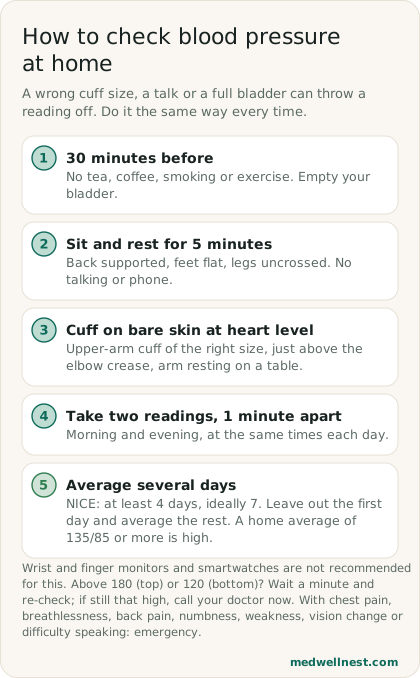
For 30 minutes before, avoid smoking, caffeinated drinks such as tea and coffee, and exercise, and empty your bladder. MedlinePlus also advises against measuring straight after a meal or when you are stressed. Then sit and rest quietly for at least five minutes; MedlinePlus says ten is better. Do not talk or use your phone.
Sit with your back against the chair, feet flat on the floor and legs uncrossed. Rest your arm on a table so the middle of the cuff is at heart level. Put the cuff on bare skin, not over clothes, with its lower edge about 2.5 cm (1 inch) above the crease of your elbow. The AHA says you can use either arm, but NICE advises checking both arms at first and, if they differ by more than 15 mmHg, using the arm with the higher reading from then on.
Take two readings one minute apart and write both down. Do this at the same times each day, once in the morning and once in the evening. Most monitors store readings, but a simple notebook with the date, time and both numbers is easy to take to your doctor.
04
How many readings, and for how many days
When home readings are used to confirm high blood pressure, NICE sets out a clear protocol. Take two readings at least one minute apart, seated, twice a day, ideally morning and evening. Keep going for at least 4 days, ideally 7. Then discard the first day's readings and average all the rest.
The average of the remaining days is what the diagnosis rests on. The NHS adds that your doctor or nurse will tell you how many days they want. MedlinePlus describes a similar approach of readings before breakfast and dinner for 5 days, giving at least 10 readings. The AHA's reminder is worth keeping in mind: a single high reading is not an immediate cause for alarm.
05
Home numbers and clinic numbers are not the same
The NHS says blood pressure is usually considered high at 140/90 or higher when checked by a healthcare professional, and 135/85 or higher when checked at home. NICE uses the same pair to confirm a diagnosis. NICE notes that the matching home and ambulatory figures are 5 mmHg lower than clinic ones, which is why the home line is lower.
NICE also grades home averages. Stage 1 is a home average of 135/85 up to 149/94, following a clinic reading of 140/90 to 159/99. Stage 2 is a home average of 150/95 or higher, following a clinic reading of 160/100 or more but below 180/120. So if your home average comes out at 138/86, that is above the home line even though it would sit below 140/90 in a clinic.
06
The ACC/AHA categories, and when a reading is an emergency
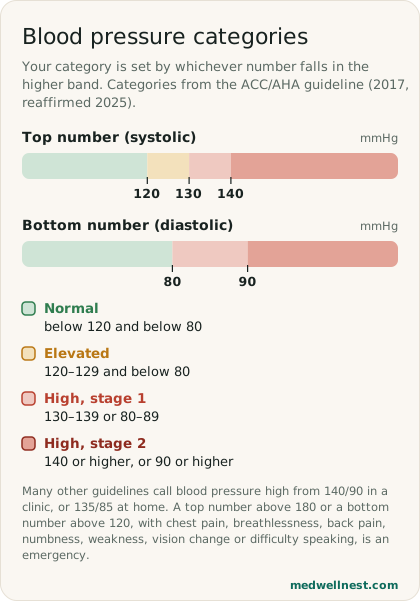
You will often see a different chart, from the American College of Cardiology and the AHA. It was set in 2017, and the 2025 guideline kept the same categories. Normal is below 120 and below 80. Elevated is 120 to 129 with a bottom number below 80. Stage 1 is 130 to 139 or 80 to 89. Stage 2 is 140 or higher, or 90 or higher. Your category is set by whichever number falls in the higher band. Neither chart is wrong; they draw the lines differently, so note which one your doctor uses.
Very high readings need a clear plan. The AHA says that if your reading is suddenly higher than 180/120, wait at least one minute and test again. If it is still that high, contact your doctor straight away, as you could have severe hypertension. If a reading above 180/120 comes with chest pain, shortness of breath, back pain, numbness, weakness, a change in vision or difficulty speaking, it is a medical emergency: call emergency services and do not wait to see whether it comes down.
NICE draws a similar line from the doctor's side. NICE asks for a same-day specialist assessment when a clinic reading is 180/120 or higher together with bleeding or swelling at the back of the eye, or life-threatening symptoms such as new confusion, chest pain, signs of heart failure or sudden kidney injury.
When to act
Routine — see a doctor
A home average of 135/85 or higher over several days, measured the NICE way: book an appointment and take your written readings with you.
Same-day — call promptly
A reading above 180/120 that is still that high when you re-check after at least one minute, with no symptoms: contact your doctor straight away.
Emergency — act now
Above 180/120 with chest pain, shortness of breath, back pain, numbness, weakness, a change in vision or difficulty speaking: call emergency services now and do not wait for it to come down.
Values mentioned in this story
Each one opens a visual guide with its normal range and what moves it — upload a report and we place your own numbers on the same scale.
Sources
- Home Blood Pressure Monitoring — American Heart Associationheart.org
- Understanding Blood Pressure Readings — American Heart Associationheart.org
- Blood pressure measurement — MedlinePlus Medical Encyclopediamedlineplus.gov
- Blood pressure test — NHSnhs.uk
- NG136: Hypertension in adults, diagnosis and management — NICEnice.org.uk
Share this story
Curious where your own values stand?
Two minutes from upload to a full visual picture. Free to analyze.