In short
A lipoma is a soft, slow-growing, usually painless lump of fat under the skin that moves under your finger. It is harmless and most need no treatment, but the NHS says to get any lump checked. A lump that is hard and fixed, growing, bleeding, or painful needs a doctor.
On this page
01
What is a lipoma (charbi ki gaanth)?
A lipoma is a soft, fatty lump that grows under the skin, according to the NHS. It says lipomas are harmless and do not usually need any treatment, but that it is important to get any lump checked by a doctor. The British Association of Dermatologists (BAD) describes it as a non-cancerous lump made up of fat cells, usually in the fatty layer under the skin and rarely in deeper muscles and organs.
The NHS says lipomas feel soft and squishy, can be anything from the size of a pea to a few centimetres across, may move slightly under your skin if you press them, are not usually painful, grow slowly and can appear anywhere on the body. They often appear on the shoulders, chest, arms, back, bottom or thighs. The BAD says they usually remain less than 10 cm across, can be more than one, tend to appear in middle age, and can affect people of all ages.
02
How can I tell a lipoma from a cyst or a boil?
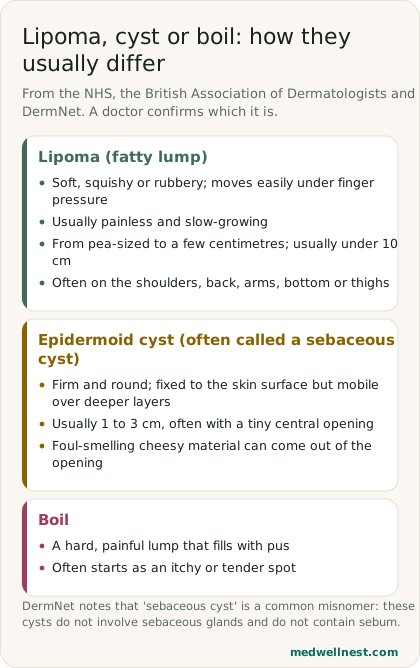
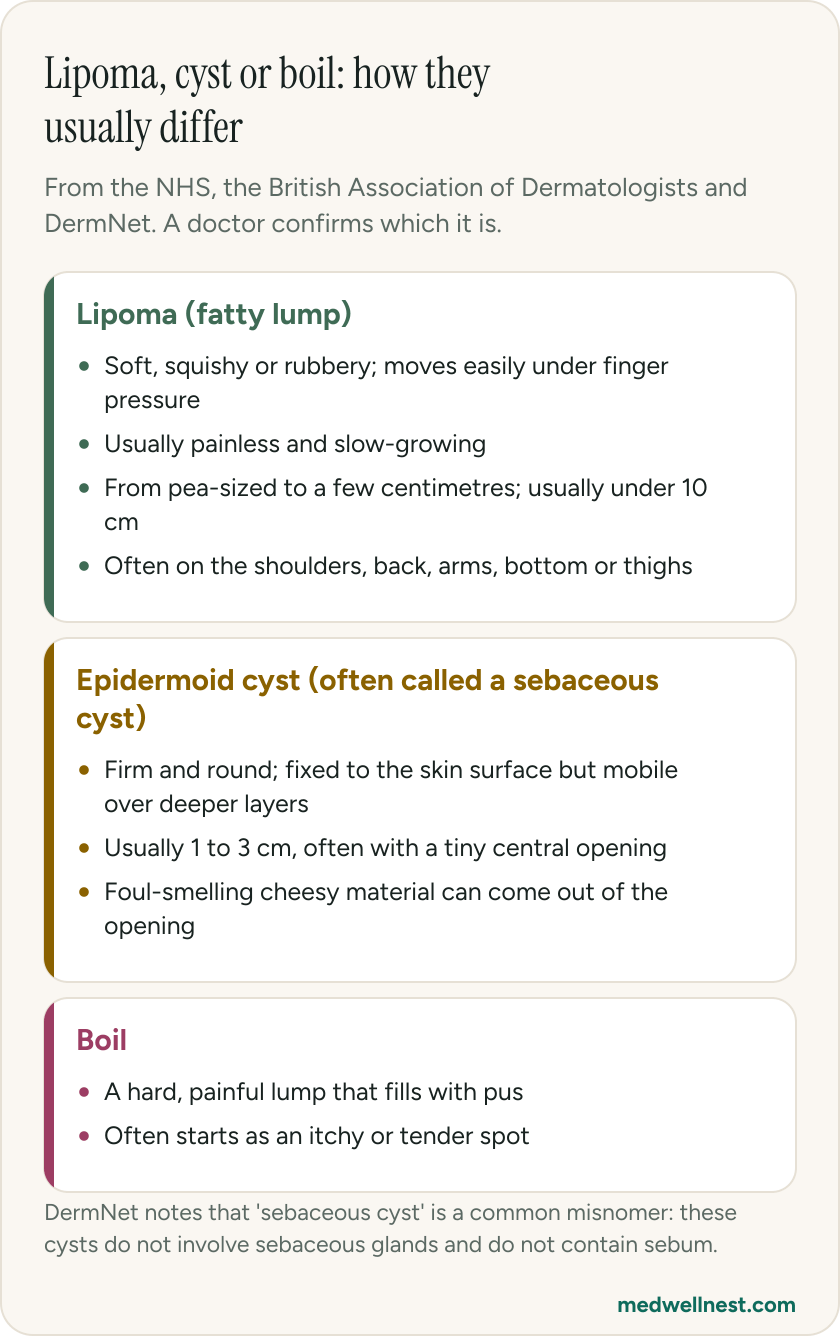
A lipoma is soft or rubbery and moves easily under a finger. DermNet describes it as a mobile, rubbery or soft, smooth, dome or egg-shaped lump under the skin, usually painless, with unchanged skin over it. An epidermoid cyst, often wrongly called a sebaceous cyst, is firmer: DermNet describes a firm, round lump fixed to the skin surface but mobile over deeper layers, usually 1 to 3 cm, often with a tiny central opening from which foul-smelling, cheesy material can come out.
DermNet explains that the name sebaceous cyst is a common misnomer, because these cysts do not involve sebaceous glands and contain no sebum. A boil is different again: the NHS says a boil is a hard, painful lump that fills with pus, and often starts as an itchy or tender spot. Do not pick, squeeze or pierce a boil, the NHS says. The BAD says scans are sometimes needed to tell a lipoma from cysts and other lumps, so a doctor has to examine it.
03
Is a lipoma cancer, and can it turn into cancer?
A typical lipoma is not cancer. The BAD says lipomas are non-cancerous, and DermNet says malignant transformation is exceedingly rare. But the NHS says that in rare cases, lumps under the skin can be a sign of something more serious, which is why a new lump should be seen. The BAD says that if a lump is increasing in size, further investigations such as a biopsy or removal might be organised to rule out the very rare possibility that it is a cancer such as liposarcoma.
Epidermoid cysts are also usually benign. DermNet says cutaneous squamous cell carcinoma may very rarely arise within one. The practical point is the same for any lump: a soft, painless, slow-growing lump that moves is the usual pattern of a lipoma, and a lump that changes is the reason to be examined.
04
When should I see a doctor about a lump, and what is urgent?
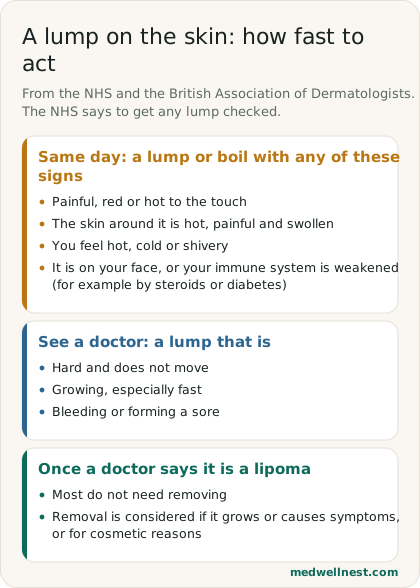
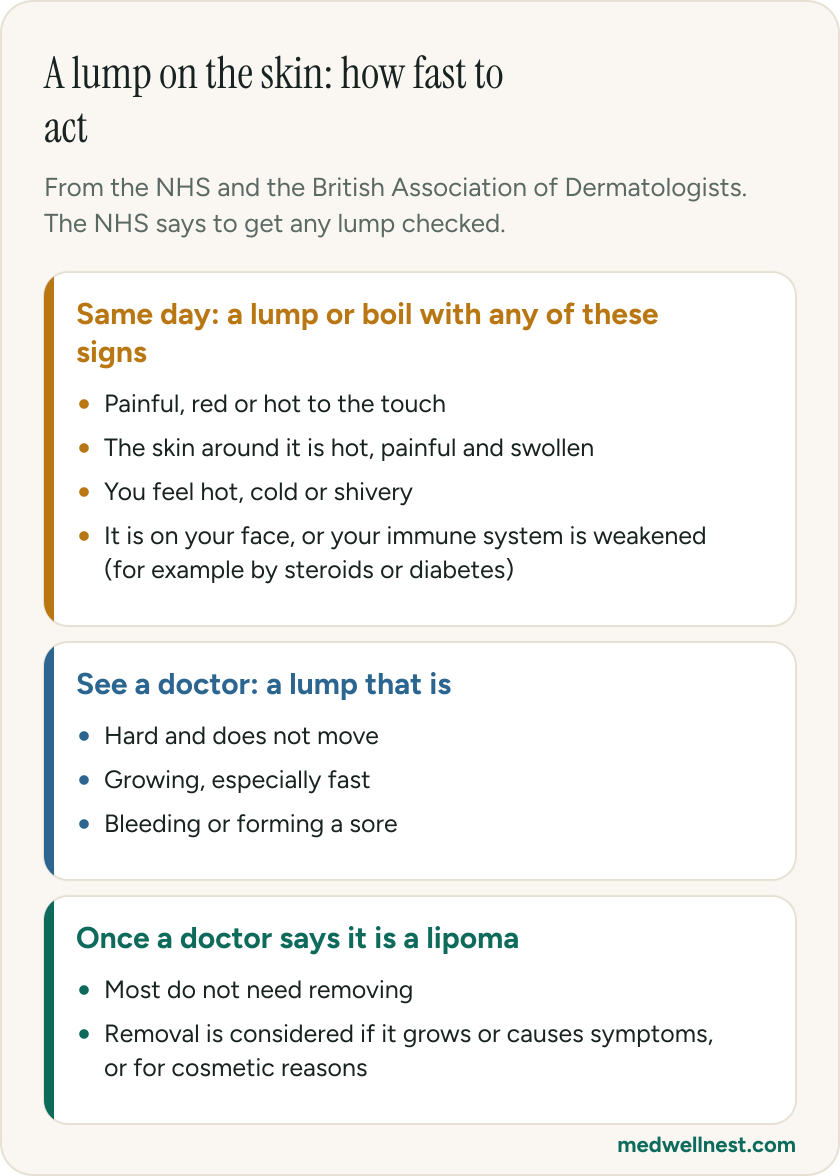
The NHS says to see a doctor if you get a lump anywhere on your body, if a lump is painful, red or hot to the touch, if it is hard and does not move, or if it increases in size. The BAD adds that you should seek advice if a lump develops concerning symptoms such as fast growth, being unable to be moved with finger pressure, bleeding, ulceration, significant pain or pain that is not only from pressure. It says to consult a doctor about any new or growing lump in your skin.
For a boil, the NHS gives a more urgent rule: ask for an urgent appointment if any one of these applies: the skin around it feels hot, painful and swollen, you feel hot, cold or shivery, it is on your face, or you have a weakened immune system, for example from steroids or diabetes. The NHS gives the same urgent advice for any skin lump that is painful, red or hot. DermNet says a cyst that ruptures can swell, redden and become tender, sometimes through infection, so a hot, swollen lump with fever is worth the same urgency. The sources we read do not give a size at which a lump must be checked, so size alone is not the test; change, hardness, fixity and pain are.
05
How is a lipoma diagnosed?
The BAD says a lipoma is diagnosed by examination by a healthcare professional. The NHS says a doctor will usually be able to tell if a lump is a lipoma, and if there is any doubt they may refer you for a scan. The BAD says ultrasound, CT or MRI scans are sometimes needed to tell a lipoma from other benign skin lesions, including cysts, or from cancer tumours, and that a biopsy or full removal may be organised if the lump is growing.
DermNet says lipomas are usually diagnosed clinically, with imaging or a biopsy considered if there is doubt. If a lipoma is removed, the NHS says it may be sent to a laboratory to confirm what it is.
06
Does a lipoma need to be removed, and can it come back?
Most do not. The BAD says there is no medical need to remove the vast majority, and the NHS says it removes lipomas only if they are growing or causing symptoms because of where they are. The BAD says they are often removed for cosmetic reasons. DermNet says lipomas need treatment only if they press on nearby structures and cause symptoms, and most commonly if treated it is for cosmetic concern.
On recurrence, DermNet says local recurrence of a lipoma is rare after surgical removal, and that liposuction or laser techniques give better cosmetic results but have a significantly higher recurrence rate because the capsule is not completely removed. For an epidermoid cyst, DermNet says that if the cyst has ruptured or the capsule is not removed in its entirety, it may recur, and that most small uncomplicated cysts do not need treatment. If a cyst becomes infected, DermNet says antibiotics and drainage may be needed, so see a doctor rather than trying to squeeze it.
A lump under the skin: how fast to act
Routine — see a doctor
You have a new lump, or a lump that is hard and does not move, growing, bleeding or forming a sore: see a doctor. The NHS says to get any lump checked, and the BAD lists fast growth, a lump that cannot be moved with finger pressure, bleeding, ulceration and significant pain as reasons to seek advice.
Same-day — call promptly
You have a lump or boil that is painful, red or hot, or the skin around it is hot and swollen, or you feel hot, cold or shivery, or it is on your face, or you have a weakened immune system from steroids or diabetes: ask for an urgent appointment and be seen the same day. This is the NHS advice for a boil or a skin abscess, and DermNet says an inflamed or ruptured cyst can swell and redden. Do not squeeze or pierce it.
Sources
- Lipoma — NHSnhs.uk
- Lipoma: patient information leaflet (June 2024) — British Association of Dermatologistsbad.org.uk
- Lipoma — DermNetdermnetnz.org
- Epidermoid cyst — DermNetdermnetnz.org
- Boils — NHSnhs.uk
- Skin abscess — NHSnhs.uk
Share this story
Curious where your own values stand?
Two minutes from upload to a full visual picture. Free to analyze.