In short
Sarcopenia is a loss of muscle strength that raises the risk of falls and lost independence. Strength training is the best-supported response, and a consensus paper sets cut-offs for grip and chair rises. Sudden weakness on one side is a stroke emergency.
Emergency if: Weakness or numbness comes on suddenly on one side of the body, one side of the face droops, you cannot lift both arms and keep them up, or your speech is slurred or confused: call emergency services now, even if the signs go away within minutes. The NHS says this is a possible stroke, and also to call for signs that happened in the last 24 hours and have stopped.
On this page
01
What is sarcopenia (budhape mein kamzori), and is muscle loss after 50 normal?
Sarcopenia is a muscle disease, not simply a part of getting older, according to the 2019 EWGSOP2 consensus, the second report of the Working Group on Sarcopenia in Older People. The paper calls it muscle failure rooted in adverse muscle changes that build up across a lifetime, common in older age but able to occur earlier in life. Muscle mass and strength rise through youth, peak in young adulthood (up to about 40 years of age), are maintained in midlife and then fall. Beyond the age of 50, loss of leg muscle mass of 1 to 2% a year and loss of strength of 1.5 to 5% a year have been reported.
It matters because of what low strength leads to. EWGSOP2 says sarcopenia increases the risk of falls and fractures, makes everyday activities harder, is associated with heart disease, lung disease and cognitive impairment, and contributes to lower quality of life, loss of independence or a need for long-term care, and death. It also separates primary sarcopenia, when no cause other than ageing is evident, from secondary sarcopenia, when other causes are evident, such as cancer or organ failure. So weakness is not always ageing alone.
02
How do I check muscle strength: grip strength, the chair stand test and walking speed?
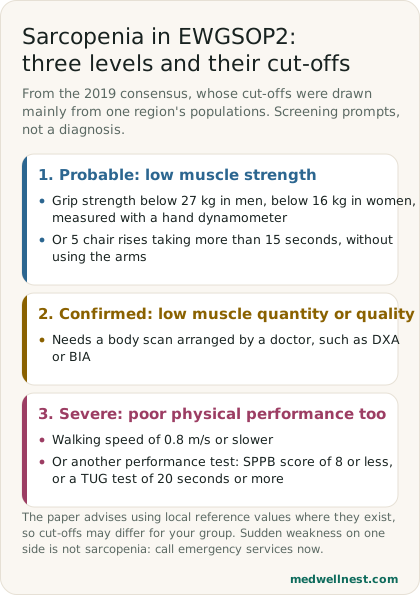
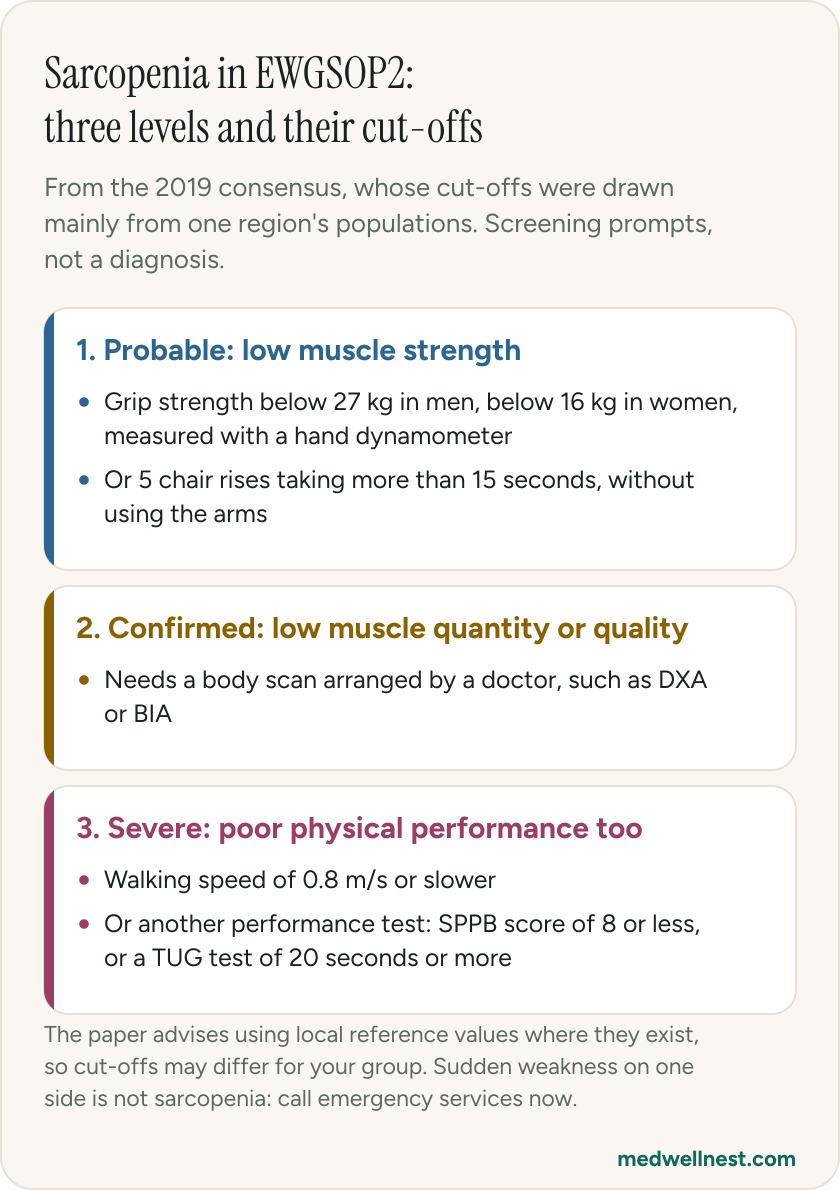
EWGSOP2 puts low muscle strength first. Sarcopenia is probable when low strength is found, it is confirmed when low muscle quantity or quality is also found, and it is called severe when poor physical performance is present as well. The cut-offs in its table are grip strength below 27 kg in men and below 16 kg in women, five rises from a chair taking more than 15 seconds, and a walking speed of 0.8 m/s or slower. Other performance cut-offs are an SPPB score of 8 or less and a timed up-and-go test of 20 seconds or more.
Grip strength has to be measured with a calibrated handheld dynamometer under defined conditions, so a rough squeeze at home cannot be compared with the 27 kg and 16 kg figures. The chair stand test times how long it takes to rise 5 times from a seat without using the arms. A simple version can be tried at home with a sturdy chair and a clock, as an impression and not a diagnosis. Confirming low muscle quantity needs a body scan such as DXA or BIA arranged by a doctor.
Two cautions from the paper. Its cut-offs were drawn mainly from one region's populations, and the authors recommend using local reference values where they exist, so the numbers may differ for other groups. And its SARC-F questionnaire, five questions on strength, walking, rising from a chair, climbing stairs and falls, has low-to-moderate sensitivity and very high specificity, so it mostly detects severe cases.
03
Can strength training reverse muscle loss after 50? What does the evidence say?
A Cochrane review of progressive resistance strength training in older adults, with searches that ended in 2008, pooled 121 trials with 6,700 participants. In most trials the training was done 2 to 3 times a week at high intensity. It had a large positive effect on muscle strength, a moderate to large effect on getting out of a chair (11 trials, 384 participants) and a modest improvement in walking speed (24 trials, 1,179 participants; on average 0.08 m/s faster), and a small but significant improvement in overall physical ability.
Serious adverse events were rare and none was reported to be directly related to the exercise programme, but muscle soreness and joint pain were reported in many studies. The reviewers note that adverse events were poorly recorded, so some caution is needed in applying the results to people with medical conditions. This is an older review. EWGSOP2 says there are more and more ways of preventing, delaying, treating and sometimes even reversing sarcopenia through early and effective interventions. The WHO guideline adds high-certainty evidence that balance and functional exercises reduce the rate of falls.
04
How much exercise do adults over 65 need, and do the NHS and WHO say the same?
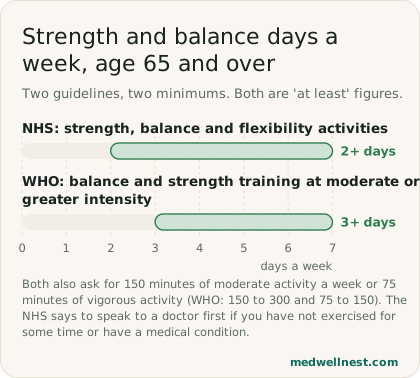
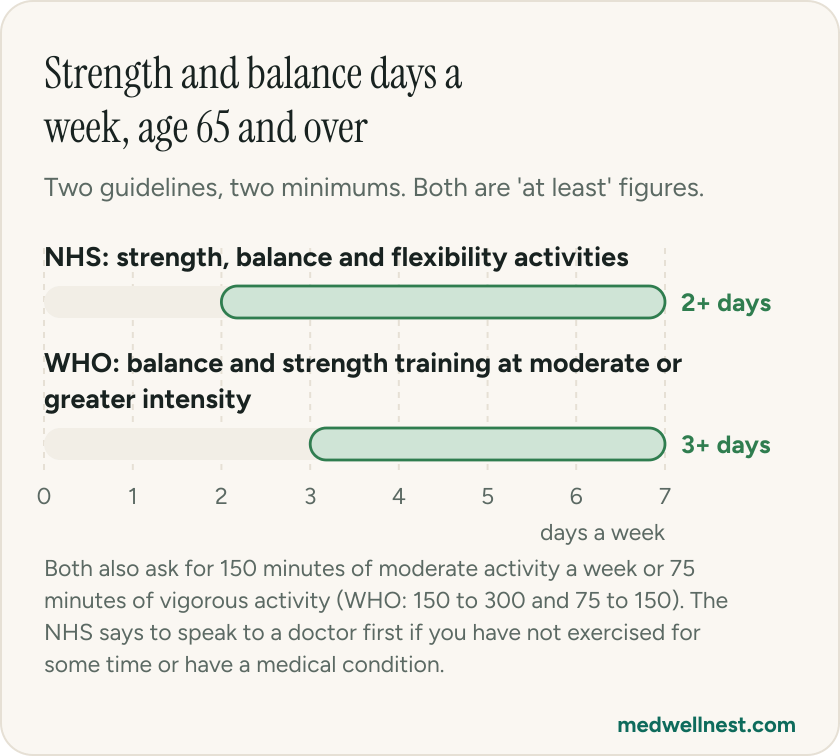
The NHS says adults aged 65 and over should be physically active every day, even if only lightly; do activities that improve strength, balance and flexibility on at least 2 days a week; and do at least 150 minutes of moderate activity or 75 minutes of vigorous activity a week, or a combination. For strength work it says to do the exercise to the point where you need a short rest before repeating it. Its examples include lifting weights, resistance bands, exercises using your own body weight, yoga, pilates, tai chi, carrying heavy shopping bags and heavy gardening. It says to speak to a doctor first if you have not exercised for some time or have medical conditions.
The WHO 2020 guideline asks adults for 150 to 300 minutes of moderate or 75 to 150 minutes of vigorous activity a week, and says older adults should also do varied multicomponent activity that emphasises functional balance and strength training at moderate or greater intensity on 3 or more days a week, to enhance function and prevent falls. It says to start with small amounts and build up, and that some activity is better than none. The two guidelines differ by a day, and both give minimums. A doctor or physiotherapist can help you choose what is safe for your joints, heart and balance.
05
How much protein do older adults need for muscle, and do I need supplements?
The PROT-AGE study group, an international expert panel convened by a geriatric medicine society with other scientific organisations, recommended in 2013 that people over 65 take in an average of at least 1.0 to 1.2 g of protein per kilogram of body weight per day, to maintain and regain lean body mass and function. For someone weighing 60 kg that works out at 60 to 72 g a day. It advises 1.2 g/kg or more for those who exercise and are otherwise active, and says most older adults with acute or chronic disease need more, 1.2 to 1.5 g/kg. It recommends both endurance and resistance exercise at levels that are safe and tolerated.
There is an important exception: older people with severe kidney disease (estimated GFR below 30 mL/min/1.73 m2) who are not on dialysis may need to limit protein, so ask your doctor before raising protein if you have kidney disease. On protein quality, timing and supplements, the group says the evidence is not yet enough to support specific recommendations, so no supplement amount can be given here. This is an expert position paper, not a trial. Our protein guide covers protein needs in general.
06
When is weakness something else, such as a stroke, or a sign of illness?
Sarcopenia builds up over months and years. Weakness that comes on suddenly is different. The NHS lists face weakness, with one side of the face drooping, arm weakness, meaning you cannot fully lift both arms and keep them there because of weakness or numbness in 1 arm, and speech problems such as slurred or confused speech, as the main signs of a stroke, along with weakness or numbness down 1 side of the body. It says to call emergency services now if you think you are having or have had a stroke, including if you had signs in the last 24 hours that have now stopped. The EWGSOP2 algorithm also tells doctors to consider other reasons for low strength, including depression, stroke, balance disorders and poor circulation in the legs.
Weight loss you did not intend is another reason to see a doctor, not to start a gym plan. EWGSOP2 calls weight loss a major cause of sarcopenia and says sarcopenia can be secondary to illness, especially conditions with inflammation such as cancer or organ failure. Our guide to preventing falls covers what to do after a fall.
Weakness after 50: how fast to act
Routine — see a doctor
You notice slower rising from a chair, a weaker grip, a slower walk or tiring more easily over months: see a doctor, ask about a strength check and whether anything else could explain it, and ask a doctor or physiotherapist about a safe strength and balance plan. Unexplained weight loss with weakness is a reason to see a doctor for the cause, not to start an exercise or protein plan alone. If you have kidney disease, ask before raising protein.
Emergency — act now
Weakness or numbness comes on suddenly on one side of the body, one side of the face droops, you cannot lift both arms and keep them up, or your speech is slurred or confused: call emergency services now, even if the signs go away within minutes. The NHS says this is a possible stroke, and also to call for signs that happened in the last 24 hours and have stopped.
Sources
- Sarcopenia: revised consensus on definition and diagnosis (EWGSOP2) — Age and Ageing, 2019pubmed.ncbi.nlm.nih.gov
- Physical activity guidelines for older adults — NHSnhs.uk
- World Health Organization 2020 guidelines on physical activity and sedentary behaviour — Br J Sports Medpubmed.ncbi.nlm.nih.gov
- Progressive resistance strength training for improving physical function in older adults — Cochrane Review, 2009pubmed.ncbi.nlm.nih.gov
- Evidence-based recommendations for optimal dietary protein intake in older people: PROT-AGE position paper — JAMDA, 2013pubmed.ncbi.nlm.nih.gov
- Symptoms of a stroke — NHSnhs.uk
Share this story
Curious where your own values stand?
Two minutes from upload to a full visual picture. Free to analyze.