In short
Myopia usually starts at ages 6 to 13 and can keep rising until about age 20. More outdoor time is linked to less myopia, while eye exercises and vitamins are not shown to help. Flashes, new floaters, a curtain or sudden blur need emergency care now.
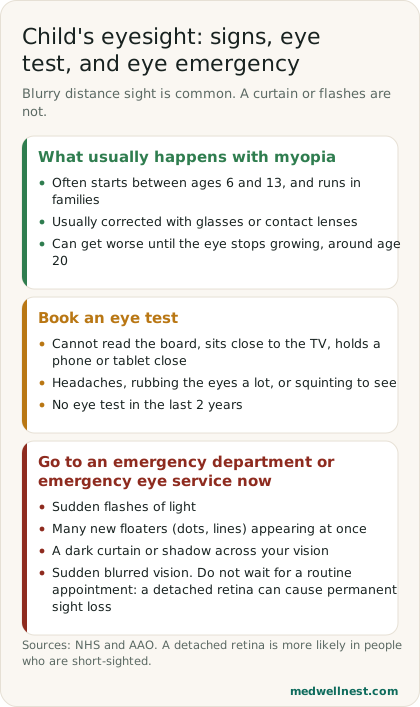
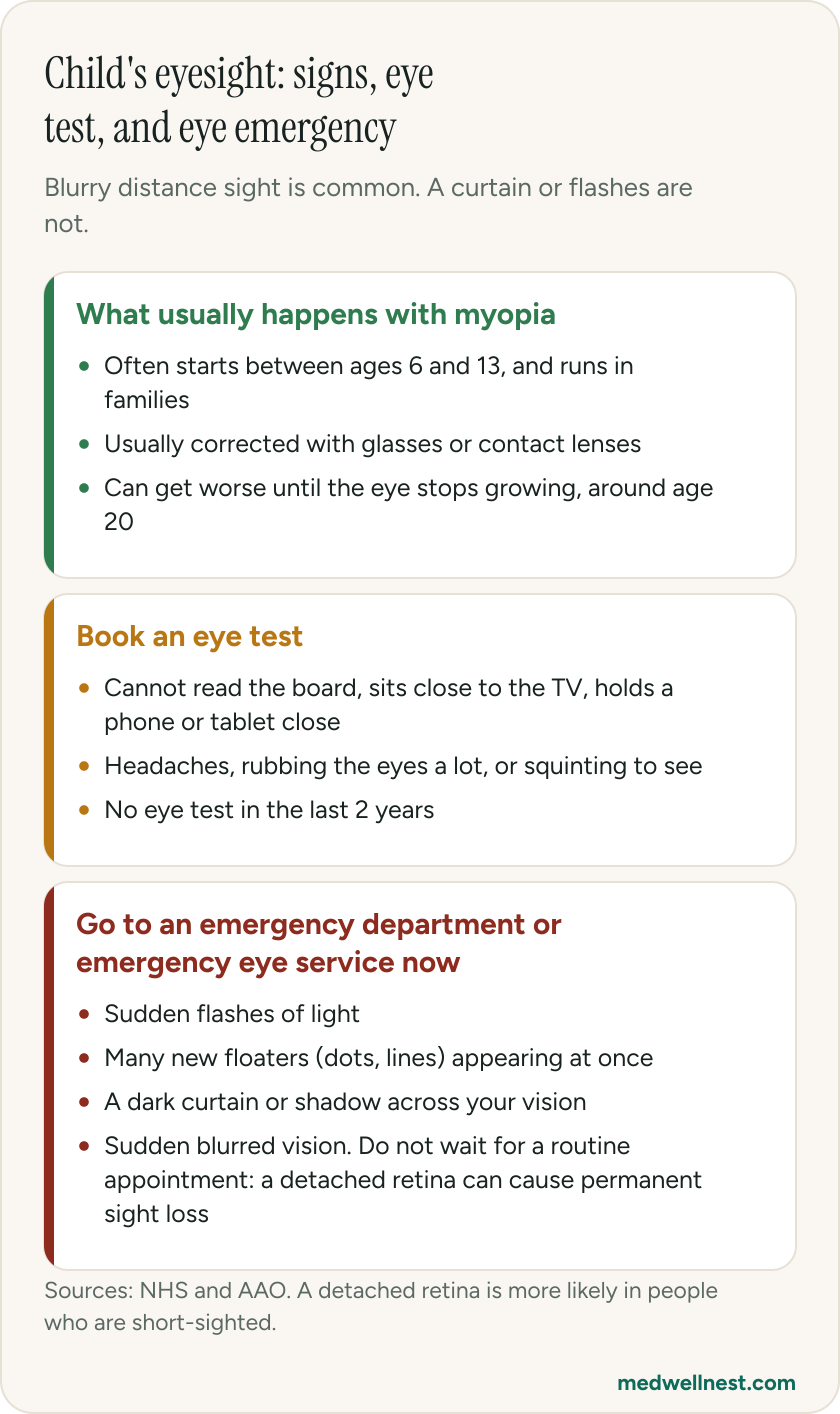
Emergency if: Your child or teenager has flashes of light, many new floaters (dots or lines) appearing at once or increasing suddenly, a dark curtain or shadow moving across their vision, or sudden blurred vision: go to an emergency department or an emergency eye service now. The AAO says a detached retina has to be examined by an eye specialist right away, otherwise sight in that eye can be lost. Do not wait for a routine appointment.
On this page
01
What is myopia, and why does my child's glasses number keep rising?
Myopia, or short-sightedness, means close objects look clear but distant ones are blurry. The AAO says this happens because the eye is longer than normal from front to back, or the front surface of the eye is too steeply curved, so light lands in front of the retina instead of on it. The NHS says it usually starts in children from age 6 to 13, and the AAO says it is often found between 8 and 12.
The number rises because the eye keeps growing. The NHS says short-sightedness can get worse until the eye has stopped growing, usually at around 20 years of age, and the AAO says a child's prescription usually steadies in the 20s, with the teenage growth years being when it may worsen. It often runs in families, but a child can be short-sighted even if neither parent is. The AAO notes that doctors do not completely understand why, and estimates that by 2050 nearly half the people in the world will have myopia.
02
How do I know my child cannot see far, and when should eyes be tested?
The NHS lists the signs: difficulty reading words from a distance such as the school whiteboard, sitting close to the TV or computer, holding a phone or tablet close to the face, headaches and rubbing the eyes a lot. The AAO adds squinting to see properly, and warns that young children might not complain about blurry vision, which is why eye exams and vision tests matter in young children. The NHS says to get an eye test from an optometrist, the eye test specialist, if your child has signs of short-sightedness or has not had an eye test for 2 years.
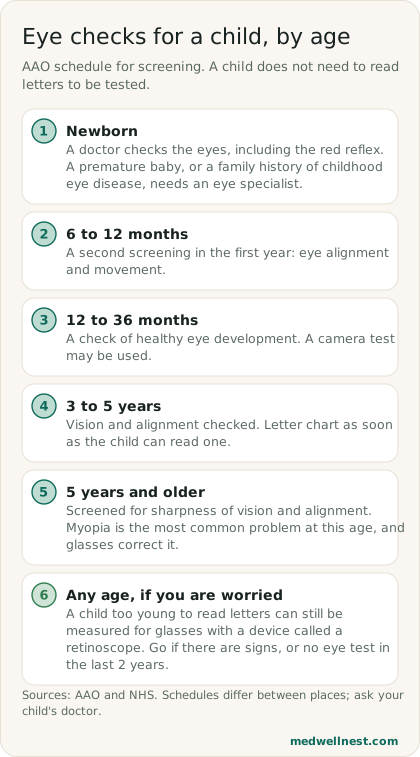
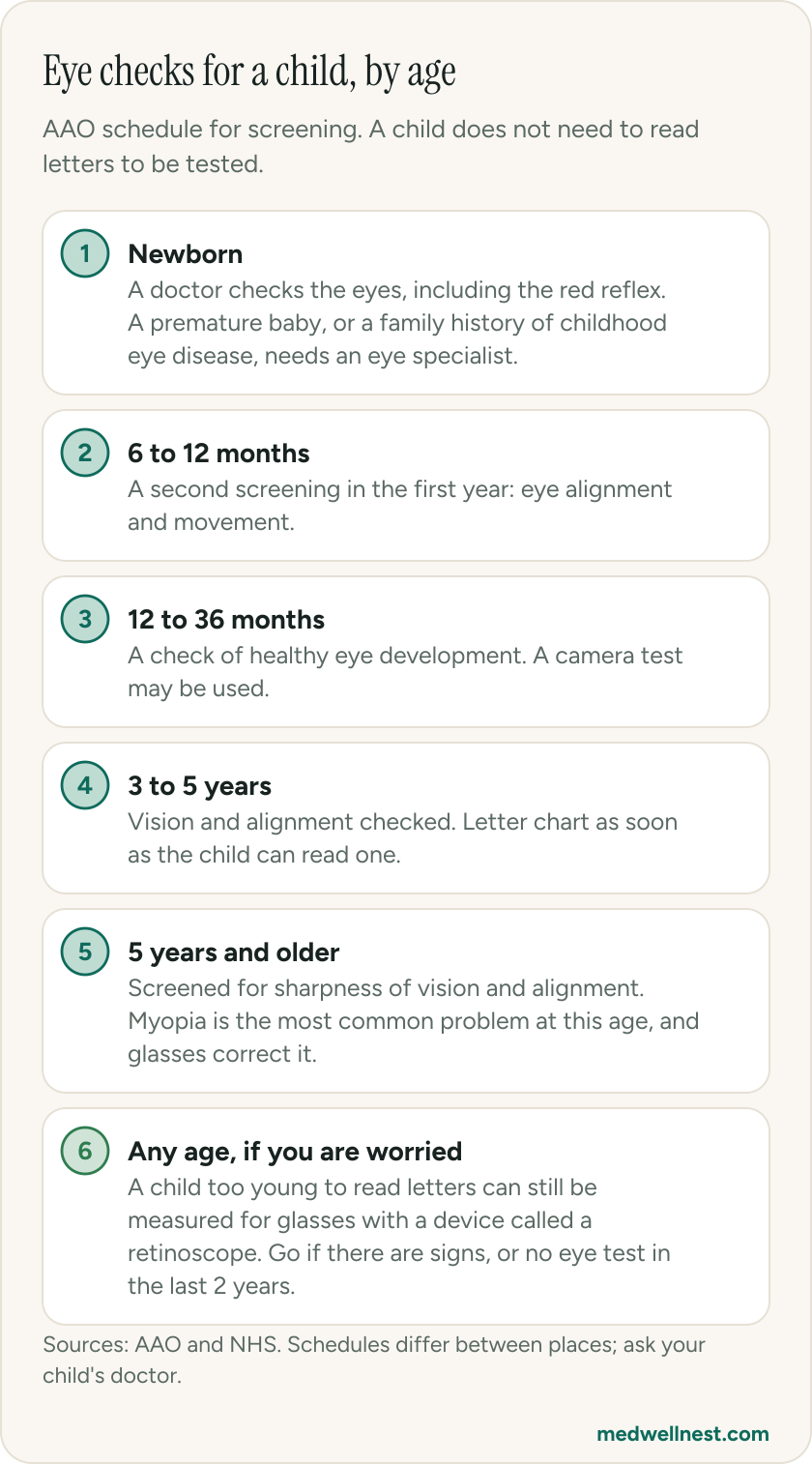
The AAO's screening schedule has checks at birth, between 6 and 12 months, between 12 and 36 months, between 3 and 5 years, and at 5 years and older, when it says myopia is the most common problem and glasses correct it. A comprehensive eye exam is advised if a child fails screening, has a vision complaint or unusual visual behaviour, or is at higher risk. A child too young to read letters can still be measured for glasses, with a device called a retinoscope.
03
Does mobile phone, TV or screen time cause myopia?
The honest answer is that none of the sources here shows that phones or screens themselves cause myopia. The AAO says too much time spent indoors increases a child's risk of myopia and that studies show more time outdoors in natural light reduces it. The IMI report, a consensus of eye researchers, lists less near work among the reasons proposed for why outdoor time helps, alongside brighter light, and says these reasons have not been completely worked out.
That means a phone is not proven to be the cause, and cutting screens alone is not proven to stop myopia. What the evidence supports is balance: the IMI report describes an observational study in which more than 2 hours a day outdoors was linked to lower odds of myopia even in children who did a lot of near work. Keep reading and screen breaks reasonable, but treat outdoor time as the part with the strongest support.
04
Does more time outdoors help, and how much is enough?
It helps with starting myopia, and the evidence is weaker for slowing it once it has begun. The NHS says spending more time outdoors, especially for children, can help stop short-sightedness getting worse, but the IMI report is more specific. It describes trials showing that more outdoor time lowered the number of children who developed myopia, a 2012 review in which each extra hour outdoors per week lowered the odds by 2%, and a 2017 review in which high outdoor time cut new myopia (risk ratio 0.54 to 0.57 compared with low outdoor time) but had no effect on progression in children who were already short-sighted.
One school trial in the IMI report added a 40-minute outdoor class every school day and asked parents to encourage outdoor play. After 3 years, 30.4% of the children in that group had developed myopia, compared with 39.5% in the comparison group. None of the sources gives an amount of outdoor time that is proven to work for every child. The 2 hours a day figure is an association from an observational study, not a prescription. The IMI report says the risks of outdoors, such as more sun exposure and skin cancer, and exposure to pollution, need to be considered.
05
What treatments slow myopia? Do eye exercises, vitamins or special glasses work?
Not exercises or supplements. The AAO says there is no scientific evidence that eye exercises, vitamins or pills can prevent myopia or make it go away. Ordinary glasses and contact lenses correct the blur. Under-correcting does not help either: the Cochrane review found that children whose myopia was under-corrected progressed slightly more than those wearing full-strength single-vision lenses, although the certainty of that evidence was low.
Specialist-directed treatments that slow progression do exist, and they are described here by class only. The Cochrane review of 41 trials with 6772 participants concluded that anti-muscarinic eye drops (the class that includes low-dose atropine) are effective in slowing myopia progression in children, that multifocal lenses may give a small benefit, and that orthokeratology, special contact lenses worn overnight, slowed eye growth. The AAO also describes special contact lenses for children aged 6 to 12 whose centre corrects distance vision while the outer part blurs side vision, which is thought to slow eye growth, and the NHS mentions specially designed glasses or contact lenses, called myopia management, while noting that more research is needed. These all need an eye specialist to choose and monitor. Many studies were at high risk of bias, drops can cause problems focusing close up, and the AAO says orthokeratology carries a risk of serious, vision-threatening eye infection, so ask about benefits and risks for your child before starting.
06
Why does high myopia matter later in life?
A higher number carries more risk of other eye disease in adulthood. The AAO defines high myopia as more than 6 diopters, and says that people with myopia have a higher risk of retinal detachment, and that people with severe myopia also have a higher risk of glaucoma, cataracts and other eye diseases. The more severe the myopia, the greater the retinal detachment risk. The NHS lists the same conditions, plus macular degeneration, for adults with severe short-sightedness. Children with uncorrected short-sightedness may also be more likely to get a squint or a lazy eye, according to the NHS.
This is the reason slowing progression is discussed at all, even though glasses fix the blur. The AAO advises people with severe myopia to see an eye doctor regularly to check the retina and to learn the warning signs of retinal detachment, which are described in the next section.
07
Which eye symptoms in a child or teenager are an emergency?
The AAO says a detached retina, where the light-sensitive layer at the back of the eye lifts away, has to be examined by an eye specialist right away or sight in that eye can be lost, and that short-sighted people are more likely to get one. Go to an emergency department or an emergency eye service now if you suddenly see flashes of light, many new floaters (dots, specks or lines) appear at once, a shadow or grey curtain moves across your vision, or your vision suddenly becomes blurred. Do not wait for a routine appointment.
Ordinary myopia is gradual: slowly blurrier distance sight over months. Anything sudden, or a curtain, is different. Teenagers with high myopia, an eye injury or a family history of retinal detachment should know these signs.
When to act
Emergency — act now
Your child or teenager has flashes of light, many new floaters (dots or lines) appearing at once or increasing suddenly, a dark curtain or shadow moving across their vision, or sudden blurred vision: go to an emergency department or an emergency eye service now. The AAO says a detached retina has to be examined by an eye specialist right away, otherwise sight in that eye can be lost. Do not wait for a routine appointment.
Routine — see a doctor
Your child cannot read the board or sits close to the screen, holds a phone or tablet close, squints, rubs their eyes or gets headaches, has not had an eye test for 2 years, or their glasses number keeps rising: book an eye test with an optometrist or eye doctor, and ask about options to slow progression. Do not rely on eye exercises, vitamins or leaving the child in weaker glasses.
Sources
- Short-sightedness (myopia) — NHSnhs.uk
- Nearsightedness: What Is Myopia? — AAO EyeSmartaao.org
- Eye Screening for Children — AAO EyeSmartaao.org
- IMI Prevention of Myopia and Its Progression — Investigative Ophthalmology & Visual Science, 2021pmc.ncbi.nlm.nih.gov
- Interventions to slow progression of myopia in children — Cochrane Database of Systematic Reviews, 2020pmc.ncbi.nlm.nih.gov
- Detached Retina — AAO EyeSmartaao.org
Share this story
Curious where your own values stand?
Two minutes from upload to a full visual picture. Free to analyze.