In short
Nocturia means waking from sleep to pass urine; sources define it as once or more a night. Causes include too much urine at night, a bladder that holds less, poor sleep, diabetes or an enlarged prostate. A 3-day bladder diary helps find the cause. Being unable to pass urine is an emergency.
Emergency if: You cannot pass urine at all, or you have severe pain or swelling in your lower tummy and the urge to pee with little or nothing coming: go to an emergency department now. NIDDK says to get help right away for an inability to urinate or severe abdominal pain because acute urinary retention can be life threatening. Also go to an emergency department now if urine or kidney infection symptoms come with confusion, drowsiness or difficulty speaking, which the NHS lists as an emergency.
On your report
Fasting Glucose, HbA1c, Creatinine, PSA (Prostate-Specific Antigen)
On this page
01
What is nocturia, and is waking once or twice a night to pee normal?
Nocturia means waking up at night to pass urine. The International Continence Society defined it in 2002 as waking one or more times in the night to urinate, with each time interrupting sleep, according to a 2025 review in the World Journal of Methodology. MedlinePlus explains why it can happen at all: normally the amount of urine your body makes decreases at night, which lets most people sleep 6 to 8 hours without having to get up.
Where the line between normal and a problem sits is debated, and some researchers argue that waking twice or more is the more meaningful threshold. Nocturia becomes more common with age and affects sleep; the 2025 review lists depression, cognitive problems, mood disorders and fall-related injuries among its complications, so it is worth taking seriously when it is frequent.
02
Why do I pee so often at night? What are the causes of nocturia?
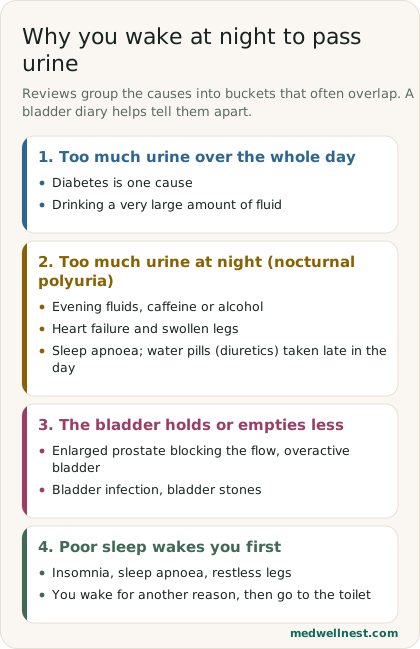
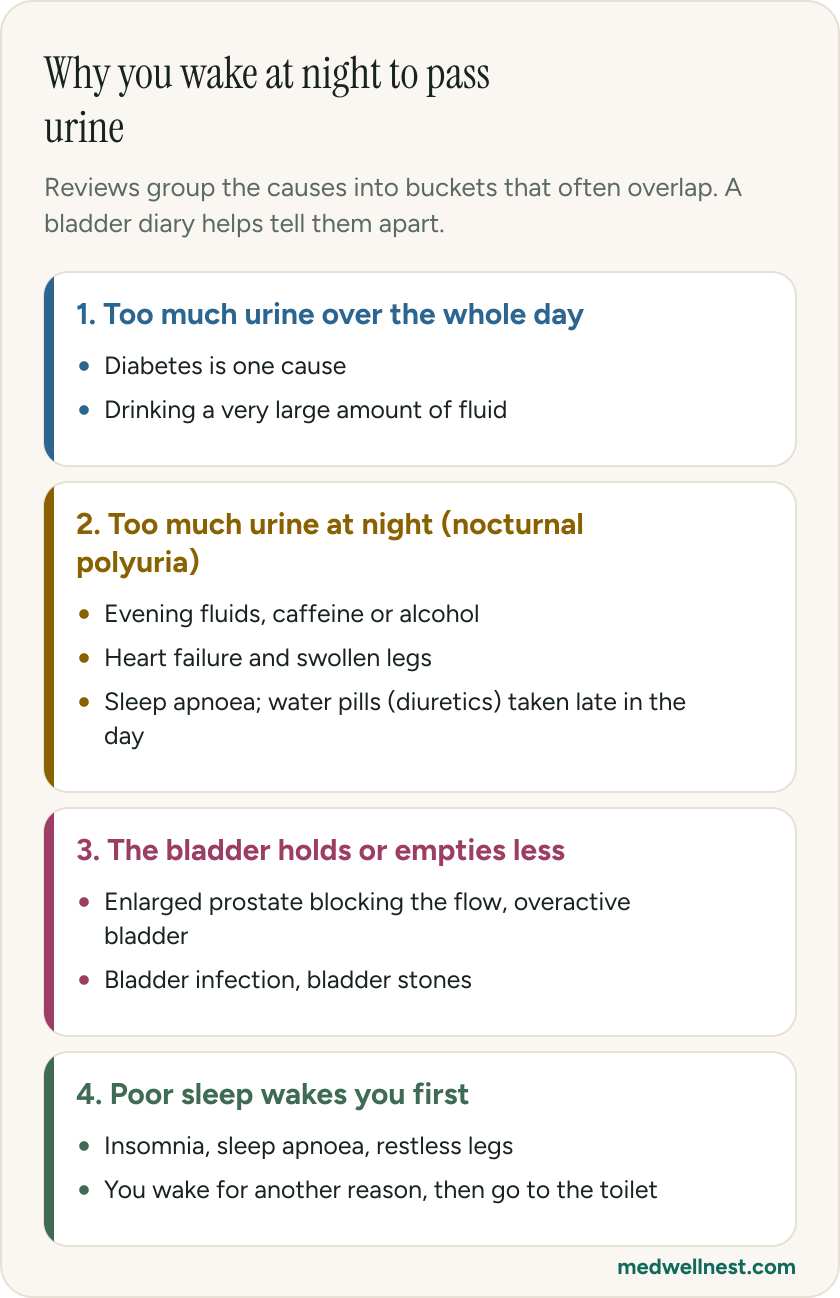
The 2025 review groups the causes into buckets that often overlap. One is too much urine over the whole day, for example from diabetes or drinking a very large amount. A second is nocturnal polyuria, meaning too much urine made at night. A third is a bladder that holds or empties less, for instance because an enlarged prostate blocks the flow, the bladder is overactive, or there is an infection or stones. A fourth is a sleep problem such as insomnia or sleep apnoea, where you wake for another reason and then use the toilet.
Nocturnal polyuria is linked in the review to evening fluids, salt, alcohol and caffeine, to sleep apnoea, to heart failure, and to swollen legs, where fluid that pooled in the legs during the day returns to the blood when you lie down. The timing of water pills (diuretics) can also matter: MedlinePlus says that if night-time urination is due to diuretic medicines, you may be told to take the medicine earlier in the day.
03
Is my night urination from diabetes or the prostate, or something else?
It can be any of these, and you cannot tell from the symptom alone. MedlinePlus lists common causes as a bladder or urinary infection, a lot of alcohol, caffeine or other fluids before bedtime, an enlarged prostate (BPH) and pregnancy. Other conditions it lists include chronic kidney disease, diabetes, drinking an excessive amount of water, heart failure, a high blood calcium level, certain medicines such as water pills, diabetes insipidus and swelling of the legs. It adds that waking often to pass urine can also be linked to obstructive sleep apnoea and other sleep disorders, and that stress and restlessness can wake you up.
Two patterns are worth knowing. The NHS lists getting up to pee in the night among the symptoms of an enlarged prostate, together with a weak flow, straining and feeling you cannot empty fully, and says to get these checked because they can sometimes be caused by other more serious conditions. Common signs of diabetes include peeing more than usual, feeling thirsty all the time, feeling very tired and losing weight without trying. If these fit you, ask for a blood sugar test.
04
How do doctors find the cause? What is a bladder diary?
A bladder diary, also called a frequency-volume chart, is the key tool. MedlinePlus advises keeping a diary of how much fluid you drink, how often you urinate and how much you pass. The NHS says that for an enlarged prostate you will usually be asked to keep a record for at least 3 days, and the 2025 review says 3 days is recommended, though there is no consensus on the exact length. It records the time and volume of each pee, day and night, and what you drank, including alcohol and caffeine.
From the diary a doctor can work out the share of your 24-hour urine passed at night and whether your bladder holds less than expected. MedlinePlus lists tests that may be done, including blood sugar, kidney function (creatinine), electrolytes and a urine test, and the review adds that men may have a PSA test and an ultrasound of the urinary tract, depending on the findings. The NHS says an enlarged prostate is checked with a urine sample, a PSA blood test and sometimes a urine flow test or bladder scan.
05
What is nocturnal polyuria? What do the 20% and 33% numbers mean?
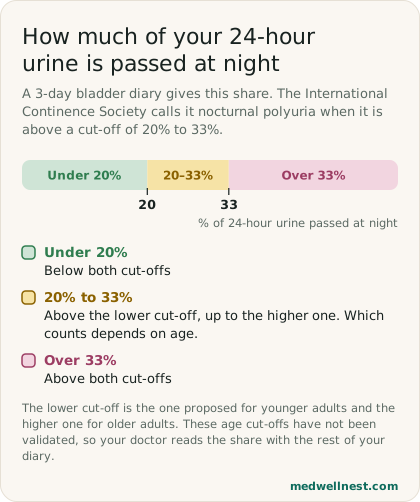
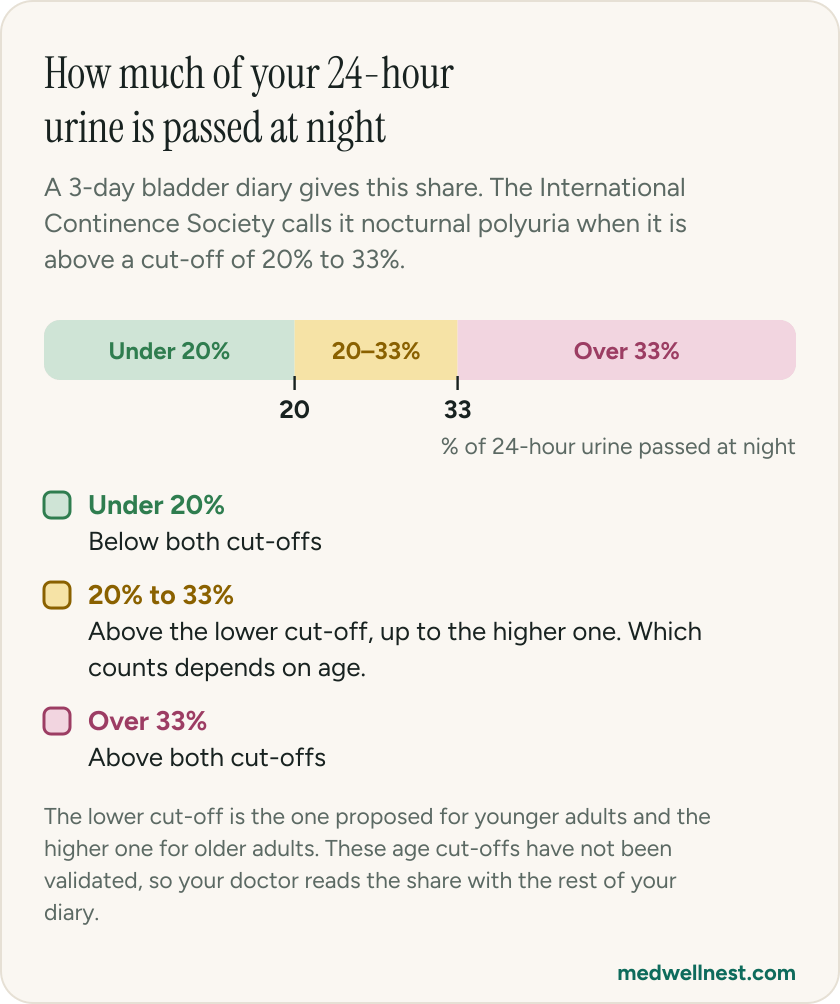
The review says the International Continence Society defines nocturnal polyuria as night-time urine volume above 20% to 33% of the 24-hour total, a percentage adjusted for age, called the nocturnal polyuria index. The night volume counts everything passed from going to sleep up to and including the first pee on waking. The lower figure is the one proposed for younger adults and the higher figure for older adults; one source describes the 33% line as traditionally used from age 65.
These cut-offs are not settled. A 2022 paper says the age groups and thresholds have not been validated and that no consensus definition of nocturnal polyuria has been agreed. The review also quotes another set of age bands (above 20% up to 35 years, above 25% from 35 to 65, above 33% from 65). So treat the numbers as a guide your doctor reads with the rest of your diary, not as a pass-or-fail line for you.
06
How can I reduce waking at night to pee? Do evening fluids and caffeine matter?
Treatment depends on the cause. MedlinePlus says drinking too much fluid in the evening, and caffeine and alcohol with or after dinner, can make you urinate more at night, so cutting these back in the evening is a sensible first step while still drinking enough through the day. Ask your doctor about the timing of water pills rather than stopping any medicine on your own.
If a diary shows nocturnal polyuria, a doctor may consider desmopressin, a synthetic version of the hormone that reduces urine output. The 2025 review says it is widely used for nocturia, but that older people, women and people who start with low blood sodium are more likely to develop low sodium (hyponatraemia), so blood sodium is checked early, from the third day of use. Do not start it without a doctor. If the cause is the prostate, sleep apnoea, diabetes or heart failure, treating that condition is what reduces the night-time trips.
07
When should I see a doctor for night-time urination, and when is it an emergency?
MedlinePlus says to contact your provider if waking to urinate continues over several days, if the number of times bothers you, or if you have pain or burning when urinating or blood in your urine. Blood in the urine needs checking even if it is only a little, so see a doctor today.
Being unable to pass urine is different. NIDDK says to seek help right away if you are unable to urinate or have severe pain in your abdomen, because acute urinary retention can be life threatening; its symptoms include severe pain and swelling in the lower abdomen. A high temperature or shivering with pain in the back or lower tummy, or not having peed all day, are urgent signs of a kidney infection per the NHS.
When to act
Emergency — act now
You cannot pass urine at all, or you have severe pain or swelling in your lower tummy and the urge to pee with little or nothing coming: go to an emergency department now. NIDDK says to get help right away for an inability to urinate or severe abdominal pain because acute urinary retention can be life threatening. Also go to an emergency department now if urine or kidney infection symptoms come with confusion, drowsiness or difficulty speaking, which the NHS lists as an emergency.
Same-day — call promptly
You see blood in your urine, even a small amount, or you have burning or pain when peeing, a high temperature or shivering, pain in your lower back, side or lower tummy, or you have not passed urine all day: see a doctor today. Blood in the pee needs checking even when it is a small amount, and the NHS lists these kidney infection signs as urgent. Very strong thirst with passing a lot of urine, unplanned weight loss or extreme tiredness also needs a blood sugar test soon.
Routine — see a doctor
You wake to pass urine on several nights, it is bothering your sleep, or your legs swell or you snore with pauses in breathing: book a visit and bring a 3-day bladder diary and a list of your medicines. Ask whether your blood sugar, kidney tests, urine test and, for men, PSA should be checked, and when to take any water pills.
Values mentioned in this story
Each one opens a visual guide with its normal range and what moves it — upload a report and we place your own numbers on the same scale.
Sources
- Urinating more at night — MedlinePlus Medical Encyclopediamedlineplus.gov
- Nocturia: An overview of current evaluation and treatment strategies — World Journal of Methodology, 2025pmc.ncbi.nlm.nih.gov
- Differences in the Prevalence of Nocturnal Polyuria by Definition: Epidemiology of Nocturnal Polyuria Study — The Journal of Urology, 2022pmc.ncbi.nlm.nih.gov
- Urinary retention: symptoms and causes — NIDDKniddk.nih.gov
- Enlarged prostate — NHSnhs.uk
- Kidney infection — NHSnhs.uk
Share this story
Curious where your own values stand?
Two minutes from upload to a full visual picture. Free to analyze.