In short
A scan that says polycystic ovaries does not diagnose PCOS, and a scan without them does not rule it out. Here is what the 2023 guideline counts as polycystic ovarian morphology, why AMH can replace the scan in adults, and why teenagers are not scanned for this.
On your report
AMH (Anti-Müllerian Hormone), Testosterone, Total
On this page
01
What the report is describing, and what the condition is called now
Polycystic ovarian morphology (PCOM) is a description of how the ovaries look on ultrasound. The 2023 international guideline for polycystic ovary syndrome says the criteria should be based on follicle excess, ovarian enlargement, or both. The follicles are the small fluid-filled sacs in the ovary that hold immature eggs; the word cysts on a report refers to them, not to the cysts that cause pain or need surgery.
That confusion is one reason the condition has been renamed. In May 2026 a global consensus published in The Lancet gave it the name polyendocrine metabolic ovarian syndrome (PMOS), saying the term PCOS is inaccurate, implying pathological ovarian cysts, and hides its endocrine and metabolic features. The consensus describes a transition period under way, so your report and your doctor may still say PCOS. The criteria below are those of the 2023 guideline.
02
The numbers: follicles, volume and the 2023 thresholds
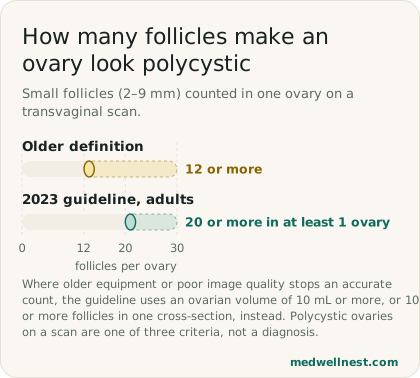
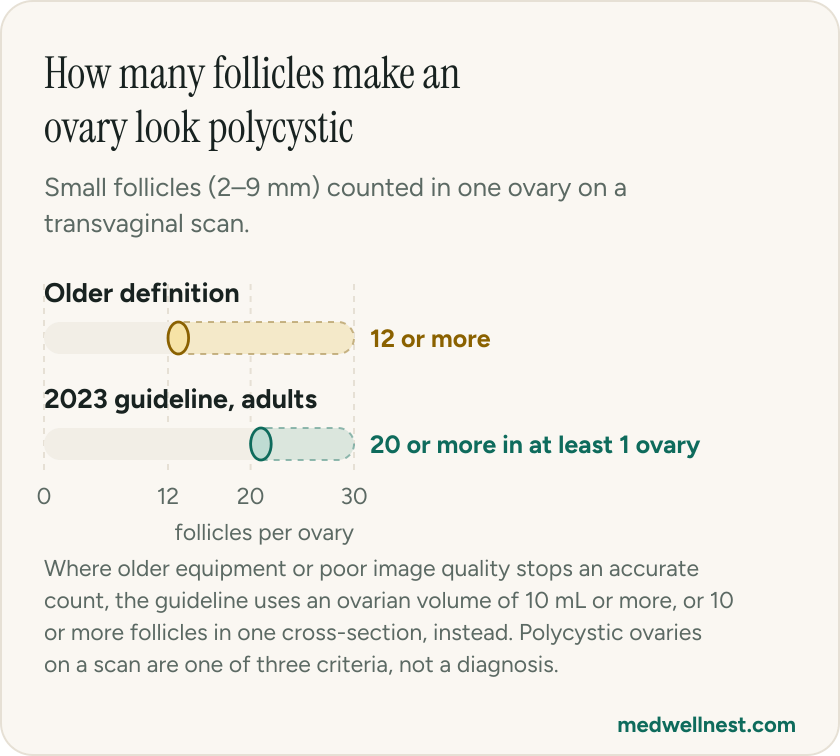
For adults, the 2023 guideline says a follicle number per ovary of 20 or more in at least one ovary should be considered the threshold for PCOM, counting small follicles of 2 to 9 mm. It calls the transvaginal approach, with the probe inside the vagina, the most accurate, if acceptable to you. An ovarian volume of 10 mL or more, or 10 or more follicles in a single cross-section, is the threshold only where older technology or poor image quality stops an accurate count of the whole ovary; a scan through the abdomen should therefore report ovarian volume and use the same 10 mL or 10 follicle cut-offs.
An older definition was 12 or more small follicles in the ovary, and the 'string of pearls' appearance, with follicles lined up around the edge of the ovary, was the historical name for it. A report written to the older rule may call an ovary polycystic where the 2023 count would not, so the exact number matters more than the label. The guideline also recommends that a report give the last menstrual period or cycle stage, the probe frequency and route, the number of 2 to 9 mm follicles in each ovary, the size of each ovary in three dimensions or as a volume, and any cysts, corpus luteum or dominant follicles (a dominant follicle is one of 10 mm or more), which should not be included when the ovarian volume is calculated. Where a dominant follicle is seen, the follicle count of the other ovary is relied on to judge PCOM.
Words such as bulky or enlarged ovaries are descriptive. The guideline defines enlargement only by that volume of 10 mL or more, so ask what number lies behind the word.
03
A scan alone does not diagnose PCOS
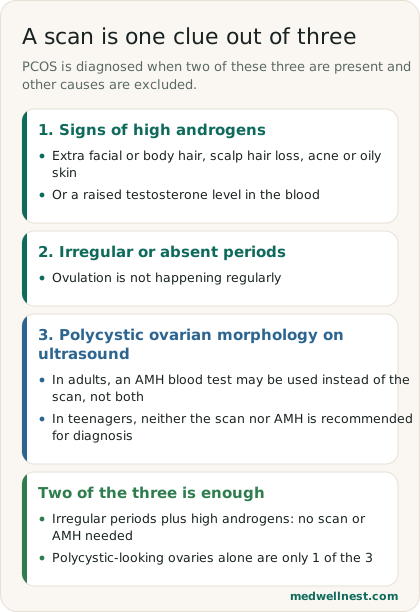
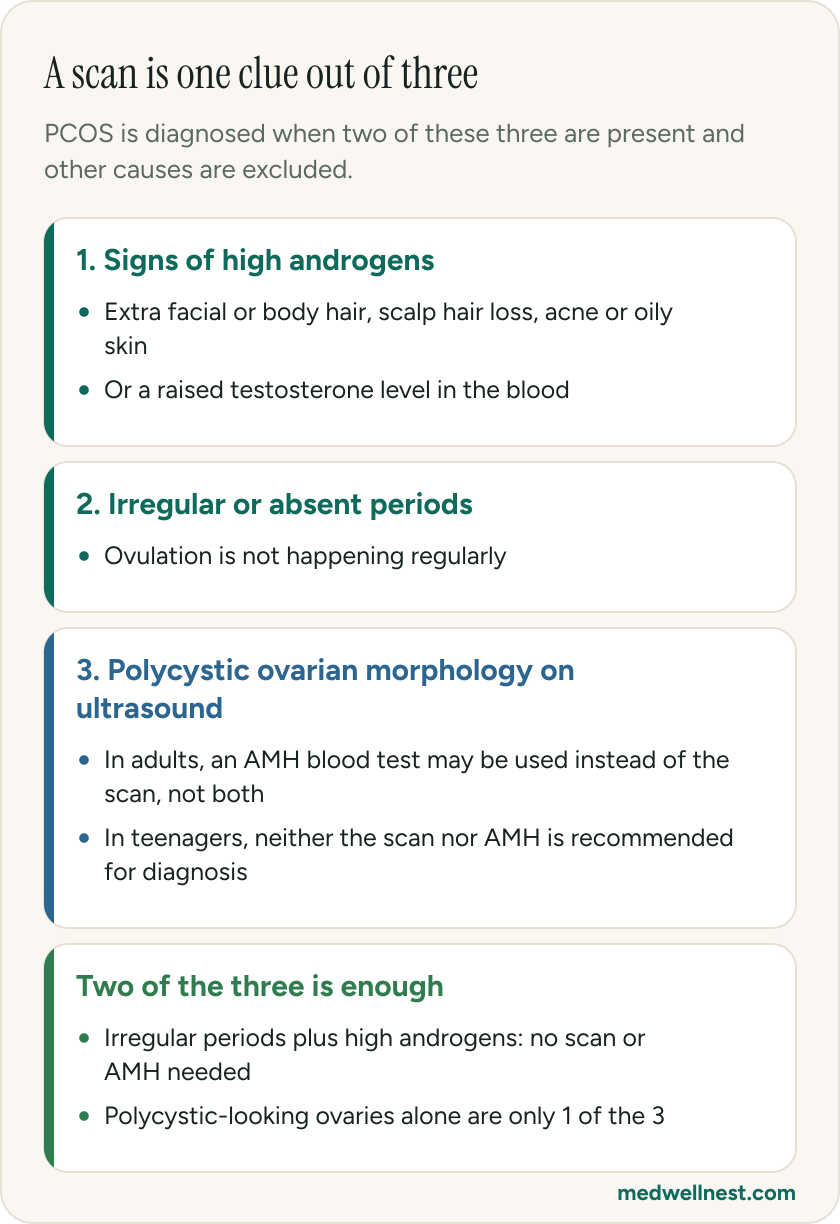
PCOS is diagnosed when at least two of three features are present and other causes have been excluded: signs of high androgens, such as extra facial or body hair, scalp hair loss, acne or oily skin, or a raised testosterone level; irregular or absent periods; and polycystic ovaries on ultrasound. The World Health Organization points out what follows from that: some women with PCOS do not have polycystic ovaries, and ovarian cysts are not required for the diagnosis.
So a report that says polycystic ovaries is one clue, and a report that does not is not a clear result either. The 2023 guideline adds that when irregular cycles and high androgens are both present, an ovarian ultrasound is not necessary for the diagnosis at all. Other causes of the same features have to be excluded first. Our PCOS guide covers the blood tests and the treatment.
04
Teenagers: why the scan is not used
In the years after the first period the ovaries commonly look multi-follicular, so the scan is unreliable then. The 2023 guideline says there are no definitive criteria for PCOM on ultrasound in adolescents, hence it is not recommended, and that AMH should not yet be used in adolescents either. In adolescents both high androgens and ovulatory dysfunction are required for the diagnosis.
The 2018 guideline put the same idea in years: ultrasound should not be used for the diagnosis in those with a gynaecological age of less than 8 years, meaning less than 8 years after the first period, because of the high incidence of multi-follicular ovaries at that stage. The 2023 guideline keeps the 8-year mark in another place, advising reassessment at or before full reproductive maturity, 8 years after the first period, for adolescents who have some features of PCOS but do not meet the criteria. A young woman whose scan, within 8 years of her first period, says polycystic ovaries has therefore not been diagnosed with PCOS by that report.
05
AMH as an alternative to the scan in adults
The 2023 guideline brought in one change that affects scan reports: serum anti-Müllerian hormone (AMH) could be used for defining PCOM in adults, as an alternative to ultrasound. It should not be used as a single test for the diagnosis, and either AMH or ultrasound may be used but both should not be done, to limit overdiagnosis.
AMH needs careful reading. The guideline notes that AMH is lower in people with a higher body mass index, can be suppressed by current or recent use of the combined contraceptive pill, and may vary across the menstrual cycle, and it asks laboratories to use cut-offs specific to the population and the assay. Our AMH guide explains the test itself.
Values mentioned in this story
Each one opens a visual guide with its normal range and what moves it — upload a report and we place your own numbers on the same scale.
Sources
- Recommendations from the 2023 International Evidence-based Guideline for the Assessment and Management of Polycystic Ovary Syndrome — Human Reproductionpmc.ncbi.nlm.nih.gov
- Recommendations from the international evidence-based guideline for the assessment and management of polycystic ovary syndrome (2018) — Human Reproductionpmc.ncbi.nlm.nih.gov
- Polyendocrine metabolic ovarian syndrome, the new name for polycystic ovary syndrome: a multistep global consensus process — The Lancet, 2026doi.org
- Polycystic ovary syndrome — WHO fact sheetwho.int
- Polycystic Ovarian Morphology and Chronic Morbidity and Mortality in PCOS — JAMA Network Open, 2025pmc.ncbi.nlm.nih.gov
Share this story
Curious where your own values stand?
Two minutes from upload to a full visual picture. Free to analyze.