In short
A negative home test is less reliable than a positive one, especially if done early. Retest in a few days to a week. If your period still has not come, stress, weight change, PCOS, thyroid problems, breastfeeding and perimenopause are common reasons. Here is when to see a doctor, and the ectopic signs that cannot wait.
Emergency if: A sudden, sharp, intense pain in your tummy, pain in the tip of your shoulder, feeling very dizzy or fainting, feeling sick or looking very pale, when there is any chance you are pregnant: go to an emergency department now. The NHS says these can mean a ruptured ectopic pregnancy with internal bleeding, which can be life threatening. Do not wait for a repeat test.
On your report
Beta-hCG (Non-Pregnancy / Tumor Marker Use), TSH
On this page
01
Why is my period late when the pregnancy test is negative?
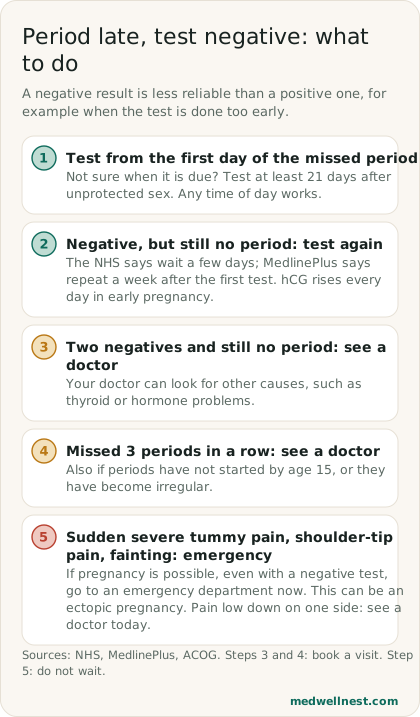
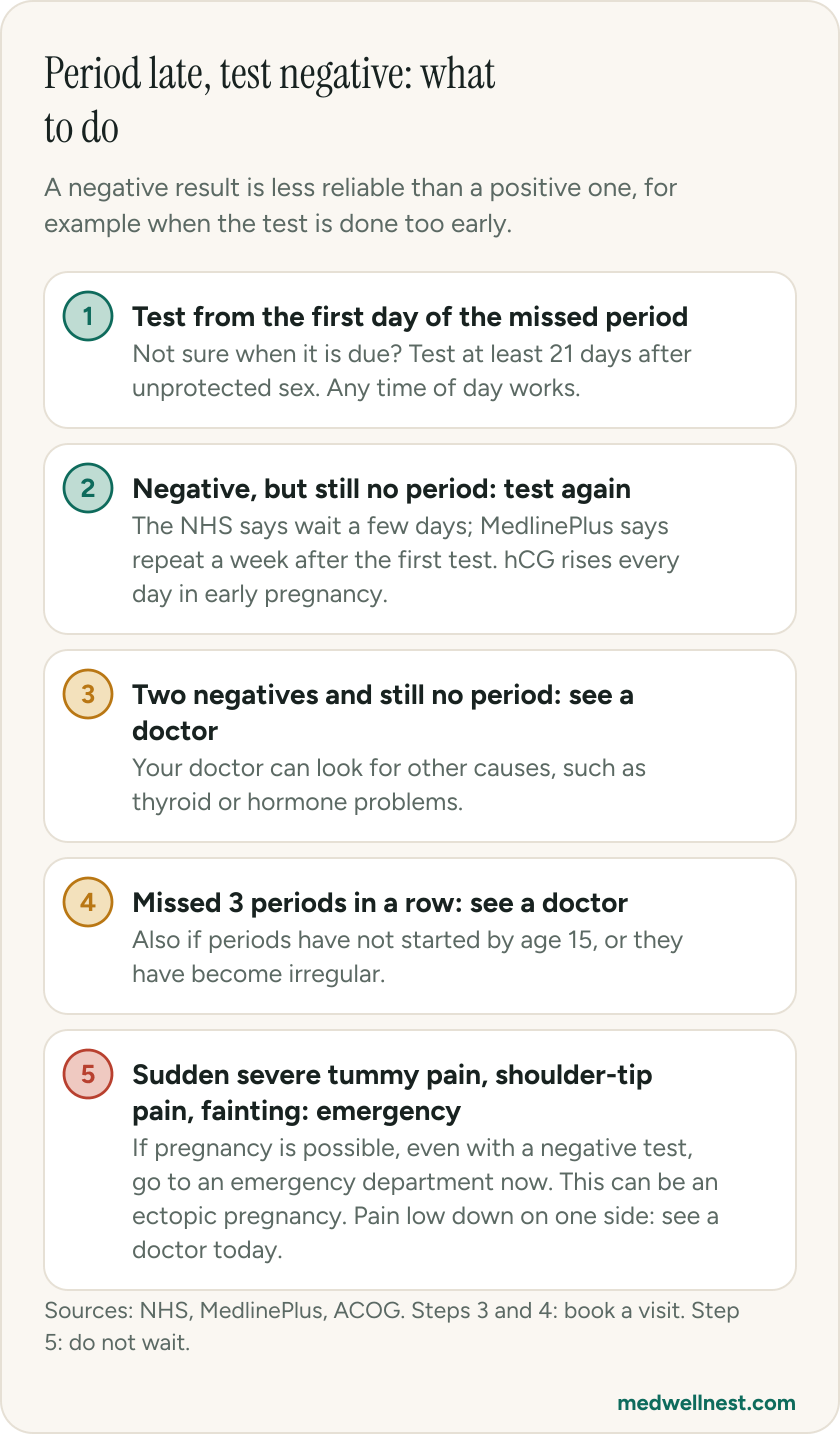
The most common reason is that the test was done too early. The NHS says pregnancy tests are most reliable from the first day of a missed period, and that a positive result is almost certainly correct but a negative result is less reliable. A test also may not be reliable if the instructions were not followed properly. Some medicines can affect results too. All tests detect the hormone hCG, which the NHS says starts to be produced around 6 days after fertilisation, so it takes time to build up.
If your period has never been regular, you may not know when it is due. In that case the NHS says to test at least 21 days after you last had unprotected sex. Tests work on a urine sample taken at any time of the day, not only the first urine of the morning. Being on the contraceptive pill does not stop a test working. If the test is truly negative, the next question is what else can delay a period, covered below.
02
When should I repeat the pregnancy test?
If you still think you are pregnant after a negative result, the NHS says to wait a few days and try again. MedlinePlus says to repeat the test a week after the first one, because hCG levels rise every day in early pregnancy, and notes that urine tests are 97 to 99 percent accurate when done a week or two after a missed period. So the advice varies a little: somewhere from a few days to a week is reasonable.
If you have two negative tests and your period has still not arrived, see a doctor. Our guide to a faint line on a pregnancy test explains what a very faint positive means, and our guide to beta hCG levels by week shows how the hormone rises if you are pregnant.
03
What else can make a period late?
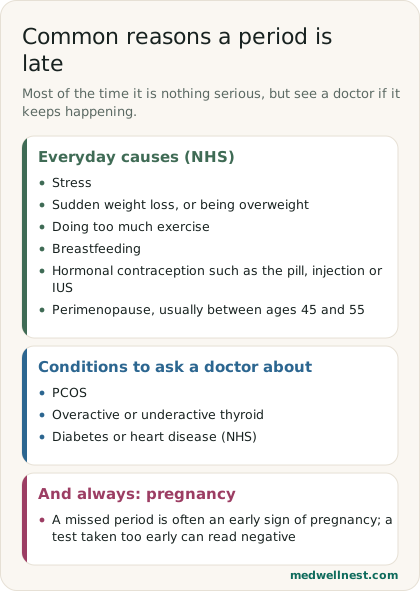
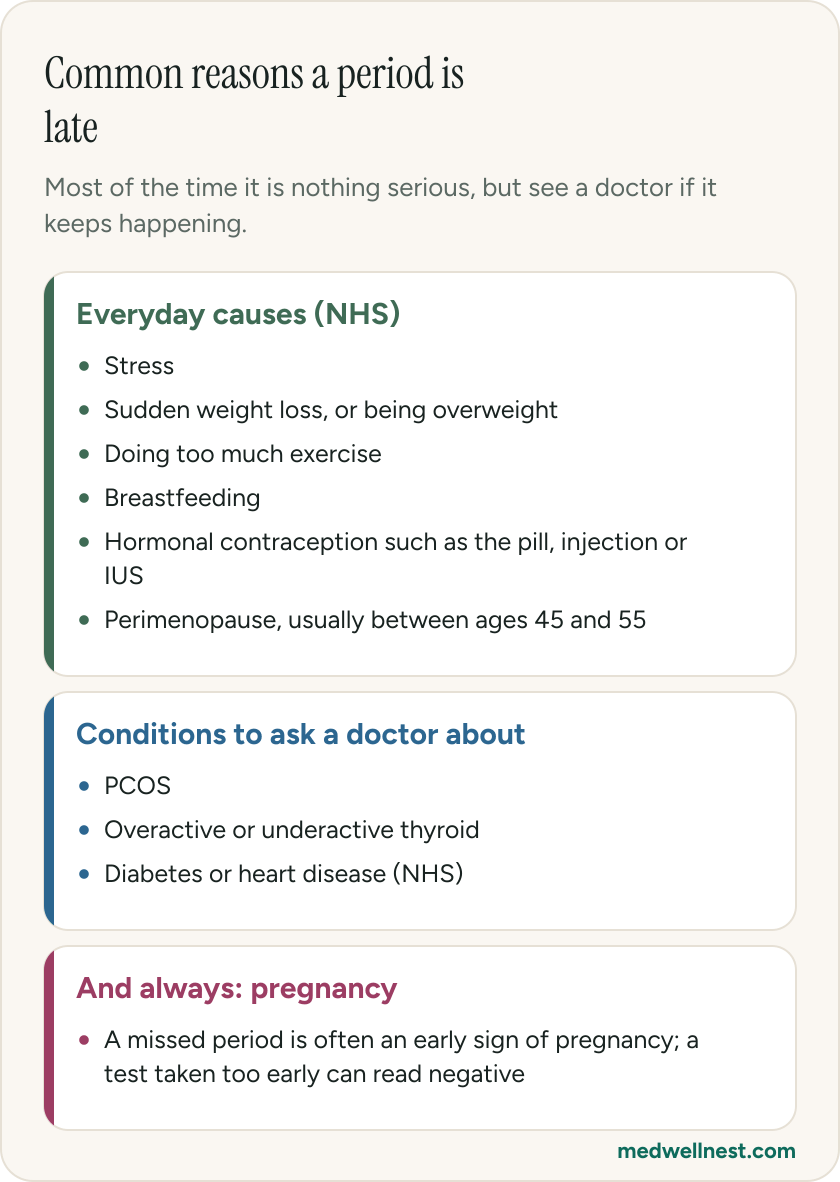
The NHS lists these common causes of a missed or late period: pregnancy, stress, the start of menopause (perimenopause), usually between ages 45 and 55, sudden weight loss, being overweight, doing too much exercise, breastfeeding, and certain hormonal contraception such as the pill, the contraceptive injection or an intrauterine system (IUS). It also says periods can stop because of conditions such as an overactive or underactive thyroid, diabetes or heart disease.
Polycystic ovary syndrome (PCOS) is another common cause. The NHS now calls it polyendocrine metabolic ovarian syndrome (PMOS), which it says used to be called PCOS. ACOG adds low body weight, about 10 percent under normal weight, eating disorders and some medicines, and says hormonal birth control can stop periods while you are taking it. Our guides to PCOS and to the thyroid profile report explain two of these in detail. Most of the time a late period is nothing serious, but see a doctor about it just in case.
04
When should I see a doctor about a late period?
The NHS says to see a doctor if you have missed your period 3 times in a row, if your periods have not started by the time you are 15, if you have missed a period and have other symptoms such as weight gain or weight loss, tiredness, hair growth on your face or dry or oily skin, or if your periods have become irregular. ACOG puts the first rule as no period for more than 3 months without explanation, at any age, and also advises an evaluation for a teenager with no sign of breast development by age 13.
The doctor will ask about your health and may do blood tests to find the cause; ACOG says tests can include hormone levels or an ultrasound. A specialist referral may follow, and treatment depends on the cause. A periods diary or app helps: the NHS says periods are irregular if the gap between them is less than 21 days or more than 35 days.
05
Could a late period and negative test be an ectopic pregnancy?
It is only one of the possible causes, but it is the one that cannot wait, so know the signs if there is any chance you are pregnant. An ectopic pregnancy is one that implants outside the womb, usually in a fallopian tube. The NHS says symptoms tend to appear between the 4th and 12th weeks, and can include a combination of a missed period, tummy pain low down on one side, vaginal bleeding or a brown watery discharge, pain in the tip of the shoulder, and discomfort when peeing or pooing.
The NHS says to contact a doctor if you have a combination of these symptoms and you might be pregnant, even if you have not had a positive pregnancy test. It says a sharp, sudden, intense pain in the tummy, feeling very dizzy or fainting, feeling sick and looking very pale can mean the tube has split open, which is life threatening and needs emergency treatment.
When to act
Emergency — act now
A sudden, sharp, intense pain in your tummy, pain in the tip of your shoulder, feeling very dizzy or fainting, feeling sick or looking very pale, when there is any chance you are pregnant: go to an emergency department now. The NHS says these can mean a ruptured ectopic pregnancy with internal bleeding, which can be life threatening. Do not wait for a repeat test.
Same-day — call promptly
Pain low down on one side, or bleeding or a brown watery discharge, with a missed period and any chance of pregnancy, even if your home test was negative: see a doctor today. The NHS says to get advice right away.
Routine — see a doctor
A second negative test and still no period, three missed periods in a row, periods that have not started by 15, or periods that have become irregular, with or without weight change, tiredness or extra hair growth: book a visit with your doctor to look for the cause.
Values mentioned in this story
Each one opens a visual guide with its normal range and what moves it — upload a report and we place your own numbers on the same scale.
Sources
- Doing a pregnancy test — NHSnhs.uk
- Missed or late periods — NHSnhs.uk
- Amenorrhea: Absence of Periods — ACOG patient FAQacog.org
- Pregnancy Test — MedlinePlusmedlineplus.gov
- Irregular periods — NHSnhs.uk
- Ectopic pregnancy — NHSnhs.uk
Share this story
Curious where your own values stand?
Two minutes from upload to a full visual picture. Free to analyze.