In short
A foreskin that will not pull back is normal in babies and young boys: the NHS says most do not retract before age 5 and some not until 10 or older. Never force it. Pain, infection or scarring need a doctor, and a foreskin stuck behind the head of the penis needs an emergency department now.
Emergency if: The foreskin has been pulled back and will not go back over the head of the penis (paraphimosis), even if it is not yet swollen or painful: go to an emergency department now. Do not drive yourself. Ask someone to drive you or call emergency services, and do not wait to see whether it settles. The NHS and the EAU both call this a medical emergency, because swelling can cut off blood flow to the penis.
On this page
01
Is it normal if my son's foreskin will not pull back?
Yes. The NHS says a tight foreskin, called phimosis, is normal in babies and young boys, that most boys' foreskins do not pull back before the age of 5, and that sometimes it is not possible until they are 10 or older. It also says the foreskins of babies and young boys usually loosen as they get older, so treatment is often not needed. The European Association of Urology (EAU) guideline for paediatric urology agrees that a foreskin that will not retract can be a normal phase that needs no treatment when there are no symptoms.
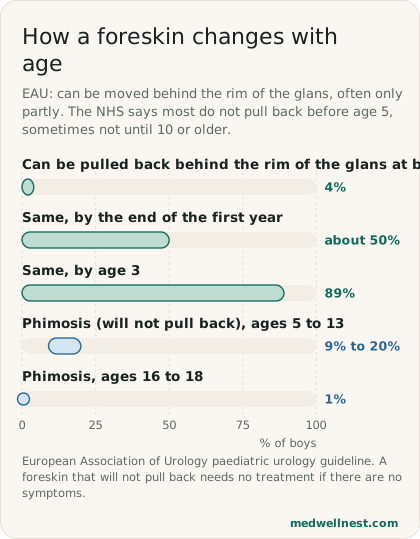
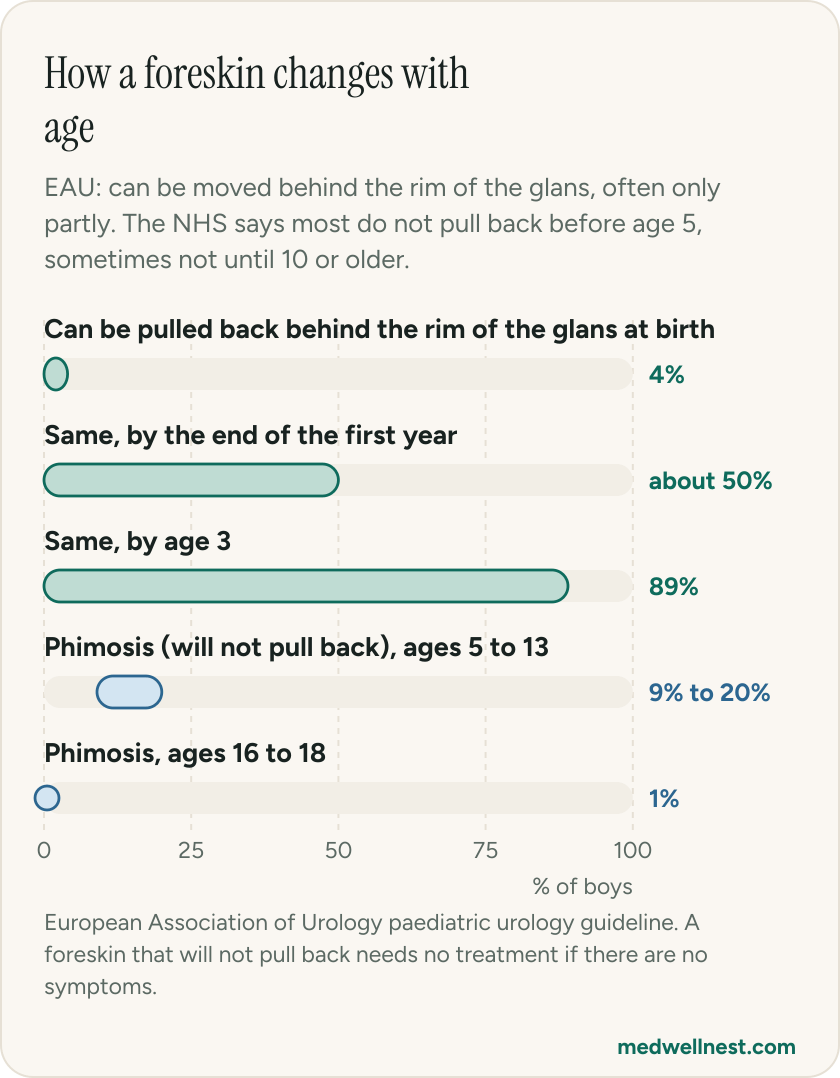
The two sources seem to measure different things. The EAU figures are for when the foreskin can be moved back behind the rim of the glans: in 4% of boys at birth, approximately 50% by the end of the first year and 89% by the age of 3. That is often only partial: the EAU also says the inner foreskin stays naturally stuck to the glans in 63% of 6- to 7-year-olds, and that most boys can retract the foreskin by puberty. The NHS figure, most not before 5 and some not until 10 or older, describes a foreskin that pulls back in the ordinary way. It says phimosis, meaning a foreskin that will not retract because of a narrow ring, occurs in 9% to 20% of 5- to 13-year-olds and in just 1% of males aged 16 to 18. Neither source treats a late-retracting foreskin as a problem in itself.
02
Should I try to pull my baby or young boy's foreskin back to clean it?
No. The NHS says not to pull back the foreskin of a baby or young boy that is still attached to the end of the penis, because it could be painful and damage it, leading to problems in later life. The EAU says the foreskin should not be retracted for cleaning until this can be done easily, and that forced retraction of a narrow foreskin may cause scarring that results in a secondary, pathological phimosis.
Cleaning is simple. For a boy, wash the outside of the penis regularly with warm water, or warm water and a non-perfumed soap, and do not use perfumed soap, talcum powder or deodorants, which may cause irritation. Once the foreskin pulls back easily on its own, the EAU says to wash under it during bathing, which becomes necessary for hygiene from puberty, and to always bring the foreskin back down over the glans afterwards.
03
Why does my son's foreskin balloon when he pees?
Ballooning is often part of normal development. The NHS says the end of a boy's penis may bulge or balloon when he pees, particularly if the foreskin is tight. The EAU says ballooning is not a sign of obstructed urine flow, that tests of flow have been normal with ballooning, and that it may be a physiological phase.
The EAU says ballooning should only be considered a problem when there is recurring balanitis, an inflamed head of the penis, and that simple ballooning of the foreskin during passing urine is not by itself a reason for surgery. Take your son to a doctor if the ballooning comes with pain, a weak stream, difficulty passing urine, blood in the urine or repeated urine infections, which the NHS lists as signs that a tight foreskin has become a problem.
04
When is a tight foreskin a problem, and when should I see a doctor?
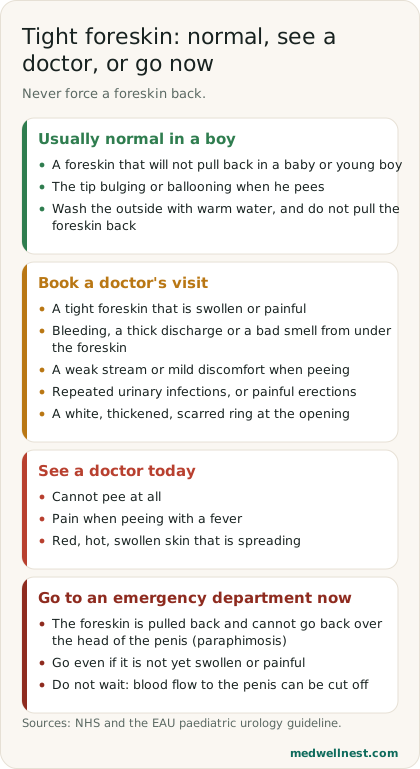
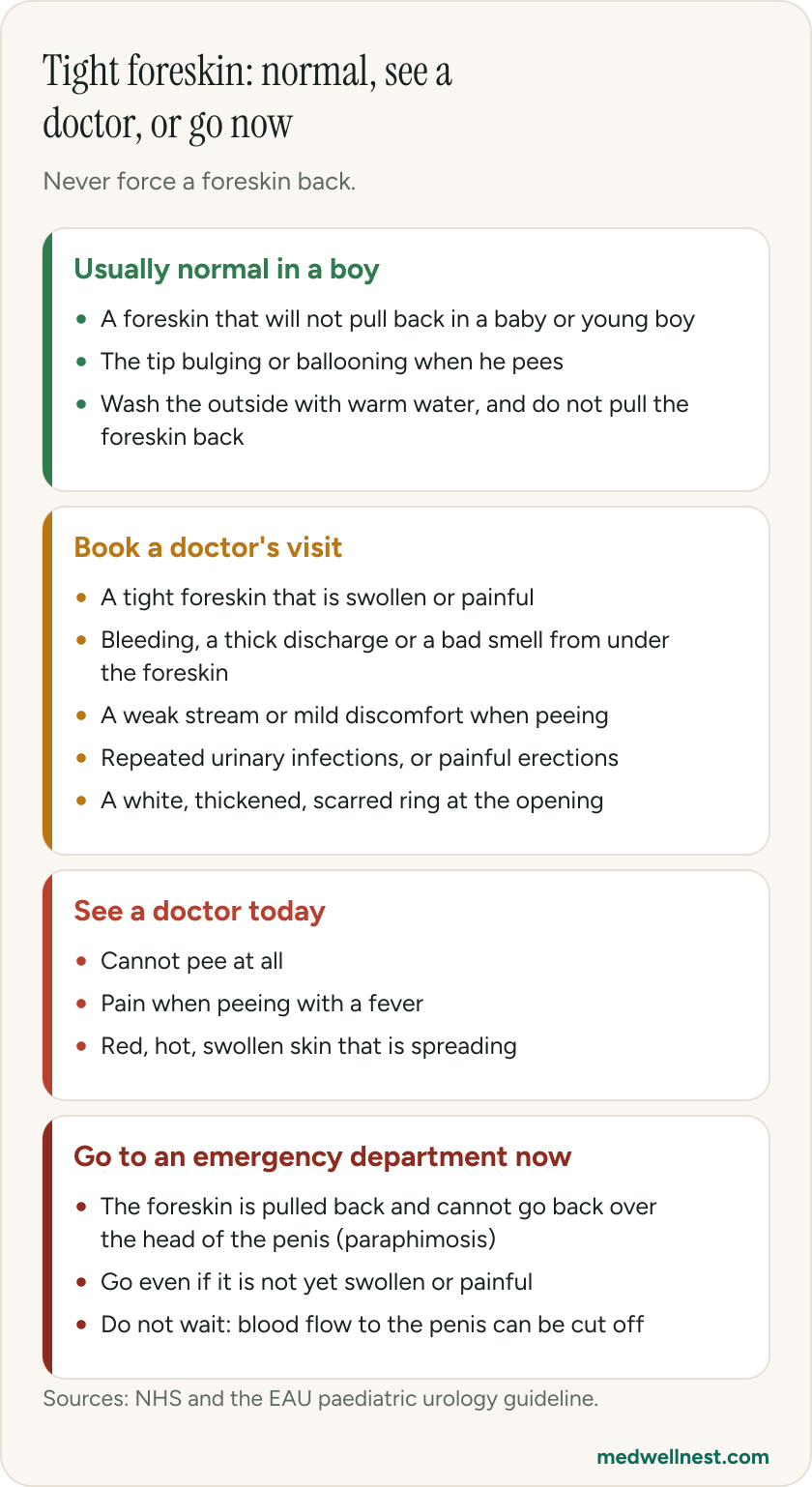
The NHS says a tight foreskin is not usually a problem unless there are symptoms: swelling and tenderness, pain when passing urine or a weak flow, blood in the urine, frequent urinary tract infections, bleeding or a thick discharge from under the foreskin or an unpleasant smell, or painful erections that make sex difficult. It says to see a doctor if the foreskin is tight and swollen or painful, if there is bleeding when passing urine, thick discharge or smell, if there is pain or difficulty passing urine, or if erections are painful.
The EAU separates two kinds. In physiological phimosis there is no scarring, and the inner foreskin is seen bulging outward from the narrow ring when it is retracted. In pathological phimosis there is scarring: the narrow ring is fibrous, often white and thickened. A doctor can tell the difference by examination. The NHS lists steroid creams or gels to soften the foreskin, antibiotics if the area is infected, and surgery, either circumcision or a procedure with small cuts in the foreskin's tip, with the EAU naming topical steroid as first-line treatment for symptomatic phimosis. Which one and how to use it is the doctor's decision.
05
What is paraphimosis, and why is it an emergency?
Paraphimosis happens when a foreskin that has been pulled back cannot go back over the head of the penis. The NHS says that if the foreskin is very tight it can get stuck, and the end of the penis then becomes very swollen and painful. It calls this a medical emergency, because immediate treatment is needed to avoid serious complications such as restricted blood flow to the penis. The EAU says paraphimosis must be regarded as a medical emergency requiring urgent treatment, and that in children it is most likely due to manipulation. The NHS emergency sign is the stuck foreskin itself, and the swelling comes after it, so go to an emergency department now even if the penis is not yet swollen.
If it happens, go to an emergency department now, for a boy or a man. The NHS says not to drive yourself: ask someone to drive you, or call emergency services, and bring any medicines you take. A doctor may be able to return the foreskin to its normal position, and sometimes circumcision is advised afterwards. To prevent it, the EAU says to make sure the foreskin is always brought back down over the glans after it has been retracted.
06
I am an adult and my foreskin is tight. What should I do?
Adults can be affected too. The NHS says that if your foreskin is tight but not causing pain or bleeding, you can wash your penis regularly with warm water or a non-perfumed soap, gently pull the foreskin back as far as you can to clean underneath, and always bring it back over the head of the penis afterwards. See a doctor if it is tight and swollen or painful, if erections are painful, or if you have bleeding, discharge, a smell, or pain or difficulty passing urine.
Repeated soreness of the head of the penis can be balanitis. The NHS says its causes include not washing the penis properly, thrush, soap or condoms that irritate the skin, a sexually transmitted infection, and diabetes, because high sugar in the urine can cause thrush. If symptoms are severe a doctor may suggest a blood test for conditions such as diabetes. Treatment depends on the cause and may be a mild steroid cream, an antifungal cream or antibiotics, and the NHS says circumcision may be considered if balanitis keeps coming back and medicine has not helped.
When to act
Emergency — act now
The foreskin has been pulled back and will not go back over the head of the penis (paraphimosis), even if it is not yet swollen or painful: go to an emergency department now. Do not drive yourself. Ask someone to drive you or call emergency services, and do not wait to see whether it settles. The NHS and the EAU both call this a medical emergency, because swelling can cut off blood flow to the penis.
Same-day — call promptly
You or your son cannot pee at all; a boy has pain when peeing with a temperature, is unwell or is being sick, which can mean a urine infection; or the penis or foreskin is red, hot, swollen and painful and the redness is spreading: see a doctor today. If there is also a very high temperature, shivering, fast breathing, dizziness or confusion, go to an emergency department now. The NHS lists a possible urine infection in a child and hot, swollen, painful skin as needing an urgent appointment, and not being able to pee at all as needing urgent advice.
Routine — see a doctor
The foreskin is tight and swollen or painful, there is bleeding, a thick discharge or a bad smell, a weak stream or mild discomfort when peeing, urine infections keep coming back, erections are painful, or the head of the penis is repeatedly sore: book a doctor's visit. A foreskin that simply will not pull back in a young boy, without symptoms, is normal and does not need treatment, and it should not be forced.
Sources
Share this story
Curious where your own values stand?
Two minutes from upload to a full visual picture. Free to analyze.