In short
Prostate volume on an ultrasound report is an estimate of size, and size does not predict how bad urinary symptoms are. Here is how volume is worked out, what is typical by age, what post-void residual adds, why grade I or II is not a standard grading, and which signs need an emergency department.
Emergency if: Not being able to pass urine at all, passing only a few drops with a full bladder, or a painful full bladder you cannot empty: go to an emergency department now. Acute urinary retention is a medical emergency, and the bladder needs draining with a catheter rather than an appointment.
On your report
PSA (Prostate-Specific Antigen)
On this page
01
How a prostate volume is worked out
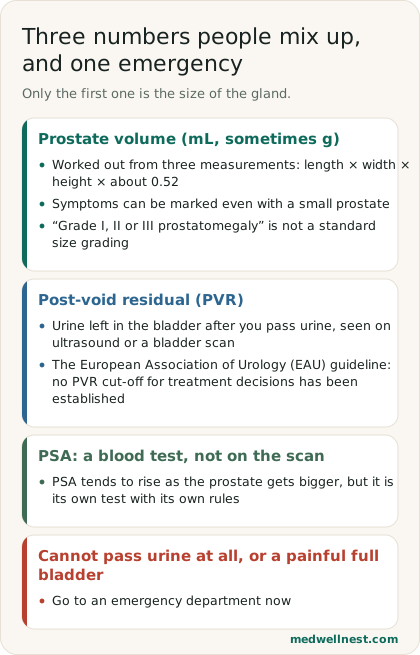
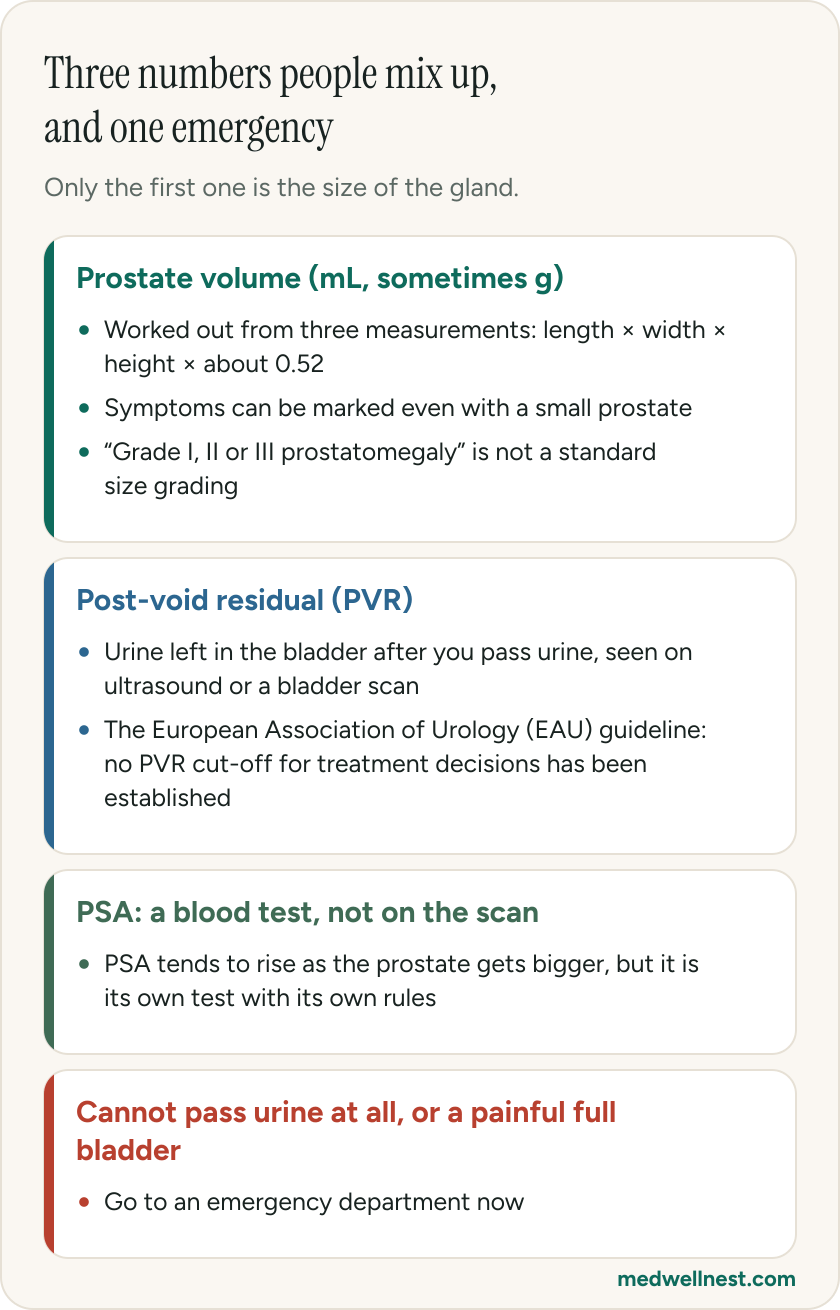
An ultrasound report gives the prostate as a volume, in millilitres (mL) or sometimes in grams. The scanner measures the gland in three directions, and the volume is worked out with the formula for an ellipsoid, an egg shape: one study of prostate volume uses 0.00052 multiplied by the three diameters in millimetres, which is the same as about 0.52 times the three diameters in centimetres. NICE speaks of grams and the European Association of Urology (EAU) of millilitres, so a report may use either.
The scan is used because the examining finger is a poor judge of size. The EAU guideline says that the correlation between a rectal examination and the true prostate volume is poor, and that transrectal ultrasound is more accurate, since the examination underestimates the volume. Size matters for choosing treatment: the EAU says that assessing it is important before 5-alpha reductase inhibitors and for selecting a procedure, and NICE draws its lines at an estimated 30 g.
02
What is typical, and how it changes with age
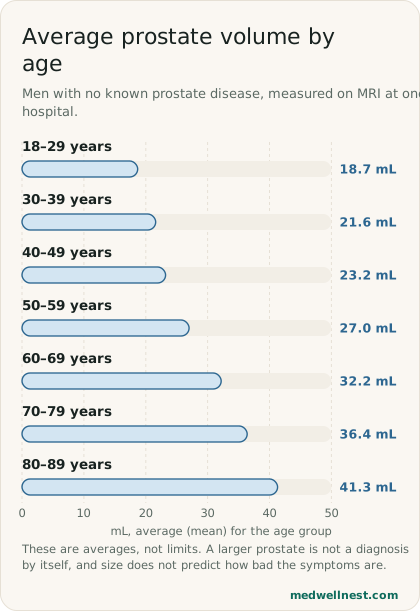
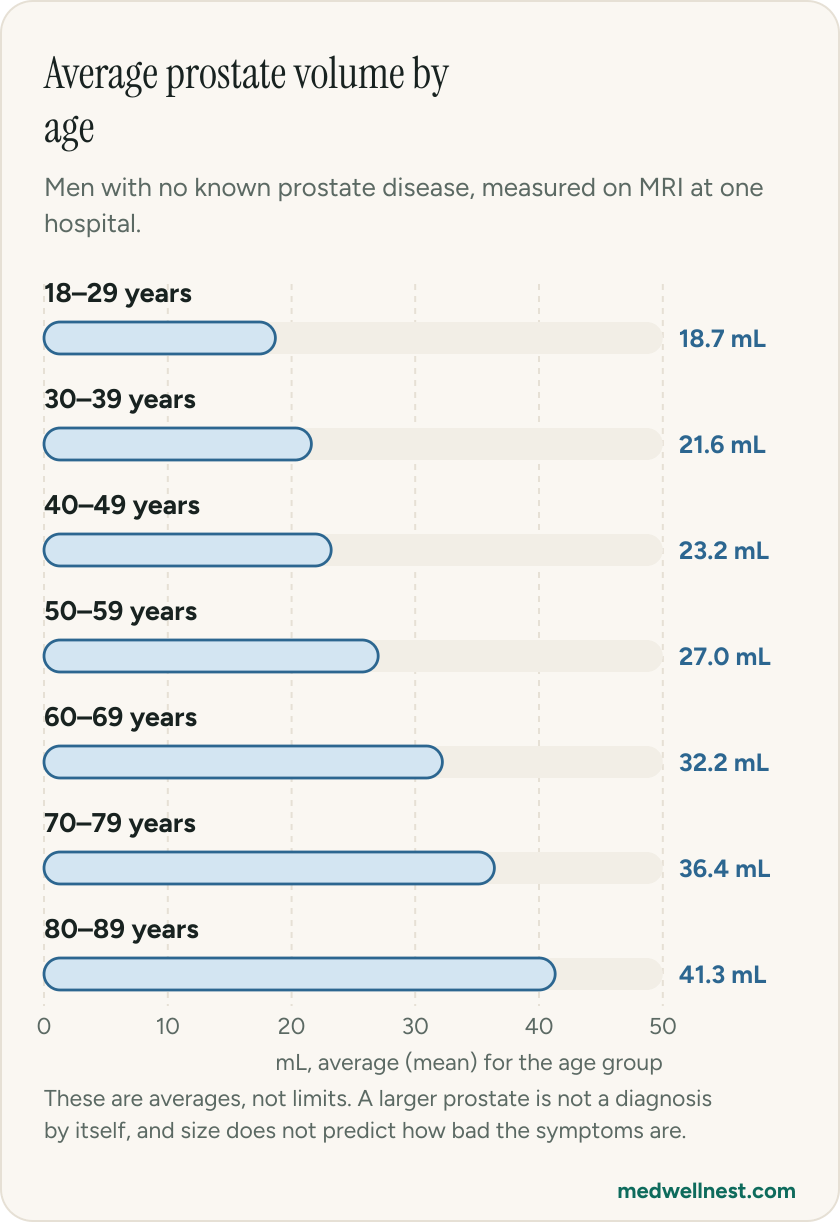
The prostate grows through adult life. In a 2026 study that measured prostate volume on MRI in men with no known prostate disease, the average was 18.7 mL at ages 18 to 29, 21.6 mL at 30 to 39 and 23.2 mL at 40 to 49, rising to 27.0 mL at 50 to 59, 32.2 mL at 60 to 69, 36.4 mL at 70 to 79 and 41.3 mL at 80 to 89. The median for the whole group was 25.4 mL. So the average is roughly 19 to 23 mL under 50, and a larger gland is typical in older men.
These are averages from one hospital's MRI scans, not limits, and an ultrasound estimate may differ from them, so a number above the average on your report is not by itself a diagnosis. The condition itself is common: the NHS describes an enlarged prostate as common and not usually serious, most common in men over 50.
03
Size does not match symptoms
A big number does not mean big trouble, and a small one does not mean none. A 2026 ultrasound study of men with benign prostatic hyperplasia (BPH) opens by noting that the association between prostate volume and urinary symptoms is inconsistent, since significant symptoms frequently occur even with small prostates.
The EAU goes further: it calls the term BPH, which is a diagnosis made on tissue under a microscope, inappropriate for what is treated, because it is obstruction to urine flow that is treated when it causes a man's symptoms. Guidelines accordingly start from the symptoms, a symptom score and a urine test, and use the scan to add information. NICE advises referral for specialist assessment when symptoms are complicated by recurrent or persistent urinary infection, retention, kidney impairment or suspected cancer.
04
Post-void residual on the same report
Post-void residual (PVR) is the urine left in the bladder after you have passed urine, measured by ultrasound or a bladder scan. It tells you how well the bladder empties, which the prostate volume does not. The EAU notes that a high PVR is not necessarily caused by blockage, because it can also result from a weak bladder muscle, and that because the measurement varies from test to test and outcome studies are lacking, no PVR threshold for treatment decisions has yet been established.
What the EAU does say is that a high baseline PVR of 350 mL or more was linked with a higher risk of symptoms getting worse in two large trials, and that watching how the PVR changes over time may identify men at risk of acute retention. The guidelines differ on routine use: the EAU recommends measuring PVR in the assessment of male urinary symptoms, while NICE advises against routinely measuring it at initial assessment but offers it at specialist assessment. NICE also advises blood tests and imaging of the kidneys for a man with chronic retention, meaning a residual volume above 1 litre or a bladder that can be felt.
05
Grade I or II prostatomegaly, and PSA
Prostatomegaly just means an enlarged prostate. We found no grading of prostate size by grade I, II or III in NICE's guideline or the EAU's, so a grade on a report is the reporter's own shorthand and the report should say what size it stands for. One real grading exists on prostate ultrasound: intravesical prostatic protrusion, where part of the gland pushes up into the bladder. The EAU grades it by distance, grade I being 0 to 4.9 mm, grade II 5 to 10 mm and grade III more than 10 mm, measured with the bladder holding 150 to 250 mL. If your report grades something, ask whether it is that.
PSA is a separate blood test and does not come from the scan. The EAU notes that PSA has a good predictive value for prostate volume, so a larger gland can raise it, but a PSA result is read on its own rules. NICE says men whose symptoms suggest an enlarged prostate, whose prostate feels abnormal on examination, or who are worried about prostate cancer should be given information, advice and time to decide whether they want a PSA test. Our PSA guide explains the result.
06
When to worry: retention, blood and pain
Not being able to pass urine at all is an emergency. Cleveland Clinic calls acute urinary retention a medical emergency, in which you may not be able to pee at all or may pass only very small amounts even though your bladder is full, and advises seeking care right away if you suddenly have trouble urinating, especially with pain in the belly. For those signs, go to an emergency department now. The usual treatment is a catheter to drain the bladder; NICE's advice is to catheterise men with acute retention immediately.
Blood in the urine or pain when passing urine needs a doctor's visit today, as the box below says; other new urinary changes can go to an ordinary appointment. The NHS lists blood in the pee, which may look pink, red or brown, pain when peeing and being unable to pee at all as reasons for urgent advice, and notes that these symptoms can sometimes be caused by other more serious conditions such as prostate cancer, where finding it early may make it easier to treat. A history of blood in the urine is one reason the EAU advises looking inside the bladder with a camera.
Prostate report findings: what can wait and what cannot
Emergency — act now
Not being able to pass urine at all, passing only a few drops with a full bladder, or a painful full bladder you cannot empty: go to an emergency department now. Acute urinary retention is a medical emergency, and the bladder needs draining with a catheter rather than an appointment.
Same-day — call promptly
Blood in the urine (pink, red or brown) or pain when passing urine: see a doctor today. Blood in the urine has to be checked out because it can be a sign of cancer, and early checking may make cancer easier to treat.
Routine — see a doctor
A report that says enlarged prostate, a volume in mL or a residual urine figure, with mild urinary symptoms: take it to an ordinary appointment with your symptom history, and ask whether a PSA test, a urine test or a urine flow test is needed. The size alone does not tell you how bad things are.
Values mentioned in this story
Each one opens a visual guide with its normal range and what moves it — upload a report and we place your own numbers on the same scale.
Sources
- Lower urinary tract symptoms in men: management (CG97) — NICEnice.org.uk
- EAU Guidelines on the Management of Non-neurogenic Male LUTS — European Association of Urologyuroweb.org
- The influence of age and the presence of prostate cancer on prostate volume, PSA and PSA density — BJU International, 2026pmc.ncbi.nlm.nih.gov
- Combined anatomical parameters predict benign prostatic hyperplasia-related lower urinary tract symptom severity: a volume-stratified study — Translational Andrology and Urology, 2026pmc.ncbi.nlm.nih.gov
- Urinary Retention: Causes, Diagnosis and Treatment — Cleveland Clinicmy.clevelandclinic.org
- Enlarged prostate — NHSnhs.uk
Share this story
Curious where your own values stand?
Two minutes from upload to a full visual picture. Free to analyze.