In short
Night pain with weakness lifting the arm can be a rotator cuff tear, and pain with stiffness can be frozen shoulder. AAOS says non-operative care helps about 80 to 85% of people with a tear. Shoulder pain with chest pain, or an injured arm you cannot move, needs emergency care.
Emergency if: Shoulder or arm pain comes with chest pain, pressure, tightness or squeezing, pain spreading to the arms, neck or jaw, shortness of breath, sweating, feeling sick, or pale, blue or grey skin: call emergency services now and do not drive yourself. Also go to an emergency department now if you injured the shoulder and cannot move the arm, or the shoulder looks out of place or has changed shape, or is painful, bruised or swollen; call an ambulance if you cannot get there yourself.
On this page
01
Why does my shoulder hurt more at night (kandhe mein raat ko dard), and is it a rotator cuff tear or frozen shoulder?
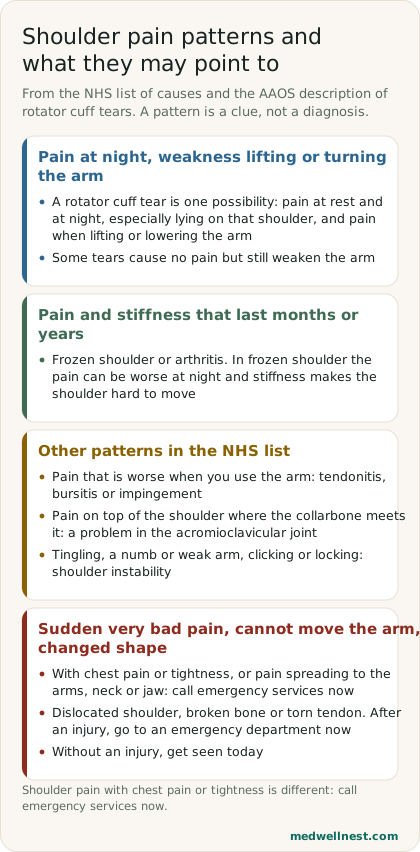
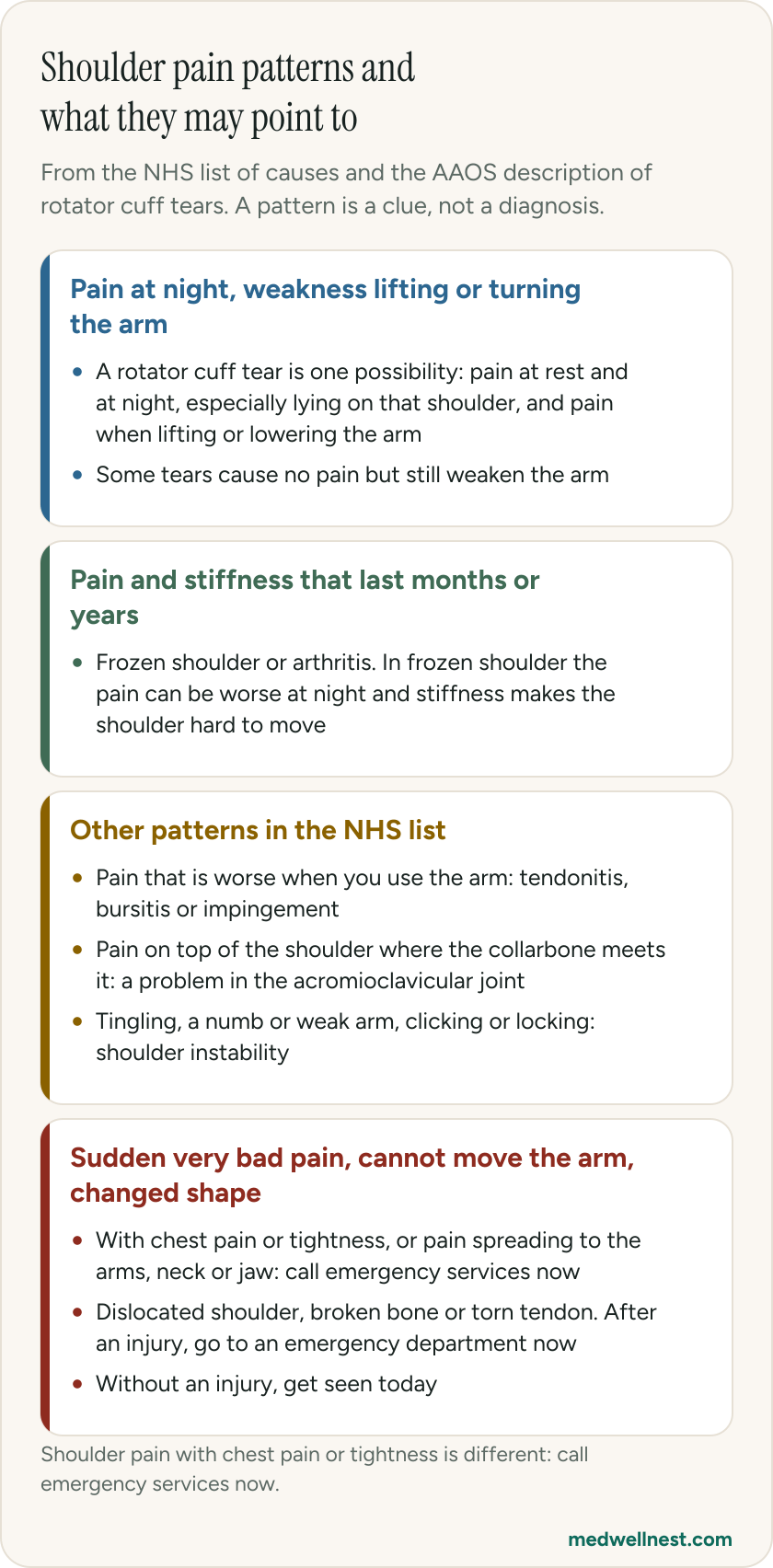
Both can hurt at night, so night pain alone does not separate them. AAOS lists pain at rest and at night, especially lying on the affected shoulder, as a common symptom of a rotator cuff tear, along with pain when lifting and lowering the arm and weakness when lifting or rotating it. The NHS says frozen shoulder means the shoulder is painful and stiff for months, sometimes years, with pain that can be worse at night and disturb sleep, and stiffness that makes it difficult to move.
The clue that differs is what the arm can do. A tear tends to bring weakness lifting or turning the arm, while frozen shoulder brings stiffness that limits movement. AAOS says tears are more common over 40, and the NHS says frozen shoulder can follow an injury or surgery that stops you moving the arm normally, and can happen with diabetes. Many other problems can cause shoulder pain, and the NHS says not to self-diagnose. Our frozen shoulder guide covers that condition in more detail.
02
What are the symptoms of a rotator cuff tear, and can it be painless?
The rotator cuff is a group of four muscles whose tendons form a covering around the head of the upper arm bone and help you lift and rotate the arm. AAOS says tears have two main causes: an injury, such as a fall on an outstretched arm or lifting something too heavy with a jerk, and wear, which is the cause in most tears. Wear-related tears develop slowly, are more likely over age 40, occur more often in the dominant arm, and in most cases are relatively painless.
A sudden tear after a fall usually causes intense pain, and may bring a snapping sensation and immediate weakness in the upper arm. A slow tear can begin as pain only when lifting the arm overhead, such as reaching a high cabinet, and over time the pain may be felt at rest and at night and no longer settle with pain medicines. AAOS also says some tears cause no pain at all but still weaken the arm. If you have a wear-related tear in one shoulder there is a greater chance of one in the other shoulder, even without pain. AAOS says that a tear can get larger over time if you keep using the shoulder despite increasing pain.
03
What else can cause shoulder pain, and what do the different patterns mean?
The NHS links patterns to causes. Pain and stiffness that do not go away over months or years suggest frozen shoulder or arthritis. Pain that is often worse while using the arm suggests tendonitis, bursitis or impingement. A tingling, numb or weak arm, or a shoulder that feels as if it is clicking or locking, suggests instability. Sudden very bad pain with difficulty moving the arm, sometimes with a change in shape, suggests a dislocated shoulder, a broken bone or a torn tendon. Pain on top of the shoulder, where the collarbone meets the shoulder joint, suggests a problem in the acromioclavicular joint. A pattern is a clue, not a diagnosis.
For ordinary shoulder pain the NHS suggests staying active and gently moving the shoulder, shoulder exercises for 6 to 8 weeks to stop the pain returning, and painkillers such as paracetamol or ibuprofen with heat or cold packs. It says not to stop using the shoulder completely and not to make up strenuous exercises or use heavy gym equipment. It says recovery can take 6 months or longer. If you think you have a rotator cuff tear, AAOS says not to attempt shoulder exercises without first consulting your doctor or physical therapist.
04
Do I need an X-ray, ultrasound or MRI for shoulder pain?
The NHS says a health professional will examine you to work out the cause and might send you for tests such as an X-ray. AAOS describes the doctor checking for tenderness, testing range of movement and arm strength, and sometimes examining the neck to make sure the pain is not coming from a pinched nerve or arthritis. The first imaging test is usually an X-ray, which shows the bones but not soft tissues like the rotator cuff, so the X-ray of a shoulder with rotator cuff pain is usually normal. It is done to make sure there is no other reason for the pain, such as arthritis, and it may also show a long-standing degenerative tear that is not causing symptoms.
An MRI or an ultrasound can show the tendons, including the location and size of a tear. AAOS says an MRI can also give an idea of how old or new a tear is, because it shows the quality of the rotator cuff muscles, and that an ultrasound may be quicker and easier to schedule but depends on the skill of the technician. We did not find a source that gives a rule for exactly when a scan is needed, so that is a decision for your doctor or physiotherapist after the examination. The NHS says to get medical help if shoulder pain has not started to feel better after 2 weeks, is getting worse, or if it is very difficult to move the arm or shoulder.
05
Can a rotator cuff tear get better without surgery? What do the 80-85% and 67% numbers mean?
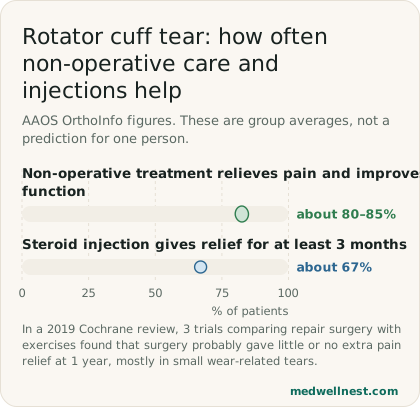
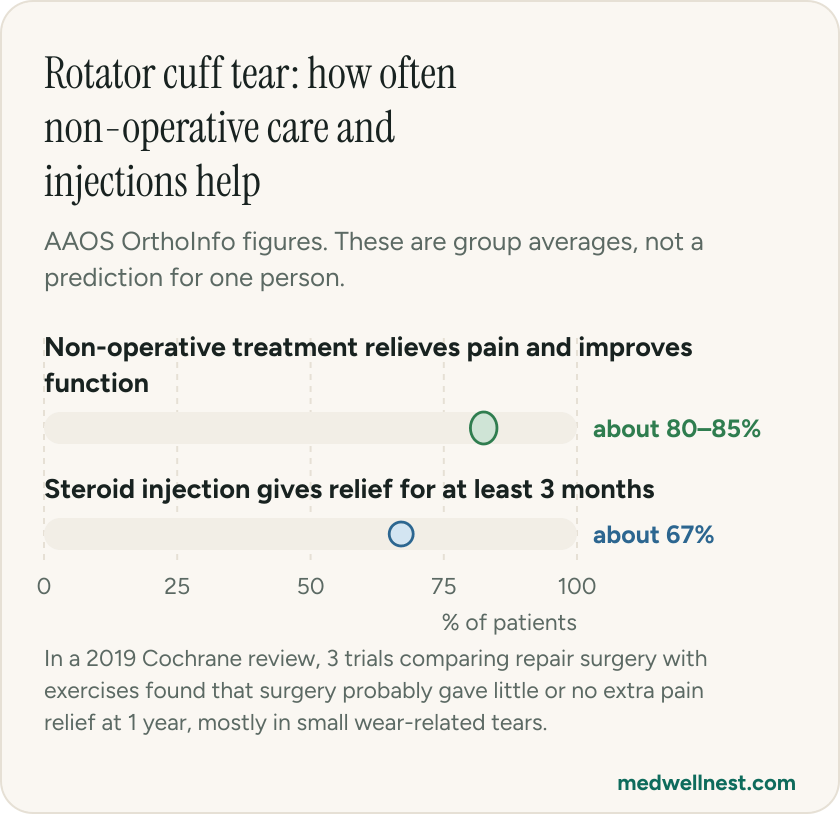
AAOS says that in about 80 to 85% of patients, non-operative treatment relieves pain and improves function in the shoulder. It does not say that the tear itself heals. The options it lists are rest and limiting overhead activities, avoiding activities that cause pain, anti-inflammatory medicines such as ibuprofen and naproxen, strengthening exercises and physical therapy, and, if these do not help, a steroid injection of a local anaesthetic with cortisone. On average, it says, injections give pain relief to about two-thirds (about 67%) of patients for at least 3 months, and repeated long-term injections carry risks. The disadvantages of the non-operative route are that the tear may get larger and you may need to limit activities.
AAOS says surgery may be recommended if pain does not improve with non-operative methods, and it lists other signs that surgery may be a good option: symptoms lasting 6 to 12 months, a large tear (more than 3 cm) with good-quality surrounding tissue, significant weakness and loss of function, or a tear caused by a recent acute injury. A 2019 Cochrane review of 9 trials is more cautious about surgery. In 3 trials comparing repair surgery followed by exercises with exercises alone, in people with full-thickness tears, surgery probably gave little or no improvement in pain at 1 year (moderate-certainty evidence, 258 people analysed), and the review was uncertain that surgery gives a clinically meaningful benefit. The trials mostly involved small degenerative tears in people with an average age between 56 and 68, so the findings may not apply to injury tears, large tears or younger people. The choice is therefore individual, and worth discussing with a shoulder specialist.
06
Can left shoulder or arm pain be a heart attack?
Sometimes. The NHS describes the chest pain of a heart attack as crushing or squeezing, and says it may also spread to the arm, neck and jaw. Other symptoms include shortness of breath, feeling or being sick, sweating, indigestion-like discomfort and pale, blue or grey skin. The NHS says to call emergency services now for chest pain that feels tight or like squeezing, chest pain spreading to the arms, neck or jaw, severe difficulty breathing, pale, blue or grey lips or skin, or someone who has passed out and is not responding normally. It says not to drive yourself.
The NHS shoulder pain page does not deal with chest pain, and its heart attack page does not single out the left side. So the rule is the combination: if shoulder or arm pain comes with chest pain, pressure or tightness, or with the other signs above, do not wait to find out whether it is the shoulder. Our guides to heart attack warning signs and to chest discomfort explain how doctors sort heart from stomach causes.
07
When is shoulder pain urgent, and when is it an emergency?
The NHS says to ask for an urgent appointment or urgent advice if you have sudden or very bad shoulder pain, cannot move the arm, your arm or shoulder has changed shape or is badly swollen, you have pins and needles that do not go away, there is no feeling in your arm or shoulder, the arm or shoulder is hot or cold to the touch, the pain started after an injury or accident such as a fall, you have severe pain in both shoulders, or you feel feverish or unwell. It says these can be signs of something serious, such as a broken or dislocated bone or a torn tendon.
For an injured shoulder the NHS dislocated shoulder page is stricter: go to an emergency department if you have injured the shoulder and cannot move your arm, the shoulder looks out of place or has changed shape, or it is painful, bruised or swollen, and call an ambulance if you cannot get there yourself. While you wait, it says to support the arm in a sling or towel, hold an ice pack to the shoulder for up to 20 minutes every 2 to 3 hours, not to move the upper arm and not to try to put the arm back yourself. Do not drive yourself.
Shoulder pain: how fast to act
Routine — see a doctor
Shoulder pain has not started to feel better after 2 weeks, is getting worse, or night pain and weakness lifting the arm continue: see a doctor, who can examine you, decide whether an X-ray, ultrasound or MRI is needed, and refer you to a physiotherapist. The NHS says it can take 6 months or longer to recover. Keep moving the shoulder gently, do not make up strenuous exercises, and if a rotator cuff tear is suspected, do not start shoulder exercises before a doctor or physical therapist has seen you.
Same-day — call promptly
With no injury to the shoulder, you have sudden or very bad shoulder pain, you cannot move your arm, or your arm or shoulder has changed shape or is badly swollen; or you have pins and needles that do not go away, no feeling in the arm or shoulder, an arm or shoulder that is hot or cold to the touch, severe pain in both shoulders, or you feel feverish or unwell: get seen today. If you injured the shoulder and cannot move the arm, or the shoulder looks out of place, has changed shape, or is painful, bruised or swollen, follow the emergency tier below instead. The NHS lists these as urgent and says they can be signs of a broken or dislocated bone, a torn tendon or something else serious.
Emergency — act now
Shoulder or arm pain comes with chest pain, pressure, tightness or squeezing, pain spreading to the arms, neck or jaw, shortness of breath, sweating, feeling sick, or pale, blue or grey skin: call emergency services now and do not drive yourself. Also go to an emergency department now if you injured the shoulder and cannot move the arm, or the shoulder looks out of place or has changed shape, or is painful, bruised or swollen; call an ambulance if you cannot get there yourself.
Sources
- Rotator cuff tears — OrthoInfo, AAOSorthoinfo.aaos.org
- Shoulder pain — NHSnhs.uk
- Frozen shoulder — NHSnhs.uk
- Dislocated shoulder — NHSnhs.uk
- Heart attack — NHSnhs.uk
- Surgery for rotator cuff tears — Cochrane Review, 2019pubmed.ncbi.nlm.nih.gov
Share this story
Curious where your own values stand?
Two minutes from upload to a full visual picture. Free to analyze.