In short
Many 'sinus headaches' turn out to be migraine: in one study of 2,991 people at a headache clinic, where people with signs of infection or an earlier migraine diagnosis had been left out, 88% had migraine or probable migraine. Real sinusitis brings a blocked nose, coloured mucus and often a high temperature.
Emergency if: A headache that starts suddenly and is extremely painful; or a headache with a seizure, numbness or weakness in the body or face, trouble speaking, balancing, walking or remembering things, drowsiness or confusion, loss of vision, or new blurred or double vision; a headache after a head injury in the last 3 months; a headache with a rash that does not fade when a glass is rolled over it; or a very high temperature, a stiff neck, or bright lights bothering you: call emergency services now. The NHS lists all of these as emergencies. With a sinus infection, swelling or redness around an eye, an eye that bulges or does not move normally, double vision or any new change in vision, swelling over the forehead, or a severe headache over the forehead: go to an emergency department now. NICE says these signs of infection spreading to the eye socket or brain need hospital care.
On this page
01
Is a sinus headache really a sinus problem?
Often it is not. A 2021 systematic review in Brain Sciences gathered the studies of people who came with 'sinus headache' or facial pain and found that most of them pointed to migraine and tension-type headache as the commonest causes, not sinus disease. The review adds a caveat: most of those studies were done in clinics, so they describe people who went for a medical opinion, not everyone who has a headache.
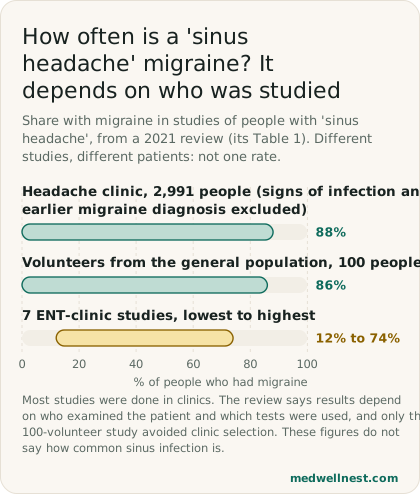
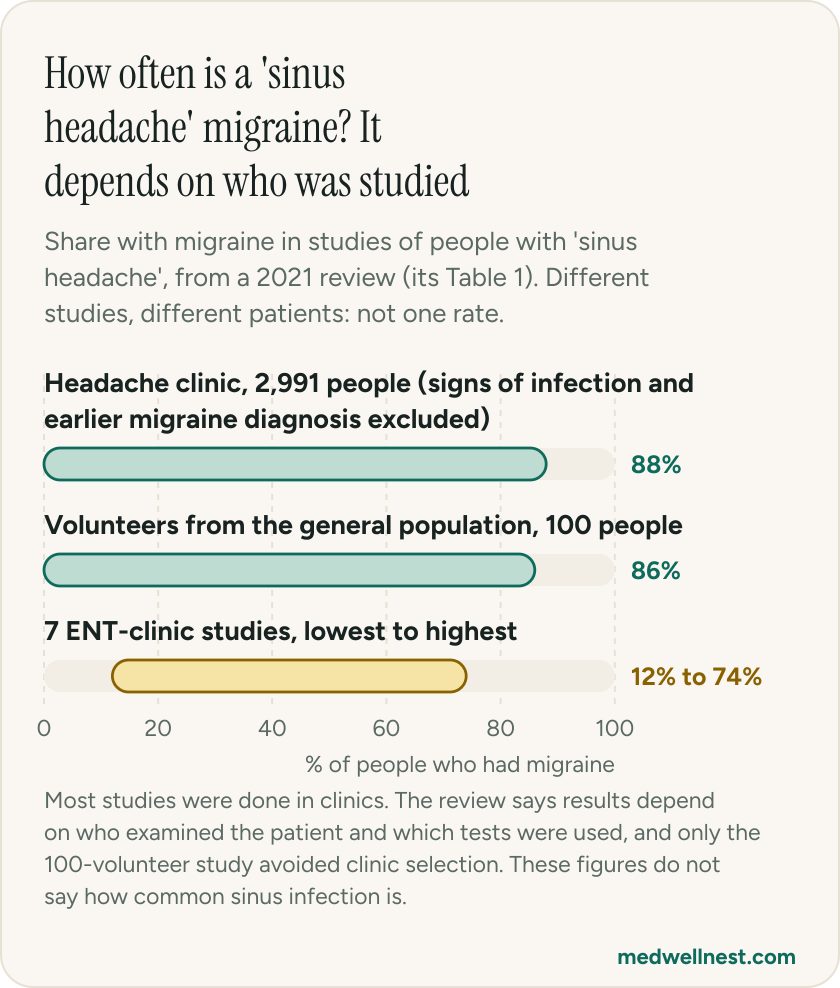
The 88% figure comes from one study in that review: 2,991 people at a headache clinic, assessed by neurologists without scans of the sinuses, from which people with signs of infection, and people already diagnosed with migraine, had been excluded. In that group 88% had migraine or probable migraine, 8% had tension-type headache and 4% had another or unspecified cause. It cannot be read as the share of all sinus headaches that are migraine, because people with signs of infection were not part of it.
Two other figures in the review show how much the answer depends on who is studied. Among 100 volunteers from the general population, 86% had migraine and 3% had a sinus (rhinogenic) cause, in a small study that did not exclude people with sinus disease. Across 7 studies in ear, nose and throat (ENT) clinics, the share with migraine ranged from 12% to 74%.
02
Why do migraine and sinusitis feel so alike?
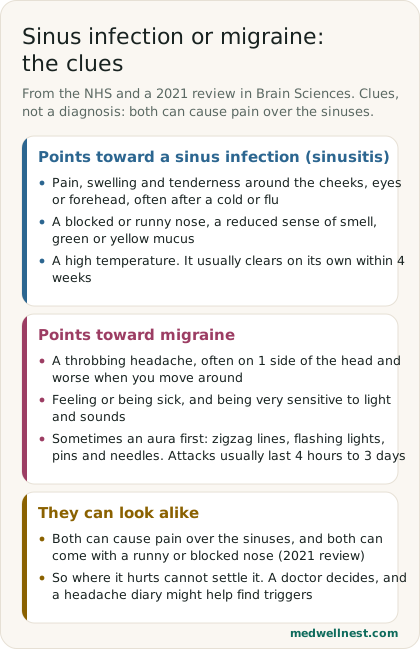
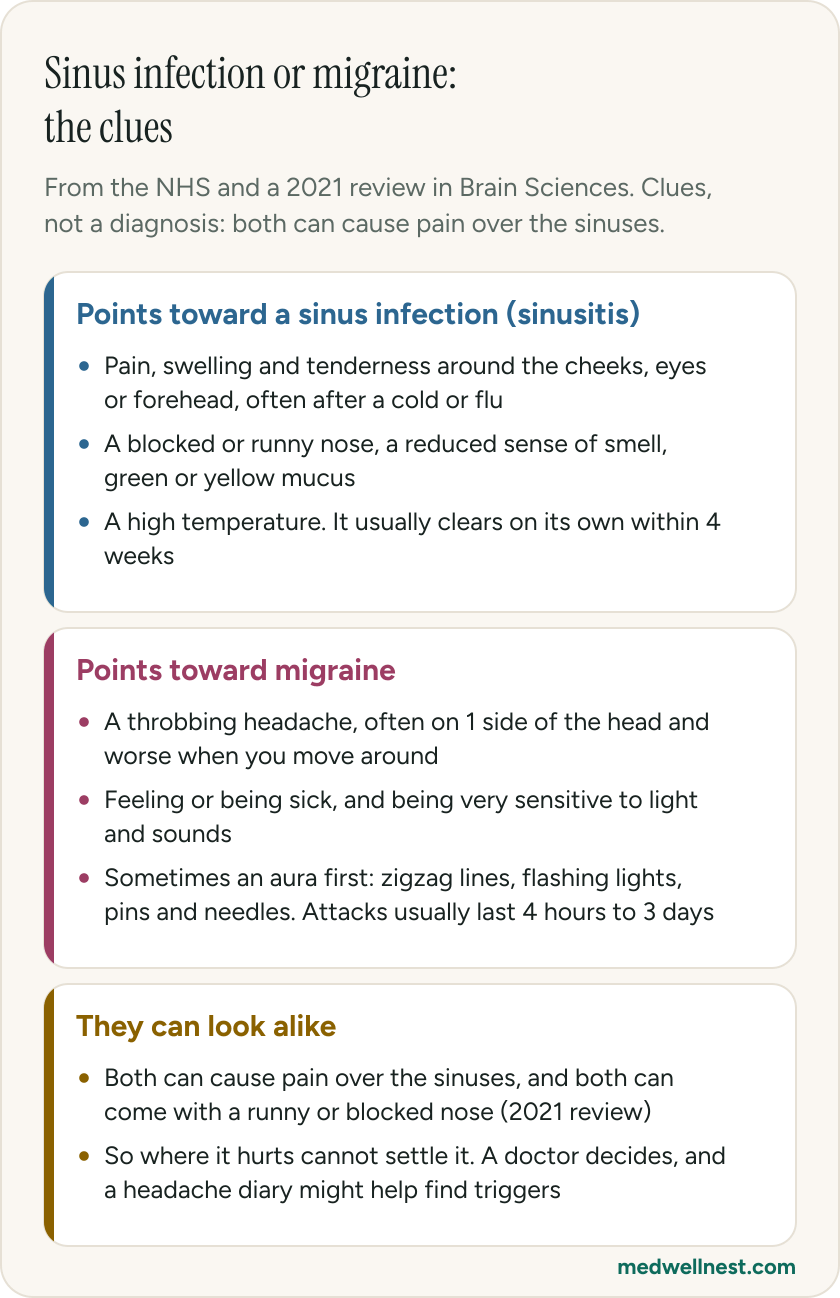
The review explains that both kinds of headache can cause pain directly over the sinuses, and both can come with nasal discharge and congestion. A blocked or runny nose with pain over the cheeks or forehead can therefore look like sinusitis even when the cause is a headache disorder.
The review also found that results depended on how patients were assessed. Headache specialists took part in only 3 of the included studies, and not every study used nasal endoscopy or sinus scans, so the review says most studies had gaps in their clinical data that could bias the results. The fair summary is that migraine is common among people who think they have a sinus headache, and that an examination, not the location of the pain, sorts out which one you have.
03
What are the signs of a real sinus infection?
The NHS lists the main symptoms of sinusitis as pain, swelling and tenderness around the cheeks, eyes or forehead, a blocked or runny nose, a reduced sense of smell, green or yellow mucus from the nose and a high temperature. A headache, toothache, bad breath, a cough and pressure in the ears are listed as other symptoms. The NHS says sinusitis is common after a cold or flu, and MedlinePlus says the symptoms very often follow a cold that does not get better or that gets worse after 7 to 10 days.
Coloured mucus is not proof. MedlinePlus says a green or yellow discharge does not mean you definitely have a sinus infection or need antibiotics, and many people with it recover fully without them. The NHS says sinusitis usually clears up on its own within 4 weeks, that it is usually caused by a virus rather than bacteria, and that antibiotics are rarely needed.
04
What are the signs of migraine?
The NHS describes a migraine attack as a throbbing headache that can be severe, often on 1 side of the head and worse when you move around, with feeling or being sick and being very sensitive to light and sounds. Some people get an aura first, such as zigzag lines or flashing lights, numbness or pins and needles, dizziness or difficulty speaking, which should not last longer than 1 hour. Attacks usually last between 4 hours and 3 days.
The NHS says triggers can include having your period, anxiety, stress and tiredness, skipping meals, too much caffeine and not getting enough regular exercise, and suggests a headache diary to help work out what sets yours off. It also says to try not to take painkillers for more than 2 days a week, because that can cause more headaches and make migraine harder to treat.
05
When should I see a doctor about a sinus headache?
For suspected sinusitis, the NHS says to see a pharmacist if you think you have it, and to see a doctor if you do not get better after 7 days of treatment from a pharmacy or doctor, do not get better after 3 weeks of treating symptoms yourself, or keep getting sinusitis. A doctor may refer you to an ear, nose and throat specialist if you still have sinusitis after 3 months of treatment, keep getting it, or only have symptoms on 1 side of your face. MedlinePlus says to contact your provider if symptoms last longer than 10 to 14 days, you have a fever, or you have a severe headache that over-the-counter pain medicine does not relieve.
For headaches that look like migraine, the NHS says to see a doctor if attacks are severe, getting worse or lasting longer than usual, happen more than once a week, are hard to control, or come regularly before or during your period. It also says to see a doctor if you regularly get headaches, or if a headache you have tried to treat yourself is not getting better or is getting worse. Ask for an urgent appointment if a migraine has lasted longer than 72 hours, aura lasts longer than 1 hour at a time, or you are pregnant or just had a baby.
06
Which headache signs mean go to hospital?
The NHS says to get emergency help for a headache that came on suddenly and is extremely painful, or that comes with any of these: a seizure; numbness or weakness in the body or face; difficulty speaking, balancing, walking or remembering things; drowsiness or confusion; loss of vision; a head injury within the last 3 months; a rash that does not fade when a glass is rolled over it; or a very high temperature, a stiff neck, or bright lights bothering you. The NHS migraine page adds losing your vision or having blurred or double vision to this list. Do not drive yourself: call emergency services. A stiff neck can also be an early migraine symptom, but the NHS says a headache with a very high temperature, a stiff neck or bright lights bothering you needs emergency help, so unless it is exactly like your usual, diagnosed migraine attacks, call emergency services.
The NHS lists a headache with vision or eye problems, a headache brought on or made worse by coughing, sneezing, bending down or exercising, and a headache with being sick as reasons for urgent advice the same day. With sinusitis, MedlinePlus lists a skin infection around the eye (orbital cellulitis), an abscess and meningitis as very rare complications and says to contact your provider about any change in vision during a sinus infection. NICE says people with sinusitis should be sent to hospital if they have swelling or redness around the eye, a bulging eye, double vision or reduced vision, swelling over the forehead, a severe headache over the forehead, or signs of meningitis, because these can mean the infection has spread to the eye socket or brain.
Headache or sinus pain: how fast to act
Emergency — act now
A headache that starts suddenly and is extremely painful; or a headache with a seizure, numbness or weakness in the body or face, trouble speaking, balancing, walking or remembering things, drowsiness or confusion, loss of vision, or new blurred or double vision; a headache after a head injury in the last 3 months; a headache with a rash that does not fade when a glass is rolled over it; or a very high temperature, a stiff neck, or bright lights bothering you: call emergency services now. The NHS lists all of these as emergencies. With a sinus infection, swelling or redness around an eye, an eye that bulges or does not move normally, double vision or any new change in vision, swelling over the forehead, or a severe headache over the forehead: go to an emergency department now. NICE says these signs of infection spreading to the eye socket or brain need hospital care.
Same-day — call promptly
A headache with other eye problems, such as sore or red eyes (loss of vision or new blurred or double vision is an emergency), a headache brought on or made worse by coughing, sneezing, bending down or exercising, a headache with vomiting, a headache with jaw pain when eating or a sore, tender scalp, a migraine that has lasted longer than 72 hours, aura lasting longer than 1 hour, a migraine or bad headache while pregnant or just after a baby, or sinusitis symptoms when you are very unwell, painkillers are not helping, symptoms are getting worse, or your immune system is weakened: contact a doctor today, or your maternity unit if you are pregnant or have just had a baby. The NHS gives these as reasons for urgent advice.
Routine — see a doctor
Sinusitis symptoms that have not improved after 3 weeks of self-care or after 7 days of treatment, sinusitis that keeps coming back, sinus symptoms on only 1 side of the face, headaches that keep coming back, or migraine attacks more than once a week or getting worse: book an appointment with a doctor. The NHS lists these as reasons to see a doctor.
Sources
- 'Sinus headache': etiology, a systematic review (Brain Sciences, 2021)pmc.ncbi.nlm.nih.gov
- Sinusitis (sinus infection) — NHSnhs.uk
- Sinusitis — MedlinePlus Medical Encyclopediamedlineplus.gov
- Migraine — NHSnhs.uk
- Headaches — NHSnhs.uk
- Sinusitis (acute): antimicrobial prescribing — NICEnice.org.uk
Share this story
Curious where your own values stand?
Two minutes from upload to a full visual picture. Free to analyze.