In short
Whether a wound needs a tetanus shot depends on two things: how dirty it is and how long since your last dose. Here is the decision grid, when immunoglobulin is added, why TT became Td, and what bites and burns change.
Emergency if: After any wound, a stiff jaw or trouble opening your mouth or swallowing, painful muscle spasms or stiffness, difficulty breathing, a fast heartbeat or a seizure: get emergency care now. A large or deep wound also needs emergency care.
On this page
01
Why even a small wound can matter
Tetanus is caused by the spores of a bacterium found almost everywhere: in soil, ash, animal and human faeces, on skin and on rusty tools such as nails and barbed wire. The WHO says the spores resist heat and most antiseptics and can survive for years. Once inside a wound they can make a toxin that causes a stiff jaw and painful muscle spasms. Symptoms usually appear 3 to 21 days after infection, most within 14 days.
It is a medical emergency, and without treatment the national Td guideline says the death rate approaches 100%. Getting tetanus does not make you immune, so the WHO says survivors still need vaccination. Tetanus can also occur in people who cannot recall any wound. The protection is the vaccine, and the moment to check it is when you are hurt.
Whatever else happens, the wound itself comes first. The CDC asks doctors to clean every wound, remove dirt and foreign material and cut away dead tissue. It also says antibiotics, on the skin or by mouth, should not be used to try to prevent tetanus, although an infected wound should be treated. Our guide Cuts and Wounds covers first aid and when a cut needs stitches.
02
Clean or dirty: how the wound is sorted
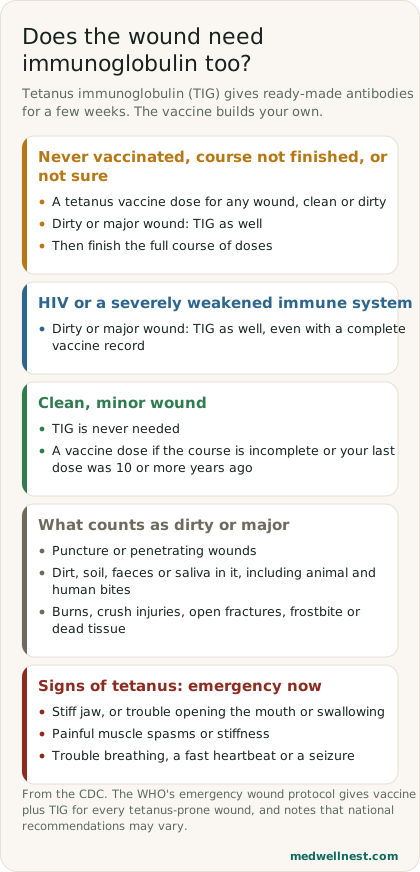
The CDC puts wounds into two groups. Clean, minor wounds carry little risk. Dirty or major wounds carry more, and include puncture or penetrating wounds; wounds with dirt, soil, faeces or saliva in them, which covers animal and human bites; and wounds with dead or crushed tissue, such as burns, crush injuries, open fractures and frostbite.
The WHO's protocol for injuries in emergencies uses a similar list and adds one more: any wound that goes more than 6 hours before it is properly cleaned and treated counts as tetanus-prone. The NHS puts it simply: there is a risk whenever soil or manure gets into a wound, such as a bite, burn or scratch, and the risk is higher with a large or deep wound or something stuck in it.
03
Do you need a booster? The years since your last dose
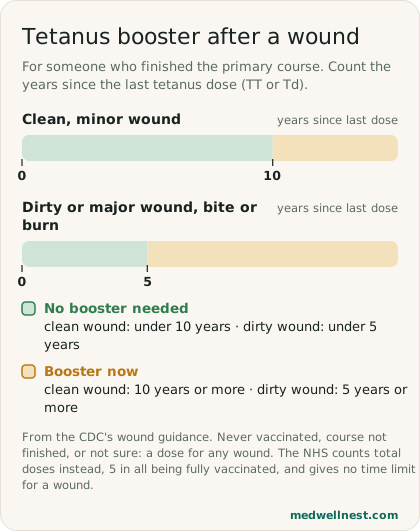
If you have completed the primary course of tetanus vaccine, the CDC's rule turns on the time since your last dose. Less than 5 years: no vaccine is needed, whatever the wound. For a clean, minor wound, a booster is needed if the last dose was 10 or more years ago. For a dirty or major wound, a booster is needed if it was 5 or more years ago.
If you were never vaccinated, did not finish the course, or do not know, the CDC says to give a dose for any wound, clean or dirty, and then complete the full series. The WHO position paper agrees that the schedule should be completed as soon as possible, and says a doctor may give a dose, preferably Td, when an injury is severe or the vaccine history is unreliable.
Sources do not all use the same yardstick. The NHS counts total doses instead: it says you may need a vaccine or booster if you have had fewer than 5 doses in all, or your history is uncertain, and it gives no time limit for a wound. The CDC's 5-year rule for dirty wounds is stricter. If you cannot remember, say so; an uncertain history is treated as incomplete.
04
When immunoglobulin is added, and what bites and burns change
Tetanus immunoglobulin (TIG) is a separate injection of ready-made antibodies. The CDC says it gives temporary protection by neutralising toxin in the blood, but it cannot neutralise toxin that has already bound to nerves, which is why it is given early. It is never needed for a clean, minor wound. For a dirty or major wound, the CDC gives TIG, as well as the vaccine, to people who were never vaccinated, did not finish the course or do not know, and to anyone with HIV or a severely weakened immune system.
The WHO position paper takes the same line: TIG for dirty wounds in people who are incompletely vaccinated or unsure. Its emergency wound protocol goes further and gives the vaccine plus TIG for every tetanus-prone injury, while noting that national recommendations may vary.
A dog or other animal bite counts as a dirty wound because of saliva, so the tetanus question applies alongside the separate rabies decision; see Bitten by a Dog, Cat or Other Animal. Burns count too, because of the damaged tissue; our guide First Aid for Burns covers what to do in the first minutes.
05
TT is now Td
If an older card says TT, that was tetanus toxoid alone. On the advice of the national technical advisory group on immunisation, the programme replaced TT with Td, which adds a lower-strength diphtheria component, for all age groups including pregnant women, with supplies due to start from November 2018. The reason was diphtheria: most cases were now in people aged 5 and over, because protection from the infant doses fades.
Nothing restarts. The national Td guideline says Td can follow earlier TT doses, all previous TT doses remain valid, and the schedule is the same. The programme gives DPT boosters at 16 to 24 months and 5 to 6 years, then Td at 10 and 16 years. In pregnancy it gives Td-1 early, Td-2 four weeks later, or a single booster (Td-B) if the pregnancy comes within 3 years of an earlier one in which 2 Td doses were given. The WHO recommends 6 doses in all for lifelong protection.
06
How long protection lasts, and the danger signs
The WHO position paper sets out how protection builds. Three infant doses plus a booster in the second year give about 3 to 5 years; a further childhood booster carries it into adolescence; and a teenage booster gives immunity that lasts through much of adult life. After a booster in adolescence or adulthood, antibodies were still at protective levels 10 years later in 97% or more of people, and the body can still respond to a booster given 25 to 30 years after the last one. Older adults are the group most likely to have gaps.
That is why the question after an injury is about dates, not about how the wound looks. Keep your vaccination card, or a photo of it, where you can find it.
Watch for tetanus in the days and weeks after any wound. A stiff jaw or difficulty opening the mouth, trouble swallowing, painful muscle spasms or stiffness, difficulty breathing, a fast heartbeat or a seizure needs emergency care straight away, as does a large or deep wound.
When to act
Emergency — act now
After any wound, a stiff jaw or trouble opening your mouth or swallowing, painful muscle spasms or stiffness, difficulty breathing, a fast heartbeat or a seizure: get emergency care now. A large or deep wound also needs emergency care.
Same-day — call promptly
A bite, burn, puncture or any wound with dirt, soil or something stuck in it, especially if you are not fully vaccinated or not sure: see a doctor today about a tetanus dose and immunoglobulin. Also go today if the wound becomes hot, swollen or red, or you get a fever.
Routine — see a doctor
A clean, minor wound, your primary course is complete and your last tetanus dose was less than 10 years ago: clean it and watch it. Find your vaccination card and check that the course is complete; if it is not, book the missing doses.
Sources
- Tetanus — WHO fact sheetwho.int
- Tetanus vaccines: WHO position paper, February 2017 (Weekly Epidemiological Record)who.int
- Prevention and management of wound infection — WHOwho.int
- Tetanus and adult diphtheria (Td) operational guidelines — National Health Missionnhm.gov.in
- Clinical Guidance for Wound Management to Prevent Tetanus — CDCcdc.gov
- Tetanus — NHSnhs.uk
Share this story
Curious where your own values stand?
Two minutes from upload to a full visual picture. Free to analyze.