In short
Your lab prints its own uric acid range, so read that first. A high number with no gout attacks, lumps or stones is common, and the ACR conditionally recommends against starting urate-lowering medicine for it. A suddenly painful, swollen joint with worsening pain, fever, shivering or nausea needs a doctor today.
On your report
Uric Acid, Creatinine, eGFR (Estimated Glomerular Filtration Rate)
On this page
01
What is a normal uric acid level, and why does my lab's range differ from another lab's?
A uric acid test, also called serum urate, measures a normal waste product the body makes when it breaks down purines. MedlinePlus prints no normal range for it, and explains why: labs often use different testing methods, so they often use different reference ranges. You cannot compare your result with ranges found elsewhere, or compare results from different labs. The range printed beside your number on your own report is the one that applies to you, and for a trend over time MedlinePlus says to use the same lab each time.
Check the unit before comparing any number. Reports may print mg/dL or micromoles per litre (µmol/L), and the two are not interchangeable. NICE writes both side by side: 6 mg/dL is 360 µmol/L and 5 mg/dL is 300 µmol/L, so going by those two pairs the µmol/L figure is about 60 times the mg/dL figure. MedlinePlus also says many medicines, including aspirin, and niacin (vitamin B-3) can change uric acid results, so tell the doctor everything you take, and do not stop a medicine without asking first.
02
Does high uric acid always mean gout?
No. MedlinePlus says that if the body makes too much uric acid, or the kidneys do not remove enough of it, uric acid builds up in the blood and can form needle-shaped crystals in and around joints, which is gout. It adds that high levels can also lead to kidney stones or kidney failure, but not everyone with high levels will have these problems, and many people have high uric acid without any health problem. A high result does not always mean a condition that needs treatment.
What high uric acid goes with, according to the sources: MedlinePlus lists eating a lot of purine-rich food (red meat and organ meats, shellfish and some fish, alcohol, and high-fructose corn syrup in soda and sweets), kidney disease, some cancers (leukaemia, myeloma, or cancer that has spread) and cancer treatment, and alcohol use disorder. The NHS adds that gout is more common in men and older people, and that you are more likely to get it if you are overweight, drink alcohol, have been through the menopause, take water tablets (diuretics) or some blood pressure medicines, or have high cholesterol, high blood pressure, kidney problems, osteoarthritis or diabetes. Our uric acid and diet story covers food in detail.
03
Do I need medicine if my uric acid is high but I have no joint pain?
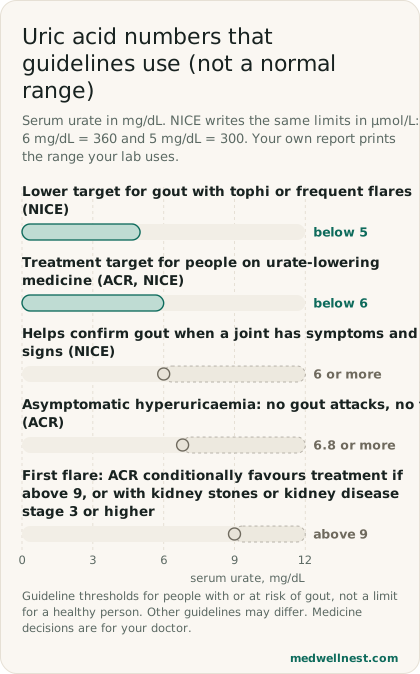
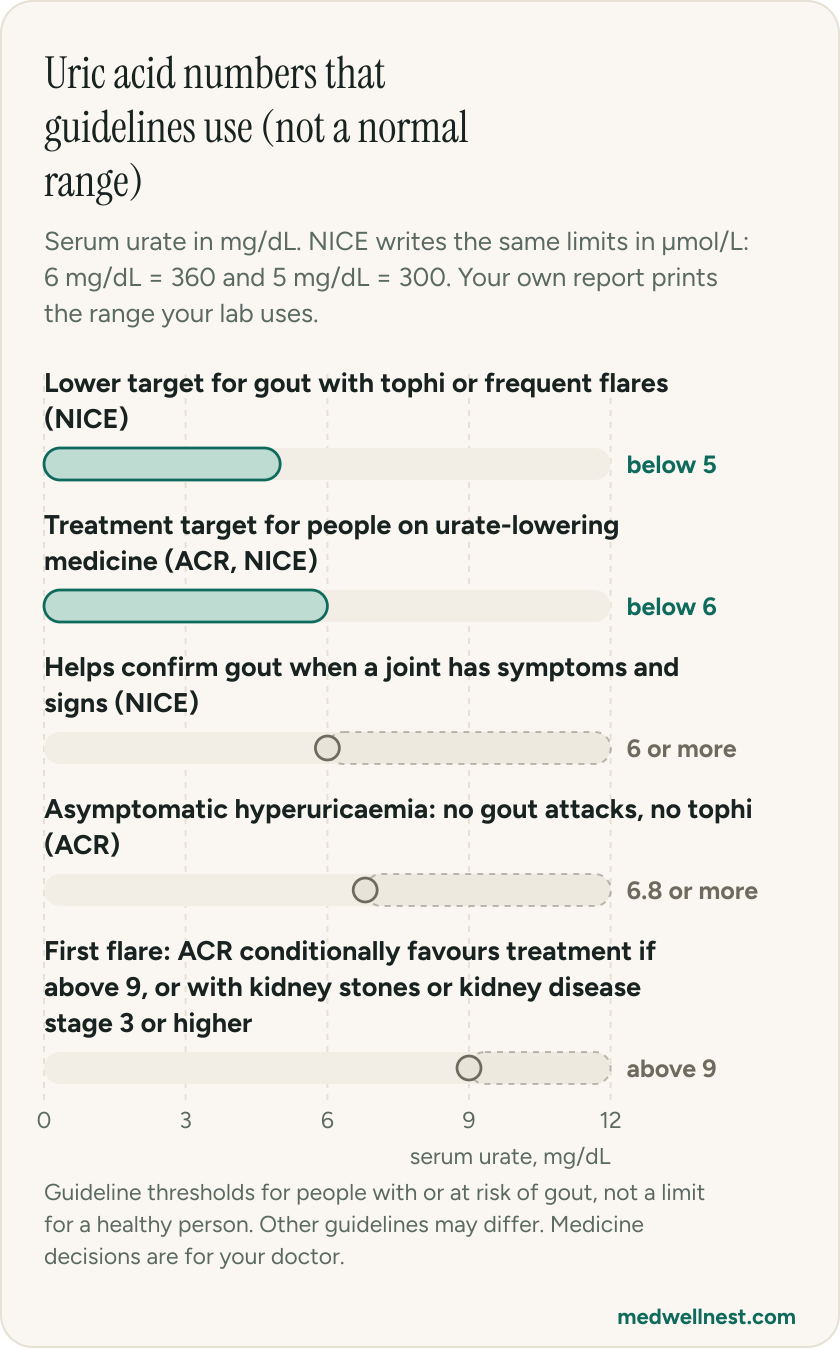
That is a decision for you and your doctor, and the main gout guideline leans towards not starting urate-lowering medicine. The 2020 American College of Rheumatology (ACR) guideline defines asymptomatic hyperuricaemia as a serum urate of about 6.8 mg/dL or more with no previous gout flare and no tophi (hard lumps under the skin made of urate crystals). For that group it says "we conditionally recommend against initiating any pharmacologic ULT", meaning any urate-lowering medicine. A conditional recommendation is the guideline's weaker grade: the right choice can depend on the person.
The guideline gives its reasons. In trials, new gout over 3 years was uncommon whether or not people took the medicine (under 1% on it, against 5% without), and 24 people would need to be treated for 3 years to prevent a single gout flare. In observational studies of people with a serum urate above 9 mg/dL and no gout, only 20% developed gout within 5 years. The panel felt that for most people with asymptomatic hyperuricaemia, including those with kidney disease, heart disease, kidney stones or high blood pressure, the benefits of medicine would not outweigh the costs or risks. The ACR says its panel weighed costs for the health system the guideline was written for, so doctors working in other health systems may weigh them differently.
The same guideline does recommend urate-lowering medicine for people who have had gout: strongly for one or more tophi, X-ray damage from gout, or 2 or more flares a year, and conditionally even after a first flare if there is moderate-to-severe kidney disease (stage 3 or higher), a serum urate above 9 mg/dL or kidney stones. Those rules are for your doctor to apply, and this page gives no doses. MedlinePlus says your doctor may order more tests to find the cause of a high result, and the NHS says that if you have gout and are prescribed uric acid-lowering medicine, it is important to take it regularly even when you have no symptoms.
04
What does the 6 mg/dL uric acid target mean on a report or in a guideline?
Six is not the upper limit of normal for healthy people. It is a treatment target and a diagnostic cut-off, both for people with joint symptoms. The ACR says: "Achieving and maintaining an SU target of <6 mg/dl over the use of no target is strongly recommended for all patients receiving ULT." NICE says the same: aim for below 360 µmol/L (6 mg/dL), and consider below 300 µmol/L (5 mg/dL) for people with gout who have tophi, chronic gouty arthritis, or frequent flares despite a level below 360.
NICE also uses 6 mg/dL as a test for a hot, painful joint: in someone with symptoms and signs of gout, a serum urate of 360 µmol/L (6 mg/dL) or more helps confirm the diagnosis. But NICE adds that if the level is below 360 µmol/L during a flare and gout is strongly suspected, the test should be repeated at least 2 weeks after the flare has settled. A normal result during an attack therefore does not rule gout out, and a single number on a report, in either direction, is not a diagnosis. NICE says joint fluid can be examined if the diagnosis stays uncertain.
05
Can high uric acid cause kidney stones or kidney damage?
It can in some people, but not in everyone with a high level. MedlinePlus says high uric acid levels can cause kidney stones or kidney failure, and that not everyone with high levels will have these problems. The NHS lists kidney stones among the complications of repeated, untreated gout. The ACR guideline says it does not directly address how gout or high uric acid affects kidney stones or kidney disease, so none of these sources gives a risk figure.
If stones are the worry, MedlinePlus describes a separate 24-hour urine uric acid test, which can help find out whether high uric acid is causing stones and can monitor stone risk in people who have gout. You collect all your urine for 24 hours in the container you are given. The NHS says small kidney stones are common and may cause no symptoms, while larger ones cause severe pain that usually starts in the side of the tummy or lower back, may spread to the groin, and may come and go. The NHS and MedlinePlus also list a high temperature, feeling shivery, feeling or being sick, needing to pee often, cloudy urine and blood in the urine.
Kidney disease is also one of the causes of high uric acid that MedlinePlus lists, which is why a uric acid result often sits beside a kidney test on the same report. Our kidney function report story explains those numbers.
06
When is a hot, swollen joint or kidney pain urgent?
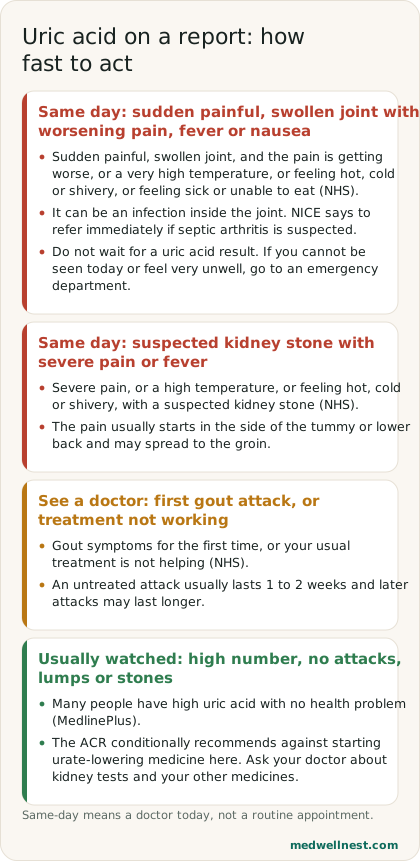
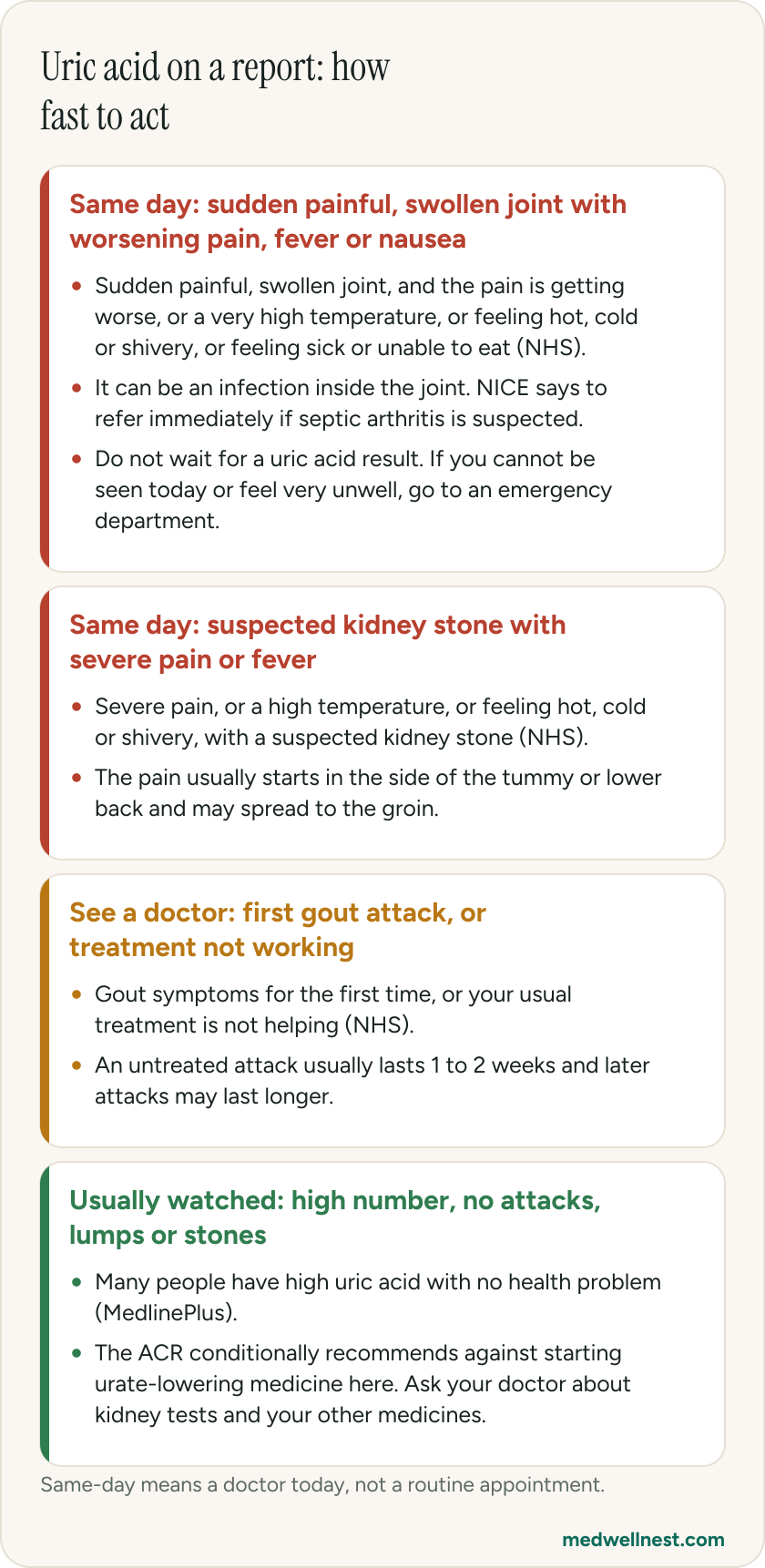
Do not wait for a uric acid result if a joint suddenly becomes painful and swollen and the pain is getting worse, you have a very high temperature or feel hot, cold or shivery, or you feel sick or cannot eat. The NHS says these can mean an infection inside the joint and need urgent medical help, and to ask for an urgent appointment or get urgent advice from the local health advice service. NICE says anyone with a painful, red, swollen joint should be assessed for septic arthritis (a joint infection), and that if it is suspected they should be referred immediately.
A normal uric acid result does not rule out gout, because NICE says the level can be below 360 µmol/L during a flare, so the look of the joint and how you feel decide the urgency, not the number. The same urgency applies to kidney stone pain: the NHS says to get an urgent appointment or urgent advice if you think you have a kidney stone and you are in severe pain, or have a high temperature or feel hot, cold or shivery. If you cannot see a doctor today, or you feel very unwell, go to an emergency department.
For a first attack of gout, or gout that your usual treatment is not settling, the NHS says to see a doctor, but not urgently. Untreated, an attack usually lasts 1 to 2 weeks, and leaving gout untreated may cause lasting damage to joints.
Uric acid report and joint or kidney pain: how fast to act
Same-day — call promptly
A joint that has suddenly become painful and swollen and the pain is getting worse, or you have a very high temperature or feel hot, cold or shivery, or you feel sick or cannot eat; or you think you have a kidney stone and you are in severe pain, or have a high temperature or feel hot, cold or shivery: see a doctor today, without waiting for a routine appointment. The NHS says a hot, swollen joint with these signs can mean an infection inside the joint and needs urgent medical help, and NICE says a suspected septic joint should be referred immediately. If you cannot be seen today, or you feel very unwell, go to an emergency department.
Routine — see a doctor
A high uric acid number on a report with no joint attacks, lumps under the skin or stones; a first gout attack that is settling; or gout that your usual treatment is not helping: book a visit with a doctor and bring the report. Do not start or stop any medicine because of the number alone. The ACR conditionally recommends against starting urate-lowering medicine for a high number with no gout attacks or tophi, and the NHS says to see a doctor for a first gout attack or treatment that is not working.
Values mentioned in this story
Each one opens a visual guide with its normal range and what moves it — upload a report and we place your own numbers on the same scale.
Sources
- Uric acid test — MedlinePlusmedlineplus.gov
- How to understand your lab results — MedlinePlusmedlineplus.gov
- Gout — NHSnhs.uk
- Kidney stones — NHSnhs.uk
- 2020 American College of Rheumatology guideline for the management of gout — Arthritis Care & Researchpubmed.ncbi.nlm.nih.gov
- Gout: diagnosis and management (NG219) — NICE guidelinenice.org.uk
Share this story
Curious where your own values stand?
Two minutes from upload to a full visual picture. Free to analyze.