In short
By the NIH's grouping, below 12 ng/mL is deficient, 12 to under 20 is inadequate and 20 or more is adequate, while above 50 may cause harm. Other expert bodies draw the lines elsewhere. Here is how to read your 25(OH)D result in either unit, and who actually needs the test.
Emergency if: Confusion, severe vomiting with signs of dehydration, or a racing or irregular heartbeat in someone taking high-dose vitamin D: go to emergency care now.
On your report
Vitamin D (25-OH), Calcium, Parathyroid Hormone, Phosphorus
On this page
01
Which number to look at on the report
A vitamin D blood test measures 25-hydroxyvitamin D, written 25(OH)D. It reflects the vitamin D you make from sunlight and the vitamin D you get from food and supplements. MedlinePlus notes that some labs report "total vitamin D" and some report vitamin D2 and D3 separately. Total vitamin D, the two added together, is the number to check.
The result comes in one of two units. Some labs report nanograms per millilitre (ng/mL) and others nanomoles per litre (nmol/L). The NIH Office of Dietary Supplements gives the conversion: 1 ng/mL equals 2.5 nmol/L, and 1 nmol/L equals 0.4 ng/mL. So 20 ng/mL is 50 nmol/L, and 30 nmol/L is 12 ng/mL. If your result looks surprisingly high or low, check the unit before anything else.
02
The NIH bands, in both units
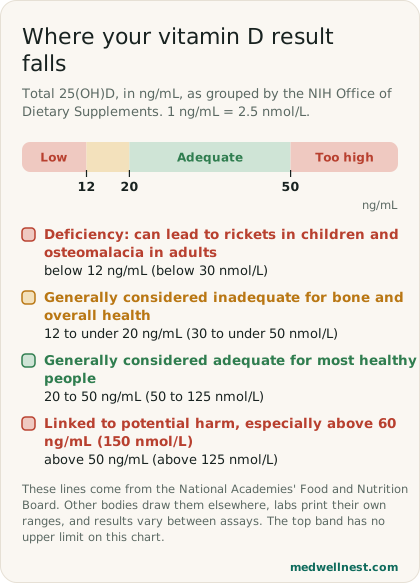
The NIH Office of Dietary Supplements groups results using lines set by the Food and Nutrition Board of the National Academies of Sciences, Engineering, and Medicine. Below 12 ng/mL (below 30 nmol/L) is associated with deficiency, which can lead to rickets in children and osteomalacia, a softening of the bones, in adults. From 12 to under 20 ng/mL (30 to under 50 nmol/L) is generally considered inadequate for bone and overall health. From 20 ng/mL (50 nmol/L) upward is generally considered adequate for most healthy people.
There is an upper line too. Above 50 ng/mL (125 nmol/L) is linked to potential adverse effects, particularly above 60 ng/mL (150 nmol/L). The Food and Nutrition Board advised avoiding levels above roughly 50 to 60 ng/mL, so more is not better past a point.
The NIH is careful to say that the levels linked to deficiency and adequacy have not been definitively identified. Results also vary between testing methods: the same blood can read falsely low or falsely high depending on the assay and the laboratory. Your lab will print its own range, often with its own labels such as deficient, insufficient, sufficient and toxic, and that range is the one that applies to your report.
03
Why other bodies draw different lines
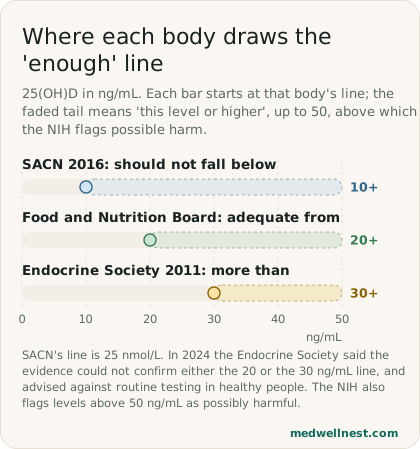
Experts disagree about where "enough" starts, and your report may follow any of them. The Scientific Advisory Committee on Nutrition (SACN) set its line lower. Its 2016 report found that the risk of poor bone and muscle health rises below 25 nmol/L, which is 10 ng/mL, and recommended that no one's level should fall below that at any time of year.
The Endocrine Society went the other way in 2011, saying a level above 30 ng/mL (75 nmol/L) was needed for the full effect on calcium, bone and muscle. Its 2024 guideline stepped back. The panel said the evidence did not confirm either the 20 ng/mL line or the 30 ng/mL line, and that levels which give specific benefits have not been established in trials. The NIH notes that the Endocrine Society has not identified levels for sufficiency, insufficiency or deficiency.
In practice this means one result can be called low by one lab and fine by another. A reading of 25 ng/mL, for example, is adequate by the NIH bands and well above the SACN line, but below the Endocrine Society's 2011 line of 30 ng/mL. It is worth asking which scale your lab uses before worrying about the label.
04
Who should be tested
MedlinePlus says routine vitamin D testing is not recommended for everyone. The Endocrine Society's 2024 guideline suggests against routine testing in the general population at every adult age and during pregnancy, and the NIH reports that the USPSTF, a national preventive-care panel, found too little evidence to judge screening in adults without symptoms.
A test makes more sense when there is a reason. MedlinePlus lists a diagnosis linked to low vitamin D, such as osteomalacia, osteoporosis or low bone density, or rickets; symptoms such as bone pain, muscle weakness or aches, and bones that break easily; and a high risk of deficiency. That includes rarely getting sun on your skin, poor nutrition, weight-loss surgery, conditions that block absorption such as coeliac disease, Crohn's disease or ulcerative colitis, kidney or liver disease, and some medicines, including certain statins and steroids. The NIH adds older adults, people with dark skin and people with obesity to the groups more likely to run low.
If you are being treated for a low level, your doctor may repeat the test to check it is rising. The NIH notes that 25(OH)D has a half-life in the blood of about 15 days, so ask your doctor when a repeat test is worth doing.
05
When the number is too high
Vitamin D toxicity is rare, and the NIH says it almost always comes from supplements. The NHS says you cannot overdose on vitamin D from sunlight, and the NIH says experts do not believe sun exposure causes toxicity. The harm comes from calcium: too much vitamin D raises calcium in the blood and urine. The NIH says toxicity usually shows very high 25(OH)D levels, typically above 150 ng/mL (375 nmol/L), with marked hypercalcaemia.
Symptoms of too much vitamin D listed by MedlinePlus are nausea and vomiting, poor appetite, constipation, muscle weakness and weight loss. The NIH adds confusion or other mental changes, pain, dehydration, passing a lot of urine, strong thirst and kidney stones, and in extreme cases kidney failure and heart rhythm problems. If your result is high and you take supplements, stop them and speak to your doctor, who may also check your calcium.
When to act
Routine — see a doctor
A low or borderline result with no symptoms: ask your doctor which scale your lab uses and whether you need treatment. Do not start high-strength supplements on your own.
Same-day — call promptly
A high result while you take vitamin D supplements, especially with nausea, vomiting, constipation, strong thirst or passing a lot of urine: stop the supplements and see a doctor today to have your calcium checked.
Emergency — act now
Confusion, severe vomiting with signs of dehydration, or a racing or irregular heartbeat in someone taking high-dose vitamin D: go to emergency care now.
Values mentioned in this story
Each one opens a visual guide with its normal range and what moves it — upload a report and we place your own numbers on the same scale.
Sources
- Vitamin D: Fact Sheet for Health Professionals — NIH Office of Dietary Supplementsods.od.nih.gov
- Vitamin D Test — MedlinePlusmedlineplus.gov
- SACN vitamin D and health report — Scientific Advisory Committee on Nutritiongov.uk
- Vitamin D for the Prevention of Disease (2024 guideline) — Endocrine Societyendocrine.org
- To D or Not To D? — Endocrine News, Endocrine Societyendocrinenews.endocrine.org
- Vitamin D — NHSnhs.uk
Share this story
Curious where your own values stand?
Two minutes from upload to a full visual picture. Free to analyze.