In short
AFI is a scan number for the fluid around your baby. Sources call an AFI of about 5 cm or less, or a deepest pocket of about 2 cm or less, low fluid, and an AFI of about 24 to 25 cm or more high fluid. A low reading starts closer monitoring, not automatic delivery, but leaking fluid or fewer movements needs a call now.
Emergency if: Fluid is leaking from your vagina or you think your waters have broken, your baby is moving less than usual or you cannot feel it move, or you have vaginal bleeding: contact your maternity unit now, even in the middle of the night. The NHS says to call your midwife or maternity unit urgently for each of these and not to wait until the next day. If the fluid is smelly or coloured, tell them straight away. If you cannot reach your maternity unit, go to an emergency department now.
On this page
01
What is AFI, and what is the deepest vertical pocket on my scan report?
Amniotic fluid is the water around your baby in the womb. An ultrasound can estimate how much there is in two ways. The amniotic fluid index (AFI) is the sum of the deepest pocket of fluid in each of the 4 quadrants of the abdomen, counting only pockets at least 1 cm wide that hold no more than passing baby parts or cord. The deepest vertical pocket (DVP), also called the single deepest pocket (SDP) or maximum vertical pocket (MVP), is one measurement: the single deepest pocket.
Your report may give either number or both, in centimetres (cm). Fluid is not meant to stay the same all pregnancy. The 2024 review in the Journal of Clinical Medicine notes that amniotic fluid volumes change through the weeks, and that the fixed cut-offs used in practice are easy to apply but do not take those changes into account. So the number is read with how many weeks pregnant you are. Our growth scan story explains the rest of that report.
02
What is the normal AFI? Is an AFI of 5 low and is 25 high?
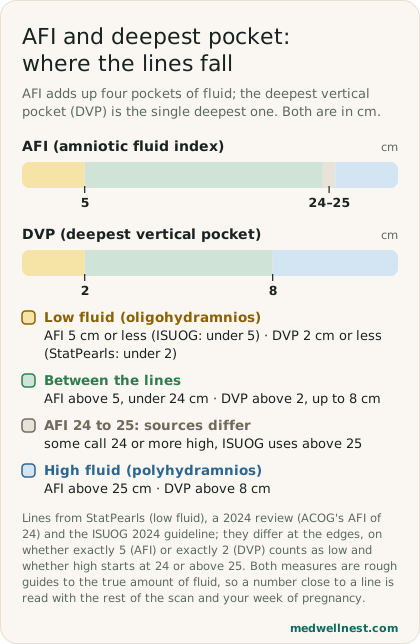
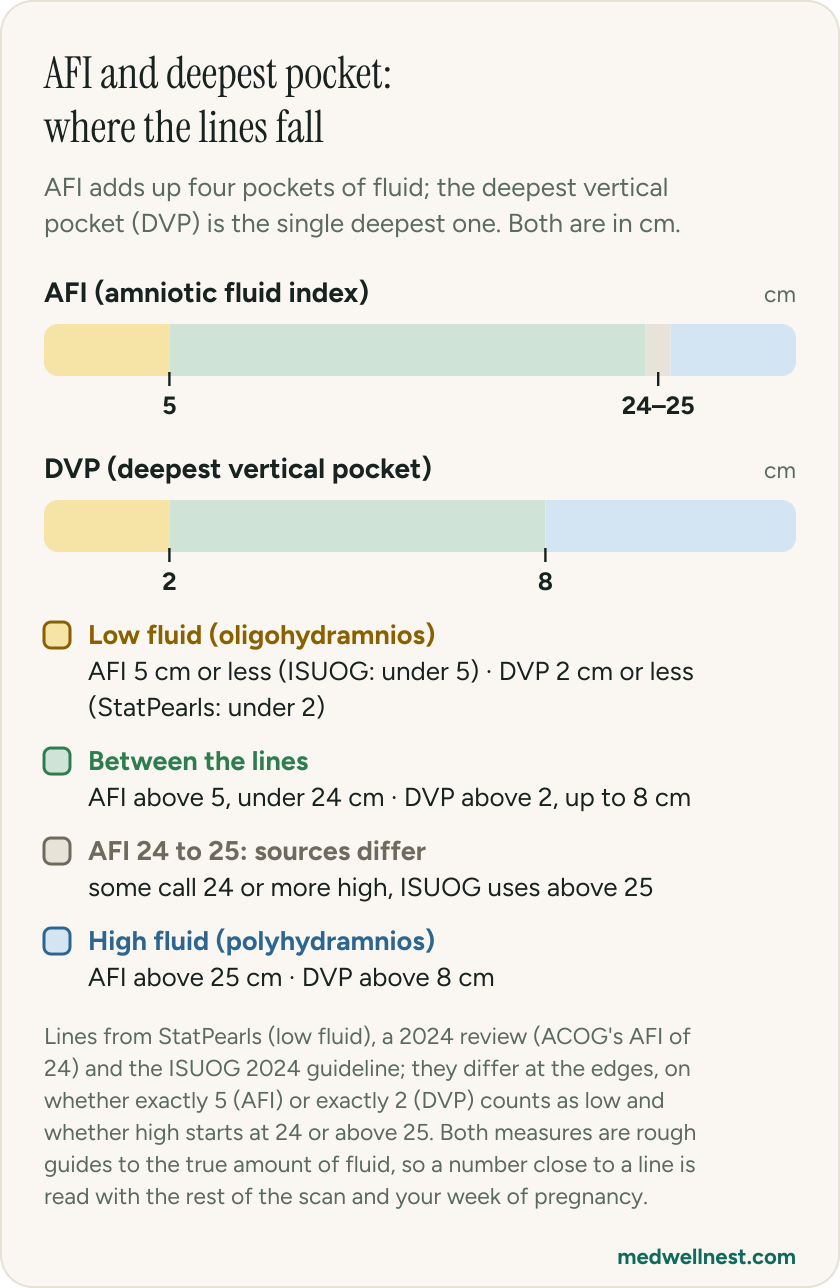
There is no single line that every source uses. StatPearls defines low fluid (oligohydramnios) as an AFI of 5 cm or less, or a DVP under 2 cm. The 2024 review says an AFI of 5 cm remains the recommended lower limit, and that ACOG adopted an AFI of 24 cm as the upper limit of normal. The ISUOG 2024 guideline on the third-trimester scan says low fluid is typically defined as an AFI below 5 cm or a DVP of 2 cm or less, and high fluid (polyhydramnios) as an AFI above 25 cm or a DVP above 8 cm.
So the sources agree on the rough lines but differ at the edges: an AFI of exactly 5 is low fluid for StatPearls but not for ISUOG, a DVP of exactly 2 is low fluid for ISUOG but not for StatPearls, and high fluid starts at an AFI of 24 for ACOG but above 25 for ISUOG. An AFI above 5 and under 24 cm, or a DVP above 2 and up to 8 cm, is not flagged by any of them. A reading just beyond a line is a reason to look more closely and repeat the measurement, not proof of a problem.
03
Why does my report say AFI but my doctor talks about the deepest pocket?
Current guidance leans towards the single deepest pocket for low fluid. The 2024 review says ACOG and SMFM guidelines recommend using the maximum vertical pocket to diagnose and manage oligohydramnios, and the ISUOG guideline says DVP may be preferable for assessing low fluid while AFI may be preferable for high fluid. The authors of the 2024 review say they continue to advocate the deepest pocket over the AFI for diagnosing low fluid.
The measurements are also rough. The 2024 review describes a pooled analysis whose authors found the AFI problematic because the share of pregnancies labelled low fluid ranged from 3% to 40% across the studies, which shows how many things can affect the number. Neither AFI nor DVP counts the water directly, so a single reading near a line is treated as a prompt for a closer look, not as a verdict.
04
My AFI is low (oligohydramnios). Is my baby in danger and what causes it?
StatPearls says low fluid most often comes from reduced fetal urination, a placenta that is not working well enough (uteroplacental insufficiency), or loss of fluid when the membranes have ruptured. It also says that in many cases a cause is never identified. A review of amniotic fluid adds that high blood pressure in pregnancy, anaemia, clotting disorders, diabetes, smoking and some medicines can contribute, and that loss of fluid through ruptured membranes should always be considered.
A low reading is linked with higher chances of some problems. The 2024 review says that in otherwise uncomplicated singleton pregnancies, low fluid was linked with more emergency caesarean births for fetal distress and more newborn intensive care admissions, and that the most common harm appears to come from early delivery decided because of the finding. These are statistics across many pregnancies, not a prediction for yours.
05
AFI is low: what tests and treatment come next, and does it mean early delivery?
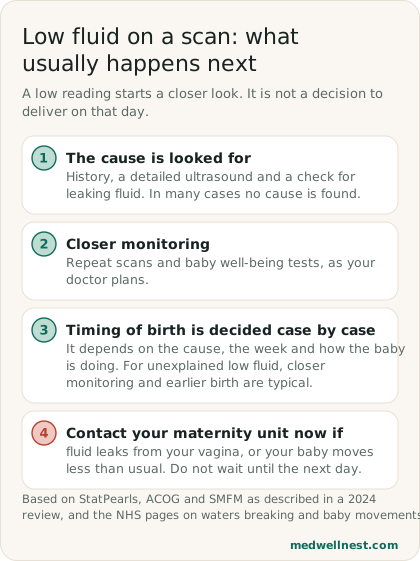
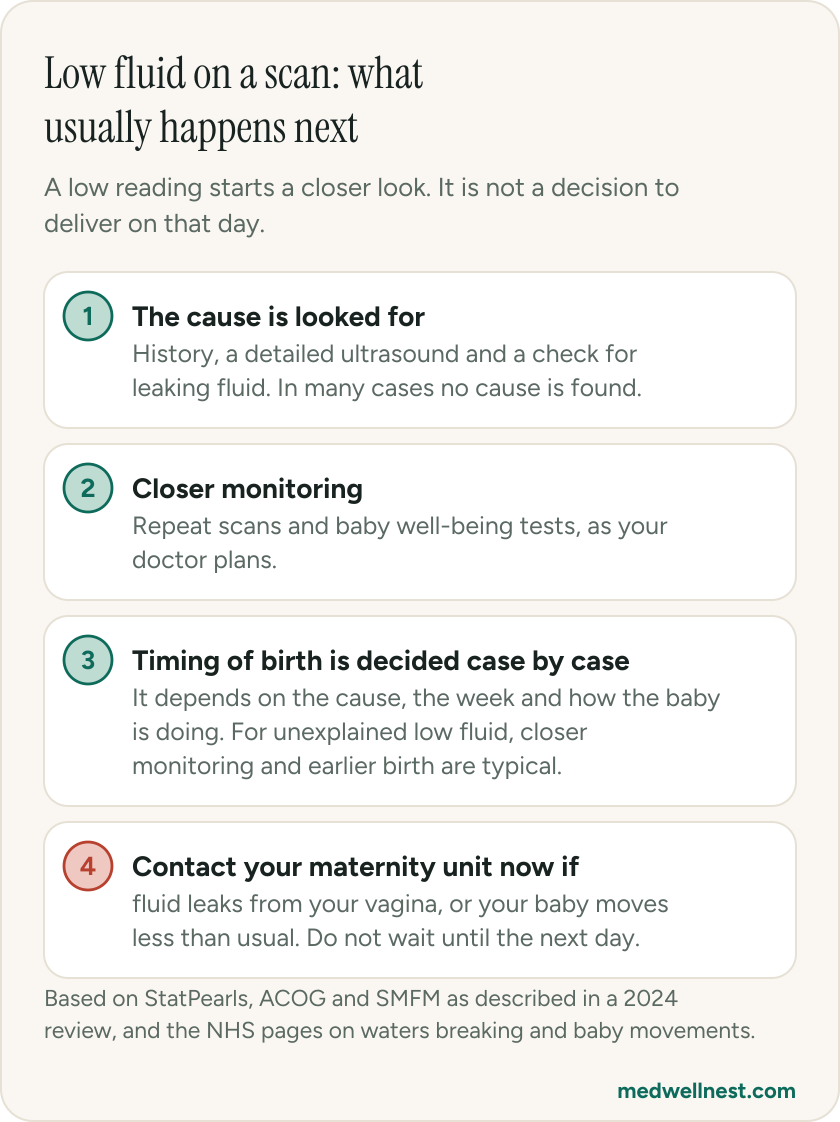
StatPearls says the work-up is a targeted history and examination, a detailed ultrasound, and amniocentesis only if there are signs of a fetal abnormality or history-based risk factors. The management and outlook depend mainly on the cause and on how many weeks pregnant you are. The 2024 review adds that a detailed scan and a check for ruptured membranes are advised, and that ACOG and SMFM recommend starting antenatal testing at diagnosis if delivery would be considered.
On timing of birth, StatPearls says closer monitoring and early delivery are typically indicated when no cause is found. The 2024 review describes ACOG and SMFM guidance, for low fluid with no other complication, to deliver at 36 0/7 to 37 6/7 weeks, or at diagnosis if found later, and says that before 34 weeks the options include admission, hydration and repeat scans. Your team decides for you, because it depends on the cause, the week and how your baby is doing on monitoring. Fewer movements or leaking fluid change that plan at once.
06
Does drinking more water raise AFI?
Possibly a little. The review of amniotic fluid says maternal hydration can affect fluid volume, and the 2024 review lists hydration among the options for low fluid before 34 weeks. A 2025 pooled analysis of four studies found the AFI rose by about 1 cm 2 hours after oral hydration and by just over 2 cm after 1 week. Its authors conclude that oral hydration increases the AFI, but they also report high variation between studies in the type, amount and frequency of fluid, and they say its effectiveness was uncertain before the analysis.
Those results are changes in the scan number. They do not show that your baby does better or that drinking can replace monitoring. Ask your team how much fluid is right for you, rather than guessing, and when the scan will be repeated.
07
My AFI is high (polyhydramnios): what causes it and what happens next?
The 2024 review says polyhydramnios complicates up to 1% of pregnancies and about half are idiopathic, meaning no cause is found. It is most commonly linked with diabetes in the mother and with fetal abnormalities, and other causes include a high fetal heart output, as in fetal anaemia. That is why high fluid leads to a detailed scan to look for a cause. Our gestational diabetes story explains how diabetes in pregnancy is found.
Guidance described in the same review says delivery for mild polyhydramnios should not be recommended before 39 weeks, that antenatal testing is recommended for moderate to severe polyhydramnios, and that the timing of birth for moderate to severe cases is individualised. It also notes that studies of unexplained high fluid report more large babies and caesarean births, while findings on stillbirth are mixed. Keep every scan and tell your team about any change in your baby's movements.
When to act
Emergency — act now
Fluid is leaking from your vagina or you think your waters have broken, your baby is moving less than usual or you cannot feel it move, or you have vaginal bleeding: contact your maternity unit now, even in the middle of the night. The NHS says to call your midwife or maternity unit urgently for each of these and not to wait until the next day. If the fluid is smelly or coloured, tell them straight away. If you cannot reach your maternity unit, go to an emergency department now.
Routine — see a doctor
Your scan report says AFI low or high, or your doctor mentions oligohydramnios or polyhydramnios and you have not been told the plan: ask your maternity team at your next contact, or call them during the day. Ask what cause is being looked for, when the next scan is, whether extra monitoring is planned, and which signs to report at once. Keep every scan appointment.
Sources
- StatPearls: Oligohydramnios (via NCBI Bookshelf)ncbi.nlm.nih.gov
- Historical Assessment, Practical Management, and Future Recommendations for Abnormal Amniotic Fluid Volumes — Journal of Clinical Medicine 2024pmc.ncbi.nlm.nih.gov
- ISUOG Practice Guidelines (2024): performance of third-trimester obstetric ultrasound scan — Ultrasound in Obstetrics & Gynecologyisuog.org
- Window to the Womb: Amniotic Fluid and Postnatal Outcomes — International Journal of Women's Health 2023pmc.ncbi.nlm.nih.gov
- Effect of oral hydration therapy on amniotic fluid index and maternal-neonatal outcomes in pregnant women with oligohydramnios: a systematic review and meta-analysis — Journal of Perinatal Medicine 2025pubmed.ncbi.nlm.nih.gov
- Signs that labour has begun — NHSnhs.uk
Share this story
Curious where your own values stand?
Two minutes from upload to a full visual picture. Free to analyze.