In short
There is no set number of kicks a day. The NHS and RCOG say to learn your own baby's pattern and to call your maternity unit straight away, at any hour, if movements are fewer or different. Here is when movements start, what happens near the end, and what to do.
Emergency if: Your baby is moving less than usual, you cannot feel your baby moving any more, or the usual pattern has changed: call your maternity unit or hospital now, at any hour, or go straight to the hospital; if you cannot reach them, go to the nearest emergency department. The NHS and RCOG say not to wait until the next day and not to rely on a home Doppler.
On this page
01
How many times should the baby move in a day? Is there a fixed kick count?
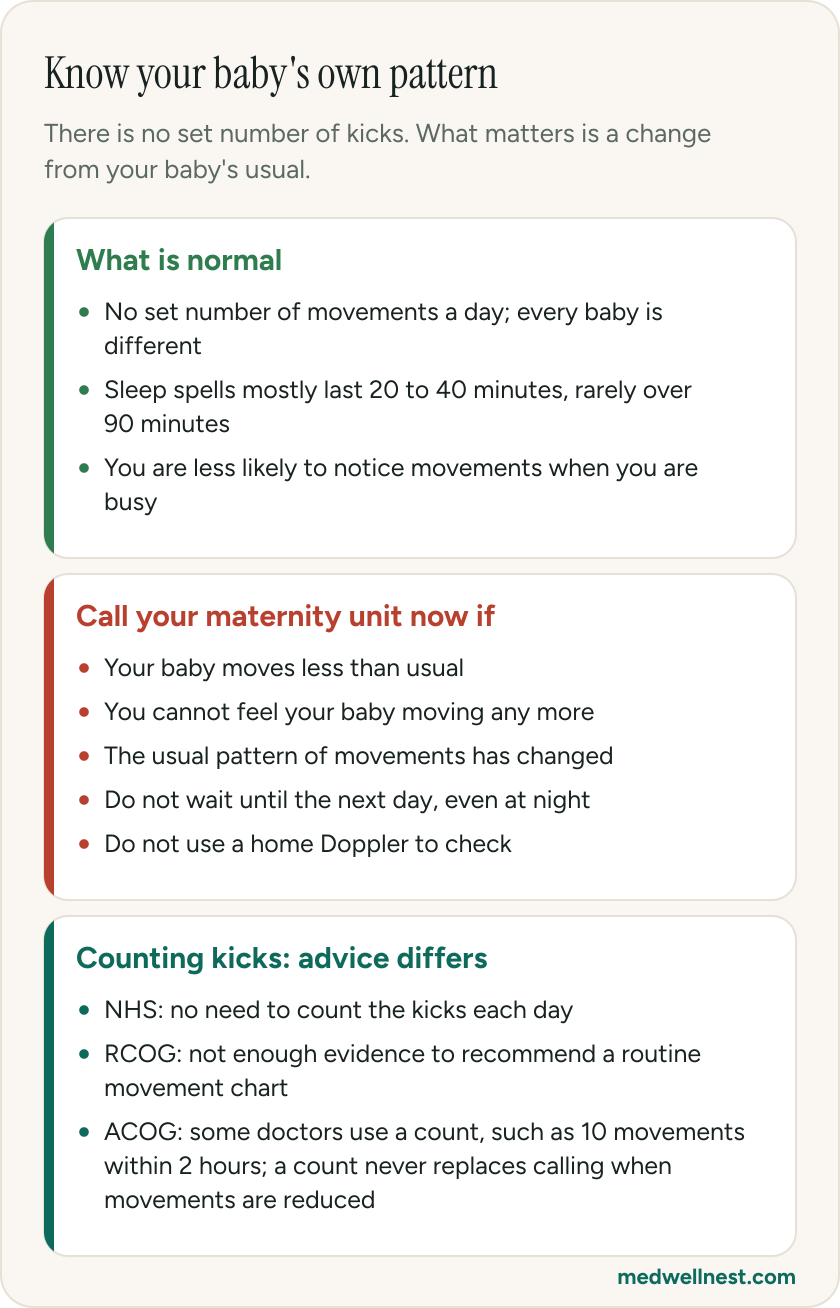
No. The NHS says there is no set number of movements you should feel each day, because every baby is different, and that you do not need to count the kicks. The RCOG says the same: no specific number of movements is considered normal. What matters is that you get to know your own baby's usual pattern from day to day, and notice when it reduces or changes.
You may have heard of a '10 kicks' rule. It comes from kick counting, where you time how long it takes to feel 10 movements. ACOG describes it for patients: if you feel less movement than you think is normal, ask your doctor whether they recommend kick counts, do the count after your biggest meal of the day, and call if you have not felt 10 kicks within 2 hours. The RCOG found not enough evidence to recommend routine use of a movement chart. So the advice differs. If your own doctor has given you a counting method, follow it. But a count is never a reason to wait: if movements feel less than usual, call without counting first.
02
When do you first feel the baby move?
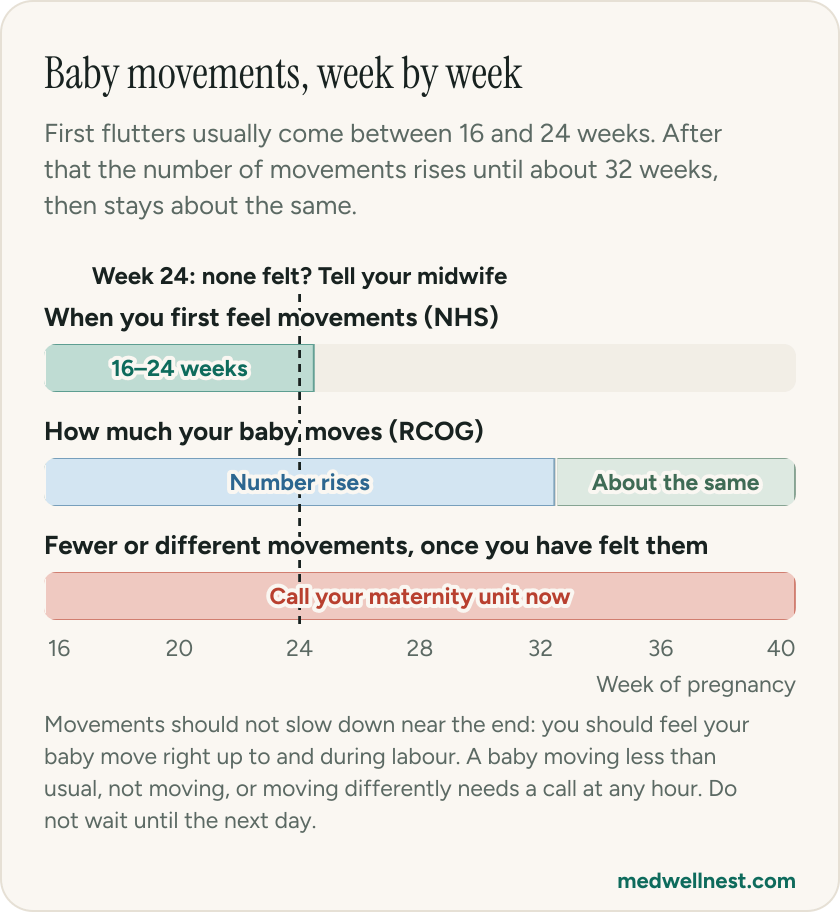
The NHS says you should start to feel your baby move between 16 and 24 weeks of pregnancy, and that with a first baby you might not feel movements until after 20 weeks. The RCOG says most women first notice movement at 18 to 20 weeks, and that if you have been pregnant before you may feel it as early as 16 weeks. ACOG says most first-time mothers will not feel kicking until about 5 months.
Early movements feel like a gentle swirling or fluttering. Later you may feel kicks, jerky movements, swishes and rolls. You may notice less if you are busy, or if your placenta lies at the front of your womb, which can make movements harder to feel.
If you have not felt your baby move by 24 weeks, tell your midwife or maternity unit. They will check your baby's heartbeat and may arrange a scan. Our guide to fetal heart rate by week explains what that heartbeat check shows.
03
Do baby movements slow down near the end of pregnancy?
No, and this is a common myth that can delay a call. The RCOG says the number of movements tends to increase until 32 weeks and then stays about the same, although the type of movement may change as the due date gets nearer. The NHS says you should feel your baby move right up to and during labour.
Babies do sleep. The RCOG says sleep periods mostly last 20 to 40 minutes and are rarely longer than 90 minutes, and that the afternoon and evening are usually the busiest times. So a quiet spell can be sleep. But feeling fewer movements, or a different pattern, for your baby is never something to put down to 'less room' and wait out. Strong pain relief or sedatives can make a baby move less, and alcohol and smoking may also affect movements, so tell the unit about them. None of these is a reason to wait before calling.
04
What should I do if the baby moves less than usual?
Call your midwife or maternity unit immediately if your baby is moving less than usual, you cannot feel your baby moving any more, or the pattern has changed. The NHS says not to wait until the next day, even if it is the middle of the night. The RCOG says never to go to sleep ignoring a reduction or change in your baby's movements. If you are past 28 weeks, it adds that you must not wait until the next day to get help. This is because a baby who is not well may move less than usual, and finding the problem sooner means the right care can start sooner.
Do not use a home Doppler, the heartbeat listening kits sold for use at home. The NHS says this is not a reliable way to check your baby's health, and that even if you hear a heartbeat it does not mean your baby is well. Do not count kicks first to see whether it settles either.
At the unit you will be asked about the movements and have a check-up. The RCOG says that after 28 weeks your baby's heart rate will usually be monitored for at least 20 minutes, and an ultrasound scan may be arranged, usually within 24 hours. Our guide to the non-stress test explains that heart rate trace. Most women who have one episode of reduced movements go on to have a healthy baby. If it happens again, call again, however many times it happens: the RCOG says you should never hesitate. Our tests and scans timeline shows where growth scans fit into routine care.
When to act
Emergency — act now
Your baby is moving less than usual, you cannot feel your baby moving any more, or the usual pattern has changed: call your maternity unit or hospital now, at any hour, or go straight to the hospital; if you cannot reach them, go to the nearest emergency department. The NHS and RCOG say not to wait until the next day and not to rely on a home Doppler.
Same-day — call promptly
You are 24 weeks pregnant and have never felt your baby move: contact your midwife or maternity unit today, without waiting for your next routine visit. The NHS and RCOG say they will check your baby's heartbeat and may arrange a scan.
Routine — see a doctor
Movements feel the same as usual but you are unsure what is normal for your baby: ask your midwife at your next visit to talk through your baby's pattern. You can also call the unit at any time you are worried.
Sources
- Your baby's movements — NHSnhs.uk
- Your baby's movements in pregnancy — Royal College of Obstetricians and Gynaecologists (RCOG)rcog.org.uk
- The Top 6 Pregnancy Questions I Hear From First-Time Moms — ACOGacog.org
- Special Tests for Monitoring Fetal Well-Being — ACOG patient FAQacog.org
- Pregnancy symptoms you need to get help for — NHSnhs.uk
Share this story
Curious where your own values stand?
Two minutes from upload to a full visual picture. Free to analyze.