In short
Most routine pregnancy checks fall into a few windows: a booking visit with blood tests by about 10 to 12 weeks, a scan at 11 to 14 weeks, the anomaly scan at around 18 to 22 weeks, a glucose test at 24 to 28 weeks when offered, and 28-week bloods. Here is when each happens, and where NICE, ACOG and WHO differ.
Emergency if: Heavy vaginal bleeding, or bleeding with severe tummy pain: get emergency care now.
On your report
Hemoglobin, Fasting Glucose, Platelet Count
On this page
01
The windows that matter
Pregnancy care is mostly check-ups: blood pressure, a urine test and a chat at each visit. On top of those, a small number of tests and scans have fixed windows, and missing a window can mean missing the test. This is an overview of when they fall. Separate guides on this site explain how to read a screening result and what the anomaly scan looks for.
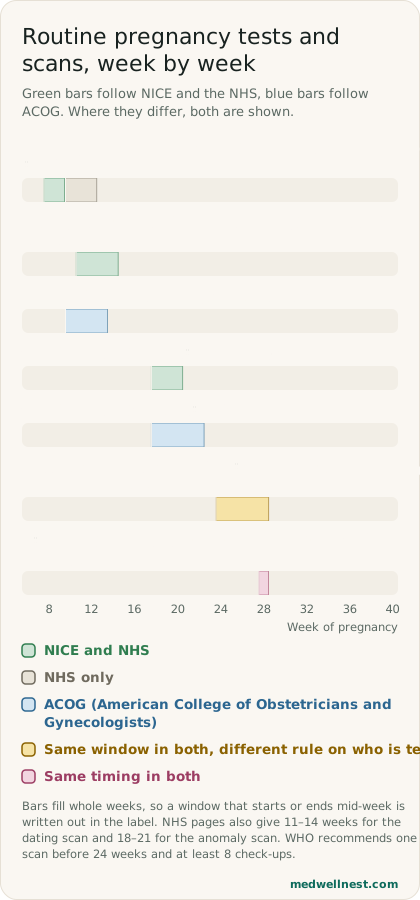
The timings below come from NICE, which writes the guidance for the NHS, from the NHS's own pages, from the American College of Obstetricians and Gynecologists (ACOG) and from the World Health Organization (WHO). They agree on the order and differ by a week or two at the edges. Where they differ, both are shown. The schedule your own clinic gives you is the one to follow.
02
Booking visit and first blood tests
NICE says the first proper appointment, the booking visit, should take place by 10 weeks. The NHS describes it as happening at 8 to 12 weeks. At that visit NICE says to offer a blood test for your full blood count, blood group and rhesus (Rh) D status, and to check your blood pressure and urine, which are then repeated at routine visits.
The same early blood sample is used for screening. It is usually also used to screen for infections such as HIV, syphilis and hepatitis B and, where offered, for inherited blood conditions such as sickle cell and thalassaemia; ask which tests your clinic runs. ACOG lists a urine test, blood tests and tests for some sexually transmitted infections at the first visit.
Screening is offered, not forced. NICE says you can accept or decline any part of it, and the NHS says your care continues as normal either way.
03
The first scan and screening, 10 to 14 weeks
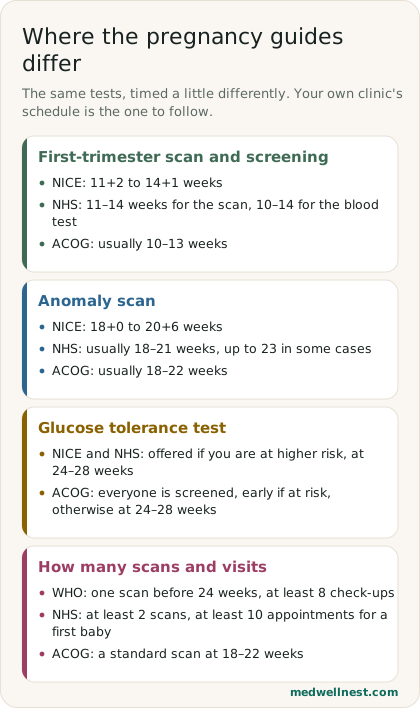
The first routine scan dates the pregnancy, checks for twins and, if you choose, is used for screening for Down's syndrome, Edwards' syndrome and Patau's syndrome. NICE sets its window at 11+2 to 14+1 weeks, meaning 11 weeks and 2 days to 14 weeks and 1 day. NHS pages give 11 to 14 weeks for the scan. ACOG says first-trimester screening, a blood test with an ultrasound, is usually done at 10 to 13 weeks.
If that window is missed, there is a later blood test. The NHS says the quadruple test is offered at 14 to 20 weeks if the combined test was not possible, and that it is not as accurate. ACOG gives 15 to 22 weeks for the same test. ACOG also describes cell-free DNA screening, which can be done from 10 weeks and takes about a week for results.
All of these give a chance, not an answer. ACOG says a positive cell-free DNA result should be followed by a diagnostic test, amniocentesis or chorionic villus sampling (CVS), before any decision is made.
04
The anomaly scan, 18 to 22 weeks
The mid-pregnancy scan checks the baby's structure and, NICE adds, where the placenta sits. NICE puts it at 18+0 to 20+6 weeks. The NHS describes it as usually happening between 18 and 21 weeks, checking for 11 conditions, and says it can be done up to 23 weeks in some cases, for example if the first attempt could not get clear pictures. ACOG says the standard exam is usually done at 18 to 22 weeks.
No scan finds everything. The NHS says some conditions show more clearly than others, and that you should still tell your midwife or doctor about any symptom that worries you, whatever the scan said.
05
The glucose test, 28-week bloods and anti-D
The oral glucose tolerance test looks for diabetes that starts in pregnancy. The window is the same across the guides, 24 to 28 weeks, but who is tested differs. NICE and the NHS offer it if you have risk factors for gestational diabetes. ACOG says every pregnant woman should be screened, with an early test if you have risk factors and a test at 24 to 28 weeks otherwise. WHO says it has no recommendation on whether or how to screen everyone, and that 24 to 28 weeks is the usual time for diagnosis.
At the 28-week appointment NICE says to offer another blood test for your full blood count, blood group and antibodies. The NHS describes it as a check on your health, iron levels and blood group.
If you are rhesus D negative and not already sensitised, the same visit is when NICE says to offer anti-D, the injection that stops your body making antibodies against an Rh-positive baby. A bleed later in pregnancy can also call for anti-D, so if you are Rh-negative and bleed, say so when you call.
06
When the guides disagree
The biggest difference is in how many scans are routine. WHO recommends one ultrasound before 24 weeks. The NHS offers at least 2. ACOG describes a standard exam at 18 to 22 weeks. NICE says not to offer routine scans after 28 weeks in an uncomplicated single pregnancy.
Visits differ too. WHO recommends at least eight contacts, the first by 12 weeks, then at 20, 26, 30, 34, 36, 38 and 40 weeks. The NHS offers at least 10 appointments for a first baby. WHO expects each health system to adapt its model, so your clinic's schedule may not match any of these exactly.
What matters is not falling through a gap. If you are close to the end of one of these windows and have not been offered the test, tell your midwife or doctor straight away, because some tests cannot be done later.
When to act
Routine — see a doctor
You are 10 weeks or more pregnant and have not been offered screening, or 18 weeks or more without an anomaly scan booked: tell your midwife or doctor now, because these tests have deadlines.
Same-day — call promptly
Any unexplained vaginal bleeding after 13 weeks, or, after 24 weeks, any worry about your baby's movements or a change in them: contact your maternity unit now, day or night; do not wait until the next day. If you are Rh-negative, say so, as you may need anti-D.
Emergency — act now
Heavy vaginal bleeding, or bleeding with severe tummy pain: get emergency care now.
Values mentioned in this story
Each one opens a visual guide with its normal range and what moves it — upload a report and we place your own numbers on the same scale.
Sources
- Antenatal care (NG201): Recommendations — NICEnice.org.uk
- Pregnancy (antenatal) care, checks and screening tests — NHSnhs.uk
- 20-week screening scan — NHSnhs.uk
- Prenatal Genetic Screening Tests — ACOGacog.org
- Gestational Diabetes — ACOGacog.org
- WHO recommendations on antenatal care for a positive pregnancy experience: summary — WHOiris.who.int
Share this story
Curious where your own values stand?
Two minutes from upload to a full visual picture. Free to analyze.