In short
The national test for diabetes in pregnancy is one blood sugar reading 2 hours after 75 g of glucose, fasting or not, with 140 mg/dL as the cut-off. Here is when it is done, how it compares with the WHO 3-reading test, and what happens after a positive result.
Emergency if: A pregnant woman on insulin has a seizure or loses consciousness: call emergency services now. The national guideline lists seizures and loss of consciousness among the signs of low blood sugar, which it says must be treated immediately.
On your report
Fasting Glucose, Post-Prandial Glucose (PPBS)
On this page
01
Why every pregnant woman is tested
Gestational diabetes is high blood sugar that starts, or is first found, during pregnancy. It usually causes no symptoms, so the only way to find it is to test. The national guideline on gestational diabetes, updated in 2018, asks for every pregnant woman to be tested, not only those thought to be at risk.
It matters for both of you. The guideline warns that babies of mothers with gestational diabetes are at risk of low blood sugar after birth and should have their sugar checked within the first hour, and that mothers and their children are at higher risk of type 2 diabetes later in life. Our guide to gestational diabetes explains the condition itself; this one is about the test.
02
How the national one-step test is done
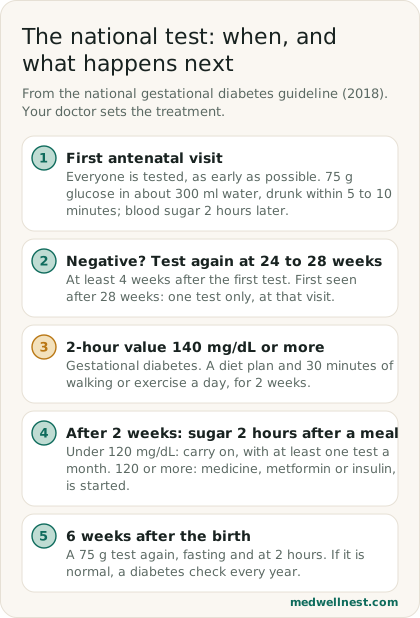
The national test is a single step. You drink 75 g of glucose dissolved in about 300 ml of water, finishing it within 5 to 10 minutes, and your blood sugar is checked 2 hours later. You do not need to fast: the guideline says the test is done whether you come fasting or not, irrespective of your last meal. It asks for a plasma-calibrated glucometer or a lab analyser, so the result is ready the same day.
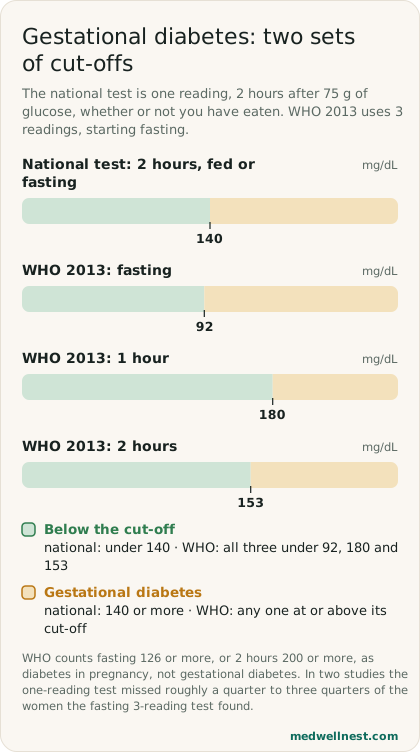
A 2-hour value of 140 mg/dL or more means gestational diabetes; under 140 is normal. If you vomit within 30 minutes of the drink, the test should be repeated the next day; after 30 minutes, it continues. This non-fasting 75 g test is often called the DIPSI test, after the study group that proposed it.
03
Which week: first visit, then 24 to 28 weeks
The guideline asks for two tests. The first is at your first antenatal visit, as early in pregnancy as possible. If it is normal, the second is at 24 to 28 weeks, when many women's sugar tolerance worsens, and at least 4 weeks after the first. The guideline notes that only about a third of women with gestational diabetes are found in the first trimester, which is why the second test matters.
If the 24 to 28 week test is missed, it can be done any time after 24 weeks. If your first visit is after 28 weeks, only one test is done, at that visit, and the guideline says late arrival is no reason to skip it.
04
The WHO three-reading test
Many labs and doctors use a different test, set out by the International Association of Diabetes and Pregnancy Study Groups (IADPSG) in 2010 and adopted by the WHO in 2013. You fast overnight, give a fasting sample, drink 75 g of glucose and give two more samples at 1 and 2 hours. Gestational diabetes is diagnosed if any one value reaches its cut-off: 92 mg/dL fasting, 180 at 1 hour or 153 at 2 hours. IADPSG places this test at 24 to 28 weeks; WHO says the diagnosis can be made at any time in pregnancy.
WHO sets upper limits too. A fasting value of 126 or more, or a 2-hour value of 200 or more, counts as diabetes in pregnancy, not gestational diabetes, because it is handled more intensively. WHO itself rates its recommendation as weak and the evidence as very low quality, and expects these criteria to label more women as having gestational diabetes. The national guideline describes its 140 test as the single-step test recommended by WHO, but the WHO cut-offs it quotes, 126 fasting and 140 at 2 hours, are not the ones in WHO's 2013 criteria, which are the three above.
05
The trade-off: easier, but it misses some women
The one-step test is simple: no fasting, one visit, one blood sample and a result the same day, which is why the guideline chose it. The cost is that it misses some women whom the fasting 3-reading test would diagnose. In a study of 1,031 pregnant women who had both tests a few days apart, the non-fasting test found only 24 of the 106 women diagnosed by the IADPSG criteria, a sensitivity of 22.6%, and the authors said it could not be recommended for diagnosis.
Other studies found it did better. In a 2017 study of 936 women, the sensitivity against the IADPSG criteria was 74.1%, so about a quarter of women with gestational diabetes were missed, and only 63% of those it flagged were confirmed by the fasting test. An earlier study it cites reported full agreement. The honest summary is that the one-step test has lower sensitivity than the 3-reading test, so a normal result is less reassuring than it looks. If your doctor suggests a fasting test as well, this is why.
06
After a positive result
The guideline starts with food and activity. After a first positive result, you get a diet plan, called medical nutrition therapy, and are asked to walk or exercise for 30 minutes a day, for 2 weeks. Then your blood sugar is checked 2 hours after a meal. If it is under 120 mg/dL, you carry on, with at least one test a month in the second and third trimesters. If it is 120 or more, medicine is started, either metformin or insulin, as your doctor decides. The targets are under 95 fasting and under 120 two hours after a meal.
The guideline also asks for extra growth scans, and for the baby's blood sugar to be checked within an hour of birth. Your own sugar usually returns to normal after delivery, but 6 weeks after the birth you should have a 75 g test again, fasting and at 2 hours: under 140 at 2 hours is normal, 140 to 199 is impaired glucose tolerance, and 200 or more, or 126 or more fasting, is diabetes. If it is normal, the guideline advises a diabetes check every year.
When to act
Emergency — act now
A pregnant woman on insulin has a seizure or loses consciousness: call emergency services now. The national guideline lists seizures and loss of consciousness among the signs of low blood sugar, which it says must be treated immediately.
Same-day — call promptly
On treatment and low blood sugar (under 70 mg/dL) more than once in a day, vomiting and unable to eat, or readings far above target despite medicine (fasting above 150 or after a meal above 200): see your doctor today. The guideline says these need a doctor straight away or referral to a larger hospital.
Routine — see a doctor
Had gestational diabetes: book the 75 g test 6 weeks after the birth, and a diabetes check every year after that if it is normal.
Values mentioned in this story
Each one opens a visual guide with its normal range and what moves it — upload a report and we place your own numbers on the same scale.
Sources
- National guideline: diagnosis and management of gestational diabetes mellitus, technical and operational guidelines (2018)nhm.gov.in
- Diagnostic criteria and classification of hyperglycaemia first detected in pregnancy (2013) — WHOncbi.nlm.nih.gov
- IADPSG recommendations on the diagnosis and classification of hyperglycemia in pregnancy (2010)pmc.ncbi.nlm.nih.gov
- Comparison of screening for gestational diabetes by OGTT in the non-fasting and fasting states (Mohan et al., 2014)pmc.ncbi.nlm.nih.gov
- Evaluation of the non-fasting 75 g glucose test (DIPSI criteria) for diagnosing gestational diabetes (2017)pmc.ncbi.nlm.nih.gov
Share this story
Curious where your own values stand?
Two minutes from upload to a full visual picture. Free to analyze.