In short
A reactive NST is reassuring. A non-reactive one is common, often means the baby was asleep, and leads to more testing rather than panic. Here is how the non-stress test and the biophysical profile are scored, what 8/10 or 6/10 means, and why reduced movements need a call to the maternity unit now.
Emergency if: The baby is moving less than usual or the pattern has changed, any bleeding late in pregnancy, or fluid leaking from the vagina, especially before 37 weeks: contact your maternity unit or go to hospital now. Do not wait until the next day or the next NST. The same applies to a BPP of 4 or less on a report you have been handed with no plan.
On your report
Fasting Glucose, TSH
On this page
01
What the non-stress test is
The non-stress test (NST), done on a CTG (cardiotocography) machine, records the baby's heart rate through a belt on the belly while you lie on your side or half sitting. It is called non-stress because nothing is done to the baby; the test simply watches how the heart rate responds when the baby moves. StatPearls, a peer-reviewed medical reference that follows the American College of Obstetricians and Gynecologists (ACOG), says it usually runs for at least 20 minutes, sometimes extended to 40 minutes to allow for the baby's sleep.
It is usually done in the third trimester when the risk to the baby is higher. StatPearls lists reasons such as high blood pressure or preeclampsia, diabetes, kidney or thyroid disease, twins, a baby who is not growing well, going past the due date, too little or too much fluid, and reduced movements. StatPearls says 32 weeks is a reasonable point for most people to start testing, because by then the NST is reactive in most babies.
02
Reactive: the reassuring result
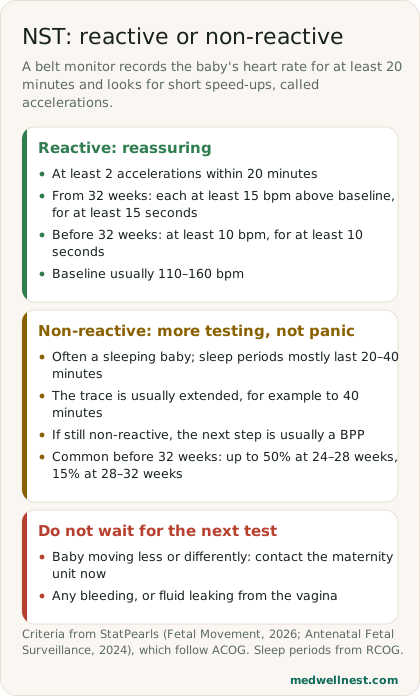
A healthy baby's heart rate briefly speeds up when it moves. These speed-ups are called accelerations. StatPearls defines a reactive NST as at least 2 accelerations within 20 minutes. From 32 weeks, each must rise at least 15 beats per minute (bpm) above the baseline and last at least 15 seconds; before 32 weeks, at least 10 bpm for at least 10 seconds is enough. The baseline heart rate should be 110–160 bpm.
StatPearls says a reactive result indicates normal control of the baby's heart rate by its nervous system and suggests the baby is well at that moment. StatPearls notes these tests have low false-negative rates, which is why a normal result is reassuring. It also says they cannot predict sudden events such as a placenta separating, so a good result last week does not cover a new problem today.
03
Non-reactive: often a sleeping baby
A non-reactive NST means the qualifying accelerations did not appear. StatPearls says this may reflect a normal fetal sleep cycle or a baby who is struggling, so the test is extended to give the baby more time. The Royal College of Obstetricians and Gynaecologists (RCOG) says babies have sleep periods that mostly last 20–40 minutes and are rarely longer than 90 minutes, and usually do not move during them.
It is especially common before 32 weeks. StatPearls says that from 24 weeks up to 50% of NSTs may be non-reactive, and from 28 to 32 weeks 15% are. Staff may use a small buzzer on the belly, called vibroacoustic stimulation, to prompt the baby to move. If the trace stays non-reactive, the next step is usually a biophysical profile or a contraction stress test.
04
The biophysical profile (BPP): five checks, 2 points each
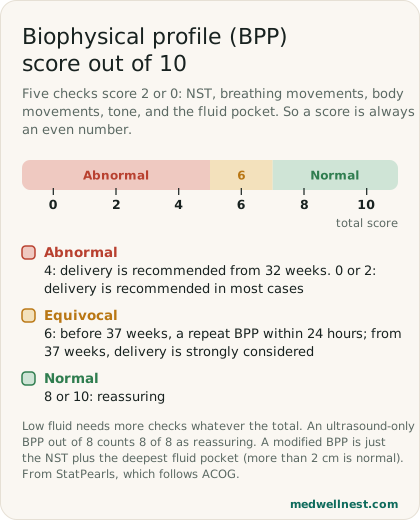
The BPP combines the NST with an ultrasound. StatPearls lists five parts, each scored 2 if present or 0 if not: a reactive NST; breathing movements, at least one episode lasting 30 seconds within 30 minutes; body movements, at least 3 within 30 minutes; tone, at least one stretch and bend of a limb or an opening and closing of a hand; and amniotic fluid, a pocket deeper than 2 cm.
A total of 8 or 10 is normal, 6 is equivocal and 4 or less is abnormal. StatPearls, following ACOG, says a score of 6 before 37 weeks leads to a repeat BPP within 24 hours, while from 37 weeks delivery is strongly considered. A score of 4 leads to a recommendation for delivery from 32 weeks, with extended monitoring possible before that. Low fluid needs more checks whatever the total. Some reports give an ultrasound-only score out of 8, where 8 of 8 is reassuring.
05
The modified BPP
A modified BPP is just two parts: the NST and the deepest pocket of amniotic fluid. StatPearls says it is normal when the NST is reactive and the deepest pocket is more than 2 cm. If either part is abnormal, the modified BPP is reported as abnormal and leads to a full BPP or a contraction stress test. Our growth scan guide explains how the fluid pocket and the amniotic fluid index are measured.
06
Reduced movements: call now, do not wait for the test
Your own sense of the baby's movements matters more than the date of the next NST. The RCOG says that if the baby is moving less than usual or the pattern has changed, you should contact your midwife or maternity unit immediately; after 28 weeks, you must not wait until the next day, and you should not rely on a home heartbeat monitor. StatPearls agrees that any reported decrease in movement should be assessed, usually starting with an NST.
ACOG advises contacting your doctor right away or going to hospital for any bleeding late in pregnancy, and for signs of preterm labour before 37 weeks, which include fluid leaking or a gush from the vagina and regular tightenings.
When to act
Emergency — act now
The baby is moving less than usual or the pattern has changed, any bleeding late in pregnancy, or fluid leaking from the vagina, especially before 37 weeks: contact your maternity unit or go to hospital now. Do not wait until the next day or the next NST. The same applies to a BPP of 4 or less on a report you have been handed with no plan.
Same-day — call promptly
An NST reported as non-reactive, or a BPP of 6, and no plan has been made yet: ask the maternity team today what the next test is and when.
Routine — see a doctor
A reactive NST or a BPP of 8 or 10: keep your scheduled checks and keep noticing your baby's usual pattern of movements.
Values mentioned in this story
Each one opens a visual guide with its normal range and what moves it — upload a report and we place your own numbers on the same scale.
Sources
- Fetal Movement — StatPearlsncbi.nlm.nih.gov
- Antenatal Fetal Surveillance — StatPearlsncbi.nlm.nih.gov
- Your baby's movements in pregnancy — RCOG patient informationrcog.org.uk
- Bleeding During Pregnancy — ACOGacog.org
- Preterm Labor and Birth — ACOGacog.org
Share this story
Curious where your own values stand?
Two minutes from upload to a full visual picture. Free to analyze.