In short
The heartbeat usually shows on a vaginal scan by the end of week 6, speeds up until about week 9 and runs at 110 to 160 beats a minute in labour. Here is what early numbers mean, NICE's rules when no heartbeat is seen, and why fewer movements need a call now.
Emergency if: Later in pregnancy, your baby is moving less than usual, you cannot feel movements any more, or the pattern has changed: call your maternity unit or hospital now. The NHS says not to wait until the next day, even at night, and not to rely on a home doppler.
On this page
01
When the heartbeat first shows on a scan
Weeks of pregnancy are counted from the first day of your last period. A 2022 review of the evidence says the embryo's heart is thought to start beating at 35 to 37 days, in the sixth week, and that by the end of the sixth week a heartbeat can normally be seen on a vaginal scan in a healthy embryo, although dates are often uncertain. Embryos of the same age differ, so the first flicker appears within a window of days rather than on a fixed day.
Your dates may not be exact. NICE says the date of your last period may not reflect the true age of the pregnancy, because cycles vary, and tells doctors not to use it alone to decide whether a heartbeat should be visible. A scan at what you think is 6 weeks that shows no heartbeat may simply be too early.
02
Early heart rates, week by week
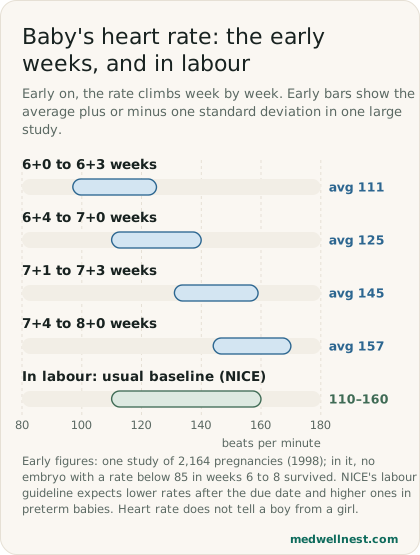
In the early weeks the rate climbs quickly. In a study of 2,164 pregnancies, the average was 111 beats a minute at 6 weeks and 0 to 3 days, 125 from 6 weeks 4 days to 7 weeks, 145 at 7 weeks 1 to 3 days and 157 from 7 weeks 4 days to 8 weeks. The review describes a rapid, almost straight-line rise until about week 9, a moderate fall to the end of the first trimester, and then a slow decline until birth.
Individual babies vary around these averages, and the rate changes from moment to moment. In that study, embryos whose rate was below 85 beats a minute in weeks 6 to 8 did not survive, which is why a very slow early heartbeat is taken seriously. A rate a little below the average is common; your doctor reads it together with the size of the embryo and your dates.
03
Later in pregnancy and in labour: 110 to 160
The 110 to 160 figure comes from NICE's guideline on monitoring in labour, NG229. It says the baseline heart rate will usually be between 110 and 160 beats a minute, measured as the average over 10 minutes when the rate is stable, leaving out the short speed-ups and slow-downs. It expects a lower baseline in babies past their due date and a higher one in babies born early.
In labour, NICE treats a stable baseline of 110 to 160 as reassuring, 100 to 109 as a feature to watch, which may be fine if it stays stable with normal variability, and a baseline below 100 or above 160 as a red feature. These are rules for continuous monitoring during labour. A single number written on a scan report is a snapshot and should be read by your doctor, not against these categories.
04
When no heartbeat is seen: NICE's rules
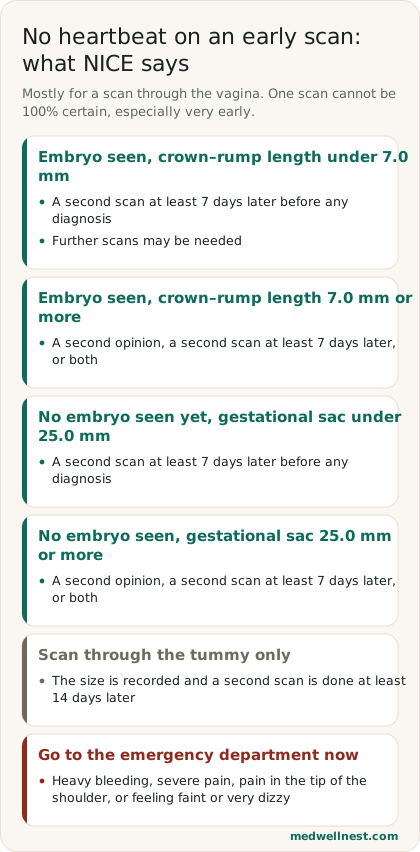
NICE is clear that one scan cannot be 100% accurate for diagnosing a miscarriage, especially very early. On a vaginal scan, if an embryo is seen and its crown-rump length is under 7.0 mm with no heartbeat, a second scan should be done at least 7 days later before any diagnosis. If it measures 7.0 mm or more with no heartbeat, NICE asks for a second opinion, a second scan at least 7 days later, or both.
If no embryo is seen yet, the gestational sac is measured instead. Under 25.0 mm, NICE asks for a second scan at least 7 days later; at 25.0 mm or more, a second opinion, a repeat scan at least 7 days later, or both. When only a scan through the tummy is possible, the repeat should be at least 14 days later. NICE says waiting for a repeat scan does not harm the pregnancy, and that you should be given a number to call. Heavy bleeding, severe pain or feeling faint means going to an emergency department now.
05
Heart rate cannot tell a boy from a girl
The belief that a fast heartbeat means a girl does not hold up. A 2023 meta-analysis of 5 studies found no significant difference in average first-trimester heart rate between boys and girls, and concluded that heart rate is not a reliable way to predict the sex.
It is also not something a scan should be used for. Finding out or revealing the sex of a baby before birth is illegal under the PCPNDT Act, and that includes hints given through the heart rate or any other sign, as our guide to NIPT explains. The heartbeat is recorded for your baby's care, not as a clue.
06
Later on, movements matter more than a heartbeat you hear
From mid-pregnancy, the baby's movements are the everyday sign to watch. The NHS says most women start to feel them between 16 and 24 weeks, and in a first pregnancy perhaps not until after 20 weeks; if you have felt nothing by 24 weeks, tell your doctor or midwife. There is no set number of movements, and you do not need to count kicks. What matters is your baby's usual pattern, and you should feel movements right up to and during labour.
If your baby is moving less than usual, you cannot feel movements any more, or the pattern changes, the NHS says to call your maternity unit immediately and not wait until the next day, even in the middle of the night. It also warns against home heartbeat monitors, called dopplers: hearing a heartbeat does not mean the baby is well.
When to act
Emergency — act now
Later in pregnancy, your baby is moving less than usual, you cannot feel movements any more, or the pattern has changed: call your maternity unit or hospital now. The NHS says not to wait until the next day, even at night, and not to rely on a home doppler.
In early pregnancy, heavy bleeding, severe pain, pain in the tip of the shoulder, or feeling faint or very dizzy: go to an emergency department now. NICE sends women with these problems straight to emergency care.
Routine — see a doctor
Told there is no heartbeat yet and a repeat scan is booked: NICE says waiting for the repeat does not harm the pregnancy. Ask for a number you can call if you have pain or bleeding before then.
Sources
- Ectopic pregnancy and miscarriage: diagnosis and initial management (NG126) — NICEnice.org.uk
- Fetal monitoring in labour (NG229) — NICEnice.org.uk
- Your baby's movements — NHSnhs.uk
- When does the human embryonic heart start beating? A review (Männer, 2022)pmc.ncbi.nlm.nih.gov
- Embryonic heart rate in early pregnancy (Stefos et al., 1998)pubmed.ncbi.nlm.nih.gov
- The role of fetal heart rate in first trimester sonograms in prediction of fetal sex: a meta-analysis (2023)pmc.ncbi.nlm.nih.gov
Share this story
Curious where your own values stand?
Two minutes from upload to a full visual picture. Free to analyze.