In short
A positive ANA is common in healthy people and is not a diagnosis on its own. Here is how to read the titre and the pattern on your report, how often healthy people test positive, and which tests usually come next.
On your report
ESR, CRP, Rheumatoid Factor (RA Factor)
On this page
01
What the ANA test looks for
An ANA test looks for antinuclear antibodies in the blood. MedlinePlus explains that these are antibodies which attack the body's own healthy cells, and they are called antinuclear because they target the nucleus, the control centre of each cell. A doctor usually orders the test when symptoms suggest an autoimmune disorder, such as fever, a rash, tiredness, joint pain, stiffness or swelling, muscle pain or swollen glands.
The American College of Rheumatology (ACR) points out that everyone has small amounts of autoantibodies. What the test asks is whether there is more than usual, and the answer comes back as a titre and, in most labs, a pattern. Both are useful clues. Neither one is a diagnosis.
02
Reading the titre: 1:40, 1:80, 1:160 and beyond
The standard method, called indirect immunofluorescence on HEp-2 cells, dilutes your serum step by step and checks whether the antibodies still light up the cells under a microscope. The titre is the weakest dilution that is still positive. Each step halves the concentration, so 1:160 means more antibody than 1:80, and 1:640 more than 1:320.
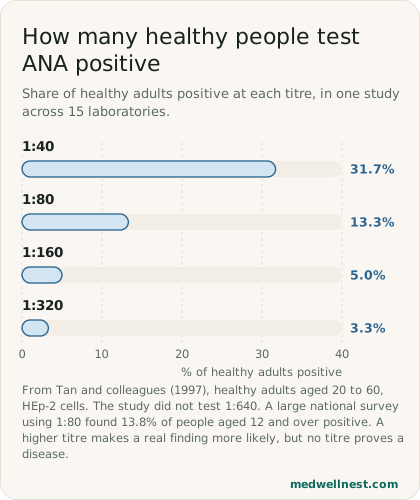
The catch is that many healthy people have a positive result at low titres. In a 1997 study in which 15 laboratories tested the same samples from healthy adults aged 20 to 60, 31.7% were positive at 1:40, 13.3% at 1:80, 5.0% at 1:160 and 3.3% at 1:320. The study did not test 1:640, so there is no matching figure for that titre. A large national population survey that screened at 1:80 found 13.8% of people aged 12 and over positive, 17.8% of women and 9.6% of men.
The ACR adds that ANA becomes more common with age, particularly after 65, and that some labs report only titres above 1:160 as positive. The 2019 lupus classification criteria use 1:80 or higher as the entry point. So the same titre may be printed as positive by one lab and borderline by another, and a higher titre makes a real finding more likely without proving anything on its own.
03
Why a positive result is not a diagnosis
MedlinePlus is plain about it: results from an ANA test alone cannot diagnose a specific disease. The ACR puts numbers on the problem. More than 95% of people with lupus test positive, which is why a negative ANA helps to rule lupus out. But only about 11 to 13% of people with a positive ANA actually have lupus or any other autoimmune or connective tissue disease, and up to 15% of completely healthy people test positive.
A positive result can also follow a viral infection, when the antibodies usually last only a short time, and certain medicines and some cancers can cause it. A negative result makes an autoimmune disorder less likely, but MedlinePlus notes it does not rule one out completely.
Even the lupus criteria treat ANA as a door, not a verdict. The 2019 EULAR/ACR criteria require an ANA of 1:80 or more before anything else is counted, then add points for specific clinical features and blood tests, and classify lupus only at 10 points or more. Their authors stress that classification criteria are not designed for diagnosis, which remains the job of a trained doctor looking at the whole person.
04
The pattern: a pointer, not a verdict
Under the microscope, the antibodies light up the cell in a particular pattern, and the report may name it: homogeneous, speckled, centromere, nucleolar and so on. The International Consensus on ANA Patterns (ICAP) has described 29 patterns, each with a code such as AC-1. Their main value is to suggest which specific antibody test to order next.
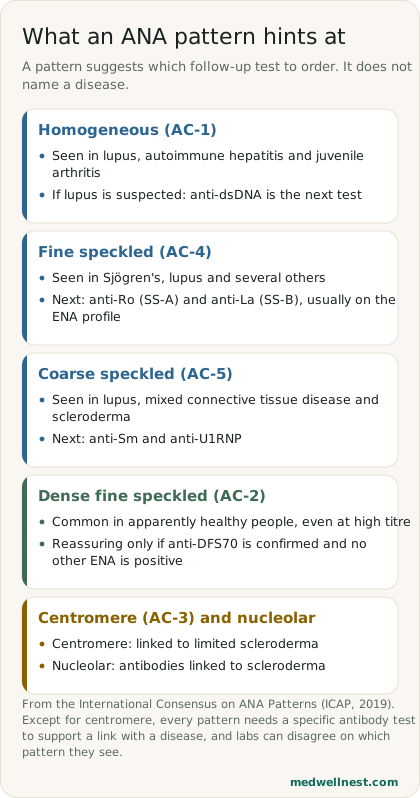
A homogeneous pattern is seen in lupus, autoimmune hepatitis and juvenile arthritis, and if lupus is suspected the next test is usually anti-dsDNA. Fine speckled patterns point towards anti-Ro and anti-La, which are linked to Sjögren's disease and lupus, and coarse speckled patterns towards anti-Sm and anti-U1RNP. The dense fine speckled pattern is interesting because it is common in apparently healthy people, sometimes at a high titre, but ICAP says it is reassuring only when a specific test confirms anti-DFS70 antibodies and no other antibody is found.
ICAP is careful to add that, apart from the centromere pattern, every pattern has to be confirmed with an antigen-specific test before it can be linked firmly to a disease. Labs also do not always agree on what they see: the consensus paper notes that some patterns can be hard to tell apart, and that some were once reported simply as homogeneous or speckled.
05
The ANA profile, ENA panel or blot
Because the screening test cannot say which antibody is present, a positive ANA is often followed by an ANA profile, also called an ENA panel or line blot. These tests look for named antibodies one by one, such as anti-Ro (SS-A), anti-La (SS-B), anti-Sm, anti-U1RNP and anti-centromere (CENP-B), with anti-dsDNA often tested separately.
ICAP links each of these follow-up tests to a disease the doctor already suspects from the symptoms. That is why the most useful next step is a consultation, ideally with a rheumatologist, rather than a longer list of tests. For how the results fit together in specific conditions, see our guides to lupus and to Sjögren's syndrome, where anti-Ro is one of the key markers.
06
What to do with a positive result
The ACR says a single positive ANA is not a sure sign of autoimmune disease, so you may not need any immediate treatment. What usually follows is a review of your history and symptoms, an examination and, if something points that way, more specific blood tests. Write down any symptoms you have noticed, including rashes, mouth ulcers, joint swelling, dry eyes or mouth, fingers turning white in the cold, and how long they have lasted.
Tell your doctor about every medicine you take, because some can cause antinuclear antibodies. MedlinePlus advises against stopping any medicine before the test unless your doctor tells you to. If you feel well and your titre is low, the likeliest explanation is that you are one of the many healthy people with a positive ANA.
When to act
Routine — see a doctor
A positive ANA at a low titre with no symptoms: this is common in healthy people. Discuss it with your doctor at a routine visit rather than starting treatment or ordering more tests on your own.
A positive ANA with symptoms such as joint swelling, a rash, mouth ulcers, dry eyes and mouth, or fingers that turn white in the cold: see your doctor, who may refer you to a rheumatologist for follow-up tests.
Values mentioned in this story
Each one opens a visual guide with its normal range and what moves it — upload a report and we place your own numbers on the same scale.
Sources
- ANA (Antinuclear Antibody) Test — MedlinePlusmedlineplus.gov
- Antinuclear Antibodies (ANA) — American College of Rheumatologyrheumatology.org
- Range of antinuclear antibodies in "healthy" individuals (Tan et al., Arthritis Rheum 1997)pubmed.ncbi.nlm.nih.gov
- Prevalence and sociodemographic correlates of antinuclear antibodies in the United States (Satoh et al., 2012)pmc.ncbi.nlm.nih.gov
- 2019 EULAR/ACR classification criteria for systemic lupus erythematosus (Aringer et al.)pmc.ncbi.nlm.nih.gov
- Clinical relevance of HEp-2 indirect immunofluorescent patterns: the ICAP perspective (Ann Rheum Dis 2019)pmc.ncbi.nlm.nih.gov
Share this story
Curious where your own values stand?
Two minutes from upload to a full visual picture. Free to analyze.