In short
An anti-HBs test shows whether the hepatitis B vaccine worked. Here is what 10 mIU/mL or more means, who should be tested and when, what happens if you do not respond, why a falling titre is usually not a problem, and how to read it with HBsAg and anti-HBc.
On this page
01
What the anti-HBs number means
Anti-HBs is the antibody against the surface protein of the hepatitis B virus. The body makes it after a successful vaccine course, and also after recovering from an infection. The Centers for Disease Control and Prevention (CDC) and WHO use the same cut-off: a level of 10 mIU/mL or more, measured 1 to 2 months after the last dose of a complete vaccine series, means you responded and are protected.
The guidance uses one cut-off only. A result of 100 or 1000 mIU/mL means the same thing as 15 for this purpose: you responded. CDC also notes that different test kits have different cut-offs, so compare a result with the reference range printed by the lab that did it.
02
Who should be tested, and when
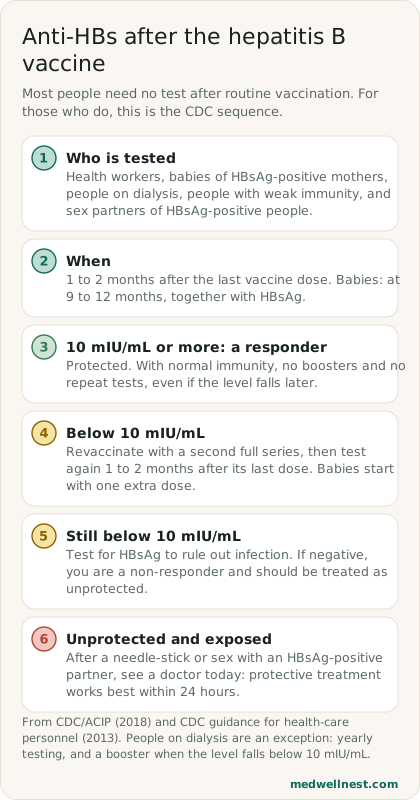
CDC says testing for immunity is not needed after routine vaccination of babies, children or adults. It recommends a post-vaccination anti-HBs test for people whose care depends on knowing: health workers and public safety workers, babies born to mothers who are HBsAg-positive, people on dialysis, people with HIV or other weakened immunity, such as during chemotherapy, and the sex partners of people who are HBsAg-positive.
Timing matters. Adults should be tested 1 to 2 months after the final dose. Babies of HBsAg-positive mothers are tested for both anti-HBs and HBsAg at 9 to 12 months of age, and not before 9 months, because antibodies given at birth can still show up. A test done many years after vaccination cannot tell someone who never responded from someone whose level has faded.
03
If your result is below 10 mIU/mL
A level below 10 after a full course means the vaccine has not yet produced a response. CDC recommends a second complete vaccine series, then another anti-HBs test 1 to 2 months after its last dose; for babies, the second course starts with a single extra dose and a test. WHO notes that almost everyone who does not respond to a first series responds to a second one.
If the level is still below 10 after the second series, CDC advises a test for HBsAg, and for health workers anti-HBc too, to check for an existing infection. Someone who is not infected is called a vaccine non-responder and should be considered unprotected. That person needs to know that any exposure to blood or body fluids from someone with hepatitis B calls for prompt protective treatment.
04
A titre that falls over the years
Anti-HBs levels fade with time, and that is expected. CDC reports that 18 years after vaccination, about 16% of people vaccinated as babies and 74% of those vaccinated at the age of 1 or older still had levels of 10 mIU/mL or more. Yet people who responded to the full course remain protected even when the level later falls below 10: when given a single challenge dose 30 years after vaccination, 88% produced a response of 10 or more, a sign of immune memory.
For this reason CDC does not generally recommend boosters for people with normal immunity, and WHO says the evidence does not support routine boosters after a complete primary series. The exceptions are people on dialysis, who should have a yearly anti-HBs test and a booster when the level falls below 10, and other people with weakened immunity, for whom the need is decided case by case. Health workers are often tested when they start a job; if the level is below 10, CDC advises one or more further doses and a retest.
05
Reading anti-HBs with HBsAg and anti-HBc
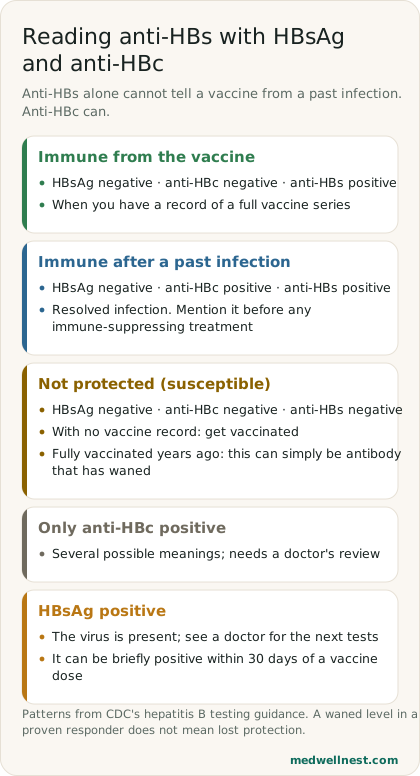
Anti-HBs alone cannot tell a vaccine from a past infection; anti-HBc, the core antibody, can, because the vaccine does not make it. CDC reads the three results together. Negative HBsAg and anti-HBc with a positive anti-HBs means immunity from vaccination, if you have a record of a full course. Negative HBsAg with positive anti-HBc and anti-HBs means an infection that has resolved; mention this before any treatment that suppresses immunity, because the virus can reactivate.
All three negative usually means not protected, and CDC advises vaccination if there is no record of a complete course. In someone vaccinated years ago, it can simply mean the antibody has faded. A positive HBsAg means the virus is present, though it can be briefly positive within 30 days of a vaccine dose. What to do after a positive HBsAg is covered in our separate story on that result.
06
After a needle-stick or other exposure
For someone who is not protected, speed matters after a possible exposure, such as a needle-stick, blood splashed into the eyes or mouth, or sex with a partner who has hepatitis B. CDC advises that protective treatment, a vaccine dose with or without hepatitis B immune globulin depending on your status, be given as soon as possible, preferably within 24 hours. The window in which it works is unlikely to be longer than 7 days after a needle-stick or 14 days after sexual exposure.
Keep a copy of your anti-HBs result and vaccine record. If you are a known responder, that record lets the doctor who sees you after an exposure act quickly and avoid unnecessary treatment.
When to act
Same-day — call promptly
A needle-stick, blood in the eyes or mouth, or sex with a partner who has hepatitis B, when you are not a known vaccine responder: see a doctor or an emergency department today. Protective treatment works best within 24 hours.
Routine — see a doctor
An anti-HBs result below 10 mIU/mL after a full vaccine course: see your doctor to arrange a second series and a repeat test 1 to 2 months after its last dose.
A positive HBsAg, or only a positive anti-HBc, on the same panel: book a visit with your doctor for the follow-up tests, and be seen the same day if you are pregnant or about to start treatment that suppresses immunity.
Sources
- Prevention of Hepatitis B Virus Infection in the United States: Recommendations of the ACIP — CDC MMWR 2018cdc.gov
- CDC Guidance for Evaluating Health-Care Personnel for Hepatitis B Virus Protection — CDC MMWR 2013cdc.gov
- Clinical Testing and Diagnosis for Hepatitis B — CDCcdc.gov
- Hepatitis B vaccines: WHO position paper, July 2017 — Weekly Epidemiological Recordiris.who.int
Share this story
Curious where your own values stand?
Two minutes from upload to a full visual picture. Free to analyze.