In short
WHO says a single dose of HPV vaccine protects girls and boys aged 9 to 20 about as well as two. The national programme now gives one free dose to girls aged 14. Here is how the vaccine prevents cervical cancer, who else can have it, the usual side effects, and why screening from 30 is still needed.
Emergency if: Trouble breathing, swelling of the face, lips or throat, or collapse after the injection: this can be a rare severe allergic reaction. Tell the vaccination staff at once, or get emergency care if you have left.
On this page
01
What HPV is
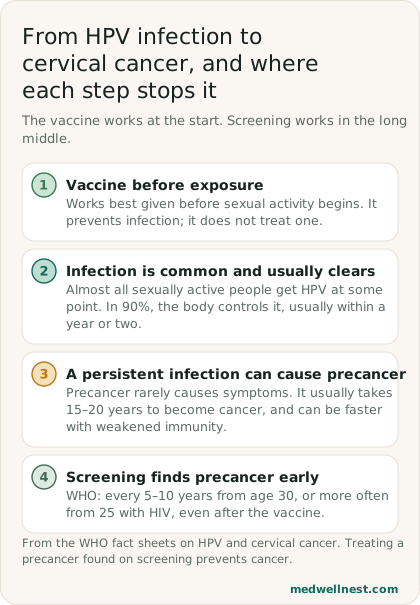
Human papillomavirus (HPV) is a group of some 200 known viruses, and it is the most common viral infection of the reproductive tract. WHO says almost all sexually active people are infected at some point, usually without symptoms, and that in 90% of people the body controls the infection by itself, usually within a year or two.
The trouble comes when a high-risk type persists. WHO counts 12 types as high-risk, with type 16 the most likely to cause cancer. A persistent infection of the cervix can cause precancer, changes in the cells that can become cervical cancer if left untreated, and WHO says this usually takes 15 to 20 years. In women with a weakened immune system, such as untreated HIV, it can take 5 to 10.
Cervical cancer is the most common HPV cancer, but persistent high-risk HPV is also linked to cancers of the vulva, vagina, mouth and throat, penis and anus. That is part of why the vaccine matters for boys too.
02
What the vaccine does, and does not do
HPV vaccines are made from virus-like particles, the outer shell of the virus. WHO says they contain no live virus and no viral DNA, so they cannot cause cancer or an HPV infection. All of them protect against types 16 and 18, which WHO says cause around 76% of cervical cancers. Quadrivalent vaccines also cover types 6 and 11, which cause genital warts, and the nonavalent vaccine adds five more high-risk types.
The vaccine prevents infection; it does not treat one. WHO says it is not used to treat HPV or the diseases it causes, and that prevention is best achieved by vaccinating girls before they become sexually active. That is why programmes target children in their early teens, not because older people cannot benefit, but because protection works best before any exposure.
Protection lasts. WHO reports antibody levels staying well above those from natural infection for up to 11 years so far, including after a single dose.
03
One dose is enough for ages 9 to 20
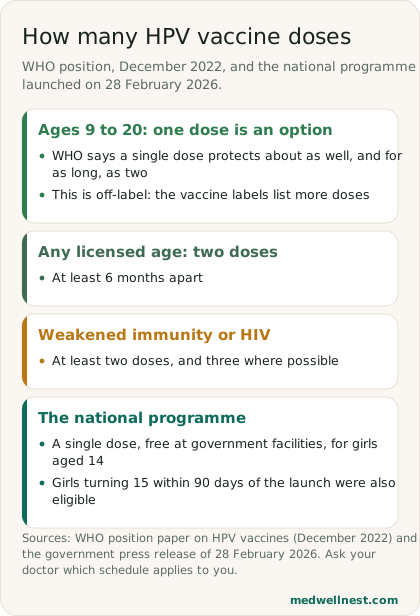
In December 2022, WHO updated its position. It says a single dose can be used for girls and boys aged 9 to 20, because current evidence shows one dose gives protection comparable in strength and duration to two. This is an off-label use: the product labels list two doses for younger children (up to age 13 or 14, depending on the vaccine) and three doses after that.
WHO's other options are two doses at least 6 months apart at any licensed age. For anyone known to have a weakened immune system, including HIV, it advises at least two doses and, where possible, three, whatever their age.
WHO's primary target is girls aged 9 to 14. It says a single dose may also be more efficient and affordable for programmes, and that reaching over 80% of girls also lowers the risk of HPV infection for boys.
04
The national programme
On 28 February 2026, the government launched a national HPV vaccination programme. A single dose of a quadrivalent vaccine, covering types 16, 18, 6 and 11, is free at government health facilities for girls aged 14. Girls who turned 15 within 90 days of the launch were also eligible during the first three-month campaign, after which the vaccine continues on routine immunisation days.
Vaccination happens only at government facilities with a cold chain and a medical officer trained to manage any reaction. The guidance says girls should not come on an empty stomach, and must stay under observation for 30 minutes afterwards. A certificate can be downloaded from the U-WIN portal.
The programme leaves some girls out for now: those with a moderate or severe illness, until they recover; those with a known allergy to yeast or a previous allergic reaction to any vaccine; those who are pregnant; girls outside the target age; and girls already vaccinated with any HPV vaccine.
05
Older girls, women and boys
If your daughter is past the programme's age, she can still benefit. WHO says catch-up vaccination of girls aged 9 to 18 when a programme starts speeds up its effect, and its single-dose option runs to age 20. Ask your doctor whether a vaccine is available to her privately, which product, and how many doses they advise.
WHO calls females aged 15 and over, boys and men secondary targets. It recommends vaccinating them where this is feasible and affordable, as long as it does not take resources from vaccinating girls or from cervical screening. WHO notes that some countries vaccinate boys as well, to lower HPV in the community and prevent HPV cancers in men.
WHO notes that the vaccines work best when given before any exposure to HPV, and they cannot clear an infection that is already there. For an adult who may already have met the virus, whether it is worth it is a conversation for your doctor.
06
Side effects and safety
WHO says more than 500 million doses have been given since 2006, and monitoring has found no serious safety problems apart from rare reports of anaphylaxis, a severe allergic reaction. That is why vaccinated girls are observed afterwards.
Reactions at the injection site are common. Across studies, WHO reports pain in 35% to 88% of people, redness in 5% to 40% and swelling in 4% to 35%. Mild headache, dizziness, muscle or joint aches, and nausea or stomach upset can follow and settle by themselves. Fainting can happen after this and many other injections; WHO says it can be minimised, and injury avoided, with appropriate preparation.
HPV vaccine is not recommended during pregnancy, although WHO says trials in more than 25,000 women found no specific safety concerns for pregnancy. It can be given while breastfeeding.
07
Screening is still needed later
The vaccine does not protect against every high-risk type, and some women will already have been exposed. WHO says regular screening remains important even for women who have been vaccinated, because precancer rarely causes symptoms.
WHO recommends screening with a high-performance test, such as an HPV test, every 5 to 10 years from age 30. Women living with HIV should start at 25 and be screened more often. A positive screen leads to a closer look at the cervix, and treating a precancer is a simple procedure that prevents cancer.
Do not wait for your screening date if you have symptoms. WHO lists unusual bleeding between periods, after menopause or after sex, a heavier or foul-smelling discharge, and persistent pain in the back, legs or pelvis as reasons to see a doctor.
When to act
Emergency — act now
Trouble breathing, swelling of the face, lips or throat, or collapse after the injection: this can be a rare severe allergic reaction. Tell the vaccination staff at once, or get emergency care if you have left.
Routine — see a doctor
Bleeding between periods, after sex or after menopause, a heavier or foul-smelling discharge, or persistent pelvic, back or leg pain: see a doctor, whether or not you have had the vaccine.
Your daughter missed the programme, you have a weakened immune system or HIV, or you are an adult wondering about the vaccine: ask your doctor which vaccine and how many doses suit you.
You are 30 or older (25 or older with HIV) and have not been screened recently: book a cervical screening test, even if you were vaccinated.
Sources
- Human papillomavirus vaccines: WHO position paper, December 2022 (Weekly Epidemiological Record No 50)iris.who.int
- Summary of the WHO position paper on HPV vaccines, December 2022cdn.who.int
- Human papillomavirus and cancer — WHO fact sheetwho.int
- Cervical cancer — WHO fact sheetwho.int
- Cervical Cancer Vaccination Campaign Launched — Press Information Bureau, 28 February 2026pib.gov.in
Share this story
Curious where your own values stand?
Two minutes from upload to a full visual picture. Free to analyze.