In short
The flu vaccine is recommended every year for pregnant women, young children, people over 65, anyone with a long-term illness and health workers. Here is when to get it where flu peaks twice a year, which vaccine the national advice prefers, and what the side effects really are.
Emergency if: Signs of a severe allergic reaction (anaphylaxis) soon after the injection: tell the vaccination staff at once, or get emergency care if you have already left. This is very rare.
On this page
01
Why it is a yearly vaccine
The WHO calls vaccination the best way to prevent flu, and safe and effective vaccines have been in use for more than 60 years. Flu is not a trivial illness: the WHO estimates 3 to 5 million cases of severe illness and 290,000 to 650,000 respiratory deaths from seasonal flu every year.
Two things make it a yearly vaccine. Protection fades over time, and the viruses keep changing, so the WHO updates the recipe twice a year, in February for the Northern Hemisphere and in September for the Southern. Having had flu before does not cover you either: the national influenza epidemiology note says there is no cross-immunity between different subtypes and strains.
This guide is about the vaccine. For how flu differs from a cold, see Flu vs. Cold: Telling Them Apart and Acting in Time, and for the national A, B and C categories and antiviral treatment, see our swine flu (H1N1) guide.
02
Who should get it
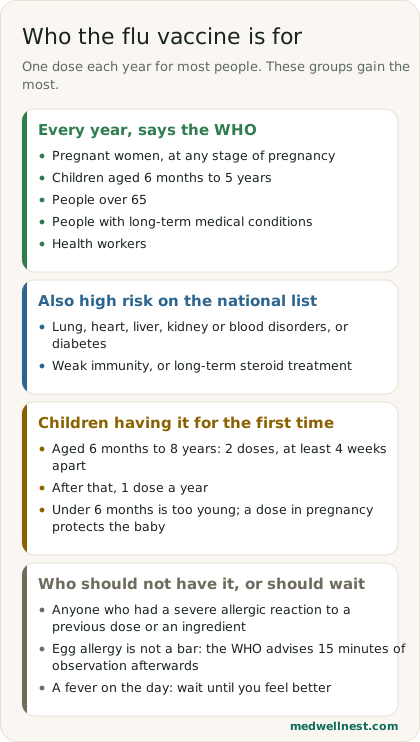
The WHO recommends a flu vaccine every year for pregnant women, children aged 6 months to 5 years, people over 65, people with long-term medical conditions, and health workers. The national list of people at high risk of severe flu is similar: children under 5, especially under 2, older people, pregnant women, health workers, people with lung, heart, liver, kidney or blood disorders or diabetes, and people with weak immunity or on long-term steroids.
In older people the vaccine works less well than in younger adults, but the WHO says it still makes illness less severe and cuts the chance of complications and death, which is why yearly vaccination is recommended. The WHO adds that vaccination matters for the carers of high-risk people too.
03
Pregnancy and young children
The WHO position paper says flu vaccines are safe and effective in pregnancy. They prevent infection in the mother, complications during the pregnancy, and flu in the baby during its first few months. The vaccine can be given at any stage of pregnancy, ideally before the flu season starts, and the WHO says the risk from flu to the mother and baby is higher than the risk from the inactivated vaccine. The live nasal spray vaccine is not recommended in pregnancy.
Babies under 6 months are too young for the vaccine; the WHO says vaccinating the mother during pregnancy is how they are protected. From 6 months, children can have an injected vaccine. A child aged 6 months to 8 years who has never had a flu vaccine needs 2 doses at least 4 weeks apart in the first year, then 1 dose each year after that.
04
When to get it where you live
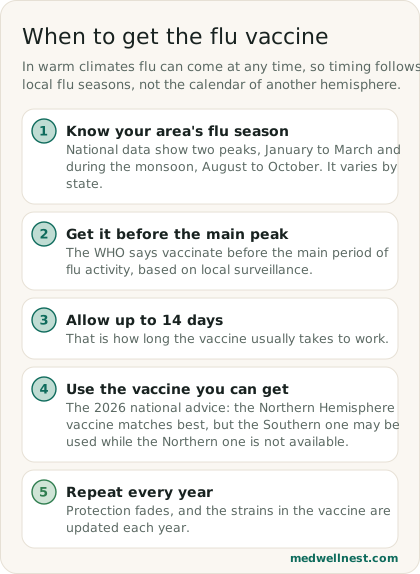
In cold climates flu comes in winter, but the WHO notes that in tropical regions it can occur all year, with less regular outbreaks. National surveillance usually shows two peaks, January to March and during the monsoon, August to October, and the national note adds that this varies from state to state. The WHO's advice for countries with more than one peak is to vaccinate before the start of the main period of flu activity, using local surveillance, whichever hemisphere the country is in.
Which vaccine? The national 2026 recommendation says the flu strains circulating in the country closely match the WHO's Northern Hemisphere recommendation, so the Northern Hemisphere vaccine would be ideal. Because it is not always available, the Southern Hemisphere vaccine may be used, and should be replaced with the Northern one as soon as that becomes available. The document does not set months for different regions, and it does not say whether someone who has already had the Southern vaccine needs another dose; ask your doctor.
Allow time for the vaccine to work. The NHS says it usually takes up to 14 days, so a dose given in the weeks before your area's main peak has time to take effect.
05
Side effects, and who should wait
The NHS says the common side effects are mild and settle within 1 to 2 days: a sore arm where the injection went, a slightly raised temperature and an aching body. A severe allergic reaction, anaphylaxis, is very rare, and vaccination staff are trained to treat it straight away.
The WHO says the injected vaccine should not be given to anyone who had a severe allergic reaction to a previous dose or to an ingredient; the nasal spray has a few more exclusions. An egg allergy is not a reason to skip it: the WHO says people with egg allergy can have an egg-based vaccine if they are watched for at least 15 minutes afterwards where medical care is available. If you have a fever on the day, the NHS advises waiting until you feel better. The flu vaccine can be given at the same visit as other vaccines, such as COVID-19 and shingles vaccines.
06
Myths that keep people away
"The vaccine gives you flu." The injected vaccines are inactivated or recombinant, and the NHS says injected flu vaccines do not contain live flu viruses and cannot give you flu. The aches some people feel settle within 1 to 2 days.
"I had the vaccine and still got flu, so it does not work." The NHS says you can still catch flu after vaccination, but it is likely to be milder and shorter. "I had it last year, so I am covered." Protection fades and the strains change, which is why the WHO recommends a dose every year. "Flu is just a bad cold." In severe cases, the WHO says, flu leads to pneumonia and sepsis, and hospital admissions and deaths happen mainly in high-risk groups.
When to act
Emergency — act now
Signs of a severe allergic reaction (anaphylaxis) soon after the injection: tell the vaccination staff at once, or get emergency care if you have already left. This is very rare.
Flu with difficulty breathing, chest pain, blue lips, confusion, a seizure, or a child who is hard to wake: get emergency care now.
Same-day — call promptly
Flu symptoms if you are pregnant, over 65, have a long-term illness or weak immunity, or in a child under 5: see a doctor today. The WHO says people at high risk should get antiviral treatment as soon as possible.
Routine — see a doctor
You are in a high-risk group, pregnant, or care for someone who is: plan your yearly vaccine before your area's main flu season, and ask your doctor which vaccine is available.
Sources
- Influenza (seasonal) — WHO fact sheetwho.int
- Vaccines against influenza: WHO position paper, May 2022 (Weekly Epidemiological Record)who.int
- Composition of the influenza vaccine to be used for coming season 2026 — NCDCncdc.mohfw.gov.in
- Epidemiology of seasonal influenza — NCDCncdc.mohfw.gov.in
- Flu vaccine — NHSnhs.uk
Share this story
Curious where your own values stand?
Two minutes from upload to a full visual picture. Free to analyze.