In short
Sudden breathlessness, chest pain or coughing up blood needs emergency care now, whatever any D-dimer says. A high D-dimer is not a diagnosis: many things raise it, and doctors use it only after a clinical probability score, and a high result leads to a scan.
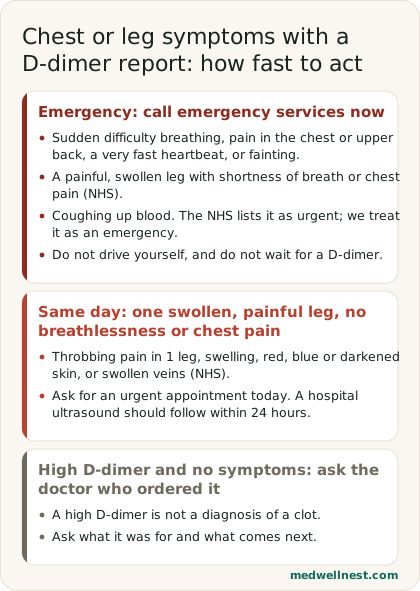
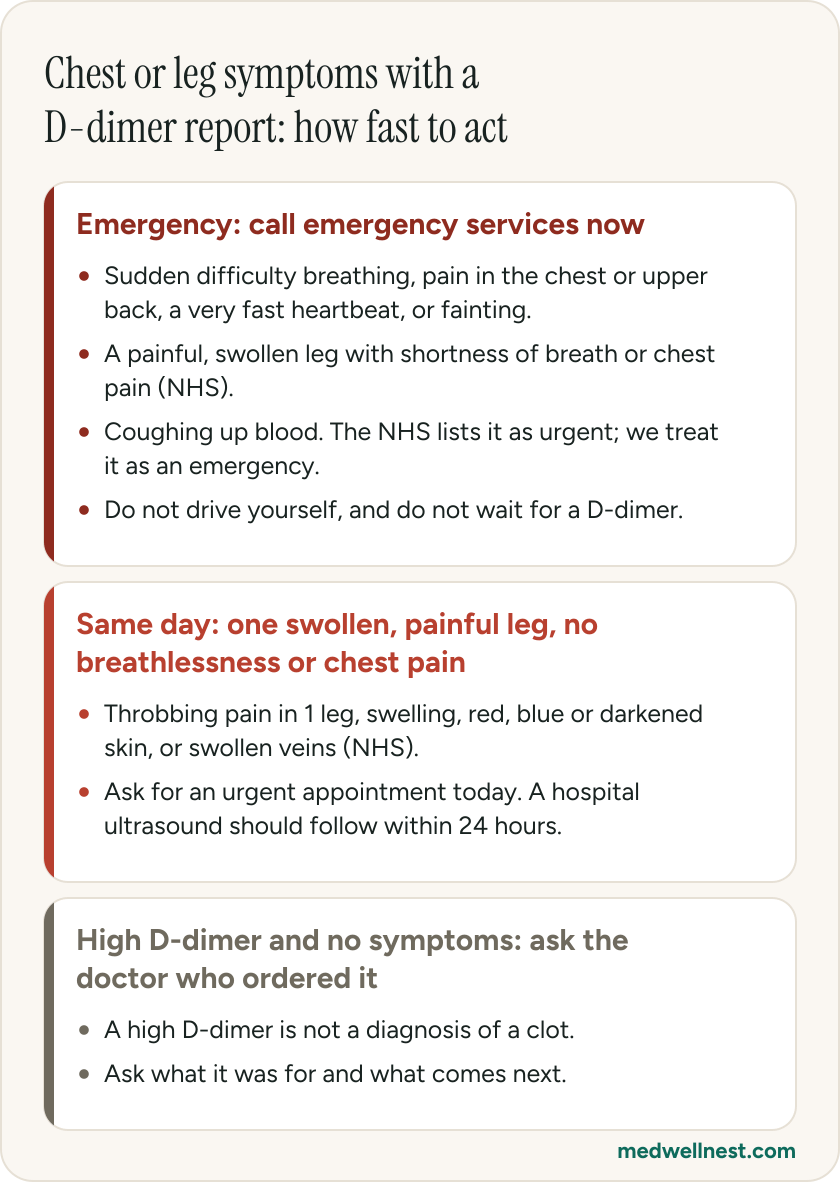
Emergency if: Sudden difficulty breathing; pain in your chest or upper back; a heart beating very fast; fainting; coughing up blood; or a painful, swollen leg with shortness of breath or chest pain: call emergency services now or go to an emergency department now, whatever your D-dimer report says. The NHS says to call for sudden breathlessness, chest or upper-back pain, a very fast heartbeat or someone passing out, and not to drive yourself. The NHS lists coughing up blood under urgent advice, MedlinePlus says to seek immediate medical attention for symptoms of a pulmonary embolism, and this page treats it as an emergency.
On your report
D-dimer, Prothrombin Time / INR
On this page
01
Chest pain, breathlessness or a swollen leg with a D-dimer report: when is it an emergency?
Do not wait for a D-dimer result, or a report, if you have these signs. The NHS says to call emergency services or go to an emergency department if you have difficulty breathing that comes on suddenly, pain in your chest or upper back, a heart beating very fast, or someone has passed out: these could be signs of a pulmonary embolism (a blood clot blocking an artery in the lung), which can be life-threatening. Do not drive yourself: ask someone to drive you or call for an ambulance, and bring your medicines. The same applies to a swollen, painful leg together with shortness of breath or chest pain.
Coughing up blood is also a sign of a pulmonary embolism. The NHS lists it under urgent advice, to ask for an urgent appointment or urgent help from the local health advice service, and MedlinePlus says to seek immediate medical attention for symptoms of a pulmonary embolism, which include cough, chest pain, trouble breathing and a rapid heartbeat. Because it can come with the signs above, this page asks you to treat coughing up blood as an emergency too. MedlinePlus also notes that many people with a pulmonary embolism have no symptoms, which is another reason not to rely on a number.
One swollen, painful leg is a same-day problem. The NHS says to ask for an urgent appointment, or urgent advice, if you think you have a deep vein thrombosis (DVT): throbbing pain in 1 leg, swelling in 1 leg, red, blue or darkened skin around the painful area, or swollen veins. If a doctor thinks you have a DVT, you should be referred to hospital within 24 hours for an ultrasound scan. NICE says a person with a swollen or painful leg is assessed in the same way, with a D-dimer as only one step.
02
What does a high D-dimer mean?
D-dimer is a protein fragment made when a blood clot dissolves. MedlinePlus says it is not usually found in the blood unless the body is making or breaking up clots, and that the test is used to check whether you may have a clot and need more tests. A higher-than-normal result may be a sign of a clotting disorder, and additional tests are needed to show where the clot is or what type of disorder it is. A high D-dimer is therefore a prompt for more testing, not a diagnosis.
High D-dimer levels are not always caused by clotting disorders. MedlinePlus lists pregnancy, heart disease, rheumatoid arthritis and recent surgery, and says being older or being immobilised (unable to move) may also cause a high level. NICE notes that D-dimer can be raised in people with COVID-19 even when there is no clot. MedlinePlus prints no normal range, so use the cut-off and unit printed on your own report.
03
Does a normal D-dimer rule out a clot?
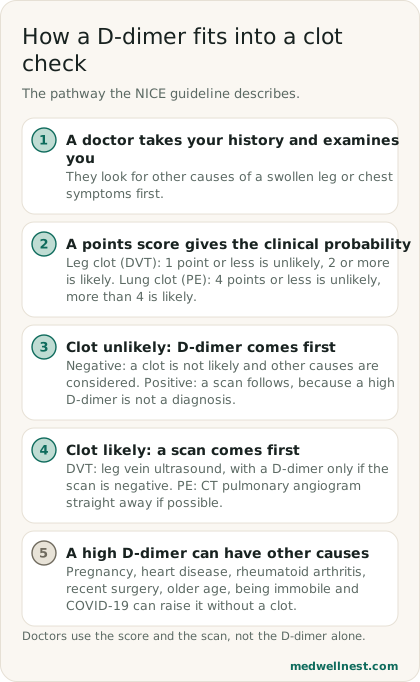
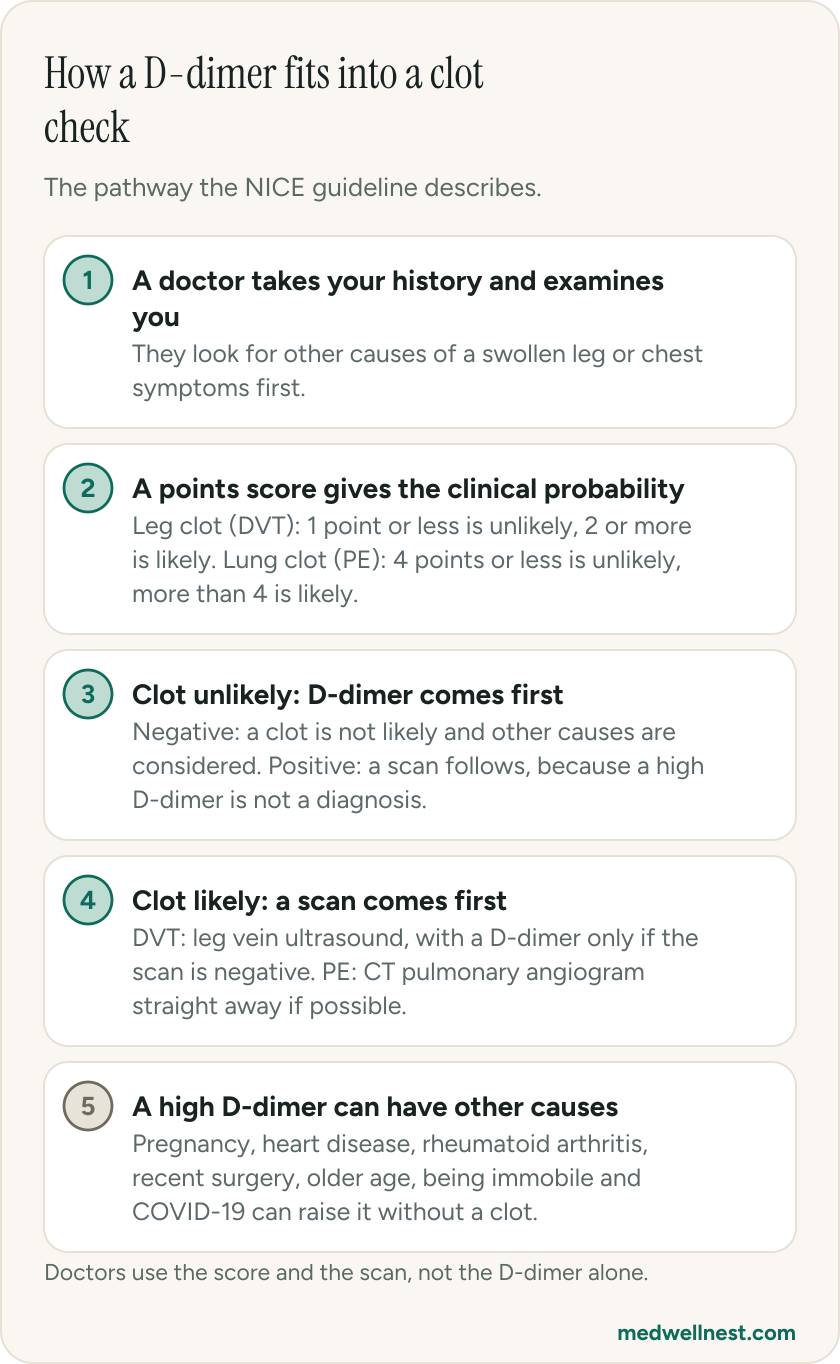
Sometimes, but only in the right situation. MedlinePlus says a low or normal D-dimer means you probably do not have a clotting disorder, but blood thinner medicines can cause a false negative result. NICE uses D-dimer to rule a clot out only when the clinical probability is "unlikely": a negative D-dimer in that group means it is not likely you have a DVT or a pulmonary embolism, and the doctor thinks about other causes of your symptoms.
When the probability is "likely", NICE does not rely on D-dimer first. For a likely DVT it offers a leg vein ultrasound scan, with a D-dimer only if the scan is negative. For a likely pulmonary embolism it offers a CT pulmonary angiogram immediately if possible. A normal D-dimer therefore cannot be used to wave away new symptoms: if chest pain, breathlessness or a swollen, painful leg is happening now, use the emergency signs above.
04
What happens after a high D-dimer?
It depends on your symptoms and on the probability score the doctor works out first. NICE's pathway is to take a history and examine you, estimate the clinical probability with the Wells score, then choose the test. If a DVT is unlikely, a D-dimer comes first, and if it is positive you are offered a leg vein ultrasound scan, with the result within 4 hours if possible, or blood-thinning treatment while you wait with the scan within 24 hours. If a pulmonary embolism is unlikely and the D-dimer is positive, you are offered a CT pulmonary angiogram, or another type of lung scan if contrast dye is not suitable.
MedlinePlus names the imaging tests used after a D-dimer that is not normal: a Doppler ultrasound of the veins, CT angiography and a ventilation-perfusion (V/Q) scan of the lungs. For people with a likely DVT whose first leg scan is negative but whose D-dimer is positive, NICE says to repeat the leg scan 6 to 8 days later. Our DVT and pulmonary embolism guides cover what follows a confirmed clot.
05
What are the Wells score and the age-adjusted D-dimer cut-off?
The Wells score is a points checklist that a clinician fills in, so you cannot score yourself from home. For a suspected DVT, 1 point or less is "unlikely" and 2 points or more is "likely"; the items include active cancer, a recent period in bed or major surgery, swelling of the whole leg, tenderness along the deep veins, and whether another diagnosis is at least as likely. For a suspected pulmonary embolism, 4 points or less is "unlikely" and more than 4 is "likely", with points for signs of DVT, a heart rate above 100 beats a minute, recent immobilisation or surgery, a previous DVT or pulmonary embolism, coughing up blood and cancer.
The cut-off is lab-specific, so use the one on your report. In the ADJUST-PE study of 3346 people with suspected pulmonary embolism, the conventional cut-off was 500 µg/L (the same as 500 ng/mL), measured with a highly sensitive test. NICE says to consider an age-adjusted threshold for people aged over 50, because the evidence suggests adjusting for age makes D-dimer more useful for ruling out a clot without reducing its accuracy for finding one, but NICE does not print a formula. The ADJUST-PE study used age × 10 µg/L for people aged 50 or over, and only in people whose clinical probability was not high. Of 331 people whose D-dimer was above 500 µg/L but below their age-adjusted cut-off and who were not scanned, 1 (0.3%) had a clot during the next 3 months. That study was done in emergency departments, so do not apply the formula to your own report yourself.
06
What should I do if my D-dimer is high and I have no symptoms?
NICE describes D-dimer as a test for people with signs or symptoms of DVT or pulmonary embolism, and MedlinePlus says the test is used to check whether you may have a clot. The sources we read do not say what to do about a high D-dimer found when you have no leg or chest symptoms and no clot was suspected. The safest step is to show the report to the doctor who ordered it, ask what it was ordered for and what comes next, and tell them about any recent surgery, long periods in bed or pregnancy, which can raise it. Know the emergency signs above, and act on them whatever the number says.
D-dimer report, chest symptoms and leg swelling: how fast to act
Emergency — act now
Sudden difficulty breathing; pain in your chest or upper back; a heart beating very fast; fainting; coughing up blood; or a painful, swollen leg with shortness of breath or chest pain: call emergency services now or go to an emergency department now, whatever your D-dimer report says. The NHS says to call for sudden breathlessness, chest or upper-back pain, a very fast heartbeat or someone passing out, and not to drive yourself. The NHS lists coughing up blood under urgent advice, MedlinePlus says to seek immediate medical attention for symptoms of a pulmonary embolism, and this page treats it as an emergency.
Same-day — call promptly
Throbbing pain in 1 leg with swelling, red, blue or darkened skin there, or swollen veins, and no breathlessness or chest pain: get medical help today, without waiting for a routine appointment. The NHS says to ask for an urgent appointment or urgent advice if you think you have a DVT, and that a doctor who suspects one should arrange a hospital ultrasound scan within 24 hours.
Routine — see a doctor
A high D-dimer on a report with no leg or chest symptoms, or a normal D-dimer you have questions about: ask the doctor who ordered it what it was for and what comes next, and tell them about recent surgery, long periods in bed or pregnancy. A D-dimer does not diagnose a clot by itself, and a normal one does not cancel the emergency signs above.
Values mentioned in this story
Each one opens a visual guide with its normal range and what moves it — upload a report and we place your own numbers on the same scale.
Sources
- D-dimer test — MedlinePlusmedlineplus.gov
- Venous thromboembolic diseases: diagnosis, management and thrombophilia testing (NG158) — NICE guidelinenice.org.uk
- DVT (deep vein thrombosis) — NHSnhs.uk
- Pulmonary embolism — NHSnhs.uk
- Age-adjusted D-dimer cutoff levels to rule out pulmonary embolism: the ADJUST-PE study — JAMA 2014pubmed.ncbi.nlm.nih.gov
Share this story
Curious where your own values stand?
Two minutes from upload to a full visual picture. Free to analyze.