In short
An EEG report describes brain waves; it does not name epilepsy. Here is what background rhythm, slowing and epileptiform discharges mean, why a normal EEG does not rule out epilepsy, why an abnormal one does not diagnose it alone, and when a seizure is an emergency.
Emergency if: Someone is having a seizure for the first time; a seizure lasts 5 minutes or more, or longer than is usual for that person; the person does not recover as usual afterwards, or has another seizure without recovering in between; or 3 or more seizures in 24 hours: call emergency services now. Do not wait for an EEG appointment. The 3-or-more-in-24-hours limit is the general epilepsy guidance; in a young child with a fever, more than one seizure in 24 hours is already an emergency, so see our febrile seizure guide.
On this page
01
What an EEG records, and what the test involves
An EEG (electroencephalogram) records the electrical activity of the brain. The NHS says the main condition it is used for is epilepsy, and that it can also be used for sleep conditions and for encephalitis, which is inflammation of the brain. StatPearls says it is primarily used to assess seizures and conditions that may mimic seizures. Small silver discs, called electrodes, are attached to the scalp with a sticky paste and wired to a recording machine.
The NHS says the test is painless and usually takes about an hour. You may be asked to open and close your eyes, breathe deeply for a few minutes, or look at a flashing light while the recording is taken. NICE advises discussing the benefits and risks of these provoking manoeuvres, hyperventilation and flashing light, with the person first. Come with clean, dry hair and no gel or wax. Results can take a few days or weeks, because a specialist has to analyse the recording.
02
The words on the report: background rhythm, slowing and spikes
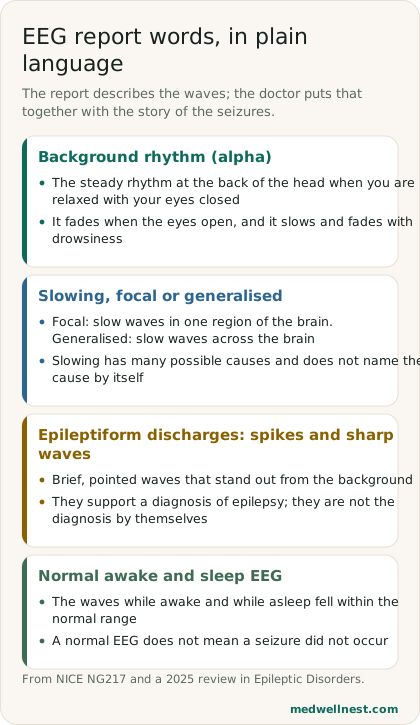
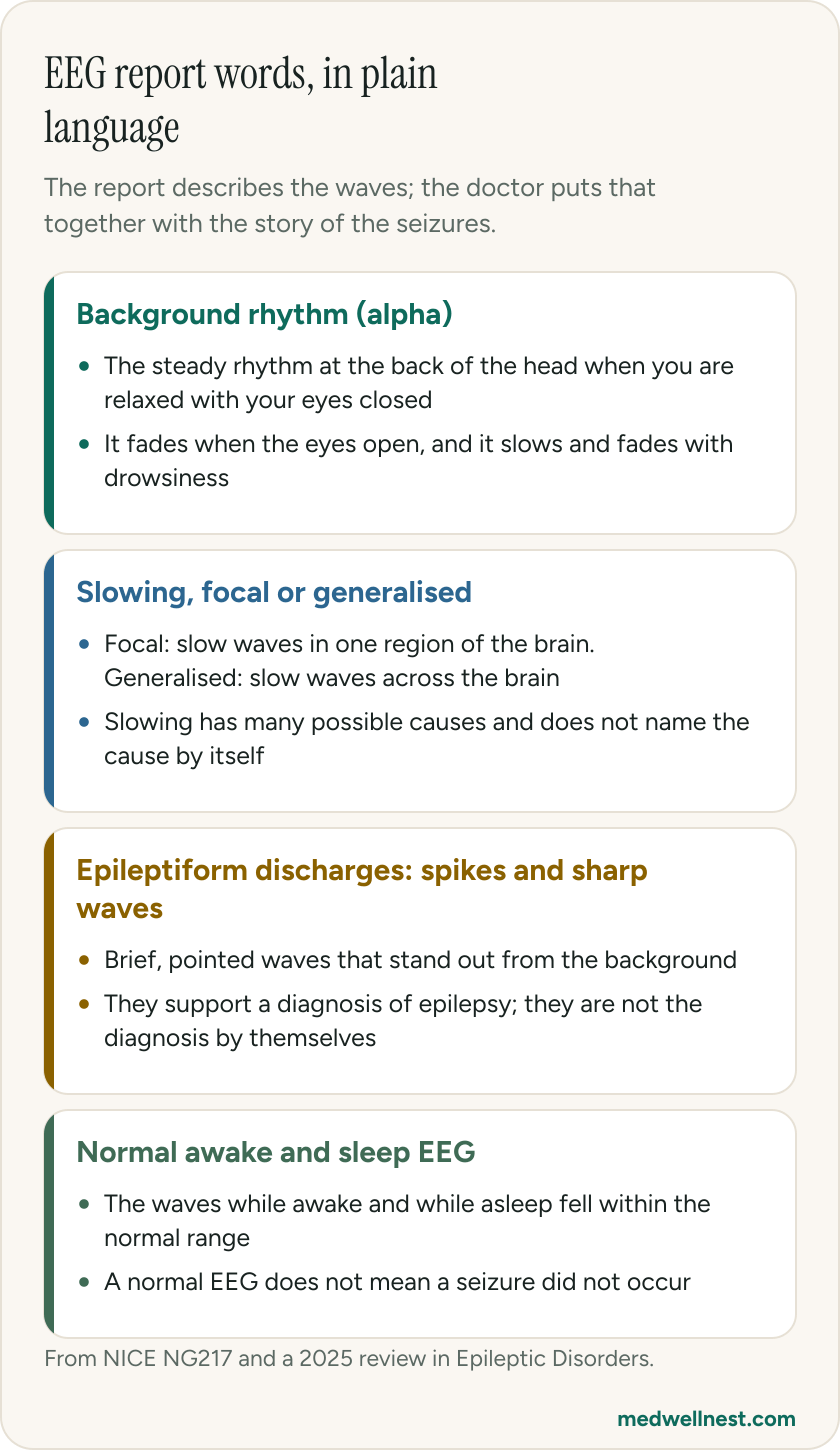
The background rhythm is the steady pattern that runs through the recording. In an awake adult it is the alpha rhythm, also called the posterior dominant rhythm, recorded over the back of the head. A table in a 2025 review in Epileptic Disorders gives a typical frequency of 9.9 cycles per second for ages 16 to 50, with a range of 8.1 to 11.7. A 2024 paper in the Journal of Neurology says the alpha rhythm is present with the eyes closed and disappears when the person opens them, and the 2025 review notes it fades and slows as drowsiness begins.
Slowing means waves in the delta range, 0.5 to 4 cycles per second, or the theta range, 4 to 8. The 2025 review says focal slowing, confined to one region, has a high likelihood of being associated with a structural lesion when it is present continuously, but that it gives no precise information about the type of lesion and can also occur without one. Generalised slowing, delta outside deep sleep or theta outside drowsiness and light sleep in an adult, is considered abnormal. The review says it is most commonly seen in encephalopathy and lists causes including head injury, infection, toxic or metabolic problems and sedative medicines.
Epileptiform discharges are abnormal, brief waveforms that stand out from the background. The review defines a spike as a pointed peak lasting 20 to 70 milliseconds and a sharp wave as one lasting 70 to 200 milliseconds; a spike-wave complex is a spike or sharp wave immediately followed by a slow wave. These are the words that bring epilepsy to mind, which is why the next section matters.
03
A normal EEG does not rule out epilepsy, and an abnormal one does not diagnose it alone
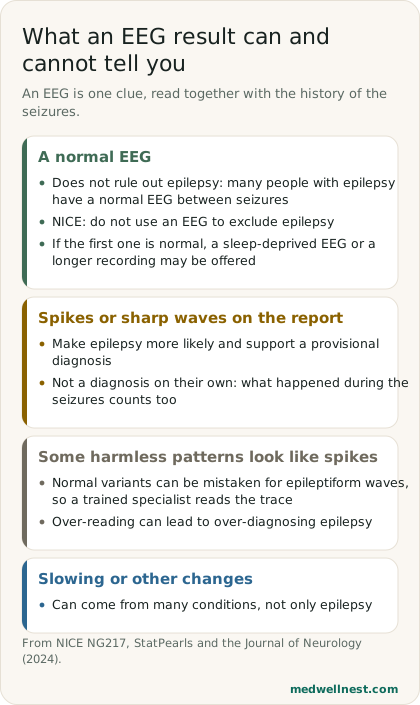
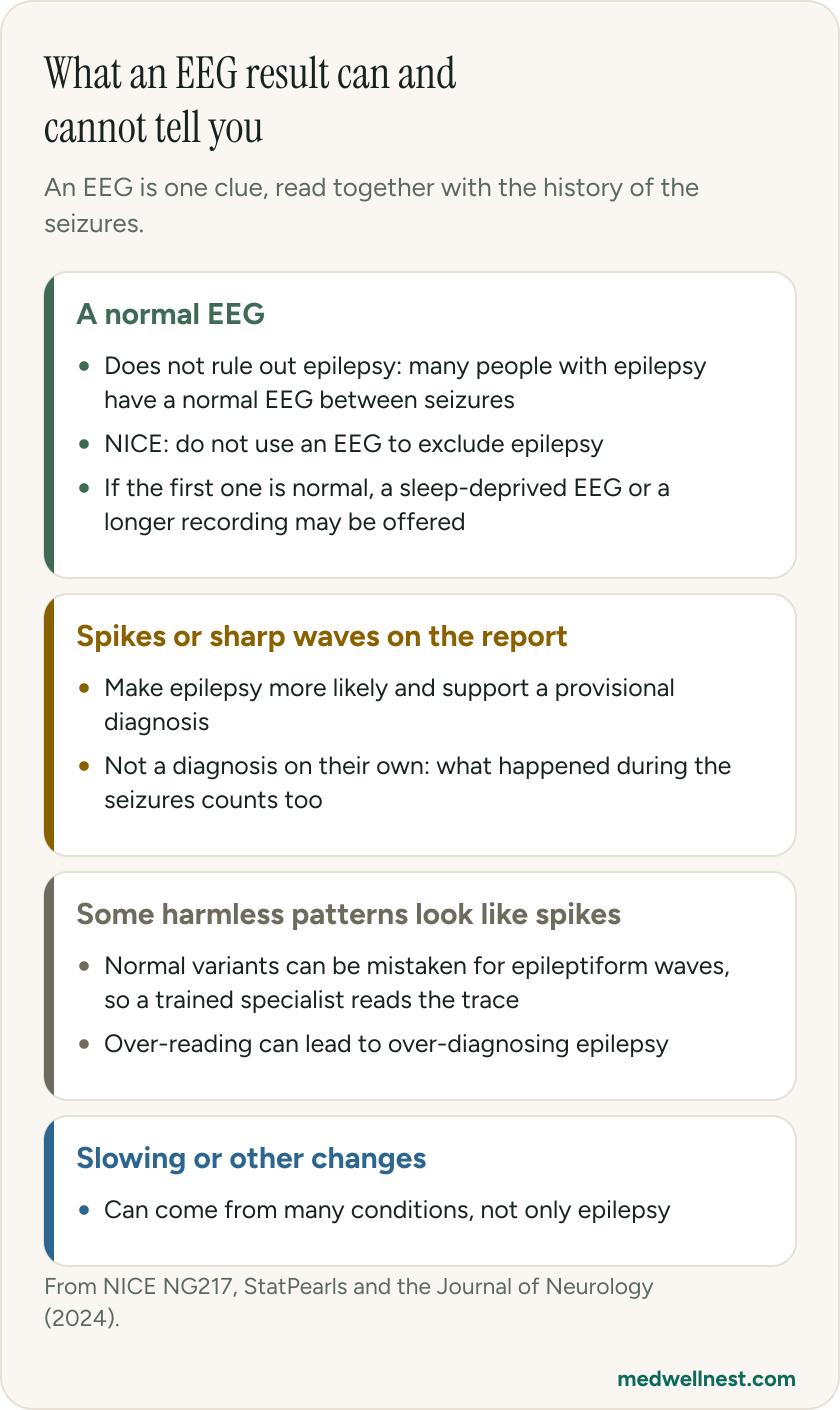
NICE's epilepsy guideline (NG217) is direct: do not use an EEG to exclude a diagnosis of epilepsy. Its committee found that a routine EEG recorded between seizures has low sensitivity, so many people with epilepsy show no abnormality, and a negative routine EEG should not be used to exclude the diagnosis.
The other direction has limits too. NICE says that when the history and examination suggest an epileptic seizure, a routine awake EEG can support the diagnosis and give information about seizure type or syndrome. Its committee found specificity high enough for a positive finding to support a provisional diagnosis: most people without epilepsy have no EEG abnormalities, so a person with a positive finding is more likely to have epilepsy than not. The history of what happened comes first, and the EEG supports or questions it.
Reading is also a skill. The Journal of Neurology paper says that telling normal variants from epileptiform patterns is crucial to prevent over-reading and, by extension, over-diagnosing epilepsy in doubtful cases. StatPearls says some benign EEG variants appear normal but may be mistaken for epileptiform activity. A line such as normal awake and sleep EEG describes the waves recorded in both states during that recording; it cannot say that a seizure did not happen.
04
Sleep deprivation, sleep EEG, ambulatory and video EEG
NICE says that if a routine EEG is normal, a sleep-deprived EEG can be considered if the person agrees, and that if routine and sleep-deprived EEGs are normal and doubt remains, an ambulatory EEG for up to 48 hours can be considered. A paper on EEG pitfalls says sleep makes epileptiform discharges more likely to appear, even short sleep. The NHS describes a sleep-deprived EEG as one done after you have been asked not to sleep for a set time the night before; you will not be able to drive afterwards, so arrange a lift home.
The NHS describes a sleep EEG as done in hospital while you sleep, an ambulatory EEG as a portable recorder worn during your usual day, and a video telemetry EEG, or video EEG, as a video recording taken during the test, usually over a few days in hospital. NICE also says to use eyewitness accounts and video footage of the seizure when assessing a first suspected seizure. If someone can safely film an episode on a phone without delaying help, show the clip to the doctor.
05
When a seizure is an emergency, whatever the EEG says
NICE calls convulsive status epilepticus, seizures lasting 5 minutes or more, a medical emergency that needs immediate treatment. It also says to manage repeated or cluster seizures, typically 3 or more self-terminating seizures in 24 hours, as a medical emergency, and a prolonged convulsive seizure, one that continues for more than 2 minutes longer than the person's usual seizure.
The NHS adds that a seizure that is happening for the first time, a seizure that does not stop or has not stopped by 5 minutes when you do not know how long they usually last, a seizure after which the person does not recover as usual, and another seizure without recovering in between all need emergency help. It also notes that people with epilepsy do not always need hospital, because many have a care plan. A normal EEG changes none of this. The 3-or-more-in-24-hours threshold is the general NHS and NICE guidance; for a child with a fever the febrile seizure rules are stricter, and more than one seizure in 24 hours is already an emergency. For seizures with fever in young children, see our febrile seizure guide; our epilepsy guide covers first aid and treatment.
Seizures and the EEG
Emergency — act now
Someone is having a seizure for the first time; a seizure lasts 5 minutes or more, or longer than is usual for that person; the person does not recover as usual afterwards, or has another seizure without recovering in between; or 3 or more seizures in 24 hours: call emergency services now. Do not wait for an EEG appointment. The 3-or-more-in-24-hours limit is the general epilepsy guidance; in a young child with a fever, more than one seizure in 24 hours is already an emergency, so see our febrile seizure guide.
Same-day — call promptly
You think you may have had a first seizure and did not go to hospital, or you have a seizure after a long seizure-free period: see a doctor today.
Routine — see a doctor
Your EEG report shows slowing or spikes, or is normal but the spells keep happening: take it to the doctor or neurologist who ordered it, and ask whether a sleep-deprived or longer EEG is needed. Do not change or stop epilepsy medicine because of a report without asking your doctor.
Sources
- Epilepsies in children, young people and adults (NG217) — NICEnice.org.uk
- EEG (electroencephalogram) — NHSnhs.uk
- Epilepsy — NHSnhs.uk
- EEG Abnormal Waveforms — StatPearlsncbi.nlm.nih.gov
- Seminar in Epileptology: normal awake and sleep patterns, interictal abnormalities, and ictal patterns on scalp EEG — Epileptic Disorders, 2025pmc.ncbi.nlm.nih.gov
- Overcoming traps and pitfalls leading to misinterpretation of normal EEG variants and variation of the background activity — Journal of Neurology, 2024pmc.ncbi.nlm.nih.gov
Share this story
Curious where your own values stand?
Two minutes from upload to a full visual picture. Free to analyze.