In short
Ferritin shows how much iron your body has stored. Read it with haemoglobin, MCV, CRP and transferrin saturation: inflammation can hide a low number, and several things besides iron can push a high one up. WHO and lab cut-offs differ, and the reason is explained here.
Emergency if: You have chest pain, fainting, or severe difficulty breathing at any point: call emergency services now or go to an emergency department now. These are general emergency signs, not something a ferritin number can tell you, and a low or high result never makes them safe to wait on.
On your report
Ferritin, Hemoglobin, MCV, CRP +2 more
On this page
01
What does my ferritin number mean?
Ferritin is the blood test for stored iron. MedlinePlus describes it as the test that measures how much iron is stored in the body, and WHO says that low ferritin suggests deficient iron stores while a raised ferritin could suggest iron overload. The unit on your report is usually ng/mL or µg/L, and these are the same number, so 9 ng/mL and 9 µg/L mean exactly the same thing.
A ferritin number is rarely read alone. MedlinePlus says your provider will consider your symptoms, age, medical history and your other blood tests, and that a result outside the printed range does not always mean a condition that needs treatment. The sections below take the usual companions in turn: haemoglobin and MCV from the blood count, CRP, transferrin saturation, and whether you are pregnant or have periods.
02
Ferritin 9, 15 or 25: is it low? Why do the cut-offs and lab ranges differ?
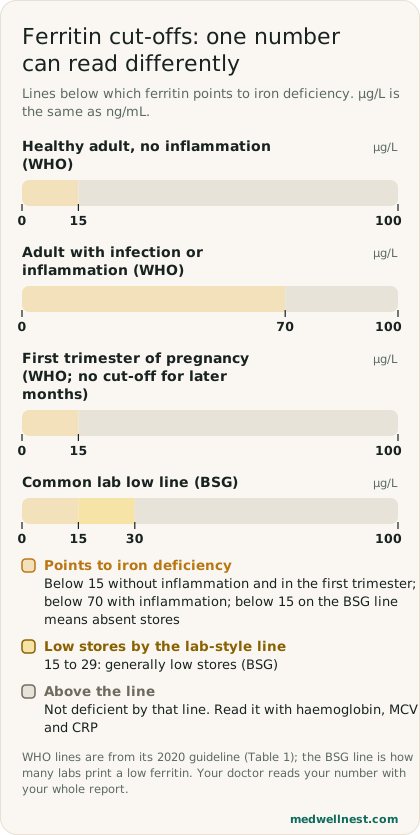
The WHO 2020 guideline sets the line for iron deficiency in apparently healthy people at a ferritin below 15 µg/L for adults and for children from 5 years, and below 12 µg/L for children under 5 years. For pregnancy it gives below 15 µg/L in the first trimester only, and it says the body changes of pregnancy make it hard to fix one ferritin number for deficiency. When infection or inflammation is present, WHO says a ferritin below 70 µg/L in adults and children from 5 years, and below 30 µg/L in children under 5 years, may be used to indicate iron deficiency, because inflammation pushes ferritin up.
Labs print different lines because the line is a judgement. The BSG guideline says a ferritin below 15 µg/L indicates absent iron stores, below 30 µg/L is generally indicative of low body iron stores, and the lower limit of normal for most laboratories lies between 15 and 30 µg/L. It also notes that a cut-off of 45 µg/L has been suggested as the best trade-off for finding iron deficiency in practice. So a ferritin of 25 can be printed as low by one lab, sit above WHO's line for a healthy adult, and still be worth discussing. The ferritin page on this site marks 30 as its low line, which matches the BSG line for generally low stores, while WHO's 15 is the stricter line for deficiency in a healthy person.
WHO also gives a high-side flag. In otherwise healthy people, a ferritin above 150 µg/L in menstruating women, or above 200 µg/L in men and in women who no longer menstruate, may indicate a risk of iron overload, and above 500 µg/L in adults who are unwell. WHO calls these flags for further evaluation, not diagnoses.
03
My ferritin is low but my haemoglobin is normal: is that a problem?
MedlinePlus says iron tests are used to check whether iron levels are too low, a sign of anaemia, but that not all people who have low iron levels have anaemia, and that low iron may not cause symptoms until it is very low. So a low ferritin with a normal haemoglobin can mean your stores are running down before the blood count has changed. It still deserves attention: the symptoms MedlinePlus lists for low iron include weakness or fatigue, dizziness, shortness of breath and an irregular heartbeat, and the NHS lists hair loss among the less common ones.
The next question is why. The NHS says heavy periods and pregnancy are very common causes of iron deficiency anaemia, and that bleeding in the stomach and intestines is another common cause, for example from anti-inflammatory painkillers such as ibuprofen and aspirin, stomach ulcers or piles. If the reason is not clear, the doctor may order more tests. A low ferritin should therefore start a conversation about the cause, not only about iron.
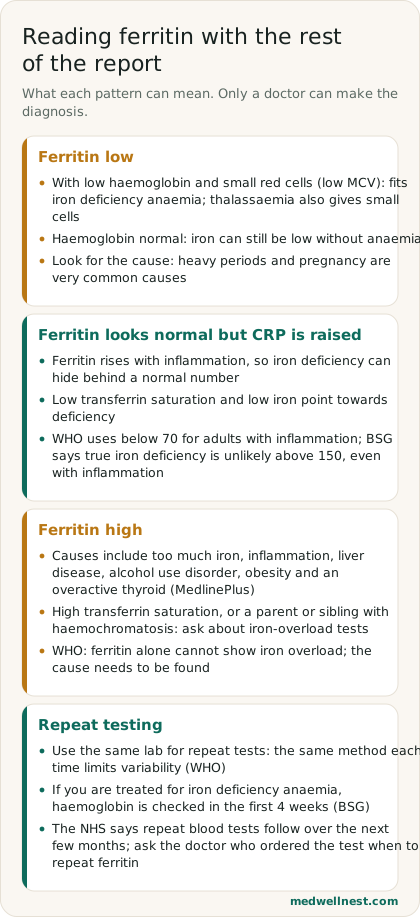
Read the blood count beside it. The BSG guideline says iron deficiency reduces the size of the red cells (a lower MCV) and the haemoglobin in each cell, so low haemoglobin with low ferritin and a low MCV fits iron deficiency anaemia. It also says MCV is not specific, because small red cells also occur in thalassaemia, and that it can miss iron deficiency: with chronic disease or a vitamin B12 or folate deficiency, the red cells may not shrink even when iron is short, so the MCV can look normal. A normal MCV therefore does not rule iron deficiency out, and a low one does not prove it.
04
My ferritin looks normal but I am tired and my CRP is high: can I still be short of iron?
Yes, it is possible. The BSG guideline says ferritin is the most specific test for iron deficiency in the absence of inflammation, and that because ferritin is an acute phase protein, apparently normal levels may occur with iron deficiency when there is an inflammatory disease. MedlinePlus lists inflammation, for example from infection or surgery, among the causes of a raised ferritin. WHO says markers of inflammation, such as CRP, should be assessed along with ferritin.
Two clues help a doctor here. BSG lists the markers of iron deficiency as low ferritin, low transferrin saturation, low serum iron and raised total iron-binding capacity, so a low transferrin saturation beside a normal-looking ferritin raises suspicion. BSG also says a ferritin above 150 µg/L is unlikely to occur with absolute iron deficiency even in the presence of inflammation, while WHO's higher line for inflamed adults is 70 µg/L. Numbers between those two lines are the ones that most need a doctor's reading alongside the CRP. Our story on ESR and CRP explains what a raised CRP can and cannot tell you.
05
Why is my ferritin high? Does it mean iron overload?
Not necessarily. MedlinePlus lists the causes of a raised ferritin as too much iron in the body, inflammation (for example from infection or surgery), an autoimmune disorder, liver disease, cancer, obesity, alcohol use disorder and an overactive thyroid, and says certain medicines can raise or lower ferritin. WHO says ferritin may be elevated by iron overload or by other causes including liver disease, obesity, inflammation and malignancy, that ferritin alone should not be used to identify the risk of iron overload, and that people with a raised ferritin should have a clinical and laboratory evaluation to find the cause.
The best-known inherited cause is haemochromatosis. The NHS describes it as a condition in which iron slowly builds up over many years and can damage the liver, joints, pancreas and heart; symptoms usually start between 30 and 60 and include tiredness, weight loss, weakness, joint pain and irregular or missed periods. The NHS says diagnosis uses a blood count, a liver test, a transferrin saturation test and a ferritin test, followed by a gene test if these suggest it. It advises speaking to a doctor about testing if a parent or sibling has haemochromatosis, even without symptoms. The NHS also lists other causes of high iron levels, including long-term liver disease, alcohol misuse, iron from supplements or injections, and conditions that need frequent blood transfusions, such as thalassaemia.
The high lines are also different for women and men. WHO's flags of 150 µg/L for menstruating women and 200 µg/L for men and women who no longer menstruate are lower than the 300 at which the ferritin page on this site starts to call a result high. A ferritin between 150 and 300 is not a diagnosis of anything by itself; it is a reason to look at the causes above, starting with the rest of your report.
06
When should I repeat a ferritin test, and what should I do before it?
The sources give no single repeat date for ferritin. WHO says the interval at which ferritin should be measured after an iron intervention depends on the type of intervention and the amount of iron provided, so the doctor who ordered your test is the right person to set it. The NHS says that if you are treated for iron deficiency anaemia the doctor may carry out repeat blood tests over the next few months, and the BSG guideline recommends checking haemoglobin within the first 4 weeks of oral iron treatment and continuing treatment for around 3 months after haemoglobin is normal, to rebuild iron stores. This story gives no supplement doses; those are for your doctor.
For repeat testing, WHO says the same method should be used each time to limit variability, so using the same lab where you can makes two numbers easier to compare. MedlinePlus says your provider may ask you to fast for 12 hours before a ferritin test and that the test is usually done in the morning, so follow the instructions you were given. Because infection or surgery can raise ferritin, ask your doctor whether a result taken during an illness should be repeated once you have recovered.
When to act
Emergency — act now
You have chest pain, fainting, or severe difficulty breathing at any point: call emergency services now or go to an emergency department now. These are general emergency signs, not something a ferritin number can tell you, and a low or high result never makes them safe to wait on.
Same-day — call promptly
Your ferritin or haemoglobin is low and you are breathless, dizzy, or your heart is racing or irregular: see a doctor today rather than waiting for a routine visit. MedlinePlus lists shortness of breath, dizziness and an irregular heartbeat among the symptoms of low iron.
Routine — see a doctor
Your ferritin is below your lab's range, or fits one of the patterns above, and you have tiredness, hair fall, heavy periods or a pregnancy: book a visit with your doctor, who can repeat or add tests and look for the cause. The NHS says heavy periods and pregnancy are very common causes of iron deficiency anaemia.
Your ferritin is above your lab's range, or a parent or sibling has haemochromatosis: see your doctor to find the cause. WHO says a raised ferritin needs a clinical and laboratory evaluation, and the NHS advises testing for relatives even without symptoms.
Values mentioned in this story
Each one opens a visual guide with its normal range and what moves it — upload a report and we place your own numbers on the same scale.
Sources
- WHO guideline on use of ferritin concentrations to assess iron status in individuals and populations — WHO (2020)who.int
- Guidelines for the management of iron deficiency anaemia in adults — BSG, Gut (2021)pmc.ncbi.nlm.nih.gov
- Ferritin blood test — MedlinePlusmedlineplus.gov
- Iron tests — MedlinePlusmedlineplus.gov
- Iron deficiency anaemia — NHSnhs.uk
- Haemochromatosis — NHSnhs.uk
Share this story
Curious where your own values stand?
Two minutes from upload to a full visual picture. Free to analyze.