In short
A FibroScan gives two numbers: liver stiffness in kPa, which tracks scarring, and CAP in dB/m, which tracks fat. Here are the guideline cut-offs, why they differ for CAP, how to tell whether the reading is valid, and what the test cannot tell you.
Emergency if: If you have been told you have cirrhosis or a very high liver stiffness, and you vomit blood, pass very dark or black stools, or suddenly become confused or slur your speech: get emergency care now.
On your report
SGPT (ALT), SGOT (AST), Platelet Count
On this page
01
Two numbers from one probe
FibroScan is a brand of vibration-controlled transient elastography (VCTE). A probe placed between the ribs on your right side, while you lie flat, measures how stiff the liver is. The EASL guideline notes that it takes a few minutes, gives results straight away and works in more than 95% of people who are not severely obese.
Your report has two main numbers. Liver stiffness, in kilopascals (kPa), estimates scarring, or fibrosis. The controlled attenuation parameter, CAP, in decibels per metre (dB/m), estimates fat, or steatosis. They answer different questions, in the same way that the grade on an ultrasound report does not tell you about scarring; see our guide Grade 1, 2, 3 Fatty Liver on Ultrasound: What the Grade Actually Means.
The cut-offs below are for fatty liver disease linked to metabolic risk, now called MASLD. Other liver diseases use other numbers: to rule out advanced chronic liver disease, for example, EASL cites 8 kPa in fatty and alcohol-related liver disease but 7 kPa in viral hepatitis.
02
Liver stiffness: reading the kPa
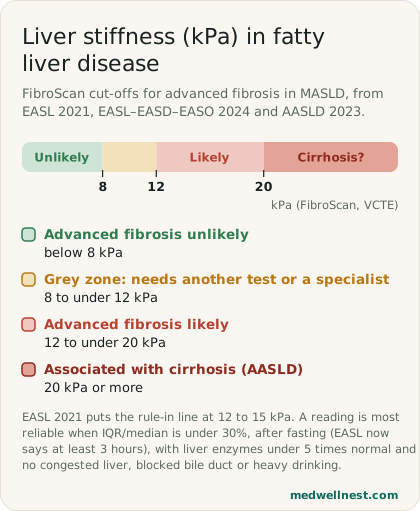
All three guidelines agree on the bottom line. A stiffness below 8 kPa makes advanced fibrosis unlikely; EASL calls 8 kPa the best-validated rule-out value, with a negative predictive value above 90%. Between 8 and 12 kPa is a grey zone that AASLD says may go with scarring from fatty liver disease. At 12 kPa or more, advanced fibrosis becomes likely. The joint EASL, EASD and EASO guideline of 2024 puts the rule-in line at 12 kPa, and EASL's 2021 guideline gives 12 to 15 kPa.
A high number is not a diagnosis. AASLD notes that the positive predictive value above 12 kPa is low, between 0.34 and 0.71 in studies, and EASL says false positives are commoner in fatty liver disease than in viral hepatitis. At the top of the scale, AASLD links 20 kPa or more with cirrhosis. EASL also cites the Baveno criteria for chronic liver disease of any cause: 10 kPa or more suggests compensated advanced chronic liver disease, and 15 kPa or more strongly suggests it.
Stiffness changes over time are also watched. AASLD says a rise of 20% may go with disease getting worse.
03
CAP: the fat number, and why the lines differ
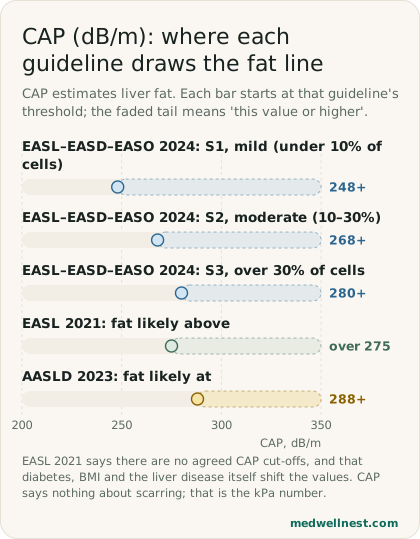
CAP is less settled than stiffness. The 2024 joint guideline gives three lines: 248 dB/m for mild fat (S1, under 10% of liver cells), 268 for moderate (S2, 10% to 30%) and 280 for severe (S3, over 30%). EASL's 2021 guideline says there are no agreed CAP cut-offs, that values above 275 dB/m might be used to diagnose fat, and that CAP cannot yet be recommended as a first-line test. AASLD uses 288 dB/m or more, and notes CAP's limited accuracy for measuring how much fat there is.
So a CAP of 270 dB/m could read as moderate fat under one guideline and below the line under another. EASL adds that diabetes, body mass index and the liver disease itself shift CAP values, and that MRI proton density fat fraction (MRI-PDFF) measures fat more accurately. The practical point: CAP says there is fat, roughly how much, and nothing about scarring. The kPa number carries the prognosis.
04
Is the reading valid? IQR/median and the other checks
A good report shows the median stiffness and the IQR, the spread between readings. The quality criteria EASL uses say the IQR divided by the median should be under 30%, from at least 10 valid measurements, taken by an experienced operator with you lying flat and your right arm raised. If your IQR/median is 30% or more, the number is less reliable and a repeat may be sensible.
Food raises liver stiffness. EASL's 2021 update says at least 3 hours of fasting is needed, up from the 2 hours in its earlier criteria, which are still reproduced in the same document. Plan on 3 hours without food.
Other things can push stiffness up without extra scarring: liver inflammation, with EASL asking for liver enzymes below 5 times the upper limit of normal; a blocked bile duct; heart failure or other causes of a congested liver; exercise just before the test; and ongoing heavy drinking. People with a BMI above 30 should be scanned with the XL probe.
05
What the test cannot tell you
EASL lists the limits plainly. Non-invasive tests are not good at picking up mild or moderate fibrosis, or at telling neighbouring stages apart, and they cannot see inflammation. The scan cannot be done at all with fluid in the belly (ascites), and the joint guideline says many ultrasound-based methods cannot reliably examine adults with class 2 obesity.
That is why guidelines start with a blood score, not the scan. The 2024 joint guideline begins with FIB-4, calculated from age, SGOT (AST), SGPT (ALT) and platelets. Below 1.3, the risk of advanced fibrosis is low; for people over 65, the line is 2.0. Between 1.3 and 2.67, elastography is one option. EASL says the results should be interpreted by liver specialists, alongside the rest of the picture.
06
What happens after the report
In the 2024 joint guideline, a stiffness below 8 kPa in someone sent for a scan after a raised FIB-4 means managing the metabolic risk factors and re-checking FIB-4 within a year. A reading of 8 kPa or more means referral to a liver specialist. Weight loss, diet, activity and cutting out alcohol are the core of treatment; see What to Eat When Fatty Liver Shows Up on a Scan and Your Liver Function Test Report, Line by Line.
Very high values bring different questions. The joint guideline says a stiffness of 15 kPa or less with a platelet count of 150 × 10^9/L or more may rule out raised pressure in the liver's blood supply, called clinically significant portal hypertension, and a stiffness of 25 kPa or more can rule it in for people without obesity. Someone with advanced chronic liver disease and a stiffness of 20 kPa or more, or platelets below 150 × 10^9/L, should have an endoscopy to look for enlarged veins, unless they are already starting beta-blocker treatment for raised portal pressure.
If you have been told you have cirrhosis, the NHS lists the emergencies: vomiting blood, very dark or black stools, or sudden confusion or slurred speech. Our guide Cirrhosis: What Does It Mean When the Liver Is Already Scarred? explains the next steps.
When to act
Emergency — act now
If you have been told you have cirrhosis or a very high liver stiffness, and you vomit blood, pass very dark or black stools, or suddenly become confused or slur your speech: get emergency care now.
Same-day — call promptly
Yellow skin or eyes, new breathlessness, or a swelling belly, legs or ankles when you have cirrhosis: see a doctor today.
Routine — see a doctor
A stiffness of 8 kPa or more: ask for referral to a liver specialist. Below 8 kPa after a raised FIB-4: work on weight, diet, activity and alcohol, and re-check FIB-4 within a year. An IQR/median of 30% or more, or a scan done soon after eating: ask whether it should be repeated.
Values mentioned in this story
Each one opens a visual guide with its normal range and what moves it — upload a report and we place your own numbers on the same scale.
Sources
- EASL Clinical Practice Guidelines on non-invasive tests for evaluation of liver disease severity and prognosis, 2021 update (accepted manuscript) — UCL Discoverydiscovery.ucl.ac.uk
- EASL–EASD–EASO Clinical Practice Guidelines on the management of MASLD (2024) — Journal of Hepatologyjournal-of-hepatology.eu
- AASLD Practice Guidance on the clinical assessment and management of nonalcoholic fatty liver disease (2023) — PMCpmc.ncbi.nlm.nih.gov
- Cirrhosis — NHSnhs.uk
Share this story
Curious where your own values stand?
Two minutes from upload to a full visual picture. Free to analyze.