In short
There is no single HbA1c for older adults. The ADA 2026 framework says below 7.0 to 7.5% if healthy, below 8.0% if health is complex, and no HbA1c target if health is very poor, with avoiding low sugar the priority. Lower is not always better.
Emergency if: An older person with diabetes has a low sugar they cannot treat themselves, has a seizure (fit), is not responding normally or is unconscious: give no food or drink if they cannot swallow safely, give glucagon if one is available and you know how to use it, and call emergency services now. High sugar with feeling or being sick, stomach pain, breathing faster than usual or a fast heartbeat, drowsiness or struggling to stay awake, a fruity smell on the breath, confusion or a high ketone level: call emergency services now or go to an emergency department now.
On your report
HbA1c, Fasting Glucose
On this page
01
What should HbA1c be in older adults with diabetes?
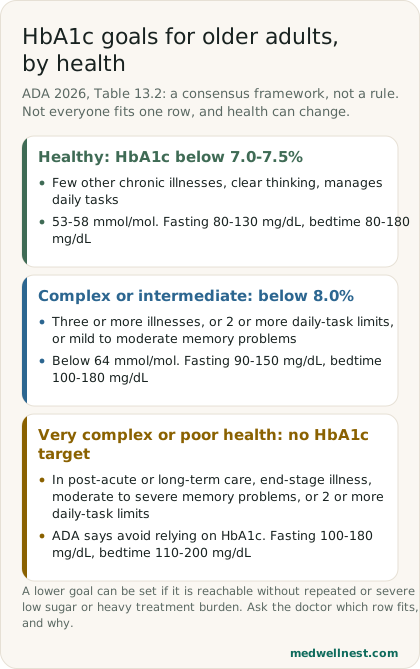
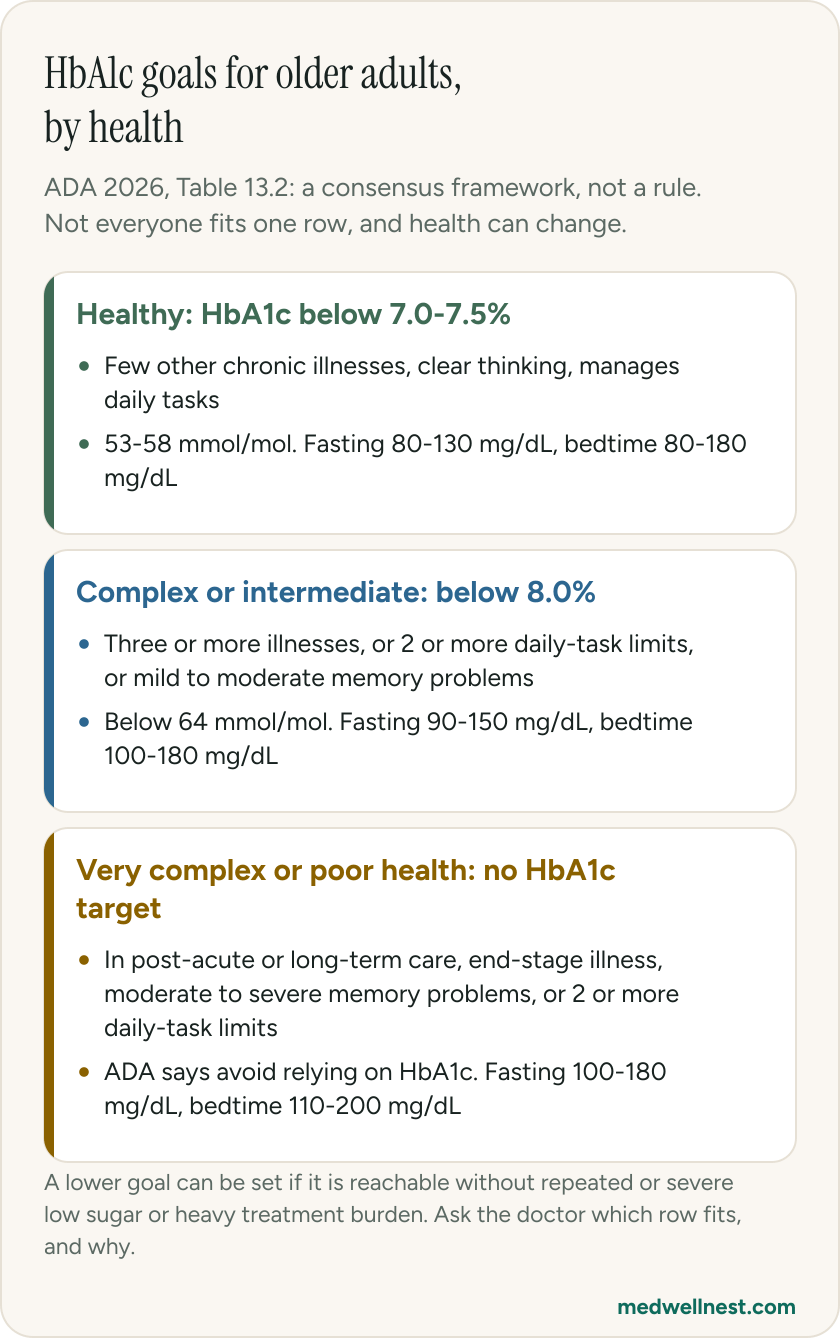
It depends on health, not on age alone. The American Diabetes Association (ADA) 2026 Standards of Care give three groups. For a healthy older adult the reasonable HbA1c goal is below 7.0 to 7.5% (below 53 to 58 mmol/mol). For complex or intermediate health it is below 8.0% (below 64 mmol/mol). For very complex or poor health the ADA says to avoid reliance on HbA1c and to base decisions on avoiding low sugar and symptomatic high sugar.
This is a consensus framework, not a rule. The ADA says not everyone clearly fits one group, and that a person's health and preferences may change over time. A lower HbA1c goal may be set if it can be reached without repeated or severe low sugar or undue treatment burden. The NHS makes the same point more simply: blood sugar levels are a guide, and your own may differ depending on your age and type of diabetes, so check with your doctor.
02
Which group is my father or mother in?
The ADA describes healthy as few coexisting chronic illnesses with intact thinking and daily function. Complex or intermediate means multiple coexisting chronic illnesses, or two or more difficulties with daily activities, or mild to moderate cognitive impairment. The ADA says multiple means at least three, and its list includes arthritis, cancer, heart failure, depression, falls, high blood pressure, incontinence, stage 3 or worse chronic kidney disease, heart attack and stroke.
Very complex or poor health means living in post-acute or long-term care, or an end-stage chronic illness, or moderate to severe cognitive impairment, or two or more difficulties with daily activities. The ADA gives examples of end-stage illness such as stage 3 to 4 heart failure, oxygen-dependent lung disease, kidney disease needing dialysis and uncontrolled metastatic cancer. Ask the doctor which group your parent is in, and why, and write the answer next to their reports.
03
What daily sugar readings should an older person aim for?
The ADA table also gives home glucose ranges. Healthy: fasting or before meals 80 to 130 mg/dL (4.4 to 7.2 mmol/L) and bedtime 80 to 180 mg/dL (4.4 to 10.0 mmol/L). Complex or intermediate: fasting 90 to 150 mg/dL (5.0 to 8.3 mmol/L) and bedtime 100 to 180 mg/dL (5.6 to 10.0 mmol/L). Very complex or poor health: fasting 100 to 180 mg/dL (5.6 to 10.0 mmol/L) and bedtime 110 to 200 mg/dL (6.1 to 11.1 mmol/L).
For people who use a continuous glucose monitor, the ADA goal for healthy older adults is at least 70% of the time between 70 and 180 mg/dL with 4% or less below 70 mg/dL. For complex or intermediate health it is at least 50% in range with less than 1% below 70 mg/dL. The blood pressure goal in the table is below 130/80 mmHg for the first two groups and below 140/90 mmHg for very complex or poor health.
Loose does not mean ignored. The ADA says significant high sugar should be avoided even in complex health, because levels above 180 mg/dL (10 mmol/L) raise the risk of dehydration, weakness, infection, poor wound healing and high-sugar emergencies.
04
Why is a lower HbA1c not always better in older people?
Because the harm of treatment can outweigh the benefit. The ADA says older adults with diabetes have a greater risk of low blood sugar, especially on sulfonylureas, meglitinides and insulin. It lists irregular meals, worsening kidney function and cognitive decline among the reasons, and notes that severe low sugar has been linked to a higher risk of dementia.
The ADA also says that intensive treatment plans with insulin or sulfonylureas in older adults with complex health have been identified as overtreatment, are common, and may raise the risk of death. The ADA cites the ACCORD and VADT trials, in which treatment aiming for an HbA1c below 6.0% with complex drug plans significantly raised the risk of low sugar needing another person's help, compared with standard treatment. The ADA notes those plans used a lot of insulin and few GLP-1 medicines, and came before SGLT2 inhibitors were available, so the lesson is about the treatment plan, not about one number.
Falls are on the ADA list of things to screen for at least once a year in older adults with diabetes, along with low sugar, memory problems and the number of medicines. Our falls story covers the other causes.
05
What should the family watch for?
Low sugar in an older person can look like many other things. The NHS lists feeling hungry, dizzy, anxious or irritable, sweating, shaking, tingling lips, a pounding heart, feeling tired or weak, blurred vision and confusion, and says severe lows can cause a seizure or loss of consciousness. The ADA notes that people with cognitive impairment may not be able to report these symptoms, so a care partner's eyes matter. Skipped meals and trouble taking tablets or insulin correctly are the first things the ADA says to check.
High sugar usually comes on gradually and may only cause symptoms when it is very high: feeling very thirsty, peeing a lot, feeling weak or tired, blurred vision and losing weight, says the NHS. The ADA adds one caution about the lab number: HbA1c can be inaccurate with kidney failure, recent significant blood loss or erythropoietin treatment, and in those cases glucose readings or a glucose monitor should guide the goals.
06
Can diabetes medicines be reduced in an older person?
Sometimes, and that decision belongs to the doctor. The ADA recommends deintensifying hypoglycaemia-causing medicines such as insulin and sulfonylureas, or switching to a type with low hypoglycaemia risk, for people at high risk of lows. It also recommends deintensifying when the harms or burdens of treatment may outweigh the benefits, within individualised goals, and simplifying complex plans, especially insulin. Studies of deintensification in diabetes and high blood pressure have shown it to be safe and possibly beneficial for older adults.
Do not reduce or skip a tablet or injection yourself. The NHS says not to skip or change doses of diabetes medicine unless your doctor or care team advises it. Instead, ask: is the plan still right for my parent's health, and could it be simpler or safer?
Older adult with diabetes: how fast to act
Emergency — act now
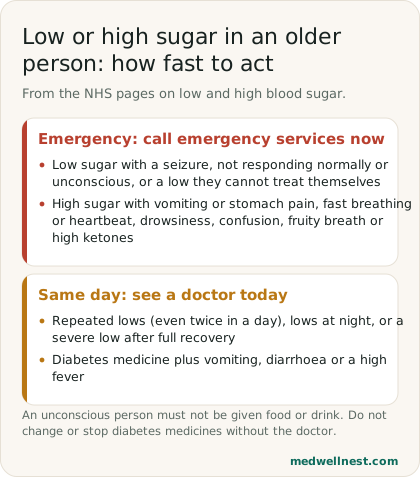
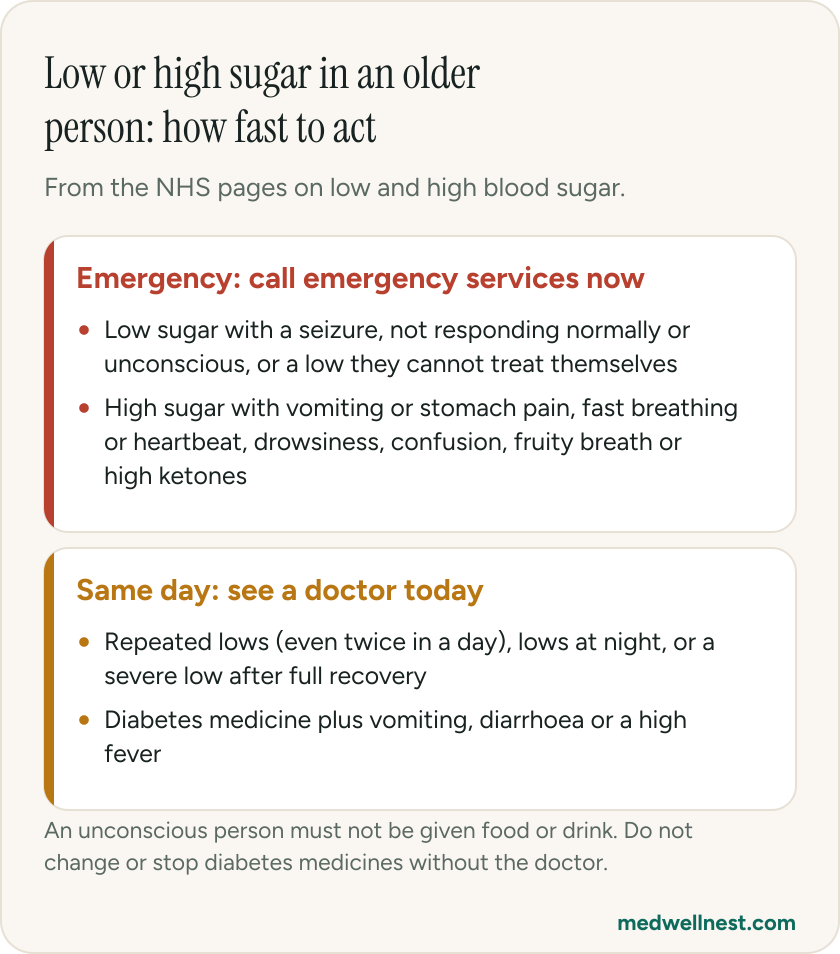
An older person with diabetes has a low sugar they cannot treat themselves, has a seizure (fit), is not responding normally or is unconscious: give no food or drink if they cannot swallow safely, give glucagon if one is available and you know how to use it, and call emergency services now. High sugar with feeling or being sick, stomach pain, breathing faster than usual or a fast heartbeat, drowsiness or struggling to stay awake, a fruity smell on the breath, confusion or a high ketone level: call emergency services now or go to an emergency department now.
Same-day — call promptly
Repeated low sugars, including more than one on the same day, a severe low from which the person has now fully recovered, lows at night, or a fall or new confusion after a low: contact the doctor or diabetes team today. The NHS says to see a doctor for frequent, severe or night-time lows. Also today: diabetes medicine with vomiting, diarrhoea or a very high temperature, which the NHS says needs an urgent appointment, and readings staying high with strong thirst, passing a lot of urine or weakness.
Routine — see a doctor
Ask the doctor which group your parent falls in and what HbA1c and daily sugar goals apply, whether any medicine could be simplified, and book the yearly check for low sugar, memory, falls and the number of medicines that the ADA advises.
Values mentioned in this story
Each one opens a visual guide with its normal range and what moves it — upload a report and we place your own numbers on the same scale.
Sources
- Standards of Care in Diabetes 2026, section 13: Older Adults — American Diabetes Associationpmc.ncbi.nlm.nih.gov
- Low blood sugar (hypoglycaemia) — NHSnhs.uk
- High blood sugar (hyperglycaemia) — NHSnhs.uk
- Treatment for type 2 diabetes — NHSnhs.uk
- Low Blood Glucose (Hypoglycemia) — American Diabetes Associationdiabetes.org
Share this story
Curious where your own values stand?
Two minutes from upload to a full visual picture. Free to analyze.