In short
An HbA1c of 7% works out to an average blood sugar of about 154 mg/dL. Here is the ADA conversion, what the 5.7% and 6.5% lines mean, why your target may not be the same as someone else's, and the conditions that can make the number wrong.
Emergency if: High sugar with vomiting, stomach pain, fast or deep breathing, fruity-smelling breath, or confusion or unusual sleepiness: this can be diabetic ketoacidosis. Get emergency care now.
On your report
HbA1c, Fasting Glucose, Post-Prandial Glucose (PPBS), Hemoglobin +2 more
On this page
01
What HbA1c measures
Glucose in your blood sticks to haemoglobin, the protein inside red blood cells. The higher your sugar runs, the more haemoglobin ends up coated, and an HbA1c test reports the share that is coated as a percentage. Because red blood cells live about three months, the result reflects your average blood sugar over roughly the past two to three months.
It is not an even average. The National Institute of Diabetes and Digestive and Kidney Diseases (NIDDK) says the last 30 days count for more than the months before. A large change over the past month will show up, but a sudden spike or dip that lasted a few hours will not.
You do not need to fast for it, and it can be done at any time of day. If you have diabetes, the American Diabetes Association (ADA) and NIDDK both say to have it at least twice a year, and more often if your treatment has changed or you are not meeting your goal.
02
Turning HbA1c into average glucose
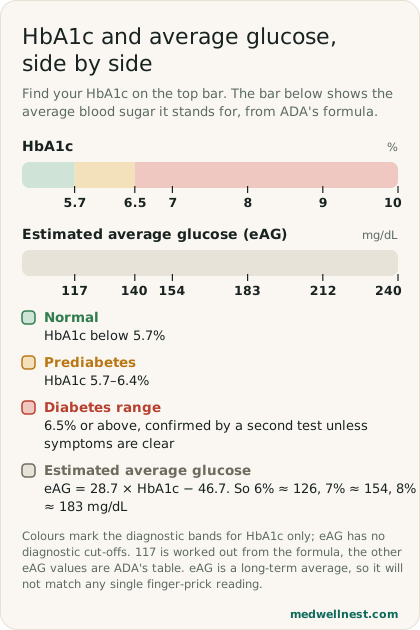
A percentage is hard to picture, so the ADA also expresses HbA1c as estimated average glucose, or eAG, in the same mg/dL units a glucose meter uses. The formula comes from a study that compared the two directly: eAG = 28.7 × HbA1c − 46.7.
In practice, the ADA's own table reads: 6% is about 126 mg/dL, 6.5% is 140, 7% is 154, 7.5% is 169, 8% is 183, 8.5% is 197, 9% is 212, 9.5% is 226 and 10% is 240. In mmol/L, the units some labs use, 7% is about 8.6 and 8% about 10.1. Worked through the same formula, the prediabetes line of 5.7% comes to about 117 mg/dL.
Do not expect your meter readings to match. eAG is a long-term average, so a single finger-prick taken before breakfast or after lunch will almost always sit above or below it. What eAG gives you is a feel for the level your sugar has been sitting at overall.
03
The 5.7% and 6.5% lines
For diagnosis, NIDDK and MedlinePlus use the same three bands. Below 5.7% is normal, 5.7% to 6.4% is prediabetes, and 6.5% or above is in the diabetes range. Within the prediabetes band, NIDDK notes, the higher the number, the greater the chance of going on to type 2 diabetes. MedlinePlus says people with prediabetes are usually retested every 1 to 2 years.
One result is not a diagnosis on its own. NIDDK says that if you have no symptoms but the test shows diabetes or prediabetes, it should be repeated on a different day, either as another HbA1c or as a different diabetes test. The exception is when the symptoms of diabetes are already clear.
The method matters too. NIDDK says a sample for diagnosis should go from a vein to a lab using a certified method, and finger-prick tests done in a clinic should not be used to diagnose. Even a good lab has some spread: a result of 6.8% could come back anywhere from 6.4% to 7.2% if the same blood were tested again, which is one more reason a single borderline number gets repeated.
HbA1c is not used to diagnose type 1 diabetes or diabetes that starts in pregnancy. For those, and for the fasting and tolerance-test cut-offs, other tests take over.
04
Why your target may not be 7%
Once diabetes is diagnosed, the question changes from which band you are in to what number you are aiming for. The ADA's patient guidance says that for most people with diabetes, the recommended target is an HbA1c of 7% or less. NIDDK puts it as below 7%, and says studies show that some people can lower their risk of complications by staying there.
That target is a starting point, not a rule. NIDDK is explicit that a level safe for one person may not be safe for another, and that pushing below 7% is not safe if it causes low blood sugar (hypoglycaemia). It lists people for whom a looser goal of 7% to 8%, or higher in some cases, may be right: those with limited life expectancy, long-standing diabetes that has been hard to bring down, severe low-sugar episodes or trouble sensing them, and advanced complications such as kidney, nerve or heart disease.
So if your doctor has set you a target of 7.5%, it is not a sign they are being careless. It is likely a judgement about the risk of lows for you. Ask what your own target is and why, and keep that number next to your results.
05
When HbA1c can mislead
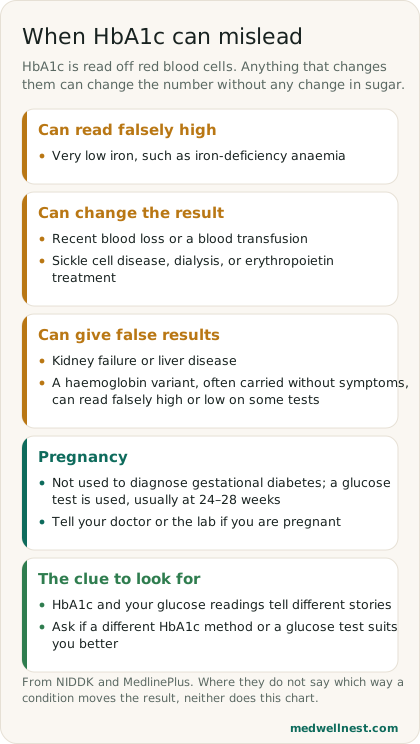
Because HbA1c is read off red blood cells, anything that changes those cells can change the number without any change in your sugar. NIDDK lists recent blood loss, a blood transfusion, sickle cell disease, dialysis and erythropoietin treatment as conditions that can change the result. It says very low iron, as in iron-deficiency anaemia, can make HbA1c falsely high, and that kidney failure and liver disease can also give false results.
Haemoglobin variants are the trap that is easiest to miss. NIDDK says people with family members who have sickle cell anaemia or thalassaemia may carry a different type of haemoglobin, often without any symptoms, and that it can make some HbA1c tests read falsely high or low. Not every test is affected, so a different HbA1c method may work where one did not.
Pregnancy is another case. NIDDK says HbA1c can be used early in pregnancy to look for diabetes that was already there, but gestational diabetes is checked with a glucose test, usually between 24 and 28 weeks. MedlinePlus asks you to tell your provider if you are pregnant, and also mentions that some medicines, including opioids and some HIV medicines, can affect the result.
06
Making sense of your own number
The most useful check is whether your HbA1c and your glucose readings agree. NIDDK says doctors suspect interference, a falsely high or low HbA1c, when the two do not match. If your meter or fasting results look good but your HbA1c looks high, or the other way round, mention it rather than assuming one of them is broken.
Bring the details to your appointment: the HbA1c itself, the eAG if your lab printed it, a few recent meter readings, and anything on the list above that applies to you, such as low iron, a recent transfusion, kidney disease or a family history of thalassaemia or sickle cell. That is the information a doctor needs to decide whether the number can be trusted.
Do not change diabetes medicines on the strength of one HbA1c. The result is a summary of the past few months, and your doctor will read it alongside your targets, your risk of lows and your other tests.
When to act
Routine — see a doctor
An HbA1c of 5.7% to 6.4%, or a first result of 6.5% or more with no symptoms: book a repeat test and an appointment to discuss it. One result is not a diagnosis.
You have diabetes and your HbA1c and meter readings tell different stories, or you have low iron, kidney disease, a recent transfusion or a family history of thalassaemia or sickle cell: raise it at your next visit before anyone changes your treatment.
Same-day — call promptly
A high reading together with feeling very thirsty, passing a lot of urine, blurred vision or losing weight without trying: see a doctor today rather than waiting for a repeat test.
Emergency — act now
High sugar with vomiting, stomach pain, fast or deep breathing, fruity-smelling breath, or confusion or unusual sleepiness: this can be diabetic ketoacidosis. Get emergency care now.
Values mentioned in this story
Each one opens a visual guide with its normal range and what moves it — upload a report and we place your own numbers on the same scale.
Sources
- eAG/A1C Conversion Calculator — American Diabetes Associationprofessional.diabetes.org
- Understanding A1C — American Diabetes Associationdiabetes.org
- The A1C Test & Diabetes — NIDDKniddk.nih.gov
- Hemoglobin A1C (HbA1c) Test — MedlinePlusmedlineplus.gov
- Diabetic ketoacidosis — NHSnhs.uk
Share this story
Curious where your own values stand?
Two minutes from upload to a full visual picture. Free to analyze.