In short
A positive hepatitis C antibody test means you were infected with the virus at some point, not necessarily that you have it now: an HCV RNA test decides that. WHO says about 30% of infected people clear the virus on their own, and antiviral medicines clear it in more than 95% of people with hepatitis C.
Emergency if: Vomiting blood, very dark or black stools, or suddenly becoming confused or having slurred speech, especially with yellow skin or eyes, in someone with hepatitis C or liver disease: call emergency services now or go to an emergency department now. The NHS lists these as emergencies for people with cirrhosis, which untreated hepatitis C can cause.
On your report
SGPT (ALT), SGOT (AST), Albumin, Prothrombin Time / INR +1 more
On this page
01
Does a positive hepatitis C antibody mean I have hepatitis C?
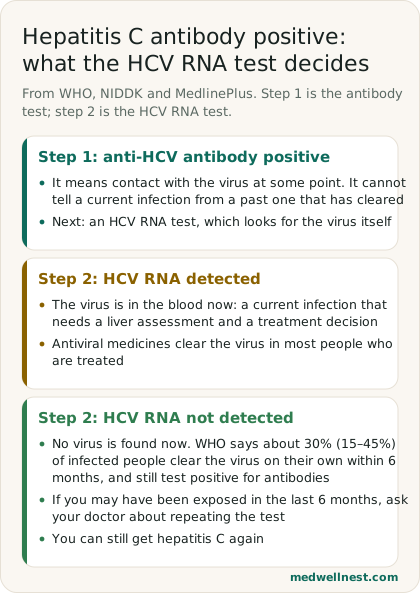
Not necessarily. An antibody test shows that your immune system has met the hepatitis C virus at some point. MedlinePlus says that for hepatitis C, unlike hepatitis A, B, D and E, an antibody test cannot tell the difference between an active infection and a past infection that has cleared up. WHO says the same: about 30% of people infected with the virus clear it through a strong immune response without needing treatment, and although they are no longer infected, they still test positive for anti-HCV antibodies.
So a positive antibody result starts the work rather than finishing it. WHO says infection is diagnosed in 2 steps: the antibody test identifies people who have been infected with the virus, and if it is positive, a nucleic acid test for HCV RNA is needed to confirm chronic infection and the need for treatment. Labs report results in different ways, so MedlinePlus says to ask your provider what your own results mean.
02
Which test comes next, and what does the HCV RNA result mean?
HCV RNA is the genetic material of the virus itself. MedlinePlus describes the PCR test as detecting the virus itself, measuring the amount of virus in the blood (the viral load) and identifying its type: there are 6 types, called genotypes 1 through 6, and the result can help your provider choose treatment. WHO says the test can be done in a lab or with a simple point-of-care machine in the clinic.
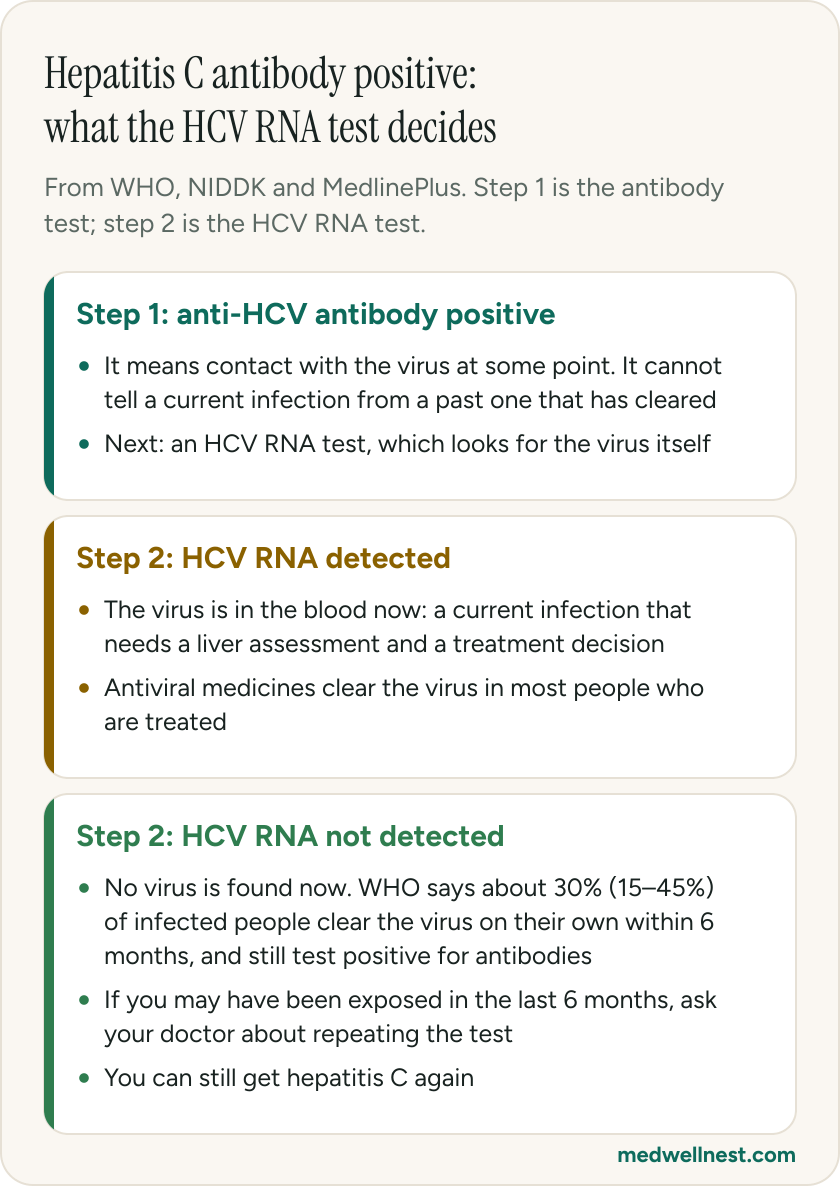
If HCV RNA is detected, the virus is in your blood now: a current infection that needs a liver assessment and a decision about treatment. If HCV RNA is not detected, no virus is found now: no current infection. Together with a positive antibody, this usually means a past infection that cleared on its own or with treatment, and sometimes the antibody result was a false positive. The sources we read do not set out a repeat-testing schedule for that result, so ask your doctor whether another test is needed, especially if you may have been exposed recently. For a negative hepatitis C test in general, the NHS says you may be advised to test again in 6 months, because the test is not always accurate if you were infected recently.
03
If the RNA test is positive, what happens next?
WHO says that once chronic infection is diagnosed, the degree of liver damage (fibrosis and cirrhosis) should be assessed, by liver biopsy or by a variety of non-invasive blood tests, and that this guides treatment decisions. NIDDK says doctors test for liver damage and for other infections such as HIV and hepatitis B before treatment, using blood tests, elastography (which measures the stiffness of the liver), ultrasound or another imaging test for cirrhosis and, only if the other tests do not give enough information, a liver biopsy.
MedlinePlus lists the tests used to identify and monitor liver damage as albumin, liver function tests, prothrombin time, liver biopsy, and elastography by ultrasound or MRI. Our liver function test and FibroScan stories explain those reports.
Without treatment, WHO says the risk of cirrhosis among people with chronic infection ranges from 15% to 30% within 20 years. The NHS says complications such as cirrhosis and liver cancer are unlikely unless you have had hepatitis C for more than 20 years, but may come sooner if you drink alcohol regularly or also have hepatitis B or HIV.
04
Can hepatitis C be treated and cleared?
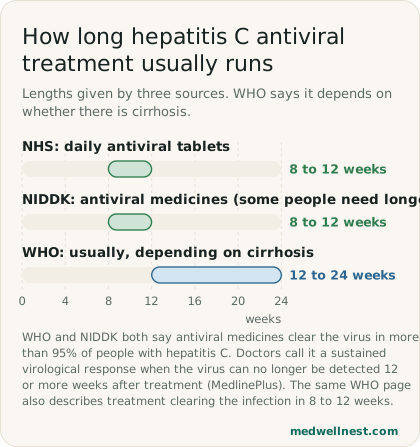
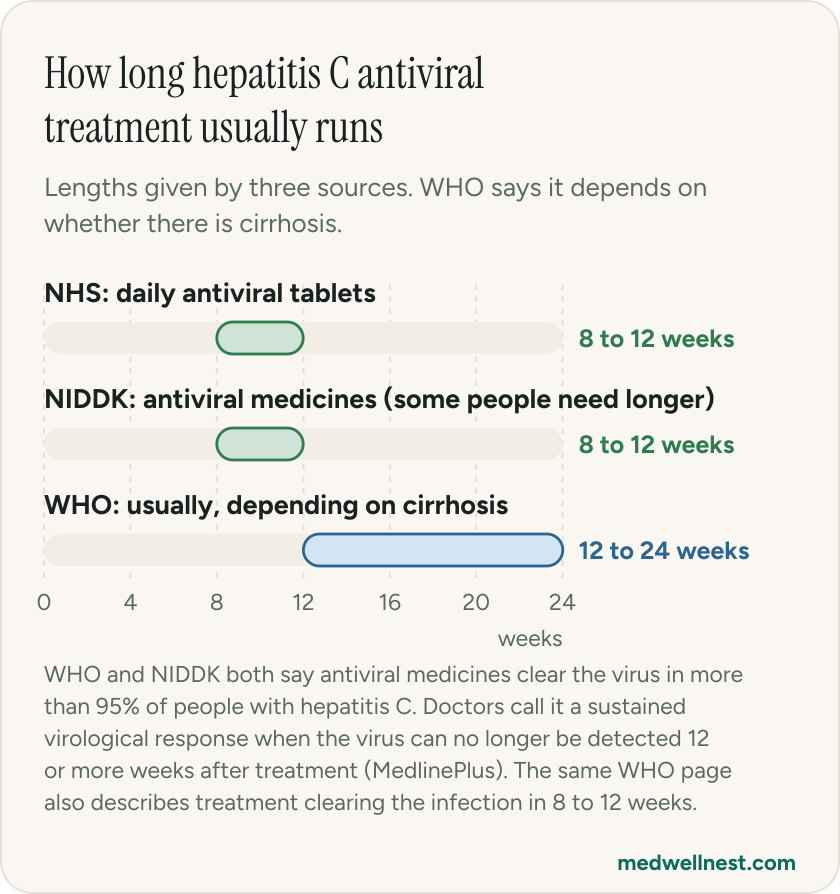
Yes. WHO says direct-acting antiviral medicines (DAAs) can clear the virus in more than 95% of people with hepatitis C, and NIDDK says antiviral medicines clear it in more than 95% of people with chronic hepatitis C in 8 to 12 weeks, though some people need longer. The NHS says treatment is antiviral tablets taken every day for 8 to 12 weeks, and that it clears the infection in most people; WHO says treatment usually lasts 12 to 24 weeks depending on whether there is cirrhosis, though the same page also describes these medicines clearing the infection in 8 to 12 weeks. WHO recommends these medicines for all adults, adolescents and children from 3 years of age with chronic hepatitis C.
Doctors check that it has worked with blood tests. MedlinePlus says a good response is when the virus can no longer be detected in the blood 12 or more weeks after treatment, which is called a sustained virological response (SVR). The NHS says you have blood tests during and after treatment to check how well it is working, and if it has not worked your specialist will recommend another medicine. It says it is important to finish the course, and that most people have no side effects, though some feel tired, get headaches or feel sick.
Clearing the virus is not immunity. The NHS says you can get hepatitis C more than once, and NIDDK says that if you had it in the past you can get it again, so the precautions in the next sections still matter. WHO says there is currently no effective vaccine against hepatitis C.
05
How is hepatitis C spread, and how is it not?
Hepatitis C is a bloodborne virus. WHO says it is most commonly passed on through reuse or inadequate sterilisation of medical equipment, especially syringes and needles, in health care settings; transfusion of unscreened blood and blood products; and sharing injection equipment when injecting drugs. It can be passed from an infected mother to her baby and through sexual practices that lead to exposure to blood, but these are less common. The NHS adds sharing items that could have blood on them, such as toothbrushes and razors, and tattoos or piercings with unsterilised equipment, and NIDDK adds nail clippers and accidental needle sticks.
It does not spread through ordinary family life. WHO says hepatitis C is not spread through breast milk, food, water or casual contact such as hugging, kissing and sharing food or drinks. NIDDK adds that you cannot get it from being coughed or sneezed on, shaking or holding hands, sharing spoons, forks and other eating utensils, or sitting next to an infected person. It says a baby cannot get hepatitis C from breast milk, though a mother should avoid breastfeeding if her nipples are cracked or bleeding.
06
Should my family and partner be tested?
None of the sources we read sets a rule that every family member must be tested, so we do not give one. What they say is practical. Because the virus spreads through blood, do not share razors, toothbrushes or nail clippers (NHS, NIDDK, MedlinePlus). Hugging, kissing, and sharing meals and utensils do not spread it, so these sources give no reason to keep your distance or use separate dishes. MedlinePlus says that for a partner in a stable relationship with no other partners the risk of passing the virus on is low, and NIDDK says to tell a sex partner you have hepatitis C and talk with your doctor about safe sex.
Anyone who thinks they could have been infected should see a doctor and be tested: the NHS says to see a doctor if you think you could have been infected, and MedlinePlus says to contact a provider if you believe you have been exposed. NIDDK says doctors typically recommend screening for all adults at least once, for pregnant women in each pregnancy, for people at risk and for anyone who asks. That is the advice in the health system NIDDK writes for; screening advice differs between health systems, so ask your doctor whether you should be tested. NIDDK also says people with hepatitis C should tell their doctor and dentist and should not donate blood, blood products, semen or tissue.
07
When is hepatitis C an emergency?
Hepatitis C often causes no symptoms (NHS), so most people with a positive result do not need emergency care. The warning signs of a failing liver are different. The NHS lists these as emergencies for people with cirrhosis, which untreated hepatitis C can cause: vomiting blood, very dark or black stools, and suddenly becoming confused or having slurred speech. Call emergency services now if any of these happen.
The NHS says yellow skin or eyes, difficulty breathing, or a swollen tummy, legs, ankles or feet in someone with cirrhosis call for an urgent appointment, and WHO lists dark urine, pale faeces and jaundice (yellowing of the skin or eyes) among the symptoms of hepatitis C. NIDDK lists confusion or difficulty thinking among the symptoms of cirrhosis, so we put yellow skin or eyes together with confusion in the emergency tier. The NHS gives its emergency signs for people already diagnosed with cirrhosis; we apply them to anyone with hepatitis C because the cost of waiting is high.
Hepatitis C: how fast to act
Emergency — act now
Vomiting blood, very dark or black stools, or suddenly becoming confused or having slurred speech, especially with yellow skin or eyes, in someone with hepatitis C or liver disease: call emergency services now or go to an emergency department now. The NHS lists these as emergencies for people with cirrhosis, which untreated hepatitis C can cause.
Same-day — call promptly
Yellow skin or yellow whites of the eyes, dark urine and pale stools, new difficulty breathing, or a swollen tummy, legs, ankles or feet in someone with hepatitis C: contact a doctor today. The NHS gives yellow skin or eyes, difficulty breathing and swelling as reasons for urgent advice in people with cirrhosis, and WHO lists dark urine, pale faeces and jaundice as symptoms of hepatitis C. If you also feel confused or very unwell, call emergency services now or go to an emergency department now.
Routine — see a doctor
A positive hepatitis C antibody result, or a possible exposure, even with no symptoms: book an appointment for an HCV RNA test and a liver assessment, and do not share razors, toothbrushes or nail clippers. If HCV RNA is not detected, ask your doctor what it means and whether to repeat the test. The NHS says to see a doctor if you think you could have been infected, and WHO says an HCV RNA test is needed after a positive antibody test.
Values mentioned in this story
Each one opens a visual guide with its normal range and what moves it — upload a report and we place your own numbers on the same scale.
Sources
- Hepatitis C — WHO fact sheetwho.int
- Hepatitis C — NHSnhs.uk
- Hepatitis C — NIDDK, National Institutes of Healthniddk.nih.gov
- Hepatitis C — MedlinePlus Medical Encyclopediamedlineplus.gov
- Hepatitis Testing — MedlinePlusmedlineplus.gov
- Cirrhosis — NHSnhs.uk
Share this story
Curious where your own values stand?
Two minutes from upload to a full visual picture. Free to analyze.