In short
HLA-B27 is an inherited marker carried by many healthy people. Here is how common it is, how strongly it is linked to ankylosing spondylitis, the back pain pattern that makes the test worth doing, and the eye symptoms that need a same-day check.
Emergency if: Sudden loss of vision in one or both eyes: go to an emergency department now.
On your report
ESR, CRP, Rheumatoid Factor (RA Factor), Anti-CCP Antibodies
On this page
01
What HLA-B27 is
HLA-B27 is a protein found on the surface of white blood cells, and the test is an ordinary blood test. It belongs to a family called human leukocyte antigens, which help the immune system tell the body's own cells apart from foreign, harmful ones. These proteins are made from inherited genes, so HLA-B27 is something you are born with or without, and treatment does not change it.
MedlinePlus explains that a positive result means HLA-B27 is present and suggests a greater-than-average risk of developing or having certain autoimmune conditions. It is used mainly to help work out the cause of joint pain, stiffness or swelling, alongside tests such as CRP, ESR, rheumatoid factor, anti-CCP antibodies and X-rays.
02
How common it is, with and without disease
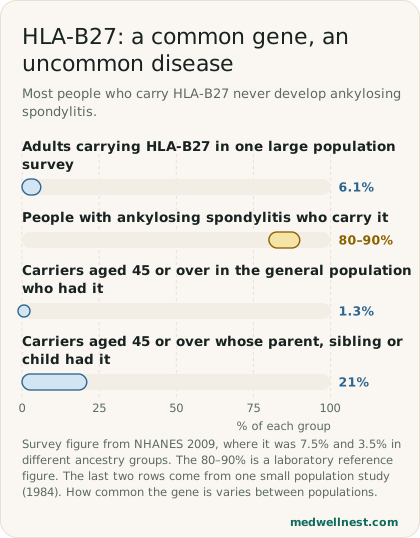
In one country's large population survey of 2,320 adults aged 20 to 69 (NHANES 2009), 6.1% carried HLA-B27, with 7.5% in one ancestry group and 3.5% in all the others combined. A laboratory reference puts it at 5% to 10% of the general population, and how common it is varies between populations. By contrast, 80% to 90% of people with ankylosing spondylitis carry it, and a review describes it as present in up to 90% of patients in most ethnic groups.
The key point is that most carriers never develop the disease. In a small population study published in 1984 (3 cases among about 230 carriers), only 1.3% of HLA-B27 carriers aged 45 or over had ankylosing spondylitis. Among carriers of the same age whose parent, brother, sister or child had the disease, 21% had it. Family history, in other words, changes the picture far more than the test result alone.
03
Why a positive test on its own is not a diagnosis
MedlinePlus is direct about this: HLA-B27 is found in some healthy people and does not always mean you have a disease. If you have the symptoms or signs of spondyloarthritis, a positive result can help confirm the diagnosis. NICE's guideline on spondyloarthritis (NG65) asks doctors to read a positive result as increasing the likelihood of spondyloarthritis affecting the joints of the limbs, not as proof of it.
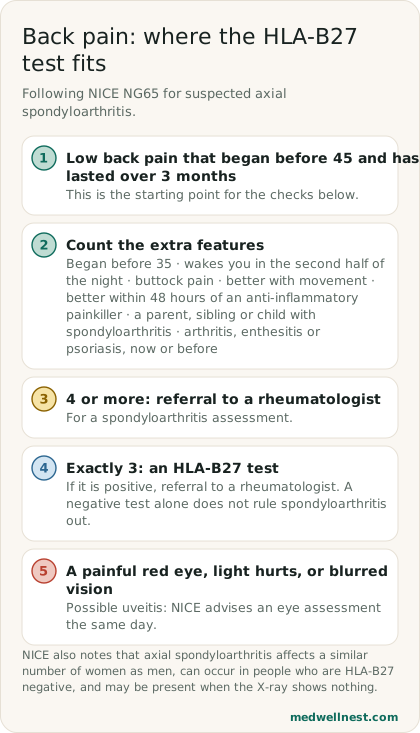
A negative result does not settle things either. NICE says not to rule out spondyloarthritis on the basis of a negative HLA-B27 result alone, and reminds doctors that axial spondyloarthritis can occur in people who are HLA-B27 negative, affects a similar number of women as men, and may be present even when a plain X-ray of the pelvis shows no inflammation. When the X-ray is normal, NICE recommends an MRI scan instead.
04
The back pain pattern that makes the test worth doing
NICE starts with low back pain that began before the age of 45 and has lasted longer than 3 months. It then counts nine extra features: pain that began before 35; waking in the second half of the night because of it; buttock pain; improvement with movement; improvement within 48 hours of taking an anti-inflammatory painkiller; a parent, sibling or child with spondyloarthritis; and current or past arthritis, enthesitis (inflammation where tendons attach to bone) or psoriasis.
With 4 or more of these, NICE recommends referral to a rheumatologist for a spondyloarthritis assessment. With exactly 3, it recommends an HLA-B27 test, and referral if the test is positive. This is where the test earns its place: as a tie-breaker in someone whose pain already fits the pattern, not as a screening test for people without symptoms.
05
Conditions linked to HLA-B27
Besides ankylosing spondylitis, MedlinePlus lists the other members of the spondyloarthritis family where a positive result can support the diagnosis: arthritis linked to Crohn's disease or ulcerative colitis, psoriatic arthritis, reactive arthritis (which can follow some gut or genital infections), inflammation of the sacroiliac joints where the spine meets the pelvis, and uveitis, an inflammation inside the eye.
NICE also asks doctors to think of spondyloarthritis in people who already have uveitis, psoriasis or inflammatory bowel disease, and in people who have had a recent genitourinary infection or have a family history of spondyloarthritis. If you carry HLA-B27 and have one of these conditions, mention any long-lasting back pain, heel pain or swollen fingers or toes to your doctor.
06
Red flag: a painful red eye
Uveitis is the complication to know about. The NHS lists eye pain that may feel worse when reading, a red or watery eye, blurred or reduced vision, sensitivity to light, and flashes or floaters; it usually affects one eye. NICE recommends a same-day assessment by an eye specialist for these symptoms, and warns that uveitis can occur during flares of spondyloarthritis.
The NHS says early treatment matters to avoid long-term complications, including loss of vision, and it treats sudden loss of sight as an emergency. Conjunctivitis can look similar, but a red eye that is also painful, hurts in bright light or blurs your vision should not be left to settle on its own.
When to act
Emergency — act now
Sudden loss of vision in one or both eyes: go to an emergency department now.
Same-day — call promptly
Eye pain, a very red eye, sensitivity to light, or blurred or changed vision, especially if you have ankylosing spondylitis, another spondyloarthritis or are HLA-B27 positive: see a doctor or an eye specialist today. NICE recommends same-day assessment for possible uveitis.
Routine — see a doctor
Low back pain that started before 45, has lasted more than 3 months, wakes you in the second half of the night or eases with movement: see a doctor and ask whether a rheumatology assessment is needed. A positive HLA-B27 result on its own, with no symptoms, does not mean you have a disease.
Values mentioned in this story
Each one opens a visual guide with its normal range and what moves it — upload a report and we place your own numbers on the same scale.
Sources
- HLA-B27 antigen — MedlinePlus Medical Encyclopediamedlineplus.gov
- Spondyloarthritis in over 16s: diagnosis and management (NG65) — NICEnice.org.uk
- The prevalence of HLA-B27 in the US: data from NHANES 2009 — Arthritis & Rheumatism, PubMedpubmed.ncbi.nlm.nih.gov
- The risk of developing ankylosing spondylitis in HLA-B27 positive individuals — Arthritis & Rheumatism, PubMedpubmed.ncbi.nlm.nih.gov
- Ankylosing spondylitis (HLA-B27) genotyping — ARUP Consultarupconsult.com
- Uveitis — NHSnhs.uk
Share this story
Curious where your own values stand?
Two minutes from upload to a full visual picture. Free to analyze.